Private Pilot (Airplane) Night Preparation Lesson Plan
Private Pilot (Airplane) • ACS Area XI, Task A
The Private Pilot (Airplane) Night Preparation Lesson Plan covers the knowledge, risk management, and skills associated with Night Preparation.
Introduction
-
Schedule
Topic:Time:Attention/Motivator:0:05Part 1, Lesson Introduction:0:05Part 2, Night Vision and Physiology:0:10Part 3, Lighting Systems:0:20Part 4, Equipment Requirements:0:20Part 5, Navigation and Orientation:0:20Part 6, Night Operations:0:20Part 7, Risk Management:0:20Part 8, Night Preparation Scenario:0:20Part 9, Lesson Conclusion:0:05Remotivation/Closure:0:05Total Ground Time:0:00
-
Attention Getter:
- Ask the learner to describe prior knowledge or experience related to night preparation.
-
Motivator:
- Night, as defined by FAR 1.1, means the time between the end of evening civil twilight and the beginning of morning civil twilight, as published in the Air Almanac, converted to local time
- Sunset and sunrise times Sunset and sunrise times may be found at the Naval Observatory Website at https://aa.usno.navy.mil/data/RS_OneYear.
- Navigation lights are required sunset to sunrise
- Navigation lights must be on full bright
- Use taxi and landing lights as appropriate for visibility and collision avoidance, following aircraft manufacturers' recommendations and avoiding glare that impairs other pilots' vision.
- Operate installed anticollision lights during day and night operations, unless the pilot in command determines that turning them off would be safer under FAR 91.209(b).
- Using a rotating beacon while an engine is running is recommended to warn ground personnel.
- Allow extra time for preflight and use a white lens flashlight to see fluids
- Taxi on the middle of the taxiway
- Night Preparation require half the speed, twice the caution
- Perform everything with half the speed and twice the caution
- Internal lights/displays must be as dim as possible while still being readable
- Night, as defined by FAR 1.1, means the time between the end of evening civil twilight and the beginning of morning civil twilight, as published in the Air Almanac, converted to local time
Materials
-
Required Materials:
- Writing instrument (pen, marker, etc.).
- Writing surface (paper, whiteboard, etc.).
- Federal Aviation Regulations (FARs) or an internet-enabled device to access FARs.
- Airman Certification Standards.
- Student jacket.
-
Optional Materials:
-
Reference Materials:
- FAR 1.1.
- Https://aa.usno.navy.mil/data/rs_oneyear.
- FAR 91.209.
- Instructor Endorsement Log.
- Basicmed.
- Fitness for Flight Supplement.
- Risk Management Handbook.
- Airplane Flying Handbook.
- Pilot Handbook of Aeronautical Knowledge.
- The Eyes and Vision Supplement.
- Night Operations Supplement.
- Taxiing Supplement.
- Aircraft Lighting Supplement.
- Spatial Disorientation and Illusions in Flight Supplement.
- Visual Scanning and Collision Avoidance Supplement.
- Flight Deck Management Supplement.
- Airworthiness Supplement.
- Test-taking Guidance.
- Test Guides.
- The Checkride Supplement.
Instructor Actions
- Before the lesson, review reference materials.
- Part 1, Lesson Introduction:
- If not previously discussed, provide expectations on time to train, ground instruction vs. flight instruction, and instructor/student availability.
- Review the lesson plan, including the attention and motivator.
- Review the airman certification standards (ACS).
- Part 2, Night Vision and Physiology:
- Use an aircraft- or scenario-specific example, then have the learner explain false horizons, autokinesis, misleading terrain or runway geometry, and lighting or weather distortions of approach height and distance; cross-check instruments and independent runway information, avoid fixation, and go around when reliable references are unavailable.
- Introduce physiological aspects of night vision, including adaptation time and limitations. (PA.XI.A.K1)
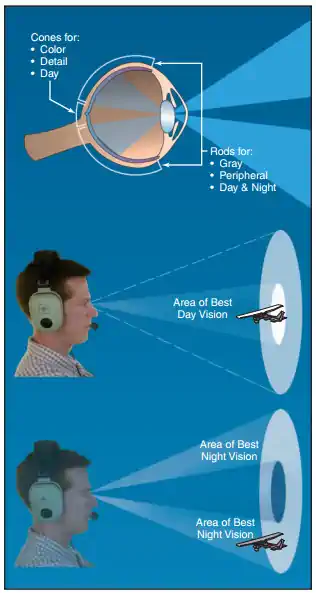
- Use an aircraft- or scenario-specific example, then have the learner explain the functions of rods and cones and how their distribution affects low-light vision.
- Use an aircraft- or scenario-specific example, then have the learner explain reduced visual acuity and color perception, the night central blind spot, and why off-center viewing helps detect dim objects.
- Discuss techniques to preserve night vision, including lighting management and avoidance of bright lights.
- Have the student explain how to develop dark adaptation before night flight by allowing adequate time in low light and avoiding bright-light exposure during preparation.
- Have the student explain how to preserve dark adaptation by managing cockpit, display, and flashlight brightness at the lowest practical level consistent with safely reading instruments and information, and avoiding unnecessary bright lights.
- Have the student explain how bright-light exposure degrades dark adaptation, why recovery requires time, and how to reduce further exposure and allow readaptation before relying on low-light visual performance.
- Elicit prior knowledge, then establish the operational relevance of visual illusions at night and how reduced visual references impact perception. (PA.XI.A.K8) (PA.XI.A.R3)
- Demonstrate how reliance on instruments increases at night to mitigate disorientation.
- Explain factors that impair night vision and how to mitigate them.
- Have the student identify bright-light exposure, glare, fatigue, hypoxia, smoking and carbon monoxide, alcohol, medication effects, and nutritional or visual deficiencies as potential night-vision impairments.
- Have the student match these hazards with appropriate mitigations: protect dark adaptation, manage lighting and glare, obtain adequate rest, assess fitness and medication compatibility, avoid smoking and carbon-monoxide exposure, and plan appropriate altitude and supplemental-oxygen use.
- Present degraded night vision or fatigue before or during flight. Have the student explain when to delay or cancel, change the plan, or land, and why lighting adjustments alone cannot correct physiological impairment. Seek appropriate medical guidance for unresolved visual or medication concerns.
- Part 3, Lighting Systems:
- Interpret aircraft position-light colors and viewing aspects; combine their pattern with relative movement to assess encounters, and explain why lights alone cannot establish range, motion, or freedom from collision risk.
- Introduce airport, runway, taxiway, and obstruction lighting systems. (PA.XI.A.K2)
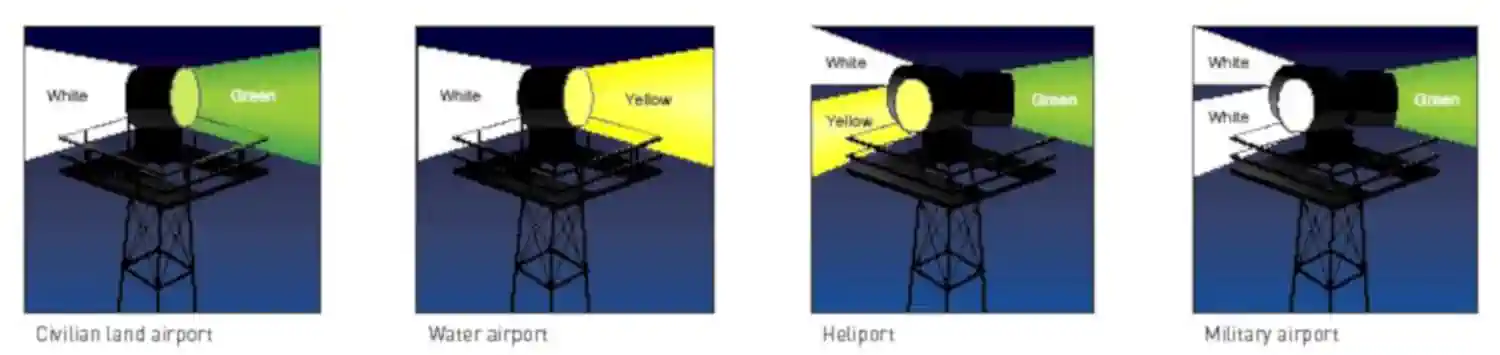
- Use an aircraft- or scenario-specific example, then have the learner explain how beacon colors and flash patterns identify airport types.
- Use an aircraft- or scenario-specific example, then have the learner explain why a beacon alone cannot confirm the intended airport, runway suitability, or weather conditions; verify using other information.
- Use guided questioning to have the learner explain and apply pilot-controlled lighting and how to activate lighting systems at non-towered airports.
- Explain approach lighting and visual glidepath guidance.
- Use an aircraft- or scenario-specific example, then have the learner explain how approach lighting helps identify the runway environment and establish alignment.
- Have the learner identify VASI (Visual Approach Slope Indicator) and PAPI (Precision Approach Path Indicator) indications and interpret above-, on-, and below-path guidance.
- Use an aircraft- or scenario-specific example, then have the learner explain limitations, including published coverage and why visual guidance does not guarantee clearance from every obstacle.
- Interpret a lighting diagram or image and explain the appropriate response.
- Explain how to operate and verify pilot-controlled lighting.
- Locate the published frequency, operating instructions, and lighting availability.
- Use an aircraft- or scenario-specific example, then have the learner explain microphone-click activation, intensity selection, and timing.
- Visually verify the intended lights are operating at a usable intensity.
- Use an aircraft- or scenario-specific example, then have the learner explain how to troubleshoot nonresponse without blocking communications, and when to delay an approach or use an alternative.
- Explain obstruction lighting and its limitations for obstacle avoidance.
- Have the learner identify common obstruction-lighting colors and patterns and explain their purpose.
- Use an aircraft- or scenario-specific example, then have the learner explain why unlighted obstacles, outages, obscured lights, and limited visibility make lighting alone insufficient for obstacle avoidance.
- Use charts, applicable NOTAMs (Notices to Airmen), and planned clearance margins alongside lighting cues.
- Explain taxiway lighting and runway-entry warning systems.
- Have the learner identify taxiway edge and centerline lighting and explain how it supports safe taxiing.
- Distinguish runway guard lights, stop bars, and runway entrance lights by appearance and purpose.
- Use an aircraft- or scenario-specific example, then have the learner explain the appropriate response to each indication and how it relates to ATC (Air Traffic Control) clearance.
- Interpret an airport-lighting diagram or image and identify where to stop or seek clarification.
- Explain runway lighting and the information conveyed by its colors and arrangement.
- Have the learner identify runway edge, threshold, end, centerline, and touchdown-zone lights, where installed, and explain their colors and arrangement.
- Use an aircraft- or scenario-specific example, then have the learner explain how those cues indicate runway boundaries, landing threshold, alignment, and approaching runway end.
- Interpret a runway-lighting diagram or image and explain what it tells the pilot.
- Present a concrete example, then require the learner to explain and apply interpretation of aircraft position lights to determine direction of travel. (PA.XI.A.K7)
- Demonstrate how lighting systems support situational awareness but require continued visual scanning.
- Part 4, Equipment Requirements:
- Use current rules and aircraft guidance to identify night VFR (Visual Flight Rules) equipment, aircraft-lighting purposes and operating requirements; verify serviceability and evaluate legal and operational consequences of lighting or electrical failures.
- Have the student select usable personal lighting, prepare readable charts and navigation tools, and organize accessible batteries, backups, and emergency equipment while preserving dark adaptation.
- Use retrieval questioning to have the learner explain aircraft equipment requirements for night VFR (FLAPS). (PA.XI.A.K3)
- Use guided questioning to have the learner explain and apply personal equipment required for night operations (flashlights, backups, batteries). (PA.XI.A.K4)
- Use an aircraft- or scenario-specific example, then have the learner explain how inoperative equipment affects airworthiness and go/no-go decisions. (PA.XI.A.R7)
- Part 5, Navigation and Orientation:
- Use guided questioning to have the learner explain and apply night navigation techniques, including reduced landmark visibility and increased reliance on instruments. (PA.XI.A.K5)
- Demonstrate how to identify airports using lighting systems and navigation aids.
- Use guided questioning to have the learner explain and apply challenges in chart reading and terrain identification at night.
- Emphasize maintaining situational awareness and avoiding fixation.
- Part 6, Night Operations:
- Prepare aircraft lighting and a night taxi route; maintain safe speed, aircraft control, and obstacle clearance during taxi and run-up, verify position using lights and route information, and stop to resolve any clearance or location uncertainty.
- Assess night collision hazards and visual-information limits; select scanning and lighting for detection and conspicuity, assess relative traffic movement, and choose conservative ground actions when surface position or clearance is uncertain.
- Use guided questioning to have the learner explain and apply night taxi procedures, including reduced visibility and increased risk of runway incursions. (PA.XI.A.K6) (PA.XI.A.R4)
- Emphasize centerline tracking, taxiway identification, and clearance awareness.
- Discuss collision avoidance techniques at night, including lighting usage and scanning. (PA.XI.A.R1)
- Have the student explain and demonstrate a systematic outside scan using short, overlapping visual sectors with pauses to detect traffic, rather than a continuous sweeping glance.
- Have the student explain and demonstrate off-center viewing by looking slightly to the side of a dim target instead of directly at it, and relate this technique to the night central blind spot.
- Have the student explain why prolonged fixation can make a dim target difficult to see, periodically shift the viewing direction, and maintain an outside scan while making appropriate instrument cross-checks.
- Part 7, Risk Management:
- Have the student assess night distraction, task-priority, disorientation, and lost-awareness hazards and justify controls using workload reduction, instrument cross-check, communication, and an early change of plan.
- Assess visual-illusion and dark-adaptation risks during preflight, taxi, departure, cruise, approach, and landing; select lighting, scanning, cross-checks, margins, and discontinuation decisions appropriate to each phase.
- Assess night runway-incursion hazards; verify assigned runway, clearance, signs, markings, and holding positions, and stop for clarification before uncertain entry or crossing.
- Compare legal night currency with proficiency for the intended aircraft and conditions; justify additional dual instruction, practice, increased margins, delay, or cancellation.
- Assess night weather hazards, including obscured clouds or terrain and localized fog; use current reports, trends, verified clearance margins, escape options, and alternate or go-around decisions.
- Assess inoperative-equipment risks before and during night flight; resolve required-equipment defects before departure and plan aircraft-specific load management, backup use, diversion, and landing before essential capability is lost.
- Use guided questioning to have the learner explain and apply risks associated with distractions, task saturation, and disorientation. (PA.XI.A.R2)
- Use guided questioning to have the learner explain and apply night currency versus proficiency and how they differ operationally. (PA.XI.A.R5)
- Use guided questioning to have the learner explain and apply weather considerations unique to night operations, including reduced visibility and difficulty identifying clouds. (PA.XI.A.R6)
- Require the student to evaluate how each risk affects go/no-go decision-making.
- Part 8, Night Preparation Scenario:
- Assess the listed night-scenario decisions against their objective-specific focus; use the linked scenarios below and do not treat whole-scenario completion as proof of every objective.
- Lead the applicable decisions in the night-preparation guided scenarios.
- Part 9, Lesson Conclusion:
- Tie lesson back to previous lessons to reinforce past experiences (law of readiness).
- Present the remotivation, conclude, and provide guidance for follow-on lessons.
- Review student actions required ahead of the next lesson.
- Update the instructor log and student progress. Select the student and sign off completed objectives. If the student does not have a connected account, record the update manually in the instructor log and student training record.
Guided Scenario(s)
- A pilot intends to fly around (not in) Class Charlie airspace at night
- How will a red flashlight impact the pilot's ability to see?
- How will a white flashlight impact the pilot's ability to see?
Instructor focus: Discuss Preserving Adaptation, Using Peripheral Vision, and Pilot-Controlled Lighting: protect night vision, apply off-center viewing, and activate lighting without blocking traffic communications. Assess the relevant decisions; whole-scenario completion alone does not establish every objective.
The Moonless Family Return
Plan and conduct a demanding night flight, including a black-hole departure, instrument transition, climb-performance decisions, enroute risk management, and a night arrival. Abbreviations used in this scenario: Pilot in Command (PIC); Precision Approach Path Indicator (PAPI).
Decision 10%Scenario Complete
Instructor focus: Discuss Dark Adaptation, Off-Center Viewing, and Altitude and Vision: preserve usable cockpit illumination, detect faint references, and respond to altitude-related visual degradation. Assess the relevant decisions; whole-scenario completion alone does not establish every objective.
The Traffic Hidden in Plain Sight
Manage a dusk-to-night flight as blind spots, scanning limits, glare, dark adaptation, hypoxia, haze, and runway illusions change what the pilot can reliably see. Abbreviations used in this scenario: Mean Sea Level (MSL).
Decision 10%Scenario Complete
Instructor focus: Confirm airport identity using lighting and independent information; activate airport lighting without blocking communications; interpret and respond to visual glidepath indications; and interpret taxi lighting with route information. Assess the relevant decisions; whole-scenario completion alone does not establish every objective.
The Fog-Lifting Night Arrival
Manage a night arrival and departure at an unfamiliar airport as shallow fog, changing runway lighting, and confusing surface cues test runway identification, approach control, and incursion avoidance.
Decision 10%Scenario Complete
- Objective-specific decisions:
- Reject a night departure with unresolved required lighting. The Moonless Family Return — Required Light Before Departure.
- Manage loss of electrical capability during night flight. The Moonless Family Return — Electrical Load.
- Prepare accessible and usable personal lighting and navigation backups. The Moonless Family Return — A Usable Backup.
- Maintain verified terrain clearance when visual navigation cues deteriorate. The Moonless Family Return — Haze and Terrain.
- Maintain orientation when outside references disappear. The Moonless Family Return — Black-Hole Departure.
- Use lighting and other cues to verify the night taxi route. The Fog-Lifting Night Arrival — Blue Edges, Green Centerline.
- Resolve uncertain aircraft clearance before moving. The Moonless Family Return — Beyond the Taxi Light.
- Use aircraft position-light patterns and relative movement to assess a threat. The Moonless Family Return — Lights Against the Town.
- Reject an unreliable visual horizon. The Dark Shoreline Disappears — False Horizon.
- Recognize and counter apparent motion caused by fixation. The Dark Shoreline Disappears — Autokinesis.
- Counter misleading runway-width cues. The Moonless Family Return — Narrow Runway.
- Maintain a verified approach path over featureless night terrain. The Dark Shoreline Disappears — Black-Hole Approach.
- Reject misleading light brightness as a distance cue. The Moonless Family Return — Bright-Runway Illusion.
- Avoid committing to a night entry with an unresolved traffic conflict. The Moonless Family Return — Reported but Unidentified.
- Recognize and respond to a possible closing traffic threat. The Moonless Family Return — Lights Against the Town.
- Reassess aircraft state and additional threats after avoidance. The Moonless Family Return — Clear of One Threat.
- Discontinue an approach when the runway is not assured clear. The Moonless Family Return — Runway No Longer Clear.
- Stop and resolve uncertain night ramp clearance. The Moonless Family Return — Beyond the Taxi Light.
- Manage fixation while preserving aircraft control. The Traffic Hidden in Plain Sight — Approach Lighting Fixation.
- Avoid an unsafe response to a misleading night horizon. The Dark Shoreline Disappears — False Horizon.
- Discontinue a landing when glare prevents adequate visual references. The Traffic Hidden in Plain Sight — Landing Glare.
- Confirm the assigned runway and clearance before takeoff. The Moonless Family Return — Runway Verification.
- Recognize a runway holding position and resolve crossing uncertainty. The Fog-Lifting Night Arrival — Flashing Yellow at the Hold Line.
- Distinguish night currency from proficiency for the intended conditions. The Moonless Family Return — Current Is Not Proficient.
- Recognize obscuration of terrain and preserve safe night routing. The Moonless Family Return — Haze and Terrain.
- Respond to localized fog obscuring runway references before dawn. The Valley That Disappeared — The First Missing Landmark.
- Resolve required-equipment defects before night departure. The Moonless Family Return — Required Light Before Departure.
- Manage an electrical failure before essential night capability is lost. The Moonless Family Return — Electrical Load.
-
Instructor focus: Assess false-horizon, autokinesis, and black-hole approach decisions. Assess the relevant decisions; whole-scenario completion alone does not establish every objective.
The Dark Shoreline Disappears
Manage a night coastal flight as acceleration, featureless terrain, head movement, false horizons, and inadvertent entry into instrument meteorological conditions test your ability to trust flight instruments. Abbreviations used in this scenario: revolutions per minute (RPM).
Decision 10%Scenario Complete
Instructor focus: Assess recognition of localized fog and the decision to delay. Assess the relevant decisions; whole-scenario completion alone does not establish every objective.
The Valley That Disappeared
Manage a dawn valley-to-coast trip as several fog mechanisms and look-alike visibility hazards affect successive routes. Fifteen decisions cover radiation, advection, upslope, steam, frontal and ice fog, slant-range visibility, whiteout, brownout, and trend-based escape gates. Abbreviations used in this scenario: Instrument Flight Rules (IFR).
Decision 10%Scenario Complete
Student Actions
- Complete the assigned readings (see content above).
- Complete initial BasicMed requirements.
- Perform self-assessment, including fitness for flight and personal minimums, as appropriate.
- Ask pertinent questions.
- Make a go/no-go decision, as appropriate.
Airman Certification Standards
Private Pilot (Airplane) Night Preparation Airman Certification Standards
- To determine that the applicant exhibits satisfactory knowledge, risk management, and skills associated with Night Preparation
- References: FAA-H-8083-2 (Risk Management Handbook), FAA-H-8083-3 (Airplane Flying Handbook), FAA-H-8083-25 (Pilot Handbook of Aeronautical Knowledge); AIM; POH/AFM.
Knowledge 8 ACS Elements
-
PA.XI.A.K2: -
PA.XI.A.K3: -
PA.XI.A.K4: -
PA.XI.A.K6: -
PA.XI.A.K7: -
PA.XI.A.K8:
Risk Management 7 ACS Elements
-
PA.XI.A.R1: -
PA.XI.A.R2: -
PA.XI.A.R3: Effect of visual illusions and night adaptation during all phases of night flying. -
PA.XI.A.R4: -
PA.XI.A.R5: Night currency versus proficiency. -
PA.XI.A.R6: Weather considerations specific to night operations. -
PA.XI.A.R7:
Skills 1 ACS Element
-
NA: Not generally evaluated in flight. If the practical test is conducted at night, all ACS Tasks are evaluated in that environment, thus there is no need for explicit Task elements to exist here.
Conclusion
-
Re-Motivation:
- Night Preparation prepares pilots to operate when reduced visual cues, illusions, fatigue, and limited emergency options demand greater discipline and awareness.
- Thoughtful preparation, current weather and airport information, reliable lighting and equipment, and conservative personal minimums help preserve options before departure.
- A deliberate instrument cross-check, effective outside scanning, clear communication, and early recognition of disorientation support safe decisions throughout night operations.
- Continued practice with Night Preparation prepares private pilots for more complex night navigation, instrument transitions, and emergency scenarios later in training.
-
Closure:
- Inform students that this lesson will serve as a starting point for the next lesson.
- Assign study materials for the next lesson.
- The Federal Aviation Administration (FAA) provides test-taking guidance and test guides on its website.
- To learn more about preparing for the practical test, visit the checkride page.