Spatial Disorientation & Illusions In Flight
Spatial disorientation occurs when a pilot misinterprets aircraft position or motion, creating illusions that can lead to loss of control.
Introduction to Spatial Disorientation & Illusions In Flight
- Sensory mismatches can cause pilots to lose orientation relative to their surroundings, a condition known as spatial disorientation.
- Disturbances to sensory systems or inaccurate perceptions may produce dangerous illusions in flight.
- Pilots may experience several types of in-flight illusions, including vestibular, visual, landing, and atmospheric illusions.
- Vestibular system illusions occur when signals from the inner ear create a false perception of motion or orientation.
- Visual cues work with information from other sensory systems, including the vestibular system, to help pilots maintain spatial orientation.
- These visual cues are even more critical at night.
- Differences in runway dimensions and slope can also lead to illusions during landing.
- Human limitations contribute to many in-flight illusions, but atmospheric conditions can also affect perception.
- Pilots can take steps to prevent illusions, but the risk cannot be eliminated entirely.
- Pilots must therefore be prepared to cope with spatial disorientation.
- Together, prevention and coping skills help reduce the risk of dangerous outcomes.
- Test your understanding of Spatial Disorientation & Illusions In Flight by completing the knowledge quiz, applying your knowledge in the interactive scenario, comparing your performance against the applicable Airman Certification Standards, and reviewing the topic summary to reinforce the key concepts before moving on to the next lesson.
WARNING:
All aeromedical topics are GENERALIZED.
Always consult with a doctor or physician to understand your specific situation.
WARNING:
All procedures are GENERALIZED.
Use the Pilot Operating Handbook (POH) procedures for specific aircraft performance and limitations.
and/or current Standard Operating Procedures (SOPs).
Spatial Disorientation & Illusions In Flight Key Highlights
- Spatial disorientation occurs when a pilot’s perception of direction, attitude, or motion does not match the aircraft’s actual position or movement.
- Visual limitations, reduced outside references, and conflicting sensory information can contribute to spatial disorientation during flight.
- The vestibular system and visual system can create powerful flight illusions that mislead pilot perception and judgment.
- Common illusions include the leans, coriolis illusion, graveyard spiral, false horizon, and somatogravic illusion.
- Spatial disorientation is especially hazardous during night operations, instrument meteorological conditions, and low-visibility environments.
- Pilots should rely on flight instruments rather than bodily sensations whenever visual references become unreliable.
- Rapid head movements during instrument flight can trigger vestibular illusions and worsen disorientation.
- Fatigue, stress, illness, and lack of instrument proficiency can increase susceptibility to flight illusions.
- Proper instrument scanning, situational awareness, and disciplined aircraft control techniques help prevent loss of control accidents.
- Understanding spatial disorientation and flight illusions improves aeronautical decision-making, instrument proficiency, and overall flight safety.
Spatial Disorientation Overview
- The unfamiliar three-dimensional environment of flight can create sensory conflicts and illusions that make spatial orientation difficult. []
- Pilots generally use the natural horizon to determine the airplane's attitude.
- When atmospheric or lighting conditions obscure the natural horizon, pilots can sometimes maintain visual reference to the surface below.
- If neither horizon nor surface references are available, pilots must use flight instruments, such as the attitude indicator, to determine the airplane's attitude.
- During periods of low visibility, information from other senses can conflict with what the pilot sees.
- Even a normally functioning sensory systems can misinterpret our position or orientation in space, leading to spatial disorientation.
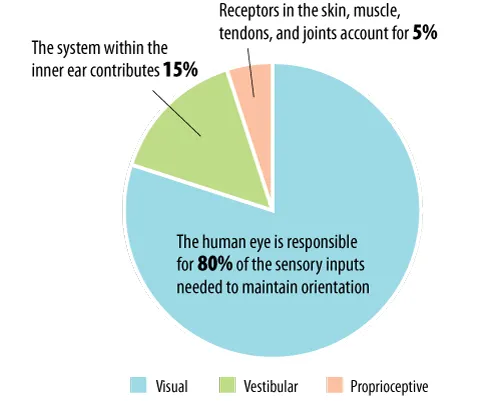
- Sensory inputs fall into three categories:
-
Visual Sensory Input:
- Visual cues are the most significant contributor to spatial orientation.
- Visual acuity (focus), depth perception, and orientation cues help pilots interpret what they see.
- Conditions that limit visual cues—such as clouds, darkness, and poor contrast between land and sky—increase the likelihood of sensory mismatches and spatial disorientation.
-
Vestibular Sensory Input:
- The vestibular system includes sensory organs in the inner ear that detect head motion.
- The vestibular system has two major components:
- Semicircular canals detect changes in rotational acceleration.
- Otolith organs detect linear (straight-line) acceleration.
- The combination of vestibular illusions and poor visibility can contribute to accidents.
-
Proprioceptive Sensory Input:
- Proprioception is the sense of the body's position.
- Proprioceptive inputs help us sense our posture and body position relative to our surroundings.
-
Spatial Disorientation Risk Factors:
- Age, fatigue, stress, anxiety, certain medical conditions, medications, smoking, alcohol, and other drugs that affect visual, vestibular, or proprioceptive inputs can increase susceptibility to spatial disorientation.
- Without visual cues, you may rely more heavily on sensations from the vestibular system.
- Certain flight conditions can mislead the vestibular system.
- When motion produces misleading vestibular signals, pilots may experience illusions that contribute to spatial disorientation.
- Conflicting sensory inputs can confuse the brain and produce illusions in flight.
Illusions in Flight
-
Vestibular System Illusions:
- Vestibular system illusions are related to the inner ear.
- Vestibular (inner-ear) illusions include:
-
The Leans:
- If entering a turn too slowly to stimulate the motion-sensing system in the inner ear (less than 2°/second), an abrupt correction of a banked attitude can create the illusion of banking in the opposite direction. []
- Because the initial turn went undetected, the pilot still feels as though the aircraft is straight and level.
- When the aircraft returns to level flight, the pilot may feel a bank in the opposite direction.
- A pilot relying on bodily sensations may lean in the direction of the original turn to regain what feels like an upright posture.
- The disoriented pilot may roll back into the original bank or, while maintaining level flight, feel compelled to lean until the illusion subsides.
- Maintaining an effective instrument scan helps the pilot detect this sensory mismatch and maintain level flight.
- A breakdown in the instrument scan can cause a pilot to trust bodily sensations and overlook a difference between the aircraft's actual and perceived attitude.
- Similarly, when entering a turn slowly and if an instrument scan is poor, a pilot may never detect the sensation of a turn.
- The pilot may not recognize what is happening until the aircraft is in an aggressive, unusual attitude.
- If entering a turn too slowly to stimulate the motion-sensing system in the inner ear (less than 2°/second), an abrupt correction of a banked attitude can create the illusion of banking in the opposite direction. []
-
Coriolis Illusion:
- The Coriolis illusion can occur when an abrupt head movement follows a prolonged turn, after the fluid in the semicircular canals has begun moving with the canals.
- Moving the head in a different plane—for example, looking elsewhere in the flight deck or reaching for a chart—may set the inner-ear fluid moving and create the illusion of turning or accelerating about a different axis.
- A disoriented pilot attempting to correct the aircraft's perceived attitude may inadvertently maneuver into a dangerous attitude.
- Pilots must develop an instrument cross-check or scan that minimizes head movement.
- Avoid abrupt head movements during prolonged, constant-rate turns, especially at night or in instrument conditions.
-
Graveyard Spin:
- During a prolonged spin, the pilot's motion-sensing system may stop detecting the rotation.
- Stopping the spin can create the illusion of spinning in the opposite direction. []
- A pilot attempting to counteract this false sensation may reenter the original spin.
- During a prolonged spin, the pilot's motion-sensing system may stop detecting the rotation.
-
Graveyard Spiral:
- During a prolonged, coordinated, constant-rate turn, a pilot may feel as though the aircraft is no longer turning. []
- If the pilot no longer senses a coordinated, constant-rate turn, an observed altitude loss can create the illusion of descending with the wings level.
- When recovering to level flight, the pilot may feel a turn in the opposite direction.
- The disoriented pilot may resume the original turn, allowing the aircraft to continue descending.
- Seeing the instruments indicate a descent, the pilot may attempt to stop the altitude loss while mistakenly believing the wings are level.
- Pulling back on the yoke tightens the spiral and increases the rate of descent.
-
Somatogravic Illusion:
- Rapid acceleration, such as during takeoff, stimulates the otolith organs similarly to tilting the head backward.
- This acceleration can create the illusion of a nose-up attitude, especially when clear visual references are absent.
- Reacting to this illusion, the pilot may lower the nose into a dive.
- Rapid deceleration, such as after a quick throttle reduction, can produce the opposite illusion, prompting the pilot to raise the nose and potentially stall the aircraft.
- Rapid acceleration, such as during takeoff, stimulates the otolith organs similarly to tilting the head backward.
-
Inversion Illusion:
- An abrupt transition from a climb to straight-and-level flight can create the sensation of tumbling backward.
- The disoriented pilot may lower the aircraft's nose, potentially intensifying the illusion.
- It is as though you're in a recliner, and you feel as though you're looking up, but gravity is actually pulling you into the chair. In reality, you're descending, and the aircraft's acceleration downward is pushing you into the seat.
-
Elevator Illusion:
- An abrupt upward acceleration, such as in a brief updraft, can stimulate the otolith organs and create the illusion of being in a climb.
- The disoriented pilot may push the aircraft into a nose-low attitude.
- An abrupt downward acceleration, such as in a brief downdraft, can have the opposite effect, prompting the disoriented pilot to raise the aircraft's nose.
- An abrupt upward acceleration, such as in a brief updraft, can stimulate the otolith organs and create the illusion of being in a climb.
-
Visual/Night Illusions:
- Of the senses, vision is the most important for safe flight.
- Terrain features and atmospheric conditions can create optical illusions.
- These illusions are primarily associated with landing.
- When transitioning from instruments to outside visual cues for landing after an instrument approach, pilots must recognize potential visual illusions and take appropriate corrective action.
-
False Horizon:
- On dark nights, the natural horizon may be difficult or impossible to see.
- Sloping cloud formations, an obscured horizon, ground lights mixed with stars, and geometric patterns of ground lights can create a false horizon, misleading pilots about the aircraft's attitude.
- A disoriented pilot may align the aircraft with a false horizon, placing it in a dangerous attitude.
- At night, pilots should cross-check outside visual references with flight and navigation instruments.
-
Autokinesis:
- Autokinesis can occur after staring at a single point of light against a dark background for more than a few seconds.
- After a few moments, the stationary light may appear to move.
- A disoriented pilot attempting to align the aircraft with the apparently moving light may lose control of the aircraft.
- To help prevent this illusion, shift your focus among objects at different distances and avoid fixating on a single target.
- Maintain a regular scan pattern.
-
Vertigo:
- A feeling of dizziness and disorientation caused by doubt in visual interpretation.
- Flickering cockpit lights, anti-collision lights, strobes, or other aircraft lights can cause flicker vertigo.
- Vertigo is often experienced when there is no well-defined horizon.
- Vertigo can also occur when transitioning from a well-lit area, such as a runway, into darkness.
- Possible symptoms include nausea, dizziness, grogginess, loss of consciousness, headaches, or confusion.
-
Black-Hole Approach:
- During a night approach over water or unlit terrain, runway lights may be the only visible lights.
- A lack of peripheral visual cues can make it difficult for pilots to orient themselves relative to the horizon.
- The runway may appear to slope upward or downward, and misjudging the approach can lead to landing short of the runway.
- Use visual glide-slope indicators, if available.
- If navigation aids (NAVAIDs) are unavailable, pilots should use flight instruments to maintain orientation and follow a standard approach profile.
- Difficulty judging distance and distinguishing approach lights from runway lights can further complicate night landings:
- Bright runway and approach lights, particularly in otherwise dark areas, may make the runway appear closer, leading to a higher-than-normal approach angle.
- Over sparsely lit terrain, the runway may appear farther away, leading to a lower-than-normal approach.
- If the runway is near a city on higher terrain in the distance, pilots may fly a lower-than-normal approach.
- Reviewing the airfield layout and boundaries before an approach can help the pilot maintain a safe approach angle.
- Where a double row of approach lights meets the runway boundary lights, pilots may have difficulty identifying where the approach lights end and the runway lights begin.
- Under certain conditions, approach lights can make the aircraft appear higher during the turn to final than when its wings are level.
- If unsure of their position or altitude during the approach, the pilot should go around.
- The black-hole illusion can also affect departures.
- See also: AOPA Air Safety Institute - Safety Quiz: IFR Into a Black Hole.
-
Landing Illusions:
- Surface features and atmospheric conditions during landing can distort a pilot's perception of height above and distance from the runway threshold.
- To reduce landing errors caused by illusions, anticipate misleading visual cues, visually inspect unfamiliar airports from the air before landing, use available glide slope or Visual Approach Slope Indicator (VASI) guidance, and maintain proficiency in landing procedures.
-
Runway Width:
[]- A narrower-than-usual runway can create an illusion in which the aircraft appears to be at a higher altitude than it actually is, especially when the runway's length-to-width ratio is comparable.
- A pilot who does not recognize this illusion may fly a lower approach, increasing the risk of striking obstacles or landing short of the intended touchdown point.
- A wider-than-usual runway can have the opposite effect, increasing the risk of leveling off too high, landing hard, or overshooting the runway.
- A narrower-than-usual runway can create an illusion in which the aircraft appears to be at a higher altitude than it actually is, especially when the runway's length-to-width ratio is comparable.
-
Runway Slope:
[]- An up-sloping runway, up-sloping terrain, or both can make the aircraft appear higher than it actually is.
- A pilot who does not recognize this illusion may fly a lower-than-normal approach.
- Down-sloping runways and approach terrain can lead pilots to fly higher-than-normal approaches.
- A higher-than-normal approach can affect landing performance by leaving less runway for the landing roll and increasing airspeed as the pilot attempts to lose excess altitude.
- An up-sloping runway, up-sloping terrain, or both can make the aircraft appear higher than it actually is.
-
Featureless Terrain:
- Horizon or surface references may be unavailable during overwater flights, at night, or in low visibility.
- A lack of visible ground features during approaches over water, dark areas, or snow-covered terrain can make the aircraft appear higher than it actually is.
- This illusion, sometimes called the “black-hole approach” (explained above), can lead pilots to fly a lower-than-normal approach.
-
Ground Lighting:
- A line of lights, such as those along a road, can be mistaken for a runway.
- Bright runway and approach lights, especially against dark surrounding terrain, can make the runway appear closer than it is, prompting a higher-than-normal approach.
- Conversely, flying over terrain with few lights to provide height cues may lead to a lower-than-normal approach.
-
Aircraft Lighting:
- Landing-light illumination can make the illuminated area appear higher than the surrounding unlit area, potentially leading pilots to fly a higher-than-normal approach.
-
Atmospheric Illusions:
- Atmospheric conditions can distort the appearance of terrain, creating visual illusions.
- Smoke, fog, smog, haze, dust, ice particles, or other phenomena can obscure surface references or the natural horizon.
- This can occur even when visibility exceeds Visual Flight Rules (VFR) minimums.
- Obscuration is more likely at airports located adjacent to large bodies of water or sparsely populated areas, where few, if any, surface references are available.
- Reflections from outside lights, sunlight shining through clouds, and beams from the aircraft's rotating anti-collision beacon can also contribute to disorientation.
-
Water Refraction:
- Rain on the windscreen can make the horizon appear lower, creating the illusion that the aircraft is higher than it actually is.
- Pilots experiencing this illusion may fly a lower-than-intended approach.
- Rain on the windscreen can make the horizon appear lower, creating the illusion that the aircraft is higher than it actually is.
-
Haze:
- Haze can make the runway appear farther away than it actually is.
- This illusion may lead the pilot to fly a lower-than-normal approach.
- Clear, bright conditions, such as those at a high-altitude airport, can make the runway appear closer than it actually is.
- This illusion may lead to a higher-than-normal approach, potentially resulting in an overshoot or a go-around.
- Water droplets on the windscreen can scatter light and impair depth perception.
- These conditions make lights and terrain features less reliable for judging height during landing.
- Haze can make the runway appear farther away than it actually is.
-
Fog:
- Entering fog can create the illusion that the aircraft is pitching up.
- Pilots reacting to this illusion may abruptly steepen their approach.
- It is not a matter of if, but when a pilot experiences some form of spatial disorientation, requiring pilots to develop the skills to recognize and recover from it.


Coping with Spatial Disorientation
- The sensations that cause illusions during instrument flight are familiar sensations from everyday life.
- Pilots cannot eliminate misleading sensations, but training and awareness can help them rely on flight instruments rather than those sensations.
- As pilots gain instrument proficiency, they become less susceptible to the effects of misleading sensations.
- To reduce the risk of illusions and their potentially disastrous consequences, pilots must:
- Understand what causes these illusions and remain alert for them. When available, use devices such as a Barany chair, Vertigon, or virtual reality spatial disorientation demonstrator to experience and recognize the illusions.
- Always obtain and understand preflight weather briefings.
- Before flying in marginal visibility (less than 3 miles) or where a visible horizon is not evident, such as flight over open water during the night, obtain training and maintain proficiency in airplane control by reference to instruments.
- Only continue flight into adverse weather conditions or dusk or darkness if proficient in using flight instruments. If you intend to fly at night, maintain your night-flight currency and proficiency to ensure safe operations. Include cross-country and local operations at various airfields.
- When using outside visual references, choose reliable, fixed points on the Earth's surface.
- Avoid sudden head movements, particularly during takeoff, turns, and landing approaches.
- Assess your fitness for flight in reduced visibility using the IMSAFE checklist. Get adequate rest, eat properly, and allow your eyes to adapt to darkness before flying at night. Illness, medication, alcohol, fatigue, sleep loss, and mild hypoxia can increase susceptibility to spatial disorientation.
- Develop proficiency in using flight instruments and trust their indications over misleading sensory perceptions.
- Coping skills help pilots respond to spatial disorientation, while prevention remains essential.
- If spatial disorientation occurs, accept that your sensory perception may be false.
- Transition immediately to the flight instruments and cross-check them for consistent indications.
- Establish straight-and-level flight with smooth control inputs while avoiding abrupt head and body movements.
- If available and appropriate, use the autopilot to stabilize the aircraft while regaining situational awareness.
- Remain calm and focused, and advise Air Traffic Control (ATC) that assistance is needed.
- Include spatial-disorientation recognition and recovery in recurrent ground and practical training through unexpected scenarios as well as isolated maneuvers.
- Use a simulator, suitable training device, or controlled in-flight training with an instructor, as appropriate.
- If spatial disorientation occurs, accept that your sensory perception may be false.
Spatial Disorientation Prevention
- Since it is not a matter of if, but when a pilot experiences spatial disorientation, pilots must prepare to recognize and manage it.
- Fly often.
- Do not fly in instrument meteorological conditions if not rated for them.
- Practice partial-panel instrument flying regularly with a safety pilot.
- Motions, forces, and visual scenes encountered in flight can create illusions of motion and position.
- Spatial disorientation resulting from these illusions can be prevented only by visual reference to reliable, fixed points on the ground or by using flight instruments.
- Anticipate visual illusions when approaching unfamiliar airports, especially at night or in adverse weather.
- Consult airport diagrams and the Chart Supplement U.S. for information on runway slope, terrain, and lighting.
- Check the altimeter frequently, especially during approaches, both day and night.
- Conduct an aerial visual inspection of unfamiliar airports before landing.
- Use available VASI, Precision Approach Path Indicator (PAPI), or electronic glide slope guidance to help maintain the approach path.
- Use the Visual Descent Point (VDP) published on many non-precision instrument approach charts.
- An emergency or other distraction that interrupts normal approach procedures can increase the risk of an approach accident.
- The following steps help reduce the risk of spatial disorientation:
- Before flying with less than 3 miles of visibility, obtain training and maintain proficiency in airplane control by reference to instruments.
- When flying at night or in reduced visibility, use the flight instruments to maintain your position and altitude.
- Maintain your night currency if you intend to fly at night, and include both cross-country and local operations at different airports in your practice.
- Familiarize yourself with the terrain and geographical features along your route.
- Review forecasts for your departure, route, and destination, and monitor for deteriorating weather throughout the flight.
- Plan your transition to instrument flying before entering Instrument Meteorological Conditions (IMC), and begin your instrument scan while still in visual conditions.
- Avoid visual flight when deteriorating weather could leave you without a safe escape route.
- Rely on instrument indications unless the natural horizon or surface reference is visible.
- Consider practicing maneuvers that elicit illusions with your flight instructor to maintain proficiency.
- Set personal minimums for VFR and Instrument Flight Rules (IFR) flight that limit your exposure to conditions that increase the risk of spatial disorientation.
Spatial Disorientation Demonstration
- A spatial disorientation demonstration introduces student pilots to misleading sensations they may experience in flight and the aircraft attitudes that can trigger them.
-
Spatial Disorientation Demonstration Purpose:
- Controlled aircraft maneuvers can help pilots experience and understand spatial disorientation.
- Although each maneuver typically produces a specific illusion, any false sensation can demonstrate disorientation.
- Even when a maneuver produces no sensation, it demonstrates that bodily senses may fail to detect bank or roll.
- Do not attempt these maneuvers at low altitudes or without an instructor or appropriate safety pilot.
- The instructor typically flies these demonstrations, but having the pilot fly under the instructor's direction can also demonstrate disorientation effectively.
- The pilot should close their eyes and tilt their head to one side.
- The instructor directs the pilot's control inputs.
- With eyes closed and head tilted, the pilot attempts to establish the requested attitude or make the instructed control input.
- Without visual references, the pilot may react to bodily sensations without knowing the aircraft's actual attitude.
- After a short time, the pilot will become disoriented, and the instructor pilot then tells the pilot to look up and recover.
- This exercise allows the pilot to experience disorientation while controlling the aircraft.
- Spatial disorientation objectives:
- These demonstrations help pilots understand human susceptibility to spatial disorientation.
- These demonstrations show that bodily sensations can give a false impression of aircraft attitude.
- These demonstrations help pilots understand how aircraft motion and head movements contribute to disorientation, helping reduce its occurrence and severity.
- These demonstrations build confidence in using flight instruments to determine aircraft attitude.
-
Spatial Disorientation Demonstration Procedure:
-
Climbing While Accelerating:
- With the pilot's eyes closed, the instructor maintains approach airspeed in a straight-and-level attitude for several seconds, then accelerates while maintaining the same attitude.
- Without visual references, the pilot may feel as though the aircraft is climbing during this maneuver.
-
Climbing While Turning:
- With the pilot's eyes still closed and the aircraft in a straight-and-level attitude, the instructor pilot now executes, with a relatively slow entry, a well-coordinated turn of about 1.5 positive G (approximately 50° bank) for 90°.
- Without outside visual references, the slight positive G during the turn can create the sensation of climbing.
- Upon sensing a climb, the pilot should immediately open their eyes to observe that a gradually established, coordinated turn can feel like a climb.
-
Diving While Turning:
- Repeating the previous procedure with eyes closed until about halfway through recovery from the turn can create a sensation of diving.
-
Tilting to the Right or Left:
- With the aircraft straight and level and the pilot's eyes closed, the instructor introduces a slight or moderate skid to either side while keeping the wings level.
- This maneuver creates the illusion of the body tilting opposite the direction of the skid.
-
Reversal of Motion:
- The reversal of motion illusion can be demonstrated in any of the three planes of motion.
- While the aircraft is straight and level, with the pilot's eyes closed, the instructor pilot smoothly and positively rolls the aircraft to approximately a 45° bank angle, maintaining its heading and pitch attitude.
- The reversal of motion illusion creates a strong sensation of rotating opposite the aircraft's actual roll direction.
- After experiencing this illusion, the pilot should open their eyes and observe the aircraft's actual banked attitude.
-
Diving or Rolling Beyond the Vertical Plane:
- This maneuver may produce extreme disorientation.
- During straight-and-level flight, the pilot should sit normally with eyes closed or gaze directed toward the floor.
- The instructor initiates a positive, coordinated roll toward a 30° or 40° bank angle.
- During the roll, the pilot tilts their head forward, looks right or left, and then immediately returns their head upright.
- The instructor should time the maneuver so that the roll stops as the pilot returns their head upright.
- This maneuver can produce intense disorientation and a sensation of falling in the direction of the roll.
-
Spatial Disorientation & Illusions in Flight Lessons & Case Studies
The following case studies summarize National Transportation Safety Board (NTSB) accident reports.
- National Transportation Safety Board Identification: WPR11FA256:
- The NTSB determines the probable cause(s) of this accident to be: the non-instrument-rated pilot's decision to conduct a visual flight rules flight over mountainous terrain into a region covered by clouds, which likely resulted in spatial disorientation and subsequent loss of airplane control.
- National Transportation Safety Board Identification: CEN13FA135:
- The NTSB determines the probable cause(s) of this accident to be: The pilot's inadvertent controlled descent into terrain due to spatial disorientation. Contributing to the accident was the lack of a visual reference due to the night conditions.
- National Transportation Safety Board Identification: ERA14LA117:
- The NTSB determines the probable cause(s) of this accident to be: The noninstrument-rated pilot's continued flight into dark night, instrument meteorological conditions, which resulted in a loss of control due to spatial disorientation and subsequent impact with water.
- National Transportation Safety Board Identification: ERA25LA087:
- The NTSB determines the probable cause(s) of this accident to be: The pilot's loss of aircraft control due to spatial disorientation, and the flight instructor's inadequate supervision, which resulted in the subsequent overstress of the airplane during recovery.
- National Transportation Safety Board Identification: ERA24LA030:
- The NTSB determines the probable cause(s) of this accident to be: The pilot's loss of airplane control and descent into terrain due to spatial disorientation during a solo night cross-country flight. Contributing to the accident was the pilot's self-reported fatigue.
- National Transportation Safety Board Identification: ERA25FA143:
- The NTSB determines the probable cause(s) of this accident to be: The pilot's loss of airplane control shortly after climbing into instrument meteorological conditions due to spatial disorientation (somatogyral illusion).
- National Transportation Safety Board Identification: ERA23FA358:
- The NTSB determines the probable cause(s) of this accident to be: The pilot's failure to maintain a positive climb rate after takeoff due to spatial disorientation (somatogravic illusion), which resulted in impact with trees and terrain.
- National Transportation Safety Board Identification: CEN23FA125:
- The NTSB determines the probable cause(s) of this accident to be: The pilot's initiation of the visual flight into instrument meteorological conditions, which resulted in spatial disorientation and a subsequent loss of helicopter control. Contributing to the accident was the pilot's flicker vertigo during the flight.
- National Transportation Safety Board Identification: WPR11LA233:
- The NTSB determines the probable cause(s) of this accident to be: The pilot's failure to maintain sufficient altitude to avoid rising terrain. Contributing to the accident was the pilot's visual illusion and disorientation due to the flat light conditions.
- National Transportation Safety Board Identification: NYC07CA116:
- The NTSB determines the probable cause(s) of this accident to be: The pilot's improper landing flare, which resulted in a hard landing. A factor in the accident was the visual illusion experienced by the pilot from landing on a long, wide runway.
Spatial Disorientation & Illusions In Flight Interactive Scenario
Interactive Scenario
Loading scenario details...
Scenario Complete
Spatial Disorientation & Illusions In Flight Knowledge Check
Choose the knowledge check that matches your current training for Spatial Disorientation & Illusions In Flight.
 Private Pilot
PPL knowledge check
Core Knowledge Review
Review foundational knowledge, key concepts, and practical considerations. Topic: Spatial Disorientation & Illusions In Flight.
- Immediate feedback
- Answer explanations
- Account progress tracking
 Commercial Pilot
CPL knowledge check
Advanced Application
Apply knowledge to advanced operations, risk management, and aeronautical decision-making. Topic: Spatial Disorientation & Illusions In Flight.
- Immediate feedback
- Answer explanations
- Account progress tracking
Why Take a Quiz?
Quizzes reinforce key concepts, identify knowledge gaps, and build confidence for real-world decisions. Quiz material is representative of the information provided here and is not based on or sourced from the Federal Aviation Administration test bank.
Spatial Disorientation & Illusions in Flight Conclusion
- When the sensory system doesn't agree with where you believe yourself to be in space, spatial disorientation has occurred.
- FAA research published in 2025 emphasizes the severity of spatial-disorientation accidents:
- An FAA analysis identified 367 fatal fixed-wing general aviation accidents involving spatial disorientation between 2003 and 2021.
- Considering fatal and nonfatal spatial-disorientation accidents together, 94 percent were fatal, compared with 19 percent of general aviation accidents overall.
- Most of the fatal accidents studied occurred in instrument meteorological conditions, and pilot experience was concentrated among pilots with fewer than 500 total flight hours.
- An FAA analysis identified 367 fatal fixed-wing general aviation accidents involving spatial disorientation between 2003 and 2021.
- Illusions rank among the most common factors cited as contributing to fatal aircraft accidents.
- Both the severity of spatial disorientation and the conditions that trigger it can vary considerably among pilots.
- In-flight motions, forces, and visual scenes can create illusions of motion and position.
- To prevent spatial disorientation from these illusions, rely on reliable, fixed ground references or flight instruments.
- Once you enter instrument conditions, commit fully to flying by reference to instruments.
- Quickly switching to visual flight after spotting a gap in the clouds or glimpsing the ground can cause spatial disorientation.
- Maintaining an effective instrument scan can help prevent this.
- Quickly switching to visual flight after spotting a gap in the clouds or glimpsing the ground can cause spatial disorientation.
- Use ICEFLAGS to remember common vestibular and visual illusions.
- Inversion, Coriolis, Elevator, False horizon, Leans, Autokinesis, Graveyard spiral, Somatogravic.
- Test your understanding of flight illusions with the Air Safety Institute's “Into a Black Hole” quiz.
- Explore AOPA's Spatial Orientation Spotlight to learn more about spatial disorientation.
- Practice recognizing and recovering from spatial disorientation in a flight simulator to build familiarity or refresh your skills.
- Still looking for something? Continue searching:
Spatial Disorientation & Illusions in Flight References
- Federal Aviation Administration (FAA) - Pilot/Controller Glossary.
- Federal Aviation Administration - Aerospace Physiology Training Class.
- Instrument Flying Handbook (1-5) Illusions Leading to Spatial Disorientation.
- Instrument Flying Handbook (1-7) Demonstration of Spatial Disorientation.
- Airplane Flying Handbook (10-2) Night Illusions.
- Advisory Circular 61-21A (Chapter 1) Disorientation (Vertigo).
- Aeronautical Information Manual (8-1-5) Illusions in Flight.
- Aeronautical Information Manual (8-1-6) Vision in Flight.
- Aircraft Owners and Pilots Association (AOPA) - Safety Quiz - Spatial Disorientation.
- AOPA - Spatial Disorientation: Confusion that Kills.
- BoldMethod - What Is A Graveyard Spiral, And How Do You Avoid It?.
- FAA Medium - It's a Confusing World Up There.
- Pilot Handbook of Aeronautical Knowledge (16-17) Vision in Flight.
- Quizlet - Types of Illusions - ICEFLAGS.