Wake Turbulence
Understand how aircraft wake vortices form and move, when they are strongest, and how pilots avoid them during takeoff, approach, landing, and cruise flight.
Introduction to Wake Turbulence
- Every aircraft generates a wake while in flight.
- Wake turbulence is a function of an aircraft producing lift, creating a vortex that forms two counter-rotating vortices trailing behind the aircraft.
- The strength and behavior of vortices generated by one aircraft can create hazardous wake turbulence for an aircraft that encounters them.
- Vortices can impose rolling moments that exceed the roll-control authority of the encountering aircraft, potentially causing injury to occupants and damage to the aircraft.
- In a slow hover taxi or stationary hover near the surface, the helicopter's main rotor(s) generate downwash, producing high velocity outwash vortices to a distance approximately three times the diameter of the rotor.
- Pilots must learn to envision the location of the vortex wake generated by larger aircraft and adjust the flight path accordingly.
- Reinforce your understanding of Wake Turbulence by completing the knowledge quiz and interactive scenario, comparing your performance with the applicable Airman Certification Standards, and reviewing the topic summary before moving on.
- Wake Turbulence Key Highlights
- Vortex Formation
- Vortex Behavior
- Avoidance Procedures
- Warning Signs
- Helicopter Specifics
- Wake Turbulence Responsibilities
- Wake Turbulence Separation
- Reduced Vertical Separation Minimum (RVSM) Considerations
- Wake Turbulence Lessons & Case Studies
- Wake Turbulence Knowledge Check
- Wake Turbulence Interactive Scenario
- Wake Turbulence-Related Airman Certification Standards
- Wake Turbulence Conclusion
- Wake Turbulence References
Help Us Grow
Enjoy CFI Notebook? A one-time donation helps us create more high-quality lessons, quizzes, scenarios, graphics, and interactive tools.
Wake Turbulence Key Highlights
- Wake turbulence is generated by wingtip vortices created as an aircraft produces lift during flight.
- Wingtip vortices are strongest when an aircraft is heavy, clean, and operating at slow airspeeds.
- Wake turbulence can cause abrupt rolling moments and loss of aircraft control for following aircraft.
- Large aircraft, especially heavy transport-category airplanes, produce the most significant wake turbulence hazards.
- Wake vortices typically sink below the generating aircraft’s flight path and drift with the wind.
- Pilots should remain above and upwind of a preceding aircraft’s flight path whenever possible.
- Takeoff, landing, and low-altitude operations present the greatest risk of wake turbulence encounters.
- Air traffic control wake turbulence separation standards help reduce the risk of hazardous vortex encounters.
- Crosswinds can move wake vortices onto adjacent runways or taxiways, increasing operational hazards.
- Understanding wake turbulence improves situational awareness, traffic spacing decisions, and overall flight safety.
Vortex Formation
-

Wake Vortex Generation - The creation of a pressure differential over the wing surface generates lift.
- The lowest pressure occurs over the upper wing surface, and the highest pressure occurs under the wing.
- This pressure differential triggers the roll-up of the airflow at the rear of the wing, resulting in swirling air masses trailing downstream of the wingtips.
- After the roll-up, the wake consists of two counter-rotating cylindrical vortices. []
- The wake vortex forms with most of the energy concentrated within a few feet of the vortex core.
- More aircraft are being manufactured or retrofitted with winglets to increase fuel efficiency (by improving the lift-to-drag ratio).
- Studies have shown, however, that winglets have a negligible effect on wake turbulence generation, particularly with the slower speeds involved during departures and arrivals.
-
Vortex Strength:
-

Wake Encounter Counter Control - The strength of the vortex depends on the weight, speed, wingspan, and shape of the generating aircraft's wing.
- The vortex strength from an aircraft increases proportionately to an increase in operating weight or a decrease in aircraft speed.
-
- Characteristics change with the extension of flaps or other wing-configuring devices.
- An aircraft creates the greatest vortex strength when:
- Heavy.
- Clean.
- A dirty aircraft configuration hastens wake decay.
- Slow.
- Wake turbulence is near maximum behind a jet transport immediately after takeoff because the aircraft is typically heavy and flying relatively slowly at a high angle of attack, requiring substantial lift and producing strong wingtip vortices.
- Wake turbulence can remain hazardous behind a jet transport during final approach and landing because the aircraft is flying slowly while producing substantial lift. Vortex generation continues until touchdown.
- High wing loading amplifies the effects of vortex strength.
- Landing gear and flap extension tend to disrupt wake formation and reduce vortex intensity.
- The terminal area presents a common high-risk setting because aircraft are slow, close to the ground, and have little altitude available for recovery.
-
Induced Roll:
- In rare instances, a wake encounter could cause catastrophic in-flight structural damage to an aircraft.
- However, the usual hazard is associated with induced rolling moments that can exceed the roll-control authority of the encountering aircraft.
- Induced roll is especially dangerous during takeoff and landing when there is little altitude for recovery.
- During in-flight testing, the aircraft intentionally flew directly through the trailing vortex cores of larger aircraft.
- These tests demonstrated that the ability of aircraft to counteract the roll imposed by wake vortex depends primarily on the wingspan and counter-control responsiveness of the encountering aircraft.
- These tests also demonstrated the difficulty for an aircraft to remain within a wake vortex.
- The natural tendency is for the circulation to eject aircraft from the vortex.
- Counter-control is usually effective and induces minimal roll in cases where the wingspan and ailerons of the encountering aircraft extend beyond the rotational flow field of the vortex.
- It is more difficult for aircraft with a short wingspan (relative to the generating aircraft) to counter the imposed roll induced by vortex flow.
- The wake of larger aircraft requires the respect of all pilots.
- Pilots of short-span aircraft, even of the high-performance type, must be especially alert to vortex encounters. []
- In rare instances, a wake encounter could cause catastrophic in-flight structural damage to an aircraft.
Vortex Behavior
-

Wake Ends/Wake Begins -

Vortex Flow Field - An aircraft generates vortices from the moment it rotates on takeoff until touchdown, since trailing vortices are a by-product of wing lift. []
- Before takeoff or touchdown, pilots should note the rotation or touchdown point of the preceding aircraft.
-

Wake Ends/Wake Begins - Circulation is outward, upward, and around the wing tips.
- Vortices remain spaced less than a wingspan apart, drifting with the wind at altitudes greater than a wingspan above the ground.
- Given this, if encountering persistent vortex turbulence, a slight change of altitude (upward) and lateral position (upwind) should provide a flight path clear of the turbulence.
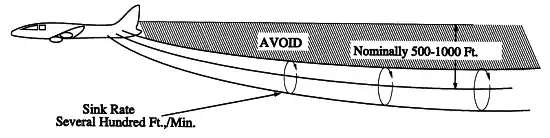
- Those from larger aircraft sink at a rate of several hundred feet per minute, slowing their descent and diminishing in strength with time and distance behind the generating aircraft. []
- When present, atmospheric turbulence hastens breakup.
- Pilots should fly at or above the preceding aircraft's flight path, altering course as necessary to avoid the area directly behind and below the generating aircraft.
- A 1,000-foot vertical separation may reduce the likelihood of a wake encounter, but it does not ensure avoidance; vortices from Heavy and especially Super aircraft may descend more than 1,000 feet before decaying to a less perceptible residual strength.
- When vortices sink close to the ground (within 100 to 200 feet), they tend to move laterally over the ground at a speed of 2 or 3 knots. [//]
-

Vortex Flow Field - Pilots should remain alert for possible wake vortex encounters in all phases of flight, particularly during takeoff, approach, and landing.
- The pilot is ultimately responsible for maintaining an appropriate interval and should consider all available information in positioning the aircraft in the terminal area to avoid the wake turbulence created by a preceding aircraft.
- Test data show that vortices can rise with the air mass that contains them.
- The effects of wind shear can cause a vortex flow field "tilting."
- In addition, ambient thermal lifting, orographic effects (such as rising terrain or tree lines), can cause a vortex flow field to rise and possibly bounce.
- A crosswind will decrease the lateral movement of the upwind vortex and increase the movement of the downwind vortex.
- Thus, a light wind with a cross-runway component of 1 to 5 knots could result in the upwind vortex remaining in the touchdown zone for some time and hasten the drift of the downwind vortex toward another runway.
- A tailwind condition can cause the vortices to move forward into the touchdown zone.
- The light quartering tailwind requires maximum caution.
-

Vortex Movement in Ground Effect - Tailwind -
Operations Problem Areas:
-

Vortex Movement Near Ground - No Wind -

Vortex Movement Near Ground - with Cross Winds - The probability of induced roll increases when the encountering aircraft's heading generally aligns with the flight path of the generating aircraft.
- A crosswind will decrease the lateral movement of the upwind vortex and increase the movement of the downwind vortex.
- Thus, a light wind with a cross runway component of 1 to 5 knots could result in the upwind vortex remaining in the touchdown zone for a period of time and hasten the drift of the downwind vortex toward another runway.
- Similarly, a tailwind condition can cause the vortices of the preceding aircraft to move forward into the touchdown zone.
- THE LIGHT QUARTERING TAILWIND REQUIRES MAXIMUM CAUTION.
- Pilots should be alert to large aircraft upwind from their approach and takeoff flight paths.
- Pilots should be vigilant in calm wind conditions and situations where the vortices could:
- Remain in the touchdown area.
- Drift from aircraft operating on a nearby runway.
- Sink into the takeoff or landing path from a crossing runway.
- Sink into the traffic pattern from other airport operations.
- Sink into the flight path of VFR aircraft operating on the hemispheric altitude 500' below.
- AVOID THE AREA BELOW AND BEHIND THE GENERATING AIRCRAFT, ESPECIALLY AT LOW ALTITUDES, WHERE EVEN A MOMENTARY WAKE ENCOUNTER COULD BE CATASTROPHIC.
-

Vortex Movement Near Ground - No Wind -

Vortex Movement Near Ground - with Cross Winds
-
Avoidance Procedures
- Under certain conditions, airport traffic controllers apply procedures for separating IFR (Instrument Flight Rules) aircraft.
- If a pilot accepts a clearance to follow a preceding aircraft visually, they accept responsibility for ensuring separation and avoiding wake turbulence.
- The controllers will also provide to VFR aircraft, with whom they are in communication and which, in the tower's opinion, may be adversely affected by wake turbulence from a larger aircraft, the position, altitude, and direction of flight of larger aircraft, followed by the phrase "caution, wake turbulence."
- After issuing the wake-turbulence caution, airport traffic controllers generally do not provide additional information to the following aircraft unless they know it is overtaking the preceding aircraft.
- Whether or not given a warning or information, the expectation is that the pilot adjusts aircraft operations and flight path as necessary to preclude serious wake encounters.
- Do not treat smooth air, the absence of a pilot report, or the absence of an ATC (Air Traffic Control) wake-turbulence advisory as assurance that the flight path is free of wake; continue to identify aircraft ahead and compare their route, altitude, and climb or descent profile with yours.
- When any doubt exists about maintaining safe separation during an approach, ask the control tower for updates on separation distance and aircraft groundspeed.
-
Landing behind a larger aircraft - same runway:
- Stay at or above the larger aircraft's final approach flight path, note its touchdown point, and land beyond it.
- Incident data shows that the most significant potential for a wake vortex incident occurs when a light aircraft is turning from base to final behind a heavy aircraft flying a straight-in approach.
- Use extreme caution to intercept the final above or well behind the heavier aircraft.
- When a pilot accepts a visual approach to follow a preceding aircraft, the pilot must establish a safe landing interval behind the instructed aircraft.
- Pilots must not decrease the separation that existed when the visual approach was issued unless they can remain on or above the flight path of the preceding aircraft.
- Stay at or above the larger aircraft's final approach flight path, note its touchdown point, and land beyond it.
-
Landing behind a larger aircraft - when a parallel runway is closer than 2,500':
- Consider the possible drift to your runway.
- Stay at or above the larger aircraft's final approach flight path- note its touchdown point.
-
Landing behind a larger aircraft - crossing runway:
- Cross above the larger aircraft's flight path.
-
Landing behind a departing larger aircraft - same runway:
- Note the larger aircraft's rotation point, and land well before it.
-
Landing behind a departing larger aircraft - crossing runway:
- Note the larger aircraft's rotation point, and if past the intersection, continue the approach to land before the intersection.
- If a larger aircraft rotates before the intersection, avoid flight below the larger aircraft's flight path.
- Abandon the approach unless a landing is ensured well before reaching the intersection.
-
Departing behind a larger aircraft:
- Note the larger aircraft's rotation point and rotate before it.
- Continue climbing above the larger aircraft's flightpath, or alter your flightpath upwind until above or clear of the larger aircraft's flightpath.
- Avoid subsequent headings that will cross below and behind a larger aircraft.
- Be alert for any critical takeoff situation that could lead to a vortex encounter.
-
Intersection takeoffs - same runway:
- Be alert to the operations of adjacent larger aircraft, particularly those upwind of your runway.
- If intersection takeoff clearance is received, avoid subsequent headings that will cross below a larger aircraft's path.
-
Departing or landing after a larger aircraft executing a low approach, missed approach, or touch-and-go landing:
- Because vortices settle and move laterally near the ground, the vortex hazard may exist along the runway and in your flight path after a larger aircraft has executed a low approach, missed approach, or a touch-and-go landing, particularly in light quartering wind conditions.
- Ensure that an interval of at least 2 minutes has elapsed before taking off or landing.
- For a small aircraft departing after one of these operations, ATC requires at least 3 minutes after a B757-size aircraft or 4 minutes after an A380-size aircraft before issuing takeoff clearance.
-
En route VFR (thousand-foot altitude plus 500'):
- Avoid flying below and behind a large aircraft's path.
- If a larger aircraft is observed above on the same track, adjust your position laterally, preferably upwind.
- If a larger aircraft is observed above on the same track (meeting or overtaking), adjust your position laterally, preferably upwind.
- Guidance on Wake Turbulence:
-
Wake Turbulence Avoidance (1995) Pilot Action to Mitigate Wake Turbulence Encounters:
Pilots should be alert for wake turbulence when operating:
- In the vicinity of aircraft climbing or descending through their altitude.
- Approximately 10-30 miles after passing 1,000' below opposite-direction traffic.
- Approximately 10-30 miles behind and 1,000' below same-direction traffic.
- Pilots encountering or anticipating wake turbulence in DRVSM (Domestic Reduced Vertical Separation Minimum) airspace have the option of requesting a vector, FL (Flight Level) change, or, if capable, a lateral offset.
- Offsets of approximately a wing span upwind generally can move the aircraft out of the immediate vicinity of another aircraft's wake vortex.
- In domestic U.S. airspace, pilots must request clearance to fly a lateral offset. Strategic lateral offsets flown in oceanic airspace do not apply.
-
Warning Signs
- Wakes may cause uncommanded aircraft movements (i.e., wing rocking).
- Maintaining situational awareness during approach and landing operations is critical.
- Ordinary turbulence is not unusual, particularly in the approach phase.
- A pilot who suspects wake turbulence is affecting their aircraft should get away from the wake, execute a missed approach or go-around, and be prepared for a stronger wake encounter.
- The onset of wake can be insidious and even surprisingly gentle.
- Wake vortex encounters can range from light turbulence to loss of control in flight or an in-flight breakup accident.
- If a wake vortex is encountered on approach, recognize and escape by initiating a go-around, balked landing, or missed approach when appropriate.
- If the encounter causes an aircraft upset, follow aircraft-specific recovery procedures and use control inputs appropriate to the aircraft's flight condition.
Helicopter Specifics
- While the behavioral characteristics are similar to a fixed-wing aircraft, circulation is outward, upward, around, and away from the main rotor(s) in all directions.
- In fact, helicopter wakes may be of significantly greater strength than those from a fixed-wing aircraft of the same weight.
- Pilots of small aircraft should avoid operating within three rotor diameters of any helicopter in a slow hover taxi or stationary hover.
- In forward flight, departing or landing helicopters produce a pair of strong, high-speed trailing vortices, similar to those made by fixed-wing aircraft.
- The strongest wake can occur when the helicopter is operating at lower speeds (20 - 50 knots).
- Some mid-size or executive-class helicopters produce wake as strong as that of heavier helicopters.
- Two-blade main rotor systems, typical of lighter helicopters, produce stronger wakes than rotor systems with more blades.
- Pilots of small aircraft should use caution when operating behind or crossing behind landing and departing helicopters.
Wake Turbulence Responsibilities
-
Pilot Responsibilities:
- Pilots should remain vigilant for wake turbulence and adjust their flightpaths as necessary, whether or not ATC provides a warning or information.
- When operating behind any aircraft, pilots acknowledge responsibility for ensuring safe takeoff and landing intervals and providing wake turbulence separation by accepting ATC instructions in the following situations.
- Traffic information.
- Instructions to follow an aircraft.
- The acceptance of a visual approach clearance.
- ATC will specify the word "super" or "heavy" as appropriate for operations conducted behind super or heavy aircraft when this information is known. Pilots of super or heavy aircraft should always use the word "super" or "heavy" in radio communications.
- Super, heavy, and large jet aircraft operators should follow the procedures outlined below during an approach to landing. These procedures establish a dependable baseline from which pilots of in-trail, lighter aircraft may reasonably expect to make effective flight path adjustments to avoid serious wake vortex turbulence.
- Pilots of aircraft that produce strong wake vortices should make every attempt to fly on the established glide-path, not above it; or, if glide-path guidance is not available, to fly as closely as possible to a "3-1" glide-path, not above it.
- Fly 3,000' at 10 miles from touchdown, 1,500' at 5 miles, 1,200' at 4 miles, and so on to touchdown.
- Pilots of aircraft that produce strong wake vortices should make every attempt to fly on the established glide-path, not above it; or, if glide-path guidance is not available, to fly as closely as possible to a "3-1" glide-path, not above it.
- Pilots of aircraft that produce strong wake vortices should fly as closely as possible to the approach course centerline or to the extended centerline of the runway of intended landing, as appropriate to conditions.
- Pilots operating lighter aircraft on visual approaches in-trail to aircraft producing strong wake vortices should use the following procedures to avoid wake turbulence. These procedures apply only to aircraft on visual approaches.
- Pilots of lighter aircraft should fly on or above the glide path. An ILS may furnish glide-path reference, a visual approach slope system, other ground-based approach slope guidance systems, or other means. In the absence of visible glide-path guidance, pilots may very nearly duplicate a 3-degree glide-slope by adhering to the "3 to 1" glide-path principle.
- Fly 3,000' at 10 miles from touchdown, 1,500' at 5 miles, 1,200' at 4 miles, and so on to touchdown.
- If the pilot of the lighter, following aircraft, has visual contact with the preceding heavier aircraft and also with the runway, the pilot may further adjust for possible wake vortex turbulence by following these practices:
- Pick a point of landing no less than 1,000' from the arrival end of the runway.
- Establish a line-of-sight to that landing point that is above and in front of the heavier preceding aircraft.
- When possible, note the point of landing of the heavier preceding aircraft and adjust the point of intended landing as necessary.
- A puff of smoke may appear at 1,000' markings of the runway, indicating that touchdown occurred at that point; therefore, adjust the point of intended landing to the 1,500' markings.
- Maintain a line of sight to the point of intended landing above and ahead of the heavier preceding aircraft; maintain it until touchdown.
- Land beyond the point of landing of the preceding heavier aircraft, ensuring you have adequate runway remaining if conducting a touch-and-go landing, or adequate stopping distance available for a full-stop landing.
- During visual approaches, pilots may request updates from ATC on separation and ground speed with respect to heavier preceding aircraft, especially when there is any question of maintaining safe separation from wake turbulence.
- Pilots should notify ATC when they encounter a wake event.
- Be as descriptive as possible (i.e., bank angle, altitude deviations, intensity and duration of the event, etc.) when reporting the event.
- ATC will record the event through their reporting system. You are also encouraged to use the Aviation Safety Reporting System (ASRS) to report wake events.
- Only where the applicable rule permits a pilot-requested waiver may specified wake separation be reduced, and the request must be explicit; some mandatory wake intervals cannot be waived.
- If doing so, pilots are assuming the risk.
- Pilots should not waive separation for convenience unless they determine it is safe to do so.
- Pilots of lighter aircraft should fly on or above the glide path. An ILS may furnish glide-path reference, a visual approach slope system, other ground-based approach slope guidance systems, or other means. In the absence of visible glide-path guidance, pilots may very nearly duplicate a 3-degree glide-slope by adhering to the "3 to 1" glide-path principle.
-
Controller Responsibilities:
- Controllers apply required wake-turbulence separation minima to aircraft operating behind a Super or Heavy, and to Small aircraft operating behind a B757, when the following aircraft is IFR, VFR receiving Class B, Class C, or TRSA services, or VFR being radar sequenced.
- When in communication with VFR aircraft that, in the tower's opinion, may be adversely affected by wake turbulence from a larger aircraft, airport traffic controllers provide that aircraft's position, altitude, and direction of flight, followed by “CAUTION—WAKE TURBULENCE.”
- Controllers issue wake-turbulence cautionary advisories, including the position, altitude if known, and direction of flight, to aircraft operating behind an aircraft that requires wake-turbulence separation in these situations:
- Terminal VFR aircraft that are not being radar vectored and are behind the larger aircraft.
- Arriving VFR aircraft that were previously radar vectored but are no longer receiving radar vectors.
- IFR aircraft that accept a visual approach or visual separation.
- Air traffic controllers should also issue cautionary information to any aircraft if, in their opinion, wake turbulence may adversely affect it.
- Tower controllers are responsible for runway separation for aircraft arriving or departing the airport.
- Pilots who accept traffic information, an instruction to follow an aircraft, or a visual approach clearance acknowledge responsibility for ensuring safe landing intervals and wake turbulence separation.
- ATC applies required wake turbulence separation minima when applicable.
- Pilots who accept traffic information, an instruction to follow an aircraft, or a visual approach clearance acknowledge responsibility for ensuring safe landing intervals and wake turbulence separation.
- Air traffic controllers are responsible for applying the appropriate wake turbulence separation criteria for departing aircraft.
Wake Turbulence Separation
- Because of the possible effects of wake turbulence, controllers apply no less than the minimum required separation to all aircraft operating behind a "Super" or "Heavy," and to Small aircraft operating behind a B757, when aircraft are IFR; VFR and receiving Class B, Class C, or TRSA airspace services; or VFR and being radar sequenced.
- Separation is applied to aircraft operating directly behind a super or heavy at the same altitude or less than 1,000 feet below, and to small aircraft operating directly behind a B757 at the same altitude or less than 500 feet below:
- Heavy behind super: 5 miles.
- Large behind super: 7 miles.
- Small behind super: 8 miles.
- Heavy behind heavy: 3 miles.
- Small/large behind heavy: 5 miles.
- Small behind B757: 4 miles.
- Also, separation, measured at the time the preceding aircraft is over the landing threshold, is provided to small aircraft:
- Small landing behind heavy - 6 miles.
- Small landing behind large, non-B757 - 4 miles.
- Separation is applied to aircraft operating directly behind a super or heavy at the same altitude or less than 1,000 feet below, and to small aircraft operating directly behind a B757 at the same altitude or less than 500 feet below:
- Additionally, appropriate time or distance intervals are provided to departing aircraft when the departure will be from the same threshold, a parallel runway separated by less than 2,500 feet with less than 500 feet threshold stagger, or on a crossing runway, and projected flight paths will cross:
- Three minutes or the appropriate radar separation when taking off will be behind a super aircraft.
- Two minutes or the appropriate radar separation is required when taking off behind a heavy aircraft.
- Two minutes or the appropriate radar separation when a small aircraft will take off behind a B757.
- NOTE: Controllers may not reduce or waive these intervals.
- A 3-minute interval will be provided when a small aircraft will take off:
- From an intersection on the same runway (same or opposite direction) behind a departing large aircraft, except a B757; or
- In the opposite direction on the same runway behind a large-aircraft takeoff or low/missed approach, except a B757.
- NOTE: This 3-minute interval may be waived upon specific pilot request.
Reduced Vertical Separation Minimum (RVSM) Considerations
- Wake turbulence can still exist at RVSM altitudes, but will generally be moderate or less in magnitude.
- Pilots should remain alert when operating:
- In the vicinity of aircraft climbing or descending through their altitude.
- Approximately 10-30 miles after passing 1,000' below the opposite direction traffic.
- Approximately 10-30 miles behind and 1,000' below the same direction traffic.
- Pilots encountering or anticipating wake turbulence in DRVSM airspace may request a vector, flight-level change, or, if capable, a lateral offset.
- Before the implementation of DRVSM, the FAA established provisions for pilots to report wake turbulence events in RVSM airspace using the NASA Aviation Safety Reporting System (ASRS).
- To date, wake turbulence has not been reported as a significant factor in DRVSM operations. European authorities also found that reports of wake turbulence encounters did not increase significantly after RVSM implementation (eight versus seven reports in a ten-month period). In addition, they found that reported wake turbulence was generally similar to moderate clear air turbulence.
- Report wake turbulence events using the NASA (National Aeronautics and Space Administration) Aviation Safety Reporting System (ASRS) through NASA's reporting page.
Wake Turbulence Lessons & Case Studies
- National Transportation Safety Board Identification: CEN19LA266:
- A Challenger 650 climbing through FL335 in smooth air encountered the probable wake of an Airbus A300 flying the same route at FL340 approximately eight to ten miles ahead; the Challenger crew was unaware of the preceding aircraft until after the encounter.
- The NTSB determines the probable cause(s) of this accident to be: The unexpected wake turbulence encounter while climbing in smooth air to cruise, resulting in passenger injuries. Contributing to the accident was the passenger seat belt sign was off.
- Some accidents have occurred even though the pilot of the trailing aircraft had carefully noted that the aircraft in front was at a considerably lower altitude. Unfortunately, this does not ensure that the flight path of the lead aircraft will be below that of the trailing aircraft.
- In 1972, a Delta Air Lines DC-9 crashed during a go-around at Greater Southwest International Airport in Fort Worth after encountering the wake vortex of an American Airlines DC-10 that had just completed a touch-and-go landing. All four occupants were killed.
- A wake turbulence encounter can range from negligible to catastrophic. Its effect depends on the weight, wingspan, and size of the generating aircraft, the distance from it, and the point of vortex encounter.
- The probability of induced roll increases when the encountering aircraft's heading is generally aligned with the flight path of the generating aircraft.
- A typical scenario for a wake encounter is in terminal airspace after accepting clearance for a visual approach behind landing traffic. Pilots must be aware of their position relative to the traffic and use all means of vertical guidance to ensure they do not fly below the flight path of the wake-generating aircraft.
- National Transportation Safety Board Identification: CEN25LA132:
- The NTSB determines the probable cause(s) of this accident to be: The failure of the U.S. Army helicopter pilots to yield the right-of-way to the landing airplane, which resulted in the airplane encountering wake turbulence emitted from the three departing U.S. Army helicopters, a subsequent loss of directional control, and a runway excursion.
- National Transportation Safety Board Identification: WPR25LA041:
- The NTSB determines the probable cause(s) of this accident to be: The pilot’s failure to maintain clearance from a commercial airliner which resulted in an encounter with wake turbulence and subsequent loss of control resulting in impact with terrain.
- National Transportation Safety Board Identification: ANC24LA093:
- The NTSB determines the probable cause(s) of this accident to be: The pilot’s encounter with wake turbulence, which resulted in substantial damage to the airplane.
- National Transportation Safety Board Identification: WPR24LA187:
- The NTSB determines the probable cause(s) of this accident to be: The pilot’s failure to maintain clearance from terrain while conducting low-level altitude operations, following an encounter with wake turbulence.
- National Transportation Safety Board Identification: WPR24LA085:
- The NTSB determines the probable cause(s) of this accident to be: A loss of airplane control due to wake turbulence resulting from the instructor pilot’s decision to continue the landing into a drifting wake vortex.
- National Transportation Safety Board Identification: ANC24LA010:
- The NTSB determines the probable cause(s) of this accident to be: The first pilot’s failure to maintain a stabilized approach, in gusty crosswind conditions, in an environment favoring wake turbulence.
- National Transportation Safety Board Identification: ERA23LA353:
- The NTSB determines the probable cause(s) of this accident to be: The pilot’s inadvertent encounter with helicopter wake turbulence during initial climb, which resulted in a loss of airplane control.
- National Transportation Safety Board Identification: WPR23LA277:
- The NTSB determines the probable cause(s) of this accident to be: The pilot’s loss of directional control during landing after encountering wake turbulence.
- National Transportation Safety Board Identification: LAX93LA298:
- In this 1993 Vacaville accident, a Cessna 172 following a large helicopter on a straight-in approach encountered some turbulence near the threshold, then more severe turbulence during the go-around, lost control, and struck the runway.
- The NTSB identified the pilot's failure to allow enough time for rotor wash to dissipate as the probable cause and wake turbulence (rotor wash) as a factor.
Wake Turbulence Knowledge Check
Choose the knowledge check that matches your current training for Wake Turbulence.
PPL knowledge check
Core Knowledge Review
Review foundational knowledge, key concepts, and practical considerations. Topic: Wake Turbulence.
- Immediate feedback
- Answer explanations
- Account progress tracking

CPL knowledge check
Advanced Application
Apply knowledge to advanced operations, risk management, and aeronautical decision-making. Topic: Wake Turbulence.
- Immediate feedback
- Answer explanations
- Account progress tracking
Why Take a Quiz?
Quizzes reinforce key concepts, identify knowledge gaps, and build confidence for real-world decisions. Quiz material is representative of the information provided here and is not based on or sourced from the Federal Aviation Administration test bank.
Wake Turbulence Interactive Scenario
Behind the Heavy on Runway Two-Seven
Manage a light-aircraft departure and return at a busy airport as heavy jets, crossing runways, wind drift, helicopters, visual separation, and landing geometry move invisible wake hazards. Abbreviations used in this scenario: Aeronautical Information Manual (AIM).
Scenario Complete
Wake Turbulence-Related Airman Certification Standards
Performance and Limitations Airman Certification Standards
- Objective: To determine whether the applicant exhibits satisfactory knowledge, risk management, and skills associated with operating an airplane safely within the parameters of its performance capabilities and limitations.
- References: FAA-H-8083-1 (Weight & Balance Handbook), FAA-H-8083-2 (Risk Management Handbook), FAA-H-8083-3 (Airplane Flying Handbook), FAA-H-8083-25 (Pilot Handbook of Aeronautical Knowledge); POH/AFM.
▤ Knowledge 3 ACS Elements
-
PA.I.F.K1: -
PA.I.F.K2: Factors affecting performance, to include:-
PA.I.F.K2a: -
PA.I.F.K2b: -
PA.I.F.K2c: -
PA.I.F.K2d: -
PA.I.F.K2e: -
PA.I.F.K2f:
-
-
PA.I.F.K3:
! Risk Management 3 ACS Elements
-
PA.I.F.R1: -
PA.I.F.R2: -
PA.I.F.R3:
✓ Skills 2 ACS Elements
-
PA.I.F.S1: Compute the weight and balance, correct out-of-CG loading errors and determine if the weight and balance remains within limits during all phases of flight. -
PA.I.F.S2: Use the appropriate airplane performance charts, tables, and data.
Commercial Pilot (Airplane) Performance and Limitations Airman Certification Standards
- Objective: To determine whether the applicant exhibits satisfactory knowledge, risk management, and skills associated with operating an airplane safely within the parameters of its performance capabilities and limitations.
- References: FAA-H-8083-1 (Weight & Balance Handbook), FAA-H-8083-2 (Risk Management Handbook), FAA-H-8083-3 (Airplane Flying Handbook), FAA-H-8083-25 (Pilot Handbook of Aeronautical Knowledge); POH/AFM.
- Commercial Pilot (Airplane) Performance and Limitations Lesson Plan.
▤ Knowledge 3 ACS Elements
-
CA.I.F.K1: -
CA.I.F.K2: Factors affecting performance, including:-
CA.I.F.K2a: Atmospheric conditions. -
CA.I.F.K2b: -
CA.I.F.K2c: -
CA.I.F.K2d: -
CA.I.F.K2e: -
CA.I.F.K2f: [Archived].
-
-
CA.I.F.K3:
! Risk Management 3 ACS Elements
-
CA.I.F.R1: -
CA.I.F.R2: -
CA.I.F.R3:
✓ Skills 2 ACS Elements
-
CA.I.F.S1: Compute the weight and balance, correct out-of-CG loading errors and determine if the weight and balance remains within limits during all phases of flight. -
CA.I.F.S2: Use the appropriate airplane performance charts, tables, and data.
Commercial Pilot (Helicopter) Traffic Patterns Airman Certification Standards
- Objective: To determine the applicant exhibits satisfactory knowledge, risk management, and skills associated with traffic patterns.
- References: 14 CFR part 91; AIM; FAA-H-8083-2, FAA-H-8083-21, FAA-H-8083-25
▤ Knowledge 4 ACS Elements
-
CH.III.C.K1: Towered and nontowered airport/heliport/helipad/landing area operations and restrictions. -
CH.III.C.K2: Traffic pattern for the current conditions. -
CH.III.C.K3: Right-of-way rules. -
CH.III.C.K4: Use of automated weather and airport/heliport information.
! Risk Management 3 ACS Elements
-
CH.III.C.R1: Collision hazards. -
CH.III.C.R2: Distractions, task prioritization, loss of situational awareness, or disorientation. -
CH.III.C.R3: Windshear and wake turbulence.
✓ Skills 6 ACS Elements
-
CH.III.C.S1: Identify and interpret airport/heliport/helipad/landing area runways, taxiways, markings, signs, and lighting. -
CH.III.C.S2: Comply with recommended helicopter traffic pattern procedures, as appropriate. -
CH.III.C.S3: Correct for wind drift to maintain the proper ground track. -
CH.III.C.S4: Maintain orientation with the runway/landing area in use, as applicable. -
CH.III.C.S5: Maintain traffic pattern altitude, ±100 feet, and the appropriate airspeed, ±10 knots. -
CH.III.C.S6: Maintain situational awareness and proper spacing from other traffic or avoid the flow of fixed-wing traffic, as appropriate.
Commercial Pilot (Helicopter) Normal Takeoff and Climb Airman Certification Standards
- Objective: To determine the applicant exhibits satisfactory knowledge, risk management, and skills associated with normal takeoff, climb operations, and rejected takeoff procedures.
- References: AIM, FAA-H-8083-2, FAA-H-8083-21, FAA-H-8083-25; POH/RFM
- Note: If a crosswind condition does not exist, the applicant’s knowledge of crosswind elements must be evaluated through oral testing.
▤ Knowledge 2 ACS Elements
-
CH.V.A.K1: Effects of atmospheric conditions, including wind, on takeoff and climb performance. -
CH.V.A.K2: Factors affecting the profile of the height/velocity (H/V) diagram.
! Risk Management 6 ACS Elements
-
CH.V.A.R1: Selection of takeoff path based on helicopter performance and limitations, available distance, and wind. -
CH.V.A.R2: Effects of:-
CH.V.A.R2a: Crosswind -
CH.V.A.R2b: Windshear -
CH.V.A.R2c: Tailwind -
CH.V.A.R2d: Turbulence, including wake turbulence -
CH.V.A.R2e: Runway/departure point surface/condition
-
-
CH.V.A.R3: Abnormal operations, including planning for:-
CH.V.A.R3a: Rejected takeoff -
CH.V.A.R3b: Powerplant failure in takeoff/climb phase of flight
-
-
CH.V.A.R4: Collision hazards. -
CH.V.A.R5: Distractions, task prioritization, loss of situational awareness, or disorientation. -
CH.V.A.R6: Runway incursion.
✓ Skills 12 ACS Elements
-
CH.V.A.S1: Complete the appropriate checklist(s). -
CH.V.A.S2: Make radio calls as appropriate. -
CH.V.A.S3: Verify assigned/correct runway, if at an airport. -
CH.V.A.S4: Determine wind direction with or without visible wind direction indicators. -
CH.V.A.S5: Clear the area, taxi into the takeoff position, and align the helicopter on the runway centerline or with takeoff path. -
CH.V.A.S6: Establish a stationary position on the surface or a stabilized hover prior to takeoff in headwind and crosswind conditions. -
CH.V.A.S7: Confirm takeoff power and instrument indications prior to forward movement. -
CH.V.A.S8: After clearing all obstacles, transition to normal climb attitude, airspeed, ±5 knots, and power setting. -
CH.V.A.S9: Maintain powerplant and main rotor (Nr) speed within normal limits. -
CH.V.A.S10: Maintain proper ground track with crosswind correction, as needed. -
CH.V.A.S11: Comply with noise abatement procedures, as applicable. -
CH.V.A.S12: Use runway incursion avoidance procedures, if applicable.
Commercial Pilot (Helicopter) Normal and Crosswind Approach Airman Certification Standards
- Objective: To determine the applicant exhibits satisfactory knowledge, risk management, and skills associated with a normal and crosswind approach.
- References: AIM; FAA-H-8083-2, FAA-H-8083-21, FAA-H-8083-25; POH/RFM
- Note: If a crosswind condition does not exist, the applicant’s knowledge of crosswind elements must be evaluated through oral testing.
▤ Knowledge 4 ACS Elements
-
CH.V.B.K1: Effects of wind, weight, altitude, and temperature on performance. -
CH.V.B.K2: Wind correction techniques on approach and landing. -
CH.V.B.K3: Landing surface, obstructions, and selection of a suitable touchdown point. -
CH.V.B.K4: Factors affecting the profile of the height/velocity (H/V) diagram.
! Risk Management 6 ACS Elements
-
CH.V.B.R1: Selection of approach path and landing based on aircraft performance and limitations, and wind. -
CH.V.B.R2: Effects of:-
CH.V.B.R2a: Crosswind -
CH.V.B.R2b: Windshear -
CH.V.B.R2c: Tailwind -
CH.V.B.R2d: Turbulence, including wake turbulence -
CH.V.B.R2e: Vortex ring state (VRS) -
CH.V.B.R2f: Touchdown surface and condition
-
-
CH.V.B.R3: Go-around/rejected landing. -
CH.V.B.R4: Collision hazards. -
CH.V.B.R5: Distractions, task prioritization, loss of situational awareness, or disorientation. -
CH.V.B.R6: Loss of tail rotor effectiveness (LTE).
✓ Skills 10 ACS Elements
-
CH.V.B.S1: Complete the appropriate checklist(s). -
CH.V.B.S2: Make radio calls as appropriate. -
CH.V.B.S3: Determine wind direction with or without visible wind direction indicators. -
CH.V.B.S4: Align the helicopter with the correct/assigned runway or touchdown point. -
CH.V.B.S5: Scan the landing area/touchdown point and adjoining area for traffic and obstructions. -
CH.V.B.S6: Maintain proper ground track with crosswind correction, if necessary. -
CH.V.B.S7: Establish and maintain a normal approach angle and rate of closure. -
CH.V.B.S8: Maintain powerplant and main rotor (Nr) speed within normal limits. -
CH.V.B.S9: Arrive at the termination point, on the surface or at a stabilized hover ±2 feet. -
CH.V.B.S10: Use runway incursion avoidance procedures, if applicable.
Commercial Pilot (Helicopter) Maximum Performance Takeoff and Climb Airman Certification Standards
- Objective: To determine the applicant exhibits satisfactory knowledge, risk management, and skills associated with maximum performance takeoff and climb.
- References: AIM; FAA-H-8083-2, FAA-H-8083-21, FAA-H-8083-25; POH/RFM
▤ Knowledge 3 ACS Elements
-
CH.V.C.K1: Situations where this maneuver is appropriate. -
CH.V.C.K2: Effects of atmospheric conditions, including wind and temperature, on takeoff and climb performance. -
CH.V.C.K3: Factors affecting the profile of the height/velocity (H/V) diagram.
! Risk Management 6 ACS Elements
-
CH.V.C.R1: Selection of takeoff path based on helicopter performance and limitations, available distance, and wind. -
CH.V.C.R2: Effects of:-
CH.V.C.R2a: Crosswind -
CH.V.C.R2b: Windshear -
CH.V.C.R2c: Tailwind -
CH.V.C.R2d: Turbulence, including wake turbulence -
CH.V.C.R2e: Surface conditions
-
-
CH.V.C.R3: Abnormal operations including:-
CH.V.C.R3a: Rejected takeoff -
CH.V.C.R3b: Powerplant failure in takeoff/climb phase of flight
-
-
CH.V.C.R4: Collision hazards. -
CH.V.C.R5: Low rotor rpm. -
CH.V.C.R6: Distractions, task prioritization, loss of situational awareness, or disorientation.
✓ Skills 7 ACS Elements
-
CH.V.C.S1: Complete the appropriate checklist(s). -
CH.V.C.S2: Make radio calls as appropriate. -
CH.V.C.S3: Use control inputs to initiate lift-off from the takeoff position using a forward climb attitude to fly the departure profile. -
CH.V.C.S4: Maintain powerplant and rotor rpm within normal limits. -
CH.V.C.S5: Use required takeoff power, or power as specified by the evaluator. -
CH.V.C.S6: After clearing all obstacles, transition to normal climb attitude, airspeed, ±5 knots, and power setting. -
CH.V.C.S7: Maintain directional control, ground track, and proper wind-drift correction throughout the maneuver.
Commercial Pilot (Helicopter) Steep Approach Airman Certification Standards
- Objective: To determine the applicant exhibits satisfactory knowledge, risk management, and skills associated with steep approach.
- References: AIM; FAA-H-8083-2, FAA-H-8083-21, FAA-H-8083-25; POH/RFM
▤ Knowledge 6 ACS Elements
-
CH.V.D.K1: A stabilized steep approach. -
CH.V.D.K2: Approach techniques and applicability. -
CH.V.D.K3: Performance data and the height velocity (H/V) diagram. -
CH.V.D.K4: Effects of atmospheric conditions on approach and landing performance. -
CH.V.D.K5: Wind correction techniques. -
CH.V.D.K6: Aircraft performance and limitations.
! Risk Management 10 ACS Elements
-
CH.V.D.R1: Selection of approach path and landing based on aircraft performance and limitations, and wind. -
CH.V.D.R2: Effects of:-
CH.V.D.R2a: Wind Direction -
CH.V.D.R2b: Windshear -
CH.V.D.R2c: Turbulence, including wake turbulence
-
-
CH.V.D.R3: Planning for:-
CH.V.D.R3a: Rejected landing and go-around -
CH.V.D.R3b: Powerplant failure during the approach
-
-
CH.V.D.R4: Collision hazards. -
CH.V.D.R5: Vortex ring state (VRS). -
CH.V.D.R6: Landing surface. -
CH.V.D.R7: Aircraft limitations. -
CH.V.D.R8: Distractions, task prioritization, loss of situational awareness, or disorientation. -
CH.V.D.R9: Loss of tail rotor effectiveness (LTE). -
CH.V.D.R10: Degraded Visual Environment (DVE) and flat light conditions.
✓ Skills 9 ACS Elements
-
CH.V.D.S1: Complete the appropriate checklist(s). -
CH.V.D.S2: Make radio calls as appropriate. -
CH.V.D.S3: Consider the wind direction and conditions, landing surface, and obstacles. -
CH.V.D.S4: Select a suitable termination point. -
CH.V.D.S5: Establish and maintain a steep approach angle, (15° maximum) and proper rate of closure. -
CH.V.D.S6: Maintain proper ground track with crosswind correction, if necessary. -
CH.V.D.S7: Maintain powerplant and main rotor (Nr) speed within normal limits. -
CH.V.D.S8: Arrive at the termination point, on the surface or at a stabilized hover ±2 feet. -
CH.V.D.S9: Use runway incursion avoidance procedures, if applicable.
Commercial Pilot (Helicopter) Rolling Takeoff (Wheel-Type Landing Gear) Airman Certification Standards
- Objective: To determine the applicant exhibits satisfactory knowledge, risk management, and skills associated with rolling takeoff with wheel-type landing gear.
- References: FAA-H-8083-2, FAA-H-8083-21, FAA-H-8083-25; POH/RFM
- Note: If a crosswind condition does not exist, the applicant’s knowledge of crosswind elements must be evaluated through oral testing.
▤ Knowledge 4 ACS Elements
-
CH.V.E.K1: Elements of a rolling takeoff. -
CH.V.E.K2: Effects of wind, weight, temperature, and density altitude. -
CH.V.E.K3: Situations when a rolling takeoff is recommended and factors related to takeoff and climb performance. -
CH.V.E.K4: Translational lift.
! Risk Management 7 ACS Elements
-
CH.V.E.R1: Selection of takeoff path based on helicopter performance and limitations, available distance, and wind. -
CH.V.E.R2: Effects of:-
CH.V.E.R2a: Wind Direction -
CH.V.E.R2b: Windshear -
CH.V.E.R2c: Turbulence, including wake turbulence
-
-
CH.V.E.R3: Planning for:-
CH.V.E.R3a: Height/Velocity (H/V) considerations -
CH.V.E.R3b: Rejected takeoff -
CH.V.E.R3c: Powerplant failure during takeoff/climb phase of flight
-
-
CH.V.E.R4: Collision hazards. -
CH.V.E.R5: Takeoff surface. -
CH.V.E.R6: Landing gear. -
CH.V.E.R7: Distractions, task prioritization, loss of situational awareness, or disorientation.
✓ Skills 10 ACS Elements
-
CH.V.E.S1: Complete the appropriate checklist(s). -
CH.V.E.S2: Make radio calls as appropriate. -
CH.V.E.S3: Determine wind direction with or without visible wind direction indicators. -
CH.V.E.S4: Verify assigned/correct takeoff path. -
CH.V.E.S5: Maintain powerplant and main rotor (Nr) speed within normal limits. -
CH.V.E.S6: Use control inputs that initiate the takeoff roll. -
CH.V.E.S7: Maintain proper ground track with crosswind correction, while accelerating. -
CH.V.E.S8: Transition to a normal climb airspeed, ±5 knots, and set appropriate power. -
CH.V.E.S9: Maintain proper ground track with crosswind correction after liftoff. -
CH.V.E.S10: Use runway incursion avoidance procedures, if applicable.
Commercial Pilot (Helicopter) Shallow Approach and Running/Roll-On Landing Airman Certification Standards
- Objective: To determine the applicant exhibits satisfactory knowledge, risk management, and skills associated with shallow approach and running/roll-on landing operation.
- References: FAA-H-8083-2, FAA-H-8083-21, FAA-H-8083-25; POH/RFM
▤ Knowledge 2 ACS Elements
-
CH.V.F.K1: Elements related to shallow approach and running/roll-on landing, including when to use the maneuver, aircraft limitations, and effect of landing surface texture. -
CH.V.F.K2: Effects of wind, weight, temperature, and density altitude.
! Risk Management 9 ACS Elements
-
CH.V.F.R1: Selection of approach path and landing based on aircraft performance and limitations, and wind. -
CH.V.F.R2: Effects of:-
CH.V.F.R2a: Wind Direction -
CH.V.F.R2b: Windshear -
CH.V.F.R2c: Turbulence, including wake turbulence
-
-
CH.V.F.R3: Planning for:-
CH.V.F.R3a: Powerplant failure during approach/landing phase of flight
-
-
CH.V.F.R4: Collision hazards. -
CH.V.F.R5: Landing surface. -
CH.V.F.R6: Dynamic rollover. -
CH.V.F.R7: Ground resonance. -
CH.V.F.R8: Aircraft limitations. -
CH.V.F.R9: Distractions, task prioritization, loss of situational awareness, or disorientation.
✓ Skills 8 ACS Elements
-
CH.V.F.S1: Complete the appropriate checklist(s). -
CH.V.F.S2: Make radio calls as appropriate. -
CH.V.F.S3: Maintain powerplant and main rotor (Nr) speed within normal limits. -
CH.V.F.S4: Establish and maintain the recommended approach angle and proper rate of closure. -
CH.V.F.S5: Determine wind direction and maintain ground track with crosswind correction. -
CH.V.F.S6: Maintain effective translational lift during surface contact with landing gear parallel to the ground track. -
CH.V.F.S7: Make smooth, timely, and correct control inputs after surface contact to maintain directional control. -
CH.V.F.S8: Use runway incursion avoidance procedures, if applicable.
Commercial Pilot (Helicopter) Straight-In Autorotation in a Single-Engine Helicopter Airman Certification Standards
- Objective: To determine the applicant exhibits satisfactory knowledge, risk management, and skills associated with a straight-in autorotation to a power recovery.
- References: AC 61-140; FAA-H-8083-2, FAA-H-8083-21, FAA-H-8083-25; POH/RFM
- Note: See Appendix 2: Safety of Flight and Appendix 3: Aircraft, Equipment, and Operational Requirements & Limitations for information related to this Task.
▤ Knowledge 5 ACS Elements
-
CH.VI.B.K1: Effects of wind, weight, temperature, and density altitude. -
CH.VI.B.K2: Main rotor (Nr) speed. -
CH.VI.B.K3: Energy management. -
CH.VI.B.K4: Causes and effects of high descent rates. -
CH.VI.B.K5: Effect of varying bank angles, airspeeds, and rotor rpm.
! Risk Management 14 ACS Elements
-
CH.VI.B.R1: Low entry altitudes. -
CH.VI.B.R2: Flight control inputs. -
CH.VI.B.R3: Turbulence, including wake turbulence. -
CH.VI.B.R4: Windshear. -
CH.VI.B.R5: Energy management. -
CH.VI.B.R6: Main rotor (Nr) speed. -
CH.VI.B.R7: Low rotor rpm or rotor stall. -
CH.VI.B.R8: Main rotor (Nr) overspeed. -
CH.VI.B.R9: Excessive rate of descent. -
CH.VI.B.R10: Powerplant failure during the maneuver. -
CH.VI.B.R11: Collision hazards. -
CH.VI.B.R12: Terminating an autorotation. -
CH.VI.B.R13: Power recovery and go-around. -
CH.VI.B.R14: Distractions, task prioritization, loss of situational awareness, or disorientation.
✓ Skills 12 ACS Elements
-
CH.VI.B.S1: Complete the appropriate checklist(s). -
CH.VI.B.S2: Make radio calls as appropriate. -
CH.VI.B.S3: Select a suitable landing area. -
CH.VI.B.S4: Clear the area. -
CH.VI.B.S5: Select an appropriate entry altitude. -
CH.VI.B.S6: Initiate the maneuver at the proper point. -
CH.VI.B.S7: Establish power-off glide with the helicopter trimmed and autorotation airspeed, ±5 knots. -
CH.VI.B.S8: Maintain main rotor (Nr) within normal limits. -
CH.VI.B.S9: Compensate for wind speed and direction as necessary to avoid undershooting or overshooting the selected landing area. -
CH.VI.B.S10: Use proper deceleration and collective pitch application that permits safe clearance between the aircraft tail boom and the surface. -
CH.VI.B.S11: Initiate proper power recovery. -
CH.VI.B.S12: Terminate autorotation to a stabilized hover, within 100 feet of a designated point.
Commercial Pilot (Helicopter) Autorotation with Turns in a Single-Engine Helicopter Airman Certification Standards
- Objective: To determine the applicant exhibits satisfactory knowledge, risk management, and skills associated with autorotation with turns.
- References: AC 61-140; FAA-H-8083-2, FAA-H-8083-21, FAA-H-8083-25; POH/RFM
- Note: See Appendix 2: Safety of Flight and Appendix 3: Aircraft, Equipment, and Operational Requirements & Limitations for information related to this Task.
▤ Knowledge 5 ACS Elements
-
CH.VI.C.K1: Effects of wind, weight, temperature, and density altitude. -
CH.VI.C.K2: Main rotor (Nr) speed. -
CH.VI.C.K3: Energy management. -
CH.VI.C.K4: Causes and effects of high descent rates. -
CH.VI.C.K5: Effect of varying bank angles, airspeeds, and rotor rpm.
! Risk Management 14 ACS Elements
-
CH.VI.C.R1: Low entry altitudes. -
CH.VI.C.R2: Flight control inputs. -
CH.VI.C.R3: Turbulence, including wake turbulence. -
CH.VI.C.R4: Windshear. -
CH.VI.C.R5: Energy management. -
CH.VI.C.R6: Main rotor (Nr) speed. -
CH.VI.C.R7: Low rotor rpm or rotor stall. -
CH.VI.C.R8: Excessive rate of descent. -
CH.VI.C.R9: Powerplant failure during the maneuver. -
CH.VI.C.R10: Rolling out of the turn. -
CH.VI.C.R11: Collision hazards. -
CH.VI.C.R12: Terminating an autorotation. -
CH.VI.C.R13: Power recovery and go-around. -
CH.VI.C.R14: Distractions, task prioritization, loss of situational awareness, or disorientation.
✓ Skills 13 ACS Elements
-
CH.VI.C.S1: Complete the appropriate checklist(s). -
CH.VI.C.S2: Make radio calls as appropriate. -
CH.VI.C.S3: Select a suitable landing area. -
CH.VI.C.S4: Clear the area. -
CH.VI.C.S5: Select an appropriate entry altitude. -
CH.VI.C.S6: Initiate the maneuver at the proper point. -
CH.VI.C.S7: Establish power-off glide with the aircraft properly trimmed and autorotation airspeed, ±5 knots. -
CH.VI.C.S8: Maintain main rotor (Nr) within normal limits. -
CH.VI.C.S9: Maneuver to avoid undershooting or overshooting the selected landing area. -
CH.VI.C.S10: Roll out no lower than 300 feet above ground level (AGL) along the flight path to the selected landing area. -
CH.VI.C.S11: Use proper deceleration and collective pitch application that permits safe clearance between the aircraft tail boom and the surface. -
CH.VI.C.S12: Initiate proper power recovery. -
CH.VI.C.S13: Terminate autorotation to a stabilized hover, within 100 feet of a designated point.
Commercial Pilot (Helicopter) Powerplant Failure at Altitude in a Single-Engine Helicopter Airman Certification Standards
- Objective: To determine the applicant exhibits satisfactory knowledge, risk management, and skills associated with a simulated powerplant failure at altitude.
- References: AC 61-140; FAA-H-8083-2, FAA-H-8083-21, FAA-H-8083-25; POH/RFM
- Note: See Appendix 2: Safety of Flight and Appendix 3: Aircraft, Equipment, and Operational Requirements & Limitations for information related to this Task.
▤ Knowledge 6 ACS Elements
-
CH.VIII.B.K1: Elements of a powerplant failure at altitude. -
CH.VIII.B.K2: Effects of wind, weight, temperature, and density altitude. -
CH.VIII.B.K3: Main rotor (Nr) speed. -
CH.VIII.B.K4: Energy management. -
CH.VIII.B.K5: Causes and effects of high descent rates. -
CH.VIII.B.K6: Effect of varying bank angles, airspeeds, and rotor rpm.
! Risk Management 11 ACS Elements
-
CH.VIII.B.R1: Low entry altitudes. -
CH.VIII.B.R2: Selection of landing area. -
CH.VIII.B.R3: Flight control inputs. -
CH.VIII.B.R4: Turbulence, including wake turbulence. -
CH.VIII.B.R5: Windshear. -
CH.VIII.B.R6: Low rotor rpm or rotor stall. -
CH.VIII.B.R7: Powerplant failure during the maneuver. -
CH.VIII.B.R8: Collision hazards. -
CH.VIII.B.R9: Autorotation power-off never-exceed speed (V ) limitation. NE -
CH.VIII.B.R10: Helicopter trim. -
CH.VIII.B.R11: Distractions, task prioritization, loss of situational awareness, or disorientation.
✓ Skills 7 ACS Elements
-
CH.VIII.B.S1: Establish an autorotation. -
CH.VIII.B.S2: Establish power-off glide with the helicopter trimmed and autorotation airspeed, ±5 knots. -
CH.VIII.B.S3: Maintain main rotor (Nr) within normal limits. -
CH.VIII.B.S4: Select a suitable landing area considering altitude, wind, terrain, and obstructions. -
CH.VIII.B.S5: Maneuver to avoid undershooting or overshooting the selected landing area. -
CH.VIII.B.S6: Make radio calls as appropriate. -
CH.VIII.B.S7: Terminate approach with a power recovery at a safe altitude as directed by the evaluator.
Instrument Rating (Helicopter) Landing from an Instrument Approach Airman Certification Standards
- Objective: To determine the applicant exhibits satisfactory knowledge, risk management, and skills associated with performing procedures for a landing from an instrument approach.
- References: 14 CFR parts 91; AIM; FAA-H-8083-2, FAA-H-8083-15, FAA-H-8083-16, FAA-H-8083-21, FAA-H-8083-25; POH/RFM
▤ Knowledge 3 ACS Elements
-
IH.VI.D.K1: Elements related to the pilot’s responsibilities, and the environmental, operational, and meteorological factors that affect landing from a straight-in approach. -
IH.VI.D.K2: Airport signs, markings, and lighting, including approach lighting systems. -
IH.VI.D.K3: Appropriate landing profiles and aircraft configurations.
! Risk Management 4 ACS Elements
-
IH.VI.D.R1: Attempting to land from an unstable approach. -
IH.VI.D.R2: Flying below the glidepath. -
IH.VI.D.R3: Transitioning from instrument to visual references for landing. -
IH.VI.D.R4: Aircraft configuration for landing.
✓ Skills 5 ACS Elements
-
IH.VI.D.S1: Transition at the DA/DH, MDA, or visual descent point (VDP) to a visual flight condition, allowing for safe visual maneuvering and a normal landing. -
IH.VI.D.S2: Adhere to all ATC or evaluator advisories, such as NOTAMs, windshear, wake turbulence, runway surface, and other operational considerations. -
IH.VI.D.S3: Complete the appropriate checklist(s). -
IH.VI.D.S4: Maintain positive helicopter control throughout the landing maneuver. -
IH.VI.D.S5: Use single-pilot resource management (SRM) or crew resource management (CRM), as appropriate.
Traffic Patterns Airman Certification Standards
- Objective: To determine whether the applicant exhibits satisfactory knowledge, risk management, and skills associated with traffic patterns
- References: 14 CFR part 91; AIM; FAA-H-8083-2 (Risk Management Handbook), FAA-H-8083-3 (Airplane Flying Handbook), FAA-H-8083-25 (Pilot Handbook of Aeronautical Knowledge)
▤ Knowledge 4 ACS Elements
-
CA.III.B.K1: Towered and nontowered airport operations. -
CA.III.B.K2: Traffic pattern selection for the current conditions. -
CA.III.B.K3: Right-of-way rules. -
CA.III.B.K4: Use of automated weather and airport information.
! Risk Management 3 ACS Elements
-
CA.III.B.R1: -
CA.III.B.R2: -
CA.III.B.R3: Windshear and wake turbulence.
✓ Skills 6 ACS Elements
-
CA.III.B.S1: Identify and interpret airport/seaplane base runways, taxiways, markings, signs, and lighting. -
CA.III.B.S2: Comply with recommended traffic pattern procedures. -
CA.III.B.S3: Correct for wind drift to maintain the proper ground track. -
CA.III.B.S4: Maintain orientation with the runway/landing area in use. -
CA.III.B.S5: Maintain traffic pattern altitude, ±100 feet, and the appropriate airspeed, ±10 knots. -
CA.III.B.S6: Maintain situational awareness and proper spacing from other aircraft in the traffic pattern.
Commercial Pilot (Airplane) Before Takeoff Check Airman Certification Standards
- Objective: To determine whether the applicant exhibits satisfactory knowledge, risk management, and skills associated with before takeoff check
- References: FAA-H-8083-2 (Risk Management Handbook), FAA-H-8083-3 (Airplane Flying Handbook), FAA-H-8083-23 (Seaplane, Skiplane, and Float/Ski Equipped Helicopter Operations Handbook), FAA-H-8083-25 (Pilot Handbook of Aeronautical Knowledge); POH/AFM.
▤ Knowledge 1 ACS Element
-
CA.II.F.K1: Purpose of before takeoff checklist items, including:-
CA.II.F.K1a: Reasons for checking each item. -
CA.II.F.K1b: Detecting malfunctions. -
CA.II.F.K1c: Ensuring the aircraft is in safe operating condition as recommended by the manufacturer.
-
! Risk Management 4 ACS Elements
-
CA.II.F.R1: Division of attention while conducting before takeoff checks. -
CA.II.F.R2: Unexpected runway changes by air traffic control (ATC). -
CA.II.F.R3: Wake turbulence. -
CA.II.F.R4: Potential powerplant failure during takeoff or other malfunction considering operational factors such as airplane characteristics, runway/takeoff path length, surface conditions, environmental conditions, and obstructions.
✓ Skills 5 ACS Elements
-
CA.II.F.S1: Review takeoff performance. -
CA.II.F.S2: Complete the appropriate checklist(s). -
CA.II.F.S3: Position the airplane appropriately considering wind direction and the presence of any aircraft, vessels, or buildings as applicable. -
CA.II.F.S4: Divide attention inside and outside the flight deck. -
CA.II.F.S5: Verify that engine parameters and airplane configuration are suitable.
Confined Area Approach and Landing (ASES, AMES) Airman Certification Standards
- Objective: To determine whether the applicant exhibits satisfactory knowledge, risk management, and skills associated with confined area approach and landing
- References: AIM; FAA-H-8083-2 (Risk Management Handbook), FAA-H-8083-3 (Airplane Flying Handbook), FAA-H-8083-23 (Seaplane, Skiplane, and Float/Ski Equipped Helicopter Operations Handbook), FAA-H-8083-25 (Pilot Handbook of Aeronautical Knowledge); POH/AFM.
▤ Knowledge 3 ACS Elements
-
CA.IV.H.K1: -
CA.IV.H.K2: -
CA.IV.H.K3: Wind correction techniques on approach and landing.
! Risk Management 6 ACS Elements
-
CA.IV.H.R1: Selection of approach path and touchdown area based on pilot capability, airplane performance and limitations, available distance, and wind. -
CA.IV.H.R2: Effects of:-
CA.IV.H.R2a: -
CA.IV.H.R2b: -
CA.IV.H.R2c: -
CA.IV.H.R2d: Wake turbulence. -
CA.IV.H.R2e:
-
-
CA.IV.H.R3: -
CA.IV.H.R4: -
CA.IV.H.R5: Low altitude maneuvering, including stall, spin, or controlled flight into terrain (CFIT). -
CA.IV.H.R6:
✓ Skills 13 ACS Elements
-
CA.IV.H.S1: Complete the appropriate checklist(s). -
CA.IV.H.S2: Make radio calls as appropriate. -
CA.IV.H.S3: Ensure the airplane is aligned for an approach to the correct/assigned landing surface. -
CA.IV.H.S4: Scan the landing area for traffic and obstructions. -
CA.IV.H.S5: Select and aim for a suitable touchdown point considering the wind, landing surface, and obstructions. -
CA.IV.H.S6: Establish the recommended approach and landing configuration, airspeed, and trim, and adjust pitch attitude and power as required to maintain a stabilized approach. -
CA.IV.H.S7: Maintain manufacturer's published approach airspeed or in its absence not more than 1.3 VSO, +10/-5 knots with gust factor applied. -
CA.IV.H.S8: -
CA.IV.H.S9: Make smooth, timely, and correct control application before, during, and after touchdown. -
CA.IV.H.S10: Contact the water at the recommended airspeed with a proper pitch attitude for the surface conditions -
CA.IV.H.S11: Touch down at a proper pitch attitude, within 200 feet beyond or on the specified point, with no side drift, minimum float, and with the airplane's longitudinal axis aligned with the projected landing path. -
CA.IV.H.S12: Execute a timely go-around if the approach cannot be made within the tolerances specified above or for any other condition that may result in an unsafe approach or landing. -
CA.IV.H.S13: Apply elevator control as necessary to stop in the shortest distance consistent with safety.
Confined Area Takeoff and Maximum Performance Climb (ASES, AMES) Airman Certification Standards
- Objective: To determine whether the applicant exhibits satisfactory knowledge, risk management, and skills associated with confined area takeoff and maximum performance climb
- References: AIM; FAA-H-8083-2 (Risk Management Handbook), FAA-H-8083-3 (Airplane Flying Handbook), FAA-H-8083-23 (Seaplane, Skiplane, and Float/Ski Equipped Helicopter Operations Handbook), FAA-H-8083-25 (Pilot Handbook of Aeronautical Knowledge); POH/AFM.
▤ Knowledge 4 ACS Elements
-
CA.IV.G.K1: Effects of atmospheric conditions, including wind, on takeoff and climb performance. -
CA.IV.G.K2: -
CA.IV.G.K3: Appropriate airplane configuration. -
CA.IV.G.K4: Effects of water surface.
! Risk Management 6 ACS Elements
-
CA.IV.G.R1: Selection of takeoff path based on pilot capability, airplane performance and limitations, available distance, and wind. -
CA.IV.G.R2: Effects of:-
CA.IV.G.R2a: -
CA.IV.G.R2b: -
CA.IV.G.R2c: -
CA.IV.G.R2d: -
CA.IV.G.R2e:
-
-
CA.IV.G.R3: Abnormal operations, including planning for.-
CA.IV.G.R3a: -
CA.IV.G.R3b:
-
-
CA.IV.G.R4: -
CA.IV.G.R5: Low altitude maneuvering, including stall, spin, or controlled flight into terrain (CFIT). -
CA.IV.G.R6:
✓ Skills 16 ACS Elements
-
CA.IV.G.S1: Complete the appropriate checklist(s). -
CA.IV.G.S2: -
CA.IV.G.S3: Verify assigned/correct takeoff path. -
CA.IV.G.S4: -
CA.IV.G.S5: Position the flight controls for the existing wind, if applicable. -
CA.IV.G.S6: Clear the area, taxi into takeoff position utilizing maximum available takeoff area, and align the airplane on the takeoff path.-
CA.IV.G.S6a: Retract the water rudders, as appropriate.
-
-
CA.IV.G.S7: Advance the throttle smoothly to takeoff power and confirm proper engine and flight instrument indications prior to rotation. -
CA.IV.G.S8: Establish a pitch attitude that maintains the most efficient planing/lift-off attitude and correct for porpoising and skipping. -
CA.IV.G.S9: Avoid excessive water spray on the propeller(s). -
CA.IV.G.S10: Rotate and lift off at the recommended airspeed, and accelerate to the recommended obstacle clearance airspeed or Vx. -
CA.IV.G.S11: Establish a pitch attitude to maintain the recommended obstacle clearance airspeed or Vx, ±5 knots until the obstacle is cleared or until the airplane is 50 feet above the surface. -
CA.IV.G.S12: Establish a pitch attitude for Vy and accelerate to Vy ±5 knots after clearing the obstacle or at 50 feet AGL if simulating an obstacle. -
CA.IV.G.S13: Retract flaps, if extended, after a positive rate of climb has been verified or in accordance with airplane manufacturer's guidance. -
CA.IV.G.S14: Maintain Vy ±5 knots to a safe maneuvering altitude. -
CA.IV.G.S15: Maintain directional control and proper wind-drift correction throughout takeoff and climb. -
CA.IV.G.S16: Comply with noise abatement procedures, as applicable.
Commercial Pilot (Airplane) Normal Approach and Landing Airman Certification Standards
- Objective: To determine whether the applicant exhibits satisfactory knowledge, risk management, and skills associated with normal approach and landing with emphasis on proper use and coordination of flight controls
- Note: If a crosswind condition does not exist, the applicant's knowledge of crosswind elements must be evaluated through oral testing
- References: AIM; FAA-H-8083-2 (Risk Management Handbook), FAA-H-8083-3 (Airplane Flying Handbook), FAA-H-8083-23 (Seaplane, Skiplane, and Float/Ski Equipped Helicopter Operations Handbook), FAA-H-8083-25 (Pilot Handbook of Aeronautical Knowledge); POH/AFM.
▤ Knowledge 3 ACS Elements
-
CA.IV.B.K1: -
CA.IV.B.K2: -
CA.IV.B.K3: Wind correction techniques on approach and landing.
! Risk Management 6 ACS Elements
-
CA.IV.B.R1: Selection of runway/landing surface, approach path, and touchdown area based on pilot capability, aircraft performance and limitations, available distance, and wind. -
CA.IV.B.R2: Effects of:-
CA.IV.B.R2a: -
CA.IV.B.R2b: -
CA.IV.B.R2c: -
CA.IV.B.R2d: -
CA.IV.B.R2e:
-
-
CA.IV.B.R3: Planning for:-
CA.IV.B.R3a: -
CA.IV.B.R3b:
-
-
CA.IV.B.R4: -
CA.IV.B.R5: Low altitude maneuvering, including stall, spin, or controlled flight into terrain (CFIT). -
CA.IV.B.R6: Distractions, task prioritization, loss of situational awareness, or disorientation.
✓ Skills 12 ACS Elements
-
CA.IV.B.S1: Complete the appropriate checklist(s). -
CA.IV.B.S2: Make radio calls as appropriate. -
CA.IV.B.S3: Ensure the airplane is aligned with the correct/assigned runway or landing surface. -
CA.IV.B.S4: Scan the runway or landing surface and adjoining area for traffic and obstructions. -
CA.IV.B.S5: Select and aim for a suitable touchdown point considering the wind, landing surface, and obstructions. -
CA.IV.B.S6: Establish the recommended approach and landing configuration, airspeed, and trim, and adjust pitch attitude and power as required to maintain a stabilized approach. -
CA.IV.B.S7: Maintain manufacturer's published approach airspeed or in its absence not more than 1.3 times the stalling speed or the minimum steady flight speed in the landing configuration (VSO), ±5 knots with gust factor applied. -
CA.IV.B.S8: -
CA.IV.B.S9: Make smooth, timely, and correct control application during round out and touchdown. -
CA.IV.B.S10: Touch down at a proper pitch attitude, within 200 feet beyond or on the specified point, with no side drift, and with the airplane's longitudinal axis aligned with and over the runway center/landing path. -
CA.IV.B.S11: Execute a timely go-around if the approach cannot be made within the tolerances specified above or for any other condition that may result in an unsafe approach or landing. -
CA.IV.B.S12: Utilize runway incursion avoidance procedures.
Commercial Pilot (Airplane) Normal Takeoff and Climb Airman Certification Standards
- Objective: To determine whether the applicant exhibits satisfactory knowledge, risk management, and skills associated with preparation for safe flight
- References: FAA-H-8083-2 (Risk Management Handbook), FAA-H-8083-3 (Airplane Flying Handbook), FAA-H-8083-23 (Seaplane, Skiplane, and Float/Ski Equipped Helicopter Operations Handbook), FAA-H-8033-25 (Pilot Handbook of Aeronautical Knowledge), FAA-h_8083-28; POH/AFM.
▤ Knowledge 3 ACS Elements
-
CA.IV.A.K1: Effects of atmospheric conditions, including wind, on takeoff and climb performance. -
CA.IV.A.K2: Best angle of climb speed (VX) and best rate of climb speed (VY). -
CA.IV.A.K3: Appropriate airplane configuration.
! Risk Management 7 ACS Elements
-
CA.IV.A.R1: Selection of runway or takeoff path based on aircraft performance and limitations, available distance, and wind. -
CA.IV.A.R2: Effects of:-
CA.IV.A.R2a: Crosswind. -
CA.IV.A.R2b: Windshear. -
CA.IV.A.R2c: Tailwind. -
CA.IV.A.R2d: Wake turbulence. -
CA.IV.A.R2e: Takeoff surface/condition.
-
-
CA.IV.A.R3: Abnormal operations, including planning for:-
CA.IV.A.R3a: Rejected takeoff. -
CA.IV.A.R3b: Potential engine failure in takeoff/climb phase of flight.
-
-
CA.IV.A.R4: -
CA.IV.A.R5: Low altitude maneuvering, including stall, spin, or controlled flight into terrain (CFIT). -
CA.IV.A.R6: -
CA.IV.A.R7:
✓ Skills 15 ACS Elements
-
CA.IV.A.S1: Complete the appropriate checklist(s). -
CA.IV.A.S2: Make radio calls as appropriate. -
CA.IV.A.S3: Verify assigned/correct runway or takeoff path. -
CA.IV.A.S4: -
CA.IV.A.S5: Position the flight controls for the existing wind, if applicable. -
CA.IV.A.S6: Clear the area, taxi into takeoff position, and align the airplane on the runway centerline (ASEL, AMEL) or takeoff path (ASES, AMES).-
CA.IV.A.S6a: Retract the water rudders, as appropriate (ASES, AMES).
-
-
CA.IV.A.S7: Advance the throttle smoothly to takeoff power and confirm proper engine and flight instrument indications prior to rotation.-
CA.IV.A.S7a: Establish and maintain the most efficient planing/lift-off attitude, and correct for porpoising or skipping (ASES, AMES).
-
-
CA.IV.A.S8: Avoid excessive water spray on the propeller(s) (ASES, AMES). -
CA.IV.A.S9: Rotate and lift off at the recommended airspeed and accelerate to VY. -
CA.IV.A.S10: [Archived]. -
CA.IV.A.S11: Establish a pitch attitude to maintain the manufacturer's recommended speed or VY, ±5 knots. -
CA.IV.A.S12: Configure the airplane in accordance with manufacturer's guidance. -
CA.IV.A.S13: Maintain VY ± knots to a safe maneuvering altitude. -
CA.IV.A.S14: Maintain directional control and proper wind-drift correction throughout takeoff and climb. -
CA.IV.A.S15: Comply with noise abatement procedures, as applicable.
Commercial Pilot (Airplane) Power-Off 180° Accuracy Approach and Landing (ASEL, ASES) Airman Certification Standards
- Objective: To determine whether the applicant exhibits satisfactory knowledge, risk management, and skills associated with power-off 180° Accuracy Approach and Landing (ASEL, ASES)
- Note: See Appendix 3: Aircraft, Equipment, and Operational Requirements & Limitations for information related to this Task
- References: AIM; FAA-H-8083-2 (Risk Management Handbook), FAA-H-8083-3 (Airplane Flying Handbook), FAA-H-8083-25 (Pilot Handbook of Aeronautical Knowledge); POH/AFM.
▤ Knowledge 4 ACS Elements
-
CA.IV.M.K1: A stabilized approach, including energy management concepts. -
CA.IV.M.K2: Effects of atmospheric conditions, including wind, on approach and landing performance. -
CA.IV.M.K3: Wind correction techniques on approach and landing. -
CA.IV.M.K4: Purpose of power-off accuracy approach.
! Risk Management 7 ACS Elements
-
CA.IV.M.R1: Selection of approach path and touchdown area based on pilot capability, airplane performance and limitations, available distance, and wind. -
CA.IV.M.R2: Effects of:-
CA.IV.M.R2a: Crosswind. -
CA.IV.M.R2b: Windshear. -
CA.IV.M.R2c: Tailwind. -
CA.IV.M.R2d: Wake turbulence. -
CA.IV.M.R2e: Water surface/condition.
-
-
CA.IV.M.R3: Planning for:-
CA.IV.M.R3a: Rejected landing and go-around. -
CA.IV.M.R3b: Land and hold short operations (LAHSO).
-
-
CA.IV.M.R4: -
CA.IV.M.R5: Low altitude maneuvering, including stall, spin, or controlled flight into terrain (CFIT). -
CA.IV.M.R6: -
CA.IV.M.R7: Forward slip operations, including fuel flowage, tail stalls with flaps, and airspeed control.
✓ Skills 8 ACS Elements
-
CA.IV.M.S1: Complete the appropriate checklist(s). -
CA.IV.M.S2: -
CA.IV.M.S3: Plan and follow a flightpath to the selected landing area considering altitude, wind, terrain, and obstructions. -
CA.IV.M.S4: Select the most suitable touchdown point based on wind, landing surface, obstructions, and aircraft limitations. -
CA.IV.M.S5: Position airplane on downwind leg, parallel to landing runway. -
CA.IV.M.S6: Correctly configure the airplane. -
CA.IV.M.S7: As necessary, correlate crosswind with direction of forward slip and transition to side slip before touchdown. -
CA.IV.M.S8: Touch down at a proper pitch attitude, within 200 feet beyond or on the specified point with no side drift and with the airplane's longitudinal axis aligned with and over the runway centerline or landing path, as applicable.
Rough Water Approach and Landing (ASES, AMES) Airman Certification Standards
- Objective: To determine whether the applicant exhibits satisfactory knowledge, risk management, and skills associated with rough water approach and landing
- Note: If a rough water condition does not exist, the applicant must be evaluated by simulating the Task
- References: AIM; FAA-H-8083-2 (Risk Management Handbook), FAA-H-8083-3 (Airplane Flying Handbook), FAA-H-8083-23 (Seaplane, Skiplane, and Float/Ski Equipped Helicopter Operations Handbook), FAA-H-8083-25 (Pilot Handbook of Aeronautical Knowledge); POH/AFM.
▤ Knowledge 5 ACS Elements
-
CA.IV.L.K1: A stabilized approach, including energy management concepts. -
CA.IV.L.K2: Effects of atmospheric conditions, including wind, on approach and landing performance. -
CA.IV.L.K3: Wind correction techniques on approach and landing. -
CA.IV.L.K4: When and why rough water techniques are used. -
CA.IV.L.K5: How to perform a proper rough water approach and landing.
! Risk Management 7 ACS Elements
-
CA.IV.L.R1: Selection of approach path and touchdown area based on pilot capability, airplane performance and limitations, available distance, and wind. -
CA.IV.L.R2: Effects of:-
CA.IV.L.R2a: Crosswind. -
CA.IV.L.R2b: Windshear. -
CA.IV.L.R2c: Tailwind. -
CA.IV.L.R2d: Wake turbulence. -
CA.IV.L.R2e: Water surface/condition.
-
-
CA.IV.L.R3: Planning for go-around and rejected landing. -
CA.IV.L.R4: -
CA.IV.L.R5: Low altitude maneuvering, including stall, spin, or controlled flight into terrain (CFIT). -
CA.IV.L.R6: -
CA.IV.L.R7: Gear position in an amphibious airplane.
✓ Skills 10 ACS Elements
-
CA.IV.L.S1: Complete the appropriate checklist(s). -
CA.IV.L.S2: -
CA.IV.L.S3: Ensure the airplane is aligned with the correct/assigned waterway. -
CA.IV.L.S4: Scan the landing area for traffic and obstructions. -
CA.IV.L.S5: Select and aim for a suitable touchdown point considering the wind conditions, landing surface, and obstructions. -
CA.IV.L.S6: Establish the recommended approach and landing configuration, airspeed, and trim, and adjust pitch attitude and power as required to maintain a stabilized approach. -
CA.IV.L.S7: Maintain manufacturer's published approach airspeed or in its absence not more than 1.3 VSO, ±5 knots with gust factor applied. -
CA.IV.L.S8: Maintain directional control and appropriate crosswind correction throughout the approach and landing. -
CA.IV.L.S9: Make smooth, timely, and correct power and control adjustments to maintain proper pitch attitude and rate of descent to touchdown. -
CA.IV.L.S10: Contact the water in a proper pitch attitude, considering the type of rough water.
Rough Water Takeoff and Climb (ASES, AMES) Airman Certification Standards
- To determine whether the applicant exhibits satisfactory knowledge, risk management, and skills associated with rough water takeoff and climb
- Note: If a rough water condition does not exist, the applicant must be evaluated by simulating the Task
- References: AIM; FAA-H-8083-2 (Risk Management Handbook), FAA-H-8083-3 (Airplane Flying Handbook), FAA-H-8083-23 (Seaplane, Skiplane, and Float/Ski Equipped Helicopter Operations Handbook), FAA-H-8083-25 (Pilot Handbook of Aeronautical Knowledge); POH/AFM.
▤ Knowledge 4 ACS Elements
-
CA.IV.K.K1: Effects of atmospheric conditions, including wind, on takeoff and climb performance. -
CA.IV.K.K2: Best angle of climb speed (Vx) and best rate of climb speed (Vy). -
CA.IV.K.K3: Appropriate airplane configuration. -
CA.IV.K.K4: Appropriate use of rough water takeoff and climb technique.
! Risk Management 7 ACS Elements
-
CA.IV.K.R1: Selection of takeoff path based on pilot capability, airplane performance and limitations, available distance, and wind. -
CA.IV.K.R2: -
CA.IV.K.R3: Abnormal operations, to include planning for.-
CA.IV.K.R3a: -
CA.IV.K.R3b:
-
-
CA.IV.K.R4: -
CA.IV.K.R5: Low altitude maneuvering, including stall, spin, or controlled flight into terrain (CFIT). -
CA.IV.K.R6: -
CA.IV.K.R7: Gear position in an amphibious airplane.
✓ Skills 13 ACS Elements
-
CA.IV.K.S1: Complete the appropriate checklist(s). -
CA.IV.K.S2: -
CA.IV.K.S3: Verify assigned/correct takeoff path. -
CA.IV.K.S4: -
CA.IV.K.S5: Position flight controls and configure the airplane for the existing conditions. -
CA.IV.K.S6: Clear the area, select an appropriate takeoff path considering wind, swells, surface hazards, or vessels.-
CA.IV.K.S6a: Retract the water rudders as appropriate; advance the throttle smoothly to takeoff power. -
CA.IV.K.S6b: Advance the throttle smoothly to takeoff power and confirm proper engine and flight instrument indications prior to rotationr.
-
-
CA.IV.K.S7: [Archived]. -
CA.IV.K.S8: Establish and maintain an appropriate planing attitude, directional control, and correct for porpoising, skipping, and increase in water drag. -
CA.IV.K.S9: Avoid excessive water spray on the propeller(s). -
CA.IV.K.S10: Lift off at minimum airspeed and accelerate to VY ±5 knots before leaving ground effect. -
CA.IV.K.S11: Configure the airplane after a positive rate of climb has been verified or in accordance with airplane manufacturer's instructions. -
CA.IV.K.S12: Maintain VY ± knots to a safe maneuvering altitude. -
CA.IV.K.S13: Maintain directional control and proper wind-drift correction throughout takeoff and climb.
Short-Field Approach and Landing (ASEL, AMEL) Airman Certification Standards
- Objective: To determine whether the applicant exhibits satisfactory knowledge, risk management, and skills associated with short-field approach and landing with emphasis on proper use and coordination of flight controls
- References: AIM; FAA-H-8083-2 (Risk Management Handbook), FAA-H-8083-3 (Airplane Flying Handbook), FAA-H-8083-25 (Pilot Handbook of Aeronautical Knowledge); POH/AFM.
▤ Knowledge 3 ACS Elements
-
CA.IV.F.K1: -
CA.IV.F.K2: -
CA.IV.F.K3: Wind correction techniques on approach and landing.
! Risk Management 6 ACS Elements
-
CA.IV.F.R1: Selection of runway based on pilot capability, airplane performance and limitations, available distance, and wind. -
CA.IV.F.R2: Effects of:-
CA.IV.F.R2a: -
CA.IV.F.R2b: -
CA.IV.F.R2c: -
CA.IV.F.R2d: -
CA.IV.F.R2e:
-
-
CA.IV.F.R3: Planning for:-
CA.IV.F.R3a: -
CA.IV.F.R3b:
-
-
CA.IV.F.R4: -
CA.IV.F.R5: Low altitude maneuvering, including stall, spin, or controlled flight into terrain (CFIT). -
CA.IV.F.R6:
✓ Skills 13 ACS Elements
-
CA.IV.F.S1: Complete the appropriate checklist(s). -
CA.IV.F.S2: Make radio calls as appropriate. -
CA.IV.F.S3: Ensure the airplane is aligned with the correct/assigned runway. -
CA.IV.F.S4: Scan the landing runway and adjoining area for traffic and obstructions. -
CA.IV.F.S5: Select and aim for a suitable touchdown point considering the wind conditions, landing surface, and obstructions. -
CA.IV.F.S6: Establish the recommended approach and landing configuration, airspeed, and trim, and adjust pitch attitude and power as required to maintain a stabilized approach. -
CA.IV.F.S7: Maintain manufacturer's published approach airspeed or in its absence not more than 1.3 VSO, ±5 knots with gust factor applied. -
CA.IV.F.S8: -
CA.IV.F.S9: Make smooth, timely, and correct control application before, during, and after touchdown. -
CA.IV.F.S10: Touch down at a proper pitch attitude within 100 feet beyond or on the specified point, threshold markings, or runway numbers, with no side drift, minimum float, and with the airplane's longitudinal axis aligned with and over the runway centerline. -
CA.IV.F.S11: Use manufacturer's recommended procedures for airplane configuration and braking. -
CA.IV.F.S12: Execute a timely go-around if the approach cannot be made within the tolerances specified above or for any other condition that may result in an unsafe approach or landing. -
CA.IV.F.S13: Use runway incursion avoidance procedures, if applicable.
Short-Field Takeoff and Maximum Performance Climb (ASEL, AMEL) Airman Certification Standards
- Objective: To determine whether the applicant exhibits satisfactory knowledge, risk management, and skills associated with short-field takeoff, maximum performance climb operations, and rejected takeoff procedures
- References: AIM, FAA-H-8083-2 (Risk Management Handbook), FAA-H-8083-3, FAA-H-8083-25 (Pilot Handbook of Aeronautical Knowledge); POH/AFM.
▤ Knowledge 3 ACS Elements
-
CA.IV.E.K1: -
CA.IV.E.K2: -
CA.IV.E.K3: Appropriate airplane configuration.
! Risk Management 6 ACS Elements
-
CA.IV.E.R1: Selection of runway based on pilot capability, airplane performance and limitations, available distance, and wind. -
CA.IV.E.R2: Effects of:-
CA.IV.E.R2a: -
CA.IV.E.R2b: -
CA.IV.E.R2c: -
CA.IV.E.R2d: -
CA.IV.E.R2e:
-
-
CA.IV.E.R3: Abnormal operations, to include planning for:-
CA.IV.E.R3a: Rejected takeoff. -
CA.IV.E.R3b:
-
-
CA.IV.E.R4: -
CA.IV.E.R5: Low altitude maneuvering, including stall, spin, or controlled flight into terrain (CFIT). -
CA.IV.E.R6:
✓ Skills 15 ACS Elements
-
CA.IV.E.S1: Complete the appropriate checklist(s). -
CA.IV.E.S2: Make radio calls as appropriate. -
CA.IV.E.S3: Verify assigned/correct runway. -
CA.IV.E.S4: -
CA.IV.E.S5: Position the flight controls for the existing wind, if applicable. -
CA.IV.E.S6: Clear the area, taxi into takeoff position, and align the airplane on the runway centerline utilizing maximum available takeoff area. -
CA.IV.E.S7: Apply brakes while setting engine power to achieve maximum performance. -
CA.IV.E.S8: Confirm takeoff power prior to brake release and verify proper engine and flight instrument indications prior to rotation. -
CA.IV.E.S9: Rotate and lift off at the recommended airspeed and accelerate to the recommended obstacle clearance airspeed or Vx, ±5 knots. -
CA.IV.E.S10: Establish a pitch attitude to maintain the recommended obstacle clearance airspeed or VX, ±5 knots until the obstacle is cleared or until the airplane is 50 feet above the surface. -
CA.IV.E.S11: Establish a pitch attitude for Vy and accelerate to Vy, ±5 knots after clearing the obstacle or at 50 feet AGL if simulating an obstacle. -
CA.IV.E.S12: Configure the airplane in accordance with the manufacturer's guidance after a positive rate of climb has been verified. -
CA.IV.E.S13: Maintain Vy ±5 knots to a safe maneuvering altitude. -
CA.IV.E.S14: Maintain directional control and proper wind-drift correction throughout takeoff and climb. -
CA.IV.E.S15: Comply with Comply with noise abatement procedures, as applicable.
Soft-Field Approach and Landing (ASEL) Airman Certification Standards
- Objective: To determine whether the applicant exhibits satisfactory knowledge, risk management, and skills associated with soft-field approach and landing with emphasis on proper use and coordination of flight controls
- References: AIM; FAA-H-8083-2 (Risk Management Handbook), FAA-H-8083-3 (Airplane Flying Handbook), FAA-H-8083-25 (Pilot Handbook of Aeronautical Knowledge); POH/AFM.
▤ Knowledge 3 ACS Elements
-
CA.IV.D.K1: A stabilized approach, to include energy management concepts. -
CA.IV.D.K2: Effects of atmospheric conditions, including wind, on approach and landing performance. -
CA.IV.D.K3: Wind correction techniques on approach and landing.
! Risk Management 6 ACS Elements
-
CA.IV.D.R1: Selection of runway based on pilot capability, airplane performance and limitations, available distance, and wind. -
CA.IV.D.R2: Effects of:-
CA.IV.D.R2a: -
CA.IV.D.R2b: -
CA.IV.D.R2c: -
CA.IV.D.R2d: -
CA.IV.D.R2e:
-
-
CA.IV.D.R3: Planning for:-
CA.IV.D.R3a: -
CA.IV.D.R3b:
-
-
CA.IV.D.R4: -
CA.IV.D.R5: Low altitude maneuvering, including stall, spin, or controlled flight into terrain (CFIT). -
CA.IV.D.R6:
✓ Skills 13 ACS Elements
-
CA.IV.D.S1: Complete the appropriate checklist(s). -
CA.IV.D.S2: Make radio calls as appropriate. -
CA.IV.D.S3: Ensure the airplane is aligned with the correct/assigned runway. -
CA.IV.D.S4: Scan the landing runway and adjoining area for traffic and obstructions. -
CA.IV.D.S5: Select and aim for a suitable touchdown point considering the wind, landing surface, and obstructions. -
CA.IV.D.S6: Establish the recommended approach and landing configuration, airspeed, and trim, and adjust pitch attitude and power as required to maintain a stabilized approach. -
CA.IV.D.S7: Maintain manufacturer's published approach airspeed or in its absence not more than 1.3 VSO, ±5 knots with gust factor applied. -
CA.IV.D.S8: -
CA.IV.D.S9: Make smooth, timely, and correct control inputs during the round out and touchdown, and, for tricycle gear airplanes, keep the nose wheel off the surface until loss of elevator effectiveness. -
CA.IV.D.S10: Touch down at a proper pitch attitude with minimum sink rate, no side drift, and with the airplane's longitudinal axis aligned with the center of the runway. -
CA.IV.D.S11: Maintain elevator as recommended by manufacturer during rollout and exit the "soft" area at a speed that would preclude sinking into the surface. -
CA.IV.D.S12: Execute a timely go-around if the approach cannot be made within the tolerances specified above or for any other condition that may result in an unsafe approach or landing. -
CA.IV.D.S13: Maintain proper position of the flight controls and sufficient speed to taxi while on the soft surface.
Soft-Field Takeoff and Climb (ASEL) Airman Certification Standards
- Objective: To determine whether the applicant exhibits satisfactory knowledge, risk management, and skills associated with soft-field takeoff, climb operations, and rejected takeoff procedures
- References: AIM; FAA-H-8083-2 (Risk Management Handbook), FAA-H-8083-3 (Airplane Flying Handbook), FAA-H-8083-25 (Pilot Handbook of Aeronautical Knowledge); POH/AFM.
▤ Knowledge 6 ACS Elements
-
CA.IV.C.K1: Effects of atmospheric conditions, including wind, on takeoff and climb performance. -
CA.IV.C.K2: -
CA.IV.C.K3: Appropriate airplane configuration. -
CA.IV.C.K4: -
CA.IV.C.K5: -
CA.IV.C.K6:
! Risk Management 6 ACS Elements
-
CA.IV.C.R1: Selection of runway based on pilot capability, airplane performance and limitations, available distance, and wind. -
CA.IV.C.R2: Effects of:-
CA.IV.C.R2a: -
CA.IV.C.R2b: -
CA.IV.C.R2c: -
CA.IV.C.R2d: -
CA.IV.C.R2e:
-
-
CA.IV.C.R3: Abnormal operations, to include planning for:-
CA.IV.C.R3a: -
CA.IV.C.R3b:
-
-
CA.IV.C.R4: -
CA.IV.C.R5: Low altitude maneuvering, including stall, spin, or controlled flight into terrain (CFIT). -
CA.IV.C.R6:
✓ Skills 14 ACS Elements
-
CA.IV.C.S1: Complete the appropriate checklist(s). -
CA.IV.C.S2: -
CA.IV.C.S3: Verify assigned/correct runway. -
CA.IV.C.S4: -
CA.IV.C.S5: Position the flight controls for the existing wind, if applicable. -
CA.IV.C.S6: Clear the area, maintain necessary flight control inputs, taxi into takeoff position and align the airplane on the runway centerline without stopping, while advancing the throttle smoothly to takeoff power. -
CA.IV.C.S7: Confirm takeoff power and proper engine and flight instrument indications. -
CA.IV.C.S8: Establish and maintain a pitch attitude that transfers the weight of the airplane from the wheels to the wings as rapidly as possible. -
CA.IV.C.S9: Lift off at the lowest possible airspeed and remain in ground effect while accelerating to Vx or Vy, as appropriate. -
CA.IV.C.S10: Establish a pitch attitude for Vx or Vy, as appropriate, and maintain selected airspeed ±5 knots during the climb. -
CA.IV.C.S11: Configure the airplane after a positive rate of climb has been verified or in accordance with airplane manufacturer's instructions. -
CA.IV.C.S12: Maintain Vx or Vy, as appropriate, ±5 knots to a safe maneuvering altitude. -
CA.IV.C.S13: Maintain directional control and proper wind-drift correction throughout takeoff and climb. -
CA.IV.C.S14: noise abatement procedures, as applicable.
Before Takeoff Check Airman Certification Standards
- Note: The evaluator must select at least one Task from this Area of Operation.
- Task F: Before Takeoff Check.
- Objective: To determine the applicant understands before takeoff checks, can apply that knowledge, manage associated risks, demonstrate appropriate skills, and provide effective instruction.
- References: FAA-H-8083-2, FAA-H-8083-3, FAA-H-8083-9, FAA-H-8083-23, FAA-H-8083-25; POH/AFM
▤ Knowledge 1 ACS Element
-
AI.V.F.K1: Purpose of before takeoff checklist items, including:-
AI.V.F.K1a: Reasons for checking each item -
AI.V.F.K1b: Detecting malfunctions -
AI.V.F.K1c: Ensuring the aircraft is in safe operating condition as recommended by the manufacturer
-
! Risk Management 4 ACS Elements
-
AI.V.F.R1: Division of attention while conducting before takeoff checks. -
AI.V.F.R2: Unexpected runway changes by air traffic control (ATC). -
AI.V.F.R3: Wake turbulence. -
AI.V.F.R4: Potential powerplant failure during takeoff or other malfunction considering operational factors such as airplane characteristics, runway/takeoff path length, surface conditions, environmental conditions, and obstructions.
✓ Skills 5 ACS Elements
-
AI.V.F.S1: Review takeoff performance. -
AI.V.F.S2: Complete the appropriate checklist(s). -
AI.V.F.S3: Position the airplane appropriately considering wind direction and the presence of any aircraft, vessels, or buildings as applicable. -
AI.V.F.S4: Divide attention inside and outside the flight deck. -
AI.V.F.S5: Verify that engine parameters and airplane configuration are suitable.
Traffic Patterns Airman Certification Standards
- Note: The evaluator must select at least one Task from this Area of Operation.
- Task B: Traffic Patterns.
- Objective: To determine the applicant understands traffic patterns, can apply that knowledge, manage associated risks, demonstrate appropriate skills, and provide effective instruction.
- References: 14 CFR part 91; AIM; FAA-H-8083-2, FAA-H-8083-3, FAA-H-8083-9, FAA-H-8083-25
▤ Knowledge 5 ACS Elements
-
AI.VI.B.K1: Towered and nontowered airport operations. -
AI.VI.B.K2: Traffic pattern selection for the current conditions. -
AI.VI.B.K3: Right-of-way rules. -
AI.VI.B.K4: Use of automated weather and airport information. -
AI.VI.B.K5: Common errors related to this Task.
! Risk Management 3 ACS Elements
-
AI.VI.B.R1: Collision hazards. -
AI.VI.B.R2: Distractions, task prioritization, loss of situational awareness, or disorientation. -
AI.VI.B.R3: Windshear and wake turbulence.
✓ Skills 7 ACS Elements
-
AI.VI.B.S1: Identify and interpret airport/seaplane base runways, taxiways, markings, signs, and lighting. -
AI.VI.B.S2: Comply with recommended traffic pattern procedures. -
AI.VI.B.S3: Correct for wind drift to maintain the proper ground track. -
AI.VI.B.S4: Maintain orientation with the runway/landing area in use. -
AI.VI.B.S5: Maintain traffic pattern altitude, ±100 feet, and the appropriate airspeed, ±10 knots. -
AI.VI.B.S6: Maintain situational awareness and proper spacing from other aircraft in the traffic pattern. -
AI.VI.B.S7: Analyze and correct common errors related to this Task.
Normal Takeoff and Climb Airman Certification Standards
- Note: The evaluator must select at least two takeoff and two landing Tasks from Area of Operation VII, Takeoffs, Landings, and Go-Arounds.
- Task A: Normal Takeoff and Climb.
- Note: If a crosswind condition does not exist, the applicant’s knowledge of crosswind elements must be evaluated through oral testing.
- Objective: To determine the applicant understands normal takeoff and climb, can apply that knowledge, manage associated risks, demonstrate appropriate skills, and provide effective instruction.
- References: AIM; FAA-H-8083-2, FAA-H-8083-3, FAA-H-8083-9, FAA-H-8083-23, FAA-H-8083-25; POH/AFM
▤ Knowledge 5 ACS Elements
-
AI.VII.A.K1: Procedures for normal and crosswind takeoff. -
AI.VII.A.K2: Effects of atmospheric conditions, including wind, on takeoff and climb performance. -
AI.VII.A.K3: Best angle of climb speed (VX) and best rate of climb speed (VY). -
AI.VII.A.K4: Appropriate airplane configuration. -
AI.VII.A.K5: Common errors related to this Task.
! Risk Management 7 ACS Elements
-
AI.VII.A.R1: Selection of runway based on pilot capability, airplane performance and limitations, available distance, and wind. -
AI.VII.A.R2: Effects of:-
AI.VII.A.R2a: Crosswind -
AI.VII.A.R2b: Windshear -
AI.VII.A.R2c: Tailwind -
AI.VII.A.R2d: Wake turbulence -
AI.VII.A.R2e: Takeoff surface/condition
-
-
AI.VII.A.R3: Abnormal operations, including planning for:-
AI.VII.A.R3a: Rejected takeoff -
AI.VII.A.R3b: Potential engine failure in takeoff/climb phase of flight
-
-
AI.VII.A.R4: Collision hazards. -
AI.VII.A.R5: Low altitude maneuvering, including stall, spin, or controlled flight into terrain (CFIT). -
AI.VII.A.R6: Distractions, task prioritization, loss of situational awareness, or disorientation. -
AI.VII.A.R7: Runway incursion.
✓ Skills 17 ACS Elements
-
AI.VII.A.S1: Complete the appropriate checklist(s). -
AI.VII.A.S2: Make radio calls as appropriate. -
AI.VII.A.S3: Verify assigned/correct runway or takeoff path. -
AI.VII.A.S4: Determine wind direction with or without visible wind direction indicators. -
AI.VII.A.S5: Position the flight controls for the existing wind, if applicable. -
AI.VII.A.S6: Clear the area, taxi into takeoff position, and align the airplane on the runway centerline (ASEL, AMEL) or takeoff path (ASES, AMES). -
AI.VII.A.S7: Retract the water rudders, as appropriate (ASES, AMES). -
AI.VII.A.S8: Advance the throttle smoothly to takeoff power and confirm proper engine and flight instrument indications prior to rotation. -
AI.VII.A.S9: Avoid excessive water spray on the propeller(s) (ASES, AMES). -
AI.VII.A.S10: Establish and maintain the most efficient planing/lift-off attitude, and correct for porpoising or skipping (ASES, AMES). -
AI.VII.A.S11: Rotate and lift off at the recommended airspeed and accelerate to VY. -
AI.VII.A.S12: Establish a pitch attitude to maintain the manufacturer’s recommended speed or VY, ±5 knots. -
AI.VII.A.S13: Configure the airplane in accordance with manufacturer’s guidance. -
AI.VII.A.S14: Maintain VY ±5 knots to a safe maneuvering altitude. -
AI.VII.A.S15: Maintain directional control and proper wind-drift correction throughout takeoff and climb. -
AI.VII.A.S16: Comply with noise abatement procedures, as applicable. -
AI.VII.A.S17: Analyze and correct common errors related to this Task.
Normal Approach and Landing Airman Certification Standards
- Note: The evaluator must select at least two takeoff and two landing Tasks from Area of Operation VII, Takeoffs, Landings, and Go-Arounds.
- Task B: Normal Approach and Landing.
- Note: If a crosswind condition does not exist, the applicant’s knowledge of crosswind elements must be evaluated through oral testing.
- Objective: To determine the applicant understands normal approach and landing, can apply that knowledge, manage associated risks, demonstrate appropriate skills, and provide effective instruction.
- References: AIM; FAA-H-8083-2, FAA-H-8083-3, FAA-H-8083-9, FAA-H-8083-23, FAA-H-8083-25; POH/AFM
▤ Knowledge 5 ACS Elements
-
AI.VII.B.K1: Procedures for normal and crosswind approach and landing. -
AI.VII.B.K2: A stabilized approach, including energy management concepts. -
AI.VII.B.K3: Effects of atmospheric conditions, including wind, on approach and landing performance. -
AI.VII.B.K4: Wind correction techniques on approach and landing. -
AI.VII.B.K5: Common errors related to this Task.
! Risk Management 6 ACS Elements
-
AI.VII.B.R1: Selection of runway/landing surface, approach path, and touchdown area based on pilot capability, aircraft performance and limitations, available distance, and wind. -
AI.VII.B.R2: Effects of:-
AI.VII.B.R2a: Crosswind -
AI.VII.B.R2b: Windshear -
AI.VII.B.R2c: Tailwind -
AI.VII.B.R2d: Wake turbulence -
AI.VII.B.R2e: Landing surface/condition
-
-
AI.VII.B.R3: Planning for:-
AI.VII.B.R3a: Rejected landing and go-around -
AI.VII.B.R3b: Land and hold short operations (LAHSO)
-
-
AI.VII.B.R4: Collision hazards. -
AI.VII.B.R5: Low altitude maneuvering, including stall, spin, or controlled flight into terrain (CFIT). -
AI.VII.B.R6: Distractions, task prioritization, loss of situational awareness, or disorientation.
✓ Skills 12 ACS Elements
-
AI.VII.B.S1: Complete the appropriate checklist(s). -
AI.VII.B.S2: Make radio calls as appropriate. -
AI.VII.B.S3: Ensure the airplane is aligned with the correct/assigned runway or landing surface. -
AI.VII.B.S4: Scan the runway or landing surface and adjoining area for traffic and obstructions. -
AI.VII.B.S5: Select and aim for a suitable touchdown point considering the wind conditions, landing surface, and obstructions. -
AI.VII.B.S6: Establish the recommended approach and landing configuration, airspeed, and trim, and adjust pitch attitude and power as required to maintain a stabilized approach. -
AI.VII.B.S7: Maintain manufacturer’s published approach airspeed or in its absence not more than 1.3 times the stalling speed or the minimum steady flight speed in the landing configuration (VSO), ±5 knots with gust factor applied. -
AI.VII.B.S8: Maintain directional control and appropriate crosswind correction throughout the approach and landing. -
AI.VII.B.S9: Make smooth, timely, and correct control application during round out and touchdown. -
AI.VII.B.S10: Touch down at a proper pitch attitude, within 200 feet beyond or on the specified point, with no side drift, and with the airplane’s longitudinal axis aligned with and over the runway center/landing path. -
AI.VII.B.S11: Execute a timely go-around if the approach cannot be made within the tolerances specified above or for any other condition that may result in an unsafe approach or landing. -
AI.VII.B.S12: Analyze and correct common errors related to this Task.
Soft-Field Takeoff and Climb (ASEL) Airman Certification Standards
- Note: The evaluator must select at least two takeoff and two landing Tasks from Area of Operation VII, Takeoffs, Landings, and Go-Arounds.
- Task C: Soft-Field Takeoff and Climb (ASEL).
- Objective: To determine the applicant understands soft-field takeoff and climb, can apply that knowledge, manage associated risks, demonstrate appropriate skills, and provide effective instruction.
- References: AIM; FAA-H-8083-2, FAA-H-8083-3, FAA-H-8083-9, FAA-H-8083-25; POH/AFM
▤ Knowledge 8 ACS Elements
-
AI.VII.C.K1: Purpose of and procedures for soft-field takeoff and climb. -
AI.VII.C.K2: Effects of atmospheric conditions, including wind, on takeoff and climb performance. -
AI.VII.C.K3: Best angle of climb speed (VX) and best rate of climb speed (VY). -
AI.VII.C.K4: Appropriate airplane configuration. -
AI.VII.C.K5: Ground effect. -
AI.VII.C.K6: Importance of weight transfer from wheels to wings. -
AI.VII.C.K7: Left turning tendencies. -
AI.VII.C.K8: Common errors related to this Task.
! Risk Management 6 ACS Elements
-
AI.VII.C.R1: Selection of runway based on pilot capability, airplane performance and limitations, available distance, and wind. -
AI.VII.C.R2: Effects of:-
AI.VII.C.R2a: Crosswind -
AI.VII.C.R2b: Windshear -
AI.VII.C.R2c: Tailwind -
AI.VII.C.R2d: Wake turbulence -
AI.VII.C.R2e: Runway surface/condition
-
-
AI.VII.C.R3: Abnormal operations, including planning for:-
AI.VII.C.R3a: Rejected takeoff -
AI.VII.C.R3b: Potential engine failure in takeoff/climb phase of flight
-
-
AI.VII.C.R4: Collision hazards. -
AI.VII.C.R5: Low altitude maneuvering, including stall, spin, or controlled flight into terrain (CFIT). -
AI.VII.C.R6: Distractions, task prioritization, loss of situational awareness, or disorientation.
✓ Skills 15 ACS Elements
-
AI.VII.C.S1: Complete the appropriate checklist(s). -
AI.VII.C.S2: Make radio calls as appropriate. -
AI.VII.C.S3: Verify assigned/correct runway. -
AI.VII.C.S4: Determine wind direction with or without visible wind direction indicators. -
AI.VII.C.S5: Position the flight controls for the existing wind, if applicable. -
AI.VII.C.S6: Clear the area, maintain necessary flight control inputs, taxi into takeoff position and align the airplane on the runway centerline without stopping, while advancing the throttle smoothly to takeoff power. -
AI.VII.C.S7: Confirm takeoff power and proper engine and flight instrument indications. -
AI.VII.C.S8: Establish and maintain a pitch attitude that transfers the weight of the airplane from the wheels to the wings as rapidly as possible. -
AI.VII.C.S9: Lift off at the lowest possible airspeed and remain in ground effect while accelerating to VX or VY, as appropriate. -
AI.VII.C.S10: Establish a pitch attitude for VX or VY, as appropriate, and maintain selected airspeed ±5 knots during the climb. -
AI.VII.C.S11: Configure the airplane after a positive rate of climb has been verified or in accordance with airplane manufacturer’s instructions. -
AI.VII.C.S12: Maintain VX or VY, as appropriate, ±5 knots to a safe maneuvering altitude. -
AI.VII.C.S13: Maintain directional control and proper wind-drift correction throughout takeoff and climb. -
AI.VII.C.S14: Comply with noise abatement procedures, as applicable. -
AI.VII.C.S15: Analyze and correct common errors related to this Task.
Soft-Field Approach and Landing (ASEL) Airman Certification Standards
- Note: The evaluator must select at least two takeoff and two landing Tasks from Area of Operation VII, Takeoffs, Landings, and Go-Arounds.
- Task D: Soft-Field Approach and Landing (ASEL).
- Objective: To determine the applicant understands soft-field approach and landing, can apply that knowledge, manage associated risks, demonstrate appropriate skills, and provide effective instruction.
- References: AIM; FAA-H-8083-2, FAA-H-8083-3, FAA-H-8083-9, FAA-H-8083-25; POH/AFM
▤ Knowledge 5 ACS Elements
-
AI.VII.D.K1: Purpose of and procedures for soft-field approach and landing. -
AI.VII.D.K2: A stabilized approach, including energy management concepts. -
AI.VII.D.K3: Effects of atmospheric conditions, including wind, on approach and landing performance. -
AI.VII.D.K4: Wind correction techniques on approach and landing. -
AI.VII.D.K5: Common errors related to this Task.
! Risk Management 6 ACS Elements
-
AI.VII.D.R1: Selection of runway based on pilot capability, airplane performance and limitations, available distance, and wind. -
AI.VII.D.R2: Effects of:-
AI.VII.D.R2a: Crosswind -
AI.VII.D.R2b: Windshear -
AI.VII.D.R2c: Tailwind -
AI.VII.D.R2d: Wake turbulence -
AI.VII.D.R2e: Runway surface/condition
-
-
AI.VII.D.R3: Planning for:-
AI.VII.D.R3a: Rejected landing and go-around -
AI.VII.D.R3b: Land and hold short operations (LAHSO)
-
-
AI.VII.D.R4: Collision hazards. -
AI.VII.D.R5: Low altitude maneuvering, including stall, spin, or controlled flight into terrain (CFIT). -
AI.VII.D.R6: Distractions, task prioritization, loss of situational awareness, or disorientation.
✓ Skills 14 ACS Elements
-
AI.VII.D.S1: Complete the appropriate checklist(s). -
AI.VII.D.S2: Make radio calls as appropriate. -
AI.VII.D.S3: Ensure the airplane is aligned with the correct/assigned runway. -
AI.VII.D.S4: Scan the landing runway and adjoining area for traffic and obstructions. -
AI.VII.D.S5: Select and aim for a suitable touchdown point considering the wind conditions, landing surface, and obstructions. -
AI.VII.D.S6: Establish the recommended approach and landing configuration, airspeed, and trim, and adjust pitch attitude and power as required to maintain a stabilized approach. -
AI.VII.D.S7: Maintain manufacturer’s published approach airspeed or in its absence not more than 1.3 times the stalling speed or the minimum steady flight speed in the landing configuration (VSO), ±5 knots with gust factor applied. -
AI.VII.D.S8: Maintain directional control and appropriate crosswind correction throughout the approach and landing. -
AI.VII.D.S9: Make smooth, timely, and correct control inputs during the round out and touchdown, and, for tricycle gear airplanes, keep the nose wheel off the surface until loss of elevator effectiveness. -
AI.VII.D.S10: Touch down at a proper pitch attitude with minimum sink rate, no side drift, and with the airplane’s longitudinal axis aligned with the center of the runway. -
AI.VII.D.S11: Maintain elevator as recommended by manufacturer during rollout and exit the “soft” area at a speed that would preclude sinking into the surface. -
AI.VII.D.S12: Execute a timely go-around if the approach cannot be made within the tolerances specified above or for any other condition that may result in an unsafe approach or landing. -
AI.VII.D.S13: Maintain proper position of the flight controls and sufficient speed to taxi while on the soft surface. -
AI.VII.D.S14: Analyze and correct common errors related to this Task.
Short-Field Takeoff and Maximum Performance Climb (ASEL, AMEL) Airman Certification Standards
- Note: The evaluator must select at least two takeoff and two landing Tasks from Area of Operation VII, Takeoffs, Landings, and Go-Arounds.
- Task E: Short-Field Takeoff and Maximum Performance Climb (ASEL, AMEL).
- Objective: To determine the applicant understands short-field takeoff and maximum performance climb, can apply that knowledge, manage associated risks, demonstrate appropriate skills, and provide effective instruction.
- References: AIM; FAA-H-8083-2, FAA-H-8083-3, FAA-H-8083-9, FAA-H-8083-25; POH/AFM
▤ Knowledge 5 ACS Elements
-
AI.VII.E.K1: Purpose of and procedures for short-field takeoff and maximum performance climb. -
AI.VII.E.K2: Effects of atmospheric conditions, including wind, on takeoff and climb performance. -
AI.VII.E.K3: Best angle of climb speed (VX) and best rate of climb speed (VY). -
AI.VII.E.K4: Appropriate airplane configuration. -
AI.VII.E.K5: Common errors related to this Task.
! Risk Management 6 ACS Elements
-
AI.VII.E.R1: Selection of runway based on pilot capability, airplane performance and limitations, available distance, and wind. -
AI.VII.E.R2: Effects of:-
AI.VII.E.R2a: Crosswind -
AI.VII.E.R2b: Windshear -
AI.VII.E.R2c: Tailwind -
AI.VII.E.R2d: Wake turbulence -
AI.VII.E.R2e: Landing surface/condition
-
-
AI.VII.E.R3: Abnormal operations, including planning for:-
AI.VII.E.R3a: Rejected takeoff -
AI.VII.E.R3b: Potential engine failure in takeoff/climb phase of flight
-
-
AI.VII.E.R4: Collision hazards. -
AI.VII.E.R5: Low altitude maneuvering, including stall, spin, or controlled flight into terrain (CFIT). -
AI.VII.E.R6: Distractions, task prioritization, loss of situational awareness, or disorientation.
✓ Skills 16 ACS Elements
-
AI.VII.E.S1: Complete the appropriate checklist(s). -
AI.VII.E.S2: Make radio calls as appropriate. -
AI.VII.E.S3: Verify assigned/correct runway. -
AI.VII.E.S4: Determine wind direction with or without visible wind direction indicators. -
AI.VII.E.S5: Position the flight controls for the existing wind, if applicable. -
AI.VII.E.S6: Clear the area, taxi into takeoff position, and align the airplane on the runway centerline utilizing maximum available takeoff area. -
AI.VII.E.S7: Apply brakes while setting engine power to achieve maximum performance. -
AI.VII.E.S8: Confirm takeoff power prior to brake release and verify proper engine and flight instrument indications prior to rotation. -
AI.VII.E.S9: Rotate and lift off at the recommended airspeed and accelerate to the recommended obstacle clearance airspeed or VX, ±5 knots. -
AI.VII.E.S10: Establish a pitch attitude to maintain the recommended obstacle clearance airspeed or VX, ±5 knots until the obstacle is cleared or until the airplane is 50 feet above the surface. -
AI.VII.E.S11: Establish a pitch attitude for VY and accelerate to VY ±5 knots after clearing the obstacle or at 50 feet above ground level (AGL) if simulating an obstacle. -
AI.VII.E.S12: Configure the airplane in accordance with the manufacturer’s guidance after a positive rate of climb has been verified. -
AI.VII.E.S13: Maintain VY ±5 knots to a safe maneuvering altitude. -
AI.VII.E.S14: Maintain directional control and proper wind-drift correction throughout takeoff and climb. -
AI.VII.E.S15: Comply with noise abatement procedures, as applicable. -
AI.VII.E.S16: Analyze and correct common errors related to this Task.
Short-Field Approach and Landing (ASEL, AMEL) Airman Certification Standards
- Note: The evaluator must select at least two takeoff and two landing Tasks from Area of Operation VII, Takeoffs, Landings, and Go-Arounds.
- Task F: Short-Field Approach and Landing (ASEL, AMEL).
- Objective: To determine the applicant understands short-field approach and landing, can apply that knowledge, manage associated risks, demonstrate appropriate skills, and provide effective instruction.
- References: AIM; FAA-H-8083-2, FAA-H-8083-3, FAA-H-8083-9, FAA-H-8083-25; POH/AFM
▤ Knowledge 5 ACS Elements
-
AI.VII.F.K1: Purpose of and procedures for short-field approach and landing. -
AI.VII.F.K2: A stabilized approach, including energy management concepts. -
AI.VII.F.K3: Effects of atmospheric conditions, including wind, on approach and landing performance. -
AI.VII.F.K4: Wind correction techniques on approach and landing. -
AI.VII.F.K5: Common errors related to this Task.
! Risk Management 6 ACS Elements
-
AI.VII.F.R1: Selection of runway based on pilot capability, airplane performance and limitations, available distance, and wind. -
AI.VII.F.R2: Effects of:-
AI.VII.F.R2a: Crosswind -
AI.VII.F.R2b: Windshear -
AI.VII.F.R2c: Tailwind -
AI.VII.F.R2d: Wake turbulence -
AI.VII.F.R2e: Landing surface/condition
-
-
AI.VII.F.R3: Planning for:-
AI.VII.F.R3a: Rejected landing and go-around -
AI.VII.F.R3b: Land and hold short operations (LAHSO)
-
-
AI.VII.F.R4: Collision hazards. -
AI.VII.F.R5: Low altitude maneuvering, including stall, spin, or controlled flight into terrain (CFIT). -
AI.VII.F.R6: Distractions, task prioritization, loss of situational awareness, or disorientation.
✓ Skills 13 ACS Elements
-
AI.VII.F.S1: Complete the appropriate checklist(s). -
AI.VII.F.S2: Make radio calls as appropriate. -
AI.VII.F.S3: Ensure the airplane is aligned with the correct/assigned runway. -
AI.VII.F.S4: Scan the landing runway and adjoining area for traffic and obstructions. -
AI.VII.F.S5: Select and aim for a suitable touchdown point considering the wind conditions, landing surface, and obstructions. -
AI.VII.F.S6: Establish the recommended approach and landing configuration, airspeed, and trim, and adjust pitch attitude and power as required to maintain a stabilized approach. -
AI.VII.F.S7: Maintain manufacturer’s published approach airspeed or in its absence not more than 1.3 times the stalling speed or the minimum steady flight speed in the landing configuration (VSO), ±5 knots with gust factor applied. -
AI.VII.F.S8: Maintain directional control and appropriate crosswind correction throughout the approach and landing. -
AI.VII.F.S9: Make smooth, timely, and correct control application before, during, and after touchdown. -
AI.VII.F.S10: Touch down at a proper pitch attitude within 100 feet beyond or on the specified point, threshold markings, or runway numbers, with no side drift, minimum float, and with the airplane’s longitudinal axis aligned with and over the runway centerline. -
AI.VII.F.S11: Use manufacturer’s recommended procedures for airplane configuration and braking. -
AI.VII.F.S12: Execute a timely go-around if the approach cannot be made within the tolerances specified above or for any other condition that may result in an unsafe approach or landing. -
AI.VII.F.S13: Analyze and correct common errors related to this Task.
Confined Area Takeoff and Maximum Performance Climb (ASES, AMES) Airman Certification Standards
- Note: The evaluator must select at least two takeoff and two landing Tasks from Area of Operation VII, Takeoffs, Landings, and Go-Arounds.
- Task G: Confined Area Takeoff and Maximum Performance Climb (ASES, AMES).
- Objective: To determine the applicant understands confined area takeoff and maximum performance climb, can apply that knowledge, manage associated risks, demonstrate appropriate skills, and provide effective instruction.
- References: AIM; FAA-H-8083-2, FAA-H-8083-3, FAA-H-8083-9, FAA-H-8083-23, FAA-H-8083-25; POH/AFM
▤ Knowledge 6 ACS Elements
-
AI.VII.G.K1: Purpose of and procedures for confined area takeoff and maximum performance climb. -
AI.VII.G.K2: Effects of atmospheric conditions, including wind, on takeoff and climb performance. -
AI.VII.G.K3: Best angle of climb speed (VX) and best rate of climb speed (VY). -
AI.VII.G.K4: Appropriate airplane configuration. -
AI.VII.G.K5: Effects of water surface. -
AI.VII.G.K6: Common errors related to this Task.
! Risk Management 6 ACS Elements
-
AI.VII.G.R1: Selection of takeoff path based on pilot capability, airplane performance and limitations, available distance, and wind. -
AI.VII.G.R2: Effects of:-
AI.VII.G.R2a: Crosswind -
AI.VII.G.R2b: Windshear -
AI.VII.G.R2c: Tailwind -
AI.VII.G.R2d: Wake turbulence -
AI.VII.G.R2e: Water surface/condition
-
-
AI.VII.G.R3: Abnormal operations, including planning for:-
AI.VII.G.R3a: Rejected takeoff -
AI.VII.G.R3b: Potential engine failure in takeoff/climb phase of flight
-
-
AI.VII.G.R4: Collision hazards. -
AI.VII.G.R5: Low altitude maneuvering, including stall, spin, or controlled flight into terrain (CFIT). -
AI.VII.G.R6: Distractions, task prioritization, loss of situational awareness, or disorientation.
✓ Skills 18 ACS Elements
-
AI.VII.G.S1: Complete the appropriate checklist(s). -
AI.VII.G.S2: Make radio calls as appropriate. -
AI.VII.G.S3: Verify assigned/correct takeoff path. -
AI.VII.G.S4: Determine wind direction with or without visible wind direction indicators. -
AI.VII.G.S5: Position the flight controls for the existing wind, if applicable. -
AI.VII.G.S6: Clear the area, taxi into takeoff position utilizing maximum available takeoff area, and align the airplane on the takeoff path. -
AI.VII.G.S7: Retract the water rudders, as appropriate. -
AI.VII.G.S8: Establish a pitch attitude that maintains the most efficient planing/lift-off attitude and correct for porpoising and skipping. -
AI.VII.G.S9: Advance the throttle smoothly to takeoff power and confirm proper engine and flight instrument indications prior to rotation. -
AI.VII.G.S10: Avoid excessive water spray on the propeller(s). -
AI.VII.G.S11: Rotate and lift off at the recommended airspeed, and accelerate to the recommended obstacle clearance airspeed or VX. -
AI.VII.G.S12: Establish a pitch attitude to maintain the recommended obstacle clearance airspeed or VX, ±5 knots until the obstacle is cleared or until the airplane is 50 feet above the surface. -
AI.VII.G.S13: Establish a pitch attitude for VY and accelerate to VY ±5 knots after clearing the obstacle or at 50 feet above ground level (AGL) if simulating an obstacle. -
AI.VII.G.S14: Retract flaps, if extended, after a positive rate of climb has been verified or in accordance with airplane manufacturer’s guidance. -
AI.VII.G.S15: Maintain VY ±5 knots to a safe maneuvering altitude. -
AI.VII.G.S16: Maintain directional control and proper wind-drift correction throughout takeoff and climb. -
AI.VII.G.S17: Comply with noise abatement procedures, as applicable. -
AI.VII.G.S18: Analyze and correct common errors related to this Task.
Confined Area Approach and Landing (ASES, AMES) Airman Certification Standards
- Note: The evaluator must select at least two takeoff and two landing Tasks from Area of Operation VII, Takeoffs, Landings, and Go-Arounds.
- Task H: Confined Area Approach and Landing (ASES, AMES).
- Objective: To determine the applicant understands confined area approach and landing, can apply that knowledge, manage associated risks, demonstrate appropriate skills, and provide effective instruction.
- References: AIM; FAA-H-8083-2, FAA-H-8083-3, FAA-H-8083-9, FAA-H-8083-23, FAA-H-8083-25; POH/AFM
▤ Knowledge 5 ACS Elements
-
AI.VII.H.K1: Purpose of and procedures for confined area approach and landing. -
AI.VII.H.K2: A stabilized approach, including energy management concepts. -
AI.VII.H.K3: Effects of atmospheric conditions, including wind, on approach and landing performance. -
AI.VII.H.K4: Wind correction techniques on approach and landing. -
AI.VII.H.K5: Common errors related to this Task.
! Risk Management 6 ACS Elements
-
AI.VII.H.R1: Selection of approach path and touchdown area based on pilot capability, airplane performance and limitations, available distance, and wind. -
AI.VII.H.R2: Effects of:-
AI.VII.H.R2a: Crosswind -
AI.VII.H.R2b: Windshear -
AI.VII.H.R2c: Tailwind -
AI.VII.H.R2d: Wake turbulence -
AI.VII.H.R2e: Water surface/condition
-
-
AI.VII.H.R3: Planning for a go-around and rejected landing. -
AI.VII.H.R4: Collision hazards. -
AI.VII.H.R5: Low altitude maneuvering, including stall, spin, or controlled flight into terrain (CFIT). -
AI.VII.H.R6: Distractions, task prioritization, loss of situational awareness, or disorientation.
✓ Skills 14 ACS Elements
-
AI.VII.H.S1: Complete the appropriate checklist(s). -
AI.VII.H.S2: Make radio calls as appropriate. -
AI.VII.H.S3: Ensure the airplane is aligned for an approach to the correct/assigned landing surface. -
AI.VII.H.S4: Scan the landing area for traffic and obstructions. -
AI.VII.H.S5: Select and aim for a suitable touchdown point considering the wind conditions, landing surface, and obstructions. -
AI.VII.H.S6: Establish the recommended approach and landing configuration, airspeed, and trim, and adjust pitch attitude and power as required to maintain a stabilized approach. -
AI.VII.H.S7: Maintain manufacturer’s published approach airspeed or in its absence not more than 1.3 VSO, +10/-5 knots with gust factor applied. -
AI.VII.H.S8: Maintain directional control and appropriate crosswind correction throughout the approach and landing. -
AI.VII.H.S9: Make smooth, timely, and correct control application before, during, and after touchdown. -
AI.VII.H.S10: Contact the water at the recommended airspeed with a proper pitch attitude for the surface conditions. -
AI.VII.H.S11: Touch down at a proper pitch attitude, within 100 feet beyond or on the specified point, with no side drift, minimum float, and with the airplane’s longitudinal axis aligned with the projected landing path. -
AI.VII.H.S12: Execute a timely go-around if the approach cannot be made within the tolerances specified above or for any other condition that may result in an unsafe approach or landing. -
AI.VII.H.S13: Apply elevator control as necessary to stop in the shortest distance consistent with safety. -
AI.VII.H.S14: Analyze and correct common errors related to this Task.
Rough Water Takeoff and Climb (ASES, AMES) Airman Certification Standards
- Note: The evaluator must select at least two takeoff and two landing Tasks from Area of Operation VII, Takeoffs, Landings, and Go-Arounds.
- Task K: Rough Water Takeoff and Climb (ASES, AMES).
- Note: If a rough water condition does not exist, the applicant must be evaluated by simulating the Task.
- Objective: To determine the applicant understands rough water takeoff and climb, can apply that knowledge, manage associated risks, demonstrate appropriate skills, and provide effective instruction.
- References: AIM; FAA-H-8083-2, FAA-H-8083-9, FAA-H-8083-23, FAA-H-8083-25; POH/AFM
▤ Knowledge 6 ACS Elements
-
AI.VII.K.K1: Purpose of and procedures for a rough water takeoff and climb. -
AI.VII.K.K2: Effects of atmospheric conditions, including wind, on takeoff and climb performance. -
AI.VII.K.K3: Best angle of climb speed (VX) and best rate of climb speed (VY). -
AI.VII.K.K4: Appropriate airplane configuration. -
AI.VII.K.K5: Appropriate use of rough water takeoff and climb technique. -
AI.VII.K.K6: Common errors related to this Task.
! Risk Management 7 ACS Elements
-
AI.VII.K.R1: Selection of takeoff path based on pilot capability, airplane performance and limitations, available distance, and wind. -
AI.VII.K.R2: Effects of:-
AI.VII.K.R2a: Crosswind -
AI.VII.K.R2b: Windshear -
AI.VII.K.R2c: Tailwind -
AI.VII.K.R2d: Wake turbulence -
AI.VII.K.R2e: Water surface/condition
-
-
AI.VII.K.R3: Abnormal operations, including planning for:-
AI.VII.K.R3a: Rejected takeoff -
AI.VII.K.R3b: Potential engine failure in takeoff/climb phase of flight
-
-
AI.VII.K.R4: Collision hazards. -
AI.VII.K.R5: Low altitude maneuvering, including stall, spin, or controlled flight into terrain (CFIT). -
AI.VII.K.R6: Distractions, task prioritization, loss of situational awareness, or disorientation. -
AI.VII.K.R7: Gear position in an amphibious airplane.
✓ Skills 15 ACS Elements
-
AI.VII.K.S1: Complete the appropriate checklist(s). -
AI.VII.K.S2: Make radio calls as appropriate. -
AI.VII.K.S3: Verify assigned/correct takeoff path. -
AI.VII.K.S4: Determine wind direction with or without visible wind direction indicators. -
AI.VII.K.S5: Position flight controls and configure the airplane for the existing conditions. -
AI.VII.K.S6: Clear the area, select an appropriate takeoff path considering wind, swells, surface hazards, or vessels. -
AI.VII.K.S7: Retract the water rudders, as appropriate. -
AI.VII.K.S8: Advance the throttle smoothly to takeoff power and confirm proper engine and flight instrument indications prior to rotation. -
AI.VII.K.S9: Establish and maintain an appropriate planing attitude, directional control, and correct for porpoising, skipping, and increase in water drag. -
AI.VII.K.S10: Avoid excessive water spray on the propeller(s). -
AI.VII.K.S11: Lift off at minimum airspeed and accelerate to VY ±5 knots before leaving ground effect. -
AI.VII.K.S12: Configure the airplane after a positive rate of climb has been verified or in accordance with airplane manufacturer’s instructions. -
AI.VII.K.S13: Maintain VY ±5 knots to a safe maneuvering altitude. -
AI.VII.K.S14: Maintain directional control and proper wind-drift correction throughout takeoff and climb. -
AI.VII.K.S15: Analyze and correct common errors related to this Task.
Rough Water Approach and Landing (ASES, AMES) Airman Certification Standards
- Note: The evaluator must select at least two takeoff and two landing Tasks from Area of Operation VII, Takeoffs, Landings, and Go-Arounds.
- Task L: Rough Water Approach and Landing (ASES, AMES).
- Note: If a rough water condition does not exist, the applicant must be evaluated by simulating the Task.
- Objective: To determine the applicant understands rough water approach, can apply that knowledge, manage associated risks, demonstrate appropriate skills, and provide effective instruction.
- References: AIM; FAA-H-8083-2, FAA-H-8083-9, FAA-H-8083-23, FAA-H-8083-25; POH/AFM
▤ Knowledge 6 ACS Elements
-
AI.VII.L.K1: Purpose of and procedures for rough water approach and landing. -
AI.VII.L.K2: A stabilized approach, including energy management concepts. -
AI.VII.L.K3: Effects of atmospheric conditions, including wind, on approach and landing performance. -
AI.VII.L.K4: Wind correction techniques on approach and landing. -
AI.VII.L.K5: When and why rough water techniques are used. -
AI.VII.L.K6: Common errors related to this Task.
! Risk Management 7 ACS Elements
-
AI.VII.L.R1: Selection of approach path and touchdown area based on pilot capability, airplane performance and limitations, available distance, and wind. -
AI.VII.L.R2: Effects of:-
AI.VII.L.R2a: Crosswind -
AI.VII.L.R2b: Windshear -
AI.VII.L.R2c: Tailwind -
AI.VII.L.R2d: Wake turbulence -
AI.VII.L.R2e: Water surface/condition
-
-
AI.VII.L.R3: Planning for a go-around and rejected landing. -
AI.VII.L.R4: Collision hazards. -
AI.VII.L.R5: Low altitude maneuvering, including stall, spin, or controlled flight into terrain (CFIT). -
AI.VII.L.R6: Distractions, task prioritization, loss of situational awareness, or disorientation. -
AI.VII.L.R7: Gear position in an amphibious airplane.
✓ Skills 11 ACS Elements
-
AI.VII.L.S1: Complete the appropriate checklist(s). -
AI.VII.L.S2: Make radio calls as appropriate. -
AI.VII.L.S3: Ensure the airplane is aligned with the correct/assigned waterway. -
AI.VII.L.S4: Scan the landing area for traffic and obstructions. -
AI.VII.L.S5: Select and aim for a suitable touchdown point considering the wind conditions, landing surface, and obstructions. -
AI.VII.L.S6: Establish the recommended approach and landing configuration, airspeed, and trim, and adjust pitch attitude and power as required to maintain a stabilized approach. -
AI.VII.L.S7: Maintain manufacturer’s published approach airspeed or in its absence not more than 1.3 times the stalling speed or the minimum steady flight speed in the landing configuration (VSO), ±5 knots with gust factor applied. -
AI.VII.L.S8: Maintain directional control and appropriate crosswind correction throughout the approach and landing. -
AI.VII.L.S9: Make smooth, timely, and correct power and control adjustments to maintain proper pitch attitude and rate of descent to touchdown. -
AI.VII.L.S10: Contact the water in a proper pitch attitude, considering the type of rough water. -
AI.VII.L.S11: Analyze and correct common errors related to this Task.
Slip to a Landing (ASEL, ASES) Airman Certification Standards
- Note: The evaluator must select at least two takeoff and two landing Tasks from Area of Operation VII, Takeoffs, Landings, and Go-Arounds.
- Task M: Slip to a Landing (ASEL, ASES).
- Objective: To determine the applicant understands a slip to a landing, can apply that knowledge, manage associated risks, demonstrate appropriate skills, and provide effective instruction.
- References: AIM; FAA-H-8083-2, FAA-H-8083-3, FAA-H-8083-9, FAA-H-8083-25; POH/AFM
▤ Knowledge 5 ACS Elements
-
AI.VII.M.K1: Purpose of and procedures for forward or side slip to a landing. -
AI.VII.M.K2: Concepts of energy management during a forward or side slip approach. -
AI.VII.M.K3: Effects of atmospheric conditions, including wind, on approach and landing performance. -
AI.VII.M.K4: Wind correction techniques during a forward or side slip. -
AI.VII.M.K5: Common errors related to this Task.
! Risk Management 9 ACS Elements
-
AI.VII.M.R1: Selection of runway/landing surface, approach path, and touchdown area based on pilot capability, aircraft performance and limitations, available distance, and wind. -
AI.VII.M.R2: Effects of:-
AI.VII.M.R2a: Crosswind -
AI.VII.M.R2b: Windshear -
AI.VII.M.R2c: Tailwind -
AI.VII.M.R2d: Wake turbulence -
AI.VII.M.R2e: Landing surface/condition
-
-
AI.VII.M.R3: Planning for:-
AI.VII.M.R3a: Rejected landing and go-around -
AI.VII.M.R3b: Land and hold short operations (LAHSO)
-
-
AI.VII.M.R4: Collision hazards. -
AI.VII.M.R5: Low altitude maneuvering, including stall, spin, or controlled flight into terrain (CFIT). -
AI.VII.M.R6: Distractions, task prioritization, loss of situational awareness, or disorientation. -
AI.VII.M.R7: Forward slip operations, including fuel flowage, tail stalls with flaps, and airspeed control. -
AI.VII.M.R8: Surface contact with the airplane’s longitudinal axis misaligned. -
AI.VII.M.R9: Unstable approach.
✓ Skills 10 ACS Elements
-
AI.VII.M.S1: Complete the appropriate checklist(s). -
AI.VII.M.S2: Make radio calls as appropriate. -
AI.VII.M.S3: Plan and follow a flightpath to the selected landing area considering altitude, wind, terrain, and obstructions. -
AI.VII.M.S4: Select the most suitable touchdown point based on wind, landing surface, obstructions, and airplane limitations. -
AI.VII.M.S5: Position airplane on downwind leg, parallel to landing runway or selected landing surface. -
AI.VII.M.S6: Configure the airplane correctly. -
AI.VII.M.S7: As necessary, correlate crosswind with direction of slip and transition to sideslip as appropriate before touchdown. -
AI.VII.M.S8: Touch down at a proper pitch attitude, within 400 feet beyond or on the specified point, with no side drift, and with the airplane’s longitudinal axis aligned with and over the runway center/landing path. -
AI.VII.M.S9: Maintain a ground track aligned with the runway center/landing path. -
AI.VII.M.S10: Analyze and correct common errors related to this Task.
Power-Off 180° Accuracy Approach and Landing (ASEL, ASES) Airman Certification Standards
- Note: The evaluator must select at least two takeoff and two landing Tasks from Area of Operation VII, Takeoffs, Landings, and Go-Arounds.
- Task O: Power-Off 180° Accuracy Approach and Landing (ASEL, ASES).
- Note: See Appendix 3: Aircraft, Equipment, and Operational Requirements & Limitations for information related to this Task.
- Objective: To determine the applicant understands a power-off 180° accuracy approach, can apply that knowledge, manage associated risks, demonstrate appropriate skills, and provide effective instruction.
- References: AIM; FAA-H-8083-2, FAA-H-8083-3, FAA-H-8083-9, FAA-H-8083-25; POH/AFM
▤ Knowledge 5 ACS Elements
-
AI.VII.O.K1: Purpose of and procedures for proper 180° accuracy approach and landing. -
AI.VII.O.K2: A stabilized approach, including energy management concepts. -
AI.VII.O.K3: Effects of atmospheric conditions, including wind, on approach and landing. -
AI.VII.O.K4: Wind correction techniques on approach and landing. -
AI.VII.O.K5: Common errors related to this Task.
! Risk Management 7 ACS Elements
-
AI.VII.O.R1: Selection of runway/landing surface, approach path, and touchdown area based on pilot capability, aircraft performance and limitations, available distance, and wind. -
AI.VII.O.R2: Effects of:-
AI.VII.O.R2a: Crosswind -
AI.VII.O.R2b: Windshear -
AI.VII.O.R2c: Tailwind -
AI.VII.O.R2d: Wake turbulence -
AI.VII.O.R2e: Landing surface/condition
-
-
AI.VII.O.R3: Planning for:-
AI.VII.O.R3a: Rejected landing and go-around -
AI.VII.O.R3b: Land and hold short operations (LAHSO)
-
-
AI.VII.O.R4: Collision hazards. -
AI.VII.O.R5: Low altitude maneuvering, including stall, spin, or controlled flight into terrain (CFIT). -
AI.VII.O.R6: Distractions, task prioritization, loss of situational awareness, or disorientation. -
AI.VII.O.R7: Forward slip operations, including fuel flowage, tail stalls with flaps, and airspeed control.
✓ Skills 9 ACS Elements
-
AI.VII.O.S1: Complete the appropriate checklist(s). -
AI.VII.O.S2: Make radio calls as appropriate. -
AI.VII.O.S3: Plan and follow a flightpath to the selected landing area considering altitude, wind, terrain, and obstructions. -
AI.VII.O.S4: Select the most suitable touchdown point based on wind, landing surface, obstructions, and aircraft limitations. -
AI.VII.O.S5: Position airplane on downwind leg, parallel to landing runway. -
AI.VII.O.S6: Correctly configure the airplane. -
AI.VII.O.S7: As necessary, correlate crosswind with direction of forward slip and transition to side slip before touchdown. -
AI.VII.O.S8: Touch down at a proper pitch attitude, within 200 feet beyond or on the specified point with no side drift and with the airplane’s longitudinal axis aligned with and over the runway centerline or landing path, as applicable. -
AI.VII.O.S9: Analyze and correct common errors related to this Task.
Landing from a Straight-In Approach Practical Test Standards
- Source: FAA-S-8081-9E, Flight Instructor Instrument Practical Test Standards for Airplane and Helicopter.
- Area VIII, Task E: Landing from a Straight-In Approach.
- Area note: The evaluator shall select Tasks A and B, to be combined with Task C, D, or E. At least one nonprecision approach procedure shall be accomplished without the use of the gyroscopic heading and attitude indicators under simulated instrument conditions. Circling approaches are not applicable to helicopters.
- References: 14 CFR part 91; FAA -H-8083-9, FAA-H-8083-15; FAA-S-ACS-8, FAA-S-ACS-14; IAP; AIM.
- Objective: To determine that the applicant:
✓ Objective Elements 4 PTS Elements
-
CFII.VIII.E.1: Exhibits instructional knowledge of the elements related to landing from a straight-in approach by describing—-
CFII.VIII.E.1a: effect of specific environmental, operational, and meteorological factors. -
CFII.VIII.E.1b: transition to, and maintenance of, a visual flight condition. -
CFII.VIII.E.1c: adherence to ATC advisories, such as NOTAMs, wind shear, wake turbulence, runway surface, and braking conditions. -
CFII.VIII.E.1d: completion of appropriate checklist items. -
CFII.VIII.E.1e: maintenance of positive aircraft control.
-
-
CFII.VIII.E.2: Exhibits instructional knowledge of common errors related to landing from a straight-in approach by describing—-
CFII.VIII.E.2a: inappropriate division of attention during the transition from instrument to visual flight conditions. -
CFII.VIII.E.2b: failure to complete required checklist items. -
CFII.VIII.E.2c: failure to properly plan and perform the turn to final approach. -
CFII.VIII.E.2d: improper technique for wind shear, wake turbulence, and crosswind. -
CFII.VIII.E.2e: failure to maintain positive aircraft control throughout the complete landing maneuver.
-
-
CFII.VIII.E.3: Demonstrates and simultaneously explains a landing from a straight- in approach from an instructional standpoint. -
CFII.VIII.E.4: Analyzes and corrects simulated common errors related to landing from a straight-in approach.
Landing from an Instrument Approach Airman Certification Standards
- Objective: To determine whether the applicant exhibits satisfactory knowledge, risk management, and skills associated with performing procedures for a landing from an instrument approach.
- Note: For non-amphibious seaplanes, this task applies only when the applicant has immediate access to an instrument approach to a waterway.
- References: 14 CFR parts 91; AIM; FAA-H-8083-2 (Risk Management Handbook), FAA-H-8083-3 (Airplane Flying Handbook), FAA-H-8083-15, FAA-H-8083-16, FAA-H-8083-25 (Pilot Handbook of Aeronautical Knowledge); POH/AFM.
▤ Knowledge 3 ACS Elements
-
IR.VI.E.K1: Elements related to the pilot's responsibilities, and the environmental, operational, and meteorological factors that affect landing from a straight-in or circling approach. -
IR.VI.E.K2: Airport signs, markings and lighting, to include approach lighting systems. -
IR.VI.E.K3: Appropriate landing profiles and aircraft configurations.
! Risk Management 4 ACS Elements
-
IR.VI.E.R1: Attempting to land from an unstable approach. -
IR.VI.E.R2: Flying below the glidepath. -
IR.VI.E.R3: Transitioning from instrument to visual references for landing. -
IR.VI.E.R4: Aircraft configuration for landing.
✓ Skills 5 ACS Elements
-
IR.VI.E.S1: Transition at the DA/DH, MDA, or visual descent point (VDP) to a visual flight condition, allowing for safe visual maneuvering and a normal landing. -
IR.VI.E.S2: Adhere to all ATC or evaluator advisories, such as NOTAMs, windshear, wake turbulence, runway surface, and other operational considerations. -
IR.VI.E.S3: Complete the appropriate checklist(s). -
IR.VI.E.S4: Maintain positive airplane control throughout the landing maneuver. -
IR.VI.E.S5: Use single-pilot resource management (SRM) or crew resource management (CRM), as appropriate.
Traffic Patterns Airman Certification Standards
- Objective: To determine whether the applicant exhibits satisfactory knowledge, risk management, and skills associated with traffic patterns
- References: 14 CFR part 91; AIM; FAA-H-8083-2 (Risk Management Handbook), FAA-H-8083-3 (Airplane Flying Handbook), FAA-H-8083-25 (Pilot Handbook of Aeronautical Knowledge)
▤ Knowledge 4 ACS Elements
-
PA.III.B.K1: -
PA.III.B.K2: Traffic pattern selection for the current conditions. -
PA.III.B.K3: -
PA.III.B.K4: Use of automated weather and airport information.
! Risk Management 3 ACS Elements
-
PA.III.B.R1: -
PA.III.B.R2: -
PA.III.B.R3: Windshear and wake turbulence.
✓ Skills 6 ACS Elements
-
PA.III.B.S1: Identify and interpret airport/seaplane base runways, taxiways, markings, signs, and lighting. -
PA.III.B.S2: Comply with recommended traffic pattern procedures. -
PA.III.B.S3: Correct for wind drift to maintain the proper ground track. -
PA.III.B.S4: Maintain orientation with the runway/landing area in use. -
PA.III.B.S5: Maintain traffic pattern altitude, ±100 feet, and the appropriate airspeed, ±10 knots. -
PA.III.B.S6: Maintain situational awareness and proper spacing from other aircraft in the traffic pattern.
Before Takeoff Check Airman Certification Standards
- Objective: To determine whether the applicant exhibits satisfactory knowledge, risk management, and skills associated with before takeoff check.
- References: FAA-H-8083-2 (Risk Management Handbook), FAA-H-8083-3 (Airplane Flying Handbook), FAA-H-8083-23 (Seaplane, Skiplane, and Float/Ski Equipped Helicopter Operations Handbook), FAA-H-8083-25 (Pilot Handbook of Aeronautical Knowledge); POH/AFM.
▤ Knowledge 1 ACS Element
-
PA.II.F.K1: Purpose of before takeoff checklist items, including:-
PA.II.F.K1a: -
PA.II.F.K1b: -
PA.II.F.K1c: Ensuring the airplane is in safe operating condition as recommended by the manufacturer.
-
! Risk Management 4 ACS Elements
-
PA.II.F.R1: Division of attention while conducting pre-flight checks. -
PA.II.F.R2: Unexpected runway changes by air traffic control (ATC). -
PA.II.F.R3: -
PA.II.F.R4: Potential powerplant failure during takeoff or other malfunction considering operational factors such as airplane characteristics, runway/takeoff path length, surface conditions, environmental conditions, and obstructions.
✓ Skills 5 ACS Elements
-
PA.II.F.S1: Review takeoff performance. -
PA.II.F.S2: Complete the appropriate checklist(s). -
PA.II.F.S3: -
PA.II.F.S4: -
PA.II.F.S5: Verify that engine parameters and airplane configuration are suitable.
Confined Area Approach and Landing Airman Certification Standards
- Objective: To determine whether the applicant exhibits satisfactory knowledge, risk management, and skills associated with confined area approach and landing.
- References: AIM; FAA-H-8083-2 (Risk Management Handbook), FAA-H-8083-3 (Airplane Flying Handbook), FAA-H-8083-23 (Seaplane, Skiplane, and Float/Ski Equipped Helicopter Operations Handbook), FAA-H-8083-25 (Pilot Handbook of Aeronautical Knowledge); POH/AFM.
▤ Knowledge 3 ACS Elements
-
PA.IV.H.K1: -
PA.IV.H.K2: -
PA.IV.H.K3: Wind correction techniques on approach and landing.
! Risk Management 6 ACS Elements
-
PA.IV.H.R1: Selection of approach path and touchdown area based on pilot capability, airplane performance and limitations, available distance, and wind. -
PA.IV.H.R2: Effects of:-
PA.IV.H.R2a: -
PA.IV.H.R2b: -
PA.IV.H.R2c: -
PA.IV.H.R2d: Wake turbulence. -
PA.IV.H.R2e:
-
-
PA.IV.H.R3: -
PA.IV.H.R4: -
PA.IV.H.R5: Low altitude maneuvering, including stall, spin, or controlled flight into terrain (CFIT). -
PA.IV.H.R6:
✓ Skills 13 ACS Elements
-
PA.IV.H.S1: Complete the appropriate checklist(s). -
PA.IV.H.S2: Make radio calls as appropriate. -
PA.IV.H.S3: Ensure the airplane is aligned for an approach to the correct/assigned landing surface. -
PA.IV.H.S4: Scan the landing area for traffic and obstructions. -
PA.IV.H.S5: Select and aim for a suitable touchdown point considering the wind, landing surface, and obstructions. -
PA.IV.H.S6: Establish the recommended approach and landing configuration, airspeed, and trim, and adjust pitch attitude and power as required to maintain a stabilized approach. -
PA.IV.H.S7: Maintain manufacturer's published approach airspeed or in its absence not more than 1.3 VSO, +10/-5 knots with gust factor applied. -
PA.IV.H.S8: -
PA.IV.H.S9: Make smooth, timely, and correct control application before, during, and after touchdown. -
PA.IV.H.S10: Contact the water at the recommended airspeed with a proper pitch attitude for the surface conditions -
PA.IV.H.S11: Touch down at a proper pitch attitude, within 200 feet beyond or on the specified point, with no side drift, minimum float, and with the airplane's longitudinal axis aligned with the projected landing path. -
PA.IV.H.S12: Execute a timely go-around if the approach cannot be made within the tolerances specified above or for any other condition that may result in an unsafe approach or landing. -
PA.IV.H.S13: Apply elevator control as necessary to stop in the shortest distance consistent with safety.
Confined Area Takeoff and Maximum Performance Climb Airman Certification Standards
- Objective: To determine whether the applicant exhibits satisfactory knowledge, risk management, and skills associated with confined area takeoff and maximum performance climb
- References: AIM; FAA-H-8083-2 (Risk Management Handbook), FAA-H-8083-3 (Airplane Flying Handbook), FAA-H-8083-23 (Seaplane, Skiplane, and Float/Ski Equipped Helicopter Operations Handbook), FAA-H-8083-25 (Pilot Handbook of Aeronautical Knowledge); POH/AFM.
▤ Knowledge 4 ACS Elements
-
PA.IV.G.K1: Effects of atmospheric conditions, including wind, on takeoff and climb performance. -
PA.IV.G.K2: -
PA.IV.G.K3: Appropriate airplane configuration. -
PA.IV.G.K4: Effects of water surface.
! Risk Management 6 ACS Elements
-
PA.IV.G.R1: Selection of takeoff path based on pilot capability, airplane performance and limitations, available distance, and wind. -
PA.IV.G.R2: Effects of:-
PA.IV.G.R2a: -
PA.IV.G.R2b: -
PA.IV.G.R2c: -
PA.IV.G.R2d: -
PA.IV.G.R2e:
-
-
PA.IV.G.R3: Abnormal operations, including planning for.-
PA.IV.G.R3a: -
PA.IV.G.R3b:
-
-
PA.IV.G.R4: -
PA.IV.G.R5: Low altitude maneuvering, including stall, spin, or controlled flight into terrain (CFIT). -
PA.IV.G.R6:
✓ Skills 16 ACS Elements
-
PA.IV.G.S1: Complete the appropriate checklist(s). -
PA.IV.G.S2: -
PA.IV.G.S3: Verify assigned/correct takeoff path. -
PA.IV.G.S4: -
PA.IV.G.S5: Position the flight controls for the existing wind, if applicable. -
PA.IV.G.S6: Clear the area, taxi into takeoff position utilizing maximum available takeoff area, and align the airplane on the takeoff path.-
PA.IV.G.S6a: Retract the water rudders, as appropriate.
-
-
PA.IV.G.S7: Advance the throttle smoothly to takeoff power and confirm proper engine and flight instrument indications prior to rotation. -
PA.IV.G.S8: Establish a pitch attitude that maintains the most efficient planing/lift-off attitude and correct for porpoising and skipping. -
PA.IV.G.S9: Avoid excessive water spray on the propeller(s). -
PA.IV.G.S10: Rotate and lift off at the recommended airspeed, and accelerate to the recommended obstacle clearance airspeed or Vx. -
PA.IV.G.S11: Establish a pitch attitude to maintain the recommended obstacle clearance airspeed or Vx, +10/-5 knots until the obstacle is cleared or until the airplane is 50 feet above the surface. -
PA.IV.G.S12: Establish a pitch attitude for Vy and accelerate to Vy +10/-5 knots after clearing the obstacle or at 50 feet AGL if simulating an obstacle. -
PA.IV.G.S13: Retract flaps, if extended, after a positive rate of climb has been verified or in accordance with airplane manufacturer's guidance. -
PA.IV.G.S14: Maintain Vy +10/-5 knots to a safe maneuvering altitude. -
PA.IV.G.S15: Maintain directional control and proper wind-drift correction throughout takeoff and climb. -
PA.IV.G.S16: Comply with noise abatement procedures, as applicable.
Normal Approach and Landing Airman Certification Standards
- Note, there is no callout to crosswind approach and landing in the airman certification standards
- Instead, it is a crosswind approach and landing with the introduction of crosswind applications
- Objective: To determine whether the applicant exhibits satisfactory knowledge, risk management, and skills associated with crosswind approach and landing with emphasis on proper use and coordination of flight controls.
- Note: If a crosswind condition does not exist, the applicant's knowledge of crosswind elements must be evaluated through oral testing
- References: AIM; FAA-H-8083-2 (Risk Management Handbook), FAA-H-8083-3 (Airplane Flying Handbook), FAA-H-8083-23 (Seaplane, Skiplane, and Float/Ski Equipped Helicopter Operations Handbook), FAA-H-8083-25 (Pilot Handbook of Aeronautical Knowledge); POH/AFM.
▤ Knowledge 3 ACS Elements
-
PA.IV.B.K1: -
PA.IV.B.K2: -
PA.IV.B.K3: Wind correction techniques on approach and landing.
! Risk Management 6 ACS Elements
-
PA.IV.B.R1: Selection of runway/landing surface, approach path, and touchdown area based on pilot capability, aircraft performance and limitations, available distance, and wind. -
PA.IV.B.R2: Effects of:-
PA.IV.B.R2a:
Crosswind. -
PA.IV.B.R2b:
Windshear. -
PA.IV.B.R2c:
Tailwind. -
PA.IV.B.R2d:
Wake turbulence. -
PA.IV.B.R2e:
Runway surface/condition.
-
-
PA.IV.B.R3: Planning for:-
PA.IV.B.R3a:
Rejected landing and go-around. -
PA.IV.B.R3b:
Land and hold short operations (LAHSO).
-
-
PA.IV.B.R4: -
PA.IV.B.R5: Low altitude maneuvering, including stall, spin, or controlled flight into terrain (CFIT). -
PA.IV.B.R6: Distractions, task prioritization, loss of situational awareness, or disorientation loss of situational awareness, or disorientation.
✓ Skills 12 ACS Elements
-
PA.IV.B.S1: Complete the appropriate checklist(s). -
PA.IV.B.S2: Make radio calls as appropriate. -
PA.IV.B.S3: Ensure the airplane is aligned with the correct/assigned runway or landing surface. -
PA.IV.B.S4: Scan the runway or landing surface and the adjoining area for traffic and obstructions. -
PA.IV.B.S5: Select and aim for a suitable touchdown point considering the wind, landing surface, and obstructions. -
PA.IV.B.S6: Establish the recommended approach and landing configuration, airspeed, and trim, and adjust pitch attitude and power as required to maintain a stabilized approach. -
PA.IV.B.S7: Maintain manufacturer's published approach airspeed or in its absence not more than 1.3 times the stalling speed or the minimum steady flight speed in the landing configuration (VSO), +10/-5 knots with gust factor applied. -
PA.IV.B.S8: -
PA.IV.B.S9: Make smooth, timely, and correct control application during round out and touchdown. -
PA.IV.B.S10: Touch down at a proper pitch attitude, within 400 feet beyond or on the specified point, with no side drift, and with the airplane's longitudinal axis aligned with and over the runway center/landing path. -
PA.IV.B.S11: Execute a timely go-around if the approach cannot be made within the tolerances specified above or for any other condition that may result in an unsafe approach or landing. -
PA.IV.B.S12: Utilize runway incursion avoidance procedures.
Normal Takeoff and Climb Airman Certification Standards
- Note, there is no callout to crosswind takeoff and climbs in the airman certification standards.
- Instead, it is a normal takeoff and climb with the introduction of crosswind applications.
- Objective: To determine whether the applicant exhibits satisfactory knowledge, risk management, and skills associated with normal takeoff, climb operations, and rejected takeoff procedures.
- Note: If a crosswind condition does not exist, the applicant's knowledge of crosswind elements must be evaluated through oral testing.
- References: AIM; FAA-H-8083-2 (Risk Management Handbook), FAA-H-8083-3 (Airplane Flying Handbook), FAA-H-8083-23 (Seaplane, Skiplane, and Float/Ski Equipped Helicopter Operations Handbook), FAA-H-8083-25 (Pilot Handbook of Aeronautical Knowledge); POH/AFM.
▤ Knowledge 3 ACS Elements
-
PA.IV.A.K1: Effects of atmospheric conditions, including wind, on takeoff and climb performance. -
PA.IV.A.K2: -
PA.IV.A.K3:
! Risk Management 7 ACS Elements
-
PA.IV.A.R1: Selection of runway or takeoff path based on aircraft performance and limitations, available distance, and wind. -
PA.IV.A.R2: Effects of:-
PA.IV.A.R2a: -
PA.IV.A.R2b: -
PA.IV.A.R2c: -
PA.IV.A.R2d: -
PA.IV.A.R2e:
-
-
PA.IV.A.R3: Abnormal operations, to include planning for:-
PA.IV.A.R3a: -
PA.IV.A.R3b:
-
-
PA.IV.A.R4: -
PA.IV.A.R5: Low altitude maneuvering including stall, spin, or controlled flight into terrain (CFIT). -
PA.IV.A.R6: Distractions, task prioritization, loss of situational awareness, or disorientation. -
PA.IV.A.R7:
✓ Skills 15 ACS Elements
-
PA.IV.A.S1: Complete the appropriate checklist(s). -
PA.IV.A.S2: Make radio calls as appropriate. -
PA.IV.A.S3: Verify assigned/correct runway or takeoff path. -
PA.IV.A.S4: -
PA.IV.A.S5: Position the flight controls for the existing wind, if applicable. -
PA.IV.A.S6: Clear the area; taxi into takeoff position and align the airplane on the runway centerline (ASEL, AMEL) or takeoff path (ASES, AMES).-
PA.IV.A.S6a: Retract the water rudders, as appropriate (ASES, AMES).
-
-
PA.IV.A.S7: Advance the throttle smoothly to takeoff power and confirm proper engine and flight instrument indications prior to rotation.-
PA.IV.A.S7a: Establish and maintain the most efficient planing/lift-off attitude, and correct for porpoising or skipping (ASES, AMES).
-
-
PA.IV.A.S8: Avoid excessive water spray on the propeller(s) (ASES, AMES). -
PA.IV.A.S9: Rotate and lift off at the recommended airspeed and accelerate to VY. -
PA.IV.A.S10: [Archived]. -
PA.IV.A.S11: Establish a pitch attitude to maintain the manufacturer's recommended speed or VY, +10/-5 knots. -
PA.IV.A.S12: Configure the airplane in accordance with manufacturer's guidance. -
PA.IV.A.S13: Maintain Vy +10/-5 knots to a safe maneuvering altitude. -
PA.IV.A.S14: Maintain directional control and proper wind-drift correction throughout takeoff and climb. -
PA.IV.A.S15: noise abatement procedures, as applicable.
Forward Slip to a Landing Airman Certification Standards
- Objective: To determine whether the applicant exhibits satisfactory knowledge, risk management, and skills associated with forward slip to a landing
- References: AIM; FAA-H-8083-2 (Risk Management Handbook), FAA-H-8083-3 (Airplane Flying Handbook), FAA-H-8083-25 (Pilot Handbook of Aeronautical Knowledge); POH/AFM.
▤ Knowledge 4 ACS Elements
-
PA.IV.M.K1: -
PA.IV.M.K2: -
PA.IV.M.K3: -
PA.IV.M.K4:
! Risk Management 9 ACS Elements
-
PA.IV.M.R1: Selection of runway/landing surface, approach path, and touchdown area based on pilot capability, aircraft performance and limitations, available distance, and wind. -
PA.IV.M.R2: Effects of:-
PA.IV.M.R2a: -
PA.IV.M.R2b: -
PA.IV.M.R2c: -
PA.IV.M.R2d: -
PA.IV.M.R2e: Water surface/condition.
-
-
PA.IV.M.R3: Planning for:-
PA.IV.M.R3a: -
PA.IV.M.R3b:
-
-
PA.IV.M.R4: -
PA.IV.M.R5: Low altitude maneuvering, including stall, spin, or controlled flight into terrain (CFIT). -
PA.IV.M.R6: -
PA.IV.M.R7: Forward slip operations, including fuel flowage, tail stalls with flaps, and airspeed control. -
PA.IV.M.R8: Surface contact with the airplane's longitudinal axis misaligned. -
PA.IV.M.R9: Unstable approach.
✓ Skills 9 ACS Elements
-
PA.IV.M.S1: Complete the appropriate checklist(s). -
PA.IV.M.S2: Make radio calls as appropriate. -
PA.IV.M.S3: Plan and follow a flightpath to the selected landing area considering altitude, wind, terrain, and obstructions. -
PA.IV.M.S4: Select the most suitable touchdown point based on wind, landing surface, obstructions, and airplane limitations. -
PA.IV.M.S5: Position airplane on downwind leg, parallel to landing runway or selected landing surface. -
PA.IV.M.S6: Configure the airplane correctly. -
PA.IV.M.S7: As necessary, correlate crosswind with direction of forward slip and transition to side slip before. -
PA.IV.M.S8: Touch down at a proper pitch attitude, within 400 feet beyond or on the specified point, with no side drift, and with the airplane's longitudinal axis aligned with and over the runway center/landing path. -
PA.IV.M.S9: Maintain a ground track aligned with the runway center/landing path.
Normal Approach and Landing Airman Certification Standards
- Objective: To determine whether the applicant exhibits satisfactory knowledge, risk management, and skills associated with normal approach and landing with emphasis on proper use and coordination of flight controls.
- Note: If a crosswind condition does not exist, the applicant's knowledge of crosswind elements must be evaluated through oral testing
- References: AIM; FAA-H-8083-2 (Risk Management Handbook), FAA-H-8083-3 (Airplane Flying Handbook), FAA-H-8083-23 (Seaplane, Skiplane, and Float/Ski Equipped Helicopter Operations Handbook), FAA-H-8083-25 (Pilot Handbook of Aeronautical Knowledge); POH/AFM.
▤ Knowledge 3 ACS Elements
-
PA.IV.B.K1: -
PA.IV.B.K2: -
PA.IV.B.K3: Wind correction techniques on approach and landing.
! Risk Management 6 ACS Elements
-
PA.IV.B.R1: Selection of runway/landing surface, approach path, and touchdown area based on pilot capability, aircraft performance and limitations, available distance, and wind. -
PA.IV.B.R2: Effects of:-
PA.IV.B.R2a: -
PA.IV.B.R2b: -
PA.IV.B.R2c: -
PA.IV.B.R2d: -
PA.IV.B.R2e:
-
-
PA.IV.B.R3: Planning for:-
PA.IV.B.R3a: -
PA.IV.B.R3b:
-
-
PA.IV.B.R4: -
PA.IV.B.R5: Low altitude maneuvering, including stall, spin, or controlled flight into terrain (CFIT). -
PA.IV.B.R6: Distractions, task prioritization, loss of situational awareness, or disorientation.
✓ Skills 12 ACS Elements
-
PA.IV.B.S1: Complete the appropriate checklist(s). -
PA.IV.B.S2: Make radio calls as appropriate. -
PA.IV.B.S3: Ensure the airplane is aligned with the correct/assigned runway or landing surface. -
PA.IV.B.S4: Scan the runway or landing surface and adjoining area for traffic and obstructions. -
PA.IV.B.S5: Select and aim for a suitable touchdown point considering the wind, landing surface, and obstructions. -
PA.IV.B.S6: Establish the recommended approach and landing configuration, airspeed, and trim, and adjust pitch attitude and power as required to maintain a stabilized approach. -
PA.IV.B.S7: Maintain manufacturer's published approach airspeed or in its absence not more than 1.3 times the stalling speed or the minimum steady flight speed in the landing configuration (VSO), +10/-5 knots with gust factor applied. -
PA.IV.B.S8: -
PA.IV.B.S9: Make smooth, timely, and correct control application during round out and touchdown. -
PA.IV.B.S10: Touch down at a proper pitch attitude, within 400 feet beyond or on the specified point, with no side drift, and with the airplane's longitudinal axis aligned with and over the runway center/landing path. -
PA.IV.B.S11: Execute a timely go-around if the approach cannot be made within the tolerances specified above or for any other condition that may result in an unsafe approach or landing. -
PA.IV.B.S12: Utilize runway incursion avoidance procedures.
Rough Water Approach and Landing Airman Certification Standards
- Objective: To determine whether the applicant exhibits satisfactory knowledge, risk management, and skills associated with rough water approach and landing
- Note: If a rough water condition does not exist, the applicant must be evaluated by simulating the Task
- References: AIM; FAA-H-8083-2 (Risk Management Handbook), FAA-H-8083-3 (Airplane Flying Handbook), FAA-H-8083-23 (Seaplane, Skiplane, and Float/Ski Equipped Helicopter Operations Handbook), FAA-H-8083-25 (Pilot Handbook of Aeronautical Knowledge); POH/AFM.
▤ Knowledge 5 ACS Elements
-
PA.IV.L.K1: A stabilized approach, including energy management concepts. -
PA.IV.L.K2: Effects of atmospheric conditions, including wind, on approach and landing performance. -
PA.IV.L.K3: Wind correction techniques on approach and landing. -
PA.IV.L.K4: When and why rough water techniques are used. -
PA.IV.L.K5: How to perform a proper rough water approach and landing.
! Risk Management 7 ACS Elements
-
PA.IV.L.R1: Selection of approach path and touchdown area based on pilot capability, airplane performance and limitations, available distance, and wind. -
PA.IV.L.R2: Effects of:-
PA.IV.L.R2a: Crosswind. -
PA.IV.L.R2b: Windshear. -
PA.IV.L.R2c: Tailwind. -
PA.IV.L.R2d: -
PA.IV.L.R2e: Water surface/condition.
-
-
PA.IV.L.R3: Planning for go-around and rejected landing. -
PA.IV.L.R4: -
PA.IV.L.R5: Low altitude maneuvering, including stall, spin, or controlled flight into terrain (CFIT). -
PA.IV.L.R6: -
PA.IV.L.R7: Gear position in an amphibious airplane.
✓ Skills 10 ACS Elements
-
PA.IV.L.S1: Complete the appropriate checklist(s). -
PA.IV.L.S2: -
PA.IV.L.S3: Ensure the airplane is aligned with the correct/assigned waterway. -
PA.IV.L.S4: Scan the landing area for traffic and obstructions. -
PA.IV.L.S5: Select and aim for a suitable touchdown point considering the wind conditions, landing surface, and obstructions. -
PA.IV.L.S6: Establish the recommended approach and landing configuration, airspeed, and trim, and adjust pitch attitude and power as required to maintain a stabilized approach. -
PA.IV.L.S7: Maintain manufacturer's published approach airspeed or in its absence not more than 1.3 VSO, +10/-5 knots with gust factor applied. -
PA.IV.L.S8: Maintain directional control and appropriate crosswind correction throughout the approach and landing. -
PA.IV.L.S9: Make smooth, timely, and correct power and control adjustments to maintain proper pitch attitude and rate of descent to touchdown. -
PA.IV.L.S10: Contact the water in a proper pitch attitude, considering the type of rough water.
Rough Water Takeoff and Climb Airman Certification Standards
- Objective: To determine whether the applicant exhibits satisfactory knowledge, risk management, and skills associated with rough water takeoff and climb
- Note: If a rough water condition does not exist, the applicant must be evaluated by simulating the Task
- References: AIM; FAA-H-8083-2 (Risk Management Handbook), FAA-H-8083-3 (Airplane Flying Handbook), FAA-H-8083-23 (Seaplane, Skiplane, and Float/Ski Equipped Helicopter Operations Handbook), FAA-H-8083-25 (Pilot Handbook of Aeronautical Knowledge); POH/AFM.
▤ Knowledge 4 ACS Elements
-
PA.IV.K.K1: Effects of atmospheric conditions, including wind, on takeoff and climb performance. -
PA.IV.K.K2: Best angle of climb speed (Vx) and best rate of climb speed (Vy). -
PA.IV.K.K3: Appropriate airplane configuration. -
PA.IV.K.K4: Appropriate use of rough water takeoff and climb technique.
! Risk Management 7 ACS Elements
-
PA.IV.K.R1: Selection of takeoff path based on pilot capability, airplane performance and limitations, available distance, and wind. -
PA.IV.K.R2: Effects of.-
PA.IV.K.R2a: -
PA.IV.K.R2b: -
PA.IV.K.R2c: -
PA.IV.K.R2d: -
PA.IV.K.R2e: Water surface/condition.
-
-
PA.IV.K.R3: Abnormal operations, to include planning for.-
PA.IV.K.R3a: -
PA.IV.K.R3b:
-
-
PA.IV.K.R4: -
PA.IV.K.R5: Low altitude maneuvering, including stall, spin, or controlled flight into terrain (CFIT). -
PA.IV.K.R6: -
PA.IV.K.R7: Gear position in an amphibious airplane.
✓ Skills 13 ACS Elements
-
PA.IV.K.S1: Complete the appropriate checklist(s). -
PA.IV.K.S2: -
PA.IV.K.S3: Verify assigned/correct takeoff path. -
PA.IV.K.S4: -
PA.IV.K.S5: Position flight controls and configure the airplane for the existing conditions. -
PA.IV.K.S6: Clear the area, select an appropriate takeoff path considering wind, swells, surface hazards, or vessels.-
PA.IV.K.S6a: Retract the water rudders as appropriate; advance the throttle smoothly to takeoff power. -
PA.IV.K.S6b: Advance the throttle smoothly to takeoff power and confirm proper engine and flight instrument indications prior to rotationr.
-
-
PA.IV.K.S7: [Archived]. -
PA.IV.K.S8: Establish and maintain an appropriate planing attitude, directional control, and correct for porpoising, skipping, and increase in water drag. -
PA.IV.K.S9: Avoid excessive water spray on the propeller(s). -
PA.IV.K.S10: Lift off at minimum airspeed and accelerate to VY ±5 knots before leaving ground effect. -
PA.IV.K.S11: Configure the airplane after a positive rate of climb has been verified or in accordance with airplane manufacturer's instructions. -
PA.IV.K.S12: Maintain VY ±5 knots to a safe maneuvering altitude. -
PA.IV.K.S13: Maintain directional control and proper wind-drift correction throughout takeoff and climb.
Short-Field Takeoff and Maximum Performance Climb Airman Certification Standards
- To determine that the applicant exhibits satisfactory knowledge, risk management, and skills associated with a short-field takeoff, maximum performance climb operations, and rejected takeoff procedures
- References: FAA-H-8083-2 (Risk Management Handbook), FAA-H-8083-3; POH/AFM; AIM
▤ Knowledge 3 ACS Elements
-
PA.IV.E.K1: -
PA.IV.E.K2: -
PA.IV.E.K3: Appropriate airplane configuration.
! Risk Management 6 ACS Elements
-
PA.IV.E.R1: Selection of runway based on pilot capability, airplane performance and limitations, available distance, and wind. -
PA.IV.E.R2: Effects of:-
PA.IV.E.R2a: -
PA.IV.E.R2b: -
PA.IV.E.R2c: -
PA.IV.E.R2d: -
PA.IV.E.R2e:
-
-
PA.IV.E.R3: Abnormal operations, to include planning for:-
PA.IV.E.R3a: Rejected takeoff. -
PA.IV.E.R3b:
-
-
PA.IV.E.R4: -
PA.IV.E.R5: Low altitude maneuvering, including stall, spin, or controlled flight into terrain (CFIT). -
PA.IV.E.R6:
✓ Skills 15 ACS Elements
-
PA.IV.E.S1: Complete the appropriate checklist(s). -
PA.IV.E.S2: Make radio calls as appropriate. -
PA.IV.E.S3: Verify assigned/correct runway. -
PA.IV.E.S4: -
PA.IV.E.S5: Position the flight controls for the existing wind, if applicable. -
PA.IV.E.S6: Clear the area, taxi into takeoff position, and align the airplane on the runway centerline utilizing maximum available takeoff area. -
PA.IV.E.S7: Apply brakes while setting engine power to achieve maximum performance. -
PA.IV.E.S8: Confirm takeoff power prior to brake release and verify proper engine and flight instrument indications prior to rotation. -
PA.IV.E.S9: Rotate and lift off at the recommended airspeed and accelerate to the recommended obstacle clearance airspeed or Vx, +10/-5 knots. -
PA.IV.E.S10: Establish a pitch attitude to maintain the recommended obstacle clearance airspeed or VX, +10/-5 knots until the obstacle is cleared or until the airplane is 50 feet above the surface. -
PA.IV.E.S11: Establish a pitch attitude for Vy and accelerate to Vy, +10/-5 knots after clearing the obstacle or at 50 feet AGL if simulating an obstacle. -
PA.IV.E.S12: Configure the airplane in accordance with the manufacturer's guidance after a positive rate of climb has been verified. -
PA.IV.E.S13: Maintain Vy +10/-5 knots to a safe maneuvering altitude. -
PA.IV.E.S14: Maintain directional control and proper wind-drift correction throughout takeoff and climb. -
PA.IV.E.S15: Comply with noise abatement procedures, as applicable.
Short-Field Approach and Landing Airman Certification Standards
- Objective: To determine whether the applicant exhibits satisfactory knowledge, risk management, and skills associated with short-field approach and landing with emphasis on proper use and coordination of flight controls
- References: AIM; FAA-H-8083-2 (Risk Management Handbook), FAA-H-8083-3 (Airplane Flying Handbook), FAA-H-8083-25 (Pilot Handbook of Aeronautical Knowledge); POH/AFM.
▤ Knowledge 3 ACS Elements
-
PA.IV.F.K1: -
PA.IV.F.K2: -
PA.IV.F.K3: Wind correction techniques on approach and landing.
! Risk Management 6 ACS Elements
-
PA.IV.F.R1: Selection of runway based on pilot capability, airplane performance and limitations, available distance, and wind. -
PA.IV.F.R2: Effects of:-
PA.IV.F.R2a: -
PA.IV.F.R2b: -
PA.IV.F.R2c: -
PA.IV.F.R2d: -
PA.IV.F.R2e:
-
-
PA.IV.F.R3: Planning for:-
PA.IV.F.R3a: -
PA.IV.F.R3b:
-
-
PA.IV.F.R4: -
PA.IV.F.R5: Low altitude maneuvering, including stall, spin, or controlled flight into terrain (CFIT). -
PA.IV.F.R6:
✓ Skills 13 ACS Elements
-
PA.IV.F.S1: Complete the appropriate checklist(s). -
PA.IV.F.S2: Make radio calls as appropriate. -
PA.IV.F.S3: Ensure the airplane is aligned with the correct/assigned runway. -
PA.IV.F.S4: Scan the landing runway and adjoining area for traffic and obstructions. -
PA.IV.F.S5: Select and aim for a suitable touchdown point considering the wind conditions, landing surface, and obstructions. -
PA.IV.F.S6: Establish the recommended approach and landing configuration, airspeed, and trim, and adjust pitch attitude and power as required to maintain a stabilized approach. -
PA.IV.F.S7: Maintain manufacturer's published approach airspeed or in its absence not more than 1.3 VSO, +10/-5 knots with gust factor applied. -
PA.IV.F.S8: -
PA.IV.F.S9: Make smooth, timely, and correct control application before, during, and after touchdown. -
PA.IV.F.S10: Touch down at a proper pitch attitude within 200 feet beyond or on the specified point, threshold markings, or runway numbers, with no side drift, minimum float, and with the airplane's longitudinal axis aligned with and over the runway centerline. -
PA.IV.F.S11: Use manufacturer's recommended procedures for airplane configuration and braking. -
PA.IV.F.S12: Execute a timely go-around if the approach cannot be made within the tolerances specified above or for any other condition that may result in an unsafe approach or landing. -
PA.IV.F.S13: Use runway incursion avoidance procedures, if applicable.
Soft-Field Approach and Landing Airman Certification Standards
- Objective: To determine whether the applicant exhibits satisfactory knowledge, risk management, and skills associated with soft-field approach and landing with emphasis on proper use and coordination of flight controls
- References: AIM; FAA-H-8083-2 (Risk Management Handbook), FAA-H-8083-3 (Airplane Flying Handbook), FAA-H-8083-25 (Pilot Handbook of Aeronautical Knowledge); POH/AFM.
▤ Knowledge 3 ACS Elements
-
PA.IV.D.K1: A stabilized approach, to include energy management concepts. -
PA.IV.D.K2: Effects of atmospheric conditions, including wind, on approach and landing performance. -
PA.IV.D.K3: Wind correction techniques on approach and landing.
! Risk Management 6 ACS Elements
-
PA.IV.D.R1: Selection of runway based on pilot capability, airplane performance and limitations, available distance, and wind. -
PA.IV.D.R2: Effects of:-
PA.IV.D.R2a: -
PA.IV.D.R2b: -
PA.IV.D.R2c: -
PA.IV.D.R2d: -
PA.IV.D.R2e:
-
-
PA.IV.D.R3: Planning for:-
PA.IV.D.R3a: -
PA.IV.D.R3b:
-
-
PA.IV.D.R4: -
PA.IV.D.R5: Low altitude maneuvering, including stall, spin, or controlled flight into terrain (CFIT). -
PA.IV.D.R6:
✓ Skills 13 ACS Elements
-
PA.IV.D.S1: Complete the appropriate checklist(s). -
PA.IV.D.S2: Make radio calls as appropriate. -
PA.IV.D.S3: Ensure the airplane is aligned with the correct/assigned runway. -
PA.IV.D.S4: Scan the landing runway and adjoining area for traffic and obstructions. -
PA.IV.D.S5: Select and aim for a suitable touchdown point considering the wind, landing surface, and obstructions. -
PA.IV.D.S6: Establish the recommended approach and landing configuration, airspeed, and trim, and adjust pitch attitude and power as required to maintain a stabilized approach. -
PA.IV.D.S7: Maintain manufacturer's published approach airspeed or in its absence not more than 1.3 VSO, +10/-5 knots with gust factor applied. -
PA.IV.D.S8: -
PA.IV.D.S9: Make smooth, timely, and correct control inputs during the round out and touchdown, and, for tricycle gear airplanes, keep the nose wheel off the surface until loss of elevator effectiveness. -
PA.IV.D.S10: Touch down at a proper pitch attitude with minimum sink rate, no side drift, and with the airplane's longitudinal axis aligned with the center of the runway. -
PA.IV.D.S11: Maintain elevator as recommended by manufacturer during rollout and exit the "soft" area at a speed that would preclude sinking into the surface. -
PA.IV.D.S12: Execute a timely go-around if the approach cannot be made within the tolerances specified above or for any other condition that may result in an unsafe approach or landing. -
PA.IV.D.S13: Maintain proper position of the flight controls and sufficient speed to taxi while on the soft surface.
Soft-Field Takeoff and Climb Airman Certification Standards
- Objective: To determine whether the applicant exhibits satisfactory knowledge, risk management, and skills associated with soft-field takeoff, climb operations, and rejected takeoff procedures.
- References: AIM; FAA-H-8083-2 (Risk Management Handbook), FAA-H-8083-3 (Airplane Flying Handbook), FAA-H-8083-25 (Pilot Handbook of Aeronautical Knowledge); POH/AFM.
▤ Knowledge 6 ACS Elements
-
PA.IV.C.K1: Effects of atmospheric conditions, including wind, on takeoff and climb performance. -
PA.IV.C.K2: -
PA.IV.C.K3: Appropriate airplane configuration. -
PA.IV.C.K4: -
PA.IV.C.K5: -
PA.IV.C.K6:
! Risk Management 6 ACS Elements
-
PA.IV.C.R1: Selection of runway based on pilot capability, airplane performance and limitations, available distance, and wind. -
PA.IV.C.R2: Effects of:-
PA.IV.C.R2a: -
PA.IV.C.R2b: -
PA.IV.C.R2c: -
PA.IV.C.R2d: -
PA.IV.C.R2e:
-
-
PA.IV.C.R3: Abnormal operations, to include planning for:-
PA.IV.C.R3a: -
PA.IV.C.R3b:
-
-
PA.IV.C.R4: -
PA.IV.C.R5: Low altitude maneuvering, including stall, spin, or controlled flight into terrain (CFIT). -
PA.IV.C.R6:
✓ Skills 14 ACS Elements
-
PA.IV.C.S1: Complete the appropriate checklist(s). -
PA.IV.C.S2: -
PA.IV.C.S3: Verify assigned/correct runway. -
PA.IV.C.S4: -
PA.IV.C.S5: Position the flight controls for the existing wind, if applicable. -
PA.IV.C.S6: Clear the area, maintain necessary flight control inputs, taxi into takeoff position and align the airplane on the runway centerline without stopping, while advancing the throttle smoothly to takeoff power. -
PA.IV.C.S7: Confirm takeoff power and proper engine and flight instrument indications. -
PA.IV.C.S8: Establish and maintain a pitch attitude that transfers the weight of the airplane from the wheels to the wings as rapidly as possible. -
PA.IV.C.S9: Lift off at the lowest possible airspeed and remain in ground effect while accelerating to Vx or Vy, as appropriate. -
PA.IV.C.S10: Establish a pitch attitude for Vx or Vy, as appropriate, and maintain selected airspeed +10/-5 knots during the climb. -
PA.IV.C.S11: Configure the airplane after a positive rate of climb has been verified or in accordance with airplane manufacturer's instructions. -
PA.IV.C.S12: Maintain Vx or Vy, as appropriate, +10/-5 knots to a safe maneuvering altitude. -
PA.IV.C.S13: Maintain directional control and proper wind-drift correction throughout takeoff and climb. -
PA.IV.C.S14: noise abatement procedures, as applicable.
Traffic Patterns Airman Certification Standards
- Task C: Traffic Patterns.
- Objective: To determine the applicant exhibits satisfactory knowledge, risk management, and skills associated with traffic patterns.
- References: 14 CFR part 91; AIM; FAA-H-8083-2, FAA-H-8083-21, FAA-H-8083-25
▤ Knowledge 4 ACS Elements
-
PH.III.C.K1: Towered and nontowered airport/heliport/helipad/landing area operations and restrictions. -
PH.III.C.K2: Traffic pattern for the current conditions. -
PH.III.C.K3: Right-of-way rules. -
PH.III.C.K4: Use of automated weather and airport/heliport information.
! Risk Management 3 ACS Elements
-
PH.III.C.R1: Collision hazards. -
PH.III.C.R2: Distractions, task prioritization, loss of situational awareness, or disorientation. -
PH.III.C.R3: Windshear and wake turbulence.
✓ Skills 6 ACS Elements
-
PH.III.C.S1: Identify and interpret airport/heliport/helipad/landing area runways, taxiways, markings, signs, and lighting. -
PH.III.C.S2: Comply with recommended helicopter traffic pattern procedures, as appropriate. -
PH.III.C.S3: Correct for wind drift to maintain the proper ground track. -
PH.III.C.S4: Maintain orientation with the runway/landing area in use, as applicable. -
PH.III.C.S5: Maintain traffic pattern altitude, ±100 feet, and the appropriate airspeed, ±10 knots. -
PH.III.C.S6: Maintain situational awareness and proper spacing from other traffic or avoid the flow of fixed-wing traffic, as appropriate. Note: Task D must be tested in addition to the other Tasks if the applicant supplies a helicopter with wheel-type landing gear.
Powerplant Failure at Altitude in a Single-Engine Helicopter Airman Certification Standards
- Task B: Powerplant Failure at Altitude in a Single-Engine Helicopter.
- Objective: To determine the applicant exhibits satisfactory knowledge, risk management, and skills associated with a simulated powerplant failure at altitude.
- Note: See Appendix 2: Safety of Flight and Appendix 3: Aircraft, Equipment, and Operational Requirements & Limitations for information related to this Task. Objective: To determine the applicant exhibits satisfactory knowledge, risk management, and skills associated with a simulated powerplant failure at altitude.
- References: AC 61-140; FAA-H-8083-2, FAA-H-8083-21, FAA-H-8083-25; POH/RFM
▤ Knowledge 6 ACS Elements
-
PH.VIII.B.K1: Elements of a powerplant failure at altitude. -
PH.VIII.B.K2: Effects of wind, weight, temperature, and density altitude. -
PH.VIII.B.K3: Main rotor (Nr) speed. -
PH.VIII.B.K4: Energy management. -
PH.VIII.B.K5: Causes and effects of high descent rates. -
PH.VIII.B.K6: Effect of varying bank angles, airspeeds, and rotor rpm.
! Risk Management 11 ACS Elements
-
PH.VIII.B.R1: Low entry altitudes. -
PH.VIII.B.R2: Selection of landing area. -
PH.VIII.B.R3: Flight control inputs. -
PH.VIII.B.R4: Turbulence, including wake turbulence. -
PH.VIII.B.R5: Low rotor rpm or rotor stall. -
PH.VIII.B.R6: Windshear. -
PH.VIII.B.R7: Powerplant failure during the maneuver. -
PH.VIII.B.R8: Collision hazards. -
PH.VIII.B.R9: Autorotation power-off never-exceed speed (V ) limitation. NE -
PH.VIII.B.R10: Helicopter trim. -
PH.VIII.B.R11: Distractions, task prioritization, loss of situational awareness, or disorientation.
✓ Skills 7 ACS Elements
-
PH.VIII.B.S1: Establish an autorotation. -
PH.VIII.B.S2: Establish power-off glide with the helicopter trimmed and autorotation airspeed, ±10 knots. -
PH.VIII.B.S3: Maintain main rotor (Nr) within normal limits. -
PH.VIII.B.S4: Select a suitable landing area considering altitude, wind, terrain, and obstructions. -
PH.VIII.B.S5: Maneuver to avoid undershooting or overshooting the selected landing area. -
PH.VIII.B.S6: Make radio calls as appropriate. -
PH.VIII.B.S7: Terminate approach with a power recovery at a safe altitude as directed by the evaluator.
Autorotation with Turns in a Single-Engine Helicopter Airman Certification Standards
- Task C: Autorotation with Turns in a Single-Engine Helicopter.
- Objective: To determine the applicant exhibits satisfactory knowledge, risk management, and skills associated with autorotation with turns.
- Note: See Appendix 2: Safety of Flight and Appendix 3: Aircraft, Equipment, and Operational Requirements & Limitations for information related to this Task.
- References: AC 61-140; FAA-H-8083-2, FAA-H-8083-21, FAA-H-8083-25; POH/RFM
▤ Knowledge 5 ACS Elements
-
PH.VI.C.K1: Effects of wind, weight, temperature, and density altitude. -
PH.VI.C.K2: Main rotor (Nr) speed. -
PH.VI.C.K3: Energy management. -
PH.VI.C.K4: Causes and effects of high descent rates. -
PH.VI.C.K5: Effect of varying bank angles, airspeeds, and rotor rpm.
! Risk Management 14 ACS Elements
-
PH.VI.C.R1: Low entry altitudes. -
PH.VI.C.R2: Flight control inputs. -
PH.VI.C.R3: Turbulence, including wake turbulence. -
PH.VI.C.R4: Windshear. -
PH.VI.C.R5: Energy management. -
PH.VI.C.R6: Main rotor (Nr) speed. -
PH.VI.C.R7: Low rotor rpm or rotor stall. -
PH.VI.C.R9: Excessive rate of descent. -
PH.VI.C.R10: Powerplant failure during the maneuver. -
PH.VI.C.R11: Rolling out of the turn. -
PH.VI.C.R12: Collision hazards. -
PH.VI.C.R13: Terminating an autorotation. -
PH.VI.C.R14: Power recovery and go-around. -
PH.VI.C.R15: Distractions, task prioritization, loss of situational awareness, or disorientation.
✓ Skills 13 ACS Elements
-
PH.VI.C.S1: Complete the appropriate checklist(s). -
PH.VI.C.S2: Make radio calls as appropriate. -
PH.VI.C.S3: Select a suitable landing area. -
PH.VI.C.S4: Clear the area. -
PH.VI.C.S5: Select an appropriate entry altitude. -
PH.VI.C.S6: Initiate the maneuver at the proper point. -
PH.VI.C.S7: Establish power-off glide with the helicopter trimmed and autorotation airspeed, ±10 knots. -
PH.VI.C.S8: Maintain main rotor (Nr) within normal limits. -
PH.VI.C.S9: Maneuver to avoid undershooting or overshooting the selected landing area. -
PH.VI.C.S10: Roll out no lower than 300 feet above ground level (AGL) along the flight path to the selected landing area. -
PH.VI.C.S11: Use proper deceleration and collective pitch application that permits safe clearance between the aircraft tail boom and the surface. -
PH.VI.C.S12: Initiate proper power recovery. -
PH.VI.C.S13: Terminate autorotation to a stabilized hover within 200 feet of a designated point.
Straight-In Autorotation in a Single-Engine Helicopter Airman Certification Standards
- Task B: Straight-In Autorotation in a Single-Engine Helicopter.
- Objective: To determine the applicant exhibits satisfactory knowledge, risk management, and skills associated with a straight-in autorotation to a power recovery.
- Note: See Appendix 2: Safety of Flight and Appendix 3: Aircraft, Equipment, and Operational Requirements & Limitations for information related to this Task.
- References: AC 61-140; FAA-H-8083-2, FAA-H-8083-21, FAA-H-8083-25; POH/RFM
▤ Knowledge 5 ACS Elements
-
PH.VI.B.K1: Effects of wind, weight, temperature, and density altitude. -
PH.VI.B.K2: Main rotor (Nr) speed. -
PH.VI.B.K3: Energy management. -
PH.VI.B.K4: Causes and effects of high descent rates. -
PH.VI.B.K5: Effect of varying bank angles, airspeeds, and rotor rpm.
! Risk Management 14 ACS Elements
-
PH.VI.B.R1: Low entry altitudes. -
PH.VI.B.R2: Flight control inputs. -
PH.VI.B.R3: Turbulence, including wake turbulence. -
PH.VI.B.R4: Windshear. -
PH.VI.B.R5: Energy management. -
PH.VI.B.R6: Main rotor (Nr) speed. -
PH.VI.B.R7: Low rotor rpm or rotor stall. -
PH.VI.B.R8: Main rotor (Nr) overspeed. -
PH.VI.B.R9: Excessive rate of descent. -
PH.VI.B.R10: Powerplant failure during the maneuver. -
PH.VI.B.R11: Collision hazards. -
PH.VI.B.R12: Terminating an autorotation. -
PH.VI.B.R13: Power recovery and go-around. -
PH.VI.B.R14: Distractions, task prioritization, loss of situational awareness, or disorientation.
✓ Skills 12 ACS Elements
-
PH.VI.B.S1: Complete the appropriate checklist(s). -
PH.VI.B.S2: Make radio calls as appropriate. -
PH.VI.B.S3: Select a suitable landing area. -
PH.VI.B.S4: Clear the area. -
PH.VI.B.S5: Select an appropriate entry altitude. -
PH.VI.B.S6: Initiate the maneuver at the proper point. -
PH.VI.B.S7: Establish power-off glide with the helicopter trimmed and autorotation airspeed, ±10 knots. -
PH.VI.B.S8: Maintain main rotor (Nr) within normal limits. -
PH.VI.B.S9: Compensate for wind speed and direction as necessary to avoid undershooting or overshooting the selected landing area. -
PH.VI.B.S10: Use proper deceleration and collective pitch application that permits safe clearance between the aircraft tail boom and the surface. -
PH.VI.B.S11: Initiate proper power recovery. -
PH.VI.B.S12: Terminate autorotation to a stabilized hover within 200 feet of a designated point.
Maximum Performance Takeoff and Climb Airman Certification Standards
- Task C: Maximum Performance Takeoff and Climb.
- Objective: To determine the applicant exhibits satisfactory knowledge, risk management, and skills associated with maximum performance takeoff and climb.
- References: AIM; FAA-H-8083-2, FAA-H-8083-21, FAA-H-8083-25; POH/RFM
▤ Knowledge 3 ACS Elements
-
PH.V.C.K1: Situations where this maneuver is appropriate. -
PH.V.C.K2: Effects of atmospheric conditions, including wind and temperature, on takeoff and climb performance. -
PH.V.C.K3: Factors affecting the profile of the height/velocity (H/V) diagram.
! Risk Management 6 ACS Elements
-
PH.V.C.R1: Selection of takeoff path based on helicopter performance and limitations, available distance, and wind. -
PH.V.C.R2: Effects of:-
PH.V.C.R2a: Crosswind -
PH.V.C.R2b: Windshear -
PH.V.C.R2c: Tailwind -
PH.V.C.R2d: Turbulence, including wake turbulence -
PH.V.C.R2e: Surface conditions
-
-
PH.V.C.R3: Abnormal operations including:-
PH.V.C.R3a: Rejected takeoff -
PH.V.C.R3b: Powerplant failure in takeoff/climb phase of flight
-
-
PH.V.C.R4: Collision hazards. -
PH.V.C.R5: Low rotor rpm. -
PH.V.C.R6: Distractions, task prioritization, loss of situational awareness, or disorientation.
✓ Skills 7 ACS Elements
-
PH.V.C.S1: Complete the appropriate checklist(s). -
PH.V.C.S2: Make radio calls as appropriate. -
PH.V.C.S3: Use control inputs to initiate lift-off from the takeoff position using a forward climb attitude to fly the departure profile. -
PH.V.C.S4: Maintain powerplant and rotor rpm within normal limits. -
PH.V.C.S5: Use required takeoff power, or power as specified by the evaluator. -
PH.V.C.S6: After clearing all obstacles, transition to normal climb attitude, airspeed, ±5 knots, and power setting. -
PH.V.C.S7: Maintain directional control, ground track, and proper wind-drift correction throughout the maneuver.
Normal and Crosswind Approach Airman Certification Standards
- Task B: Normal and Crosswind Approach.
- Objective: To determine the applicant exhibits satisfactory knowledge, risk management, and skills associated with a normal and crosswind approach.
- Note: If a crosswind condition does not exist, the applicant's knowledge of crosswind elements must be evaluated through oral testing.
- References: AIM; FAA-H-8083-2, FAA-H-8083-21, FAA-H-8083-25; POH/RFM
▤ Knowledge 4 ACS Elements
-
PH.V.B.K1: Effects of wind, weight, altitude, and temperature on performance. -
PH.V.B.K2: Wind correction techniques on approach and landing. -
PH.V.B.K3: Landing surface, obstructions, and selection of a suitable touchdown point. -
PH.V.B.K4: Factors affecting the profile of the height/velocity (H/V) diagram.
! Risk Management 6 ACS Elements
-
PH.V.B.R1: Selection of approach path and landing based on aircraft performance and limitations, and wind. -
PH.V.B.R2: Effects of:-
PH.V.B.R2a: Crosswind -
PH.V.B.R2b: Windshear -
PH.V.B.R2c: Tailwind -
PH.V.B.R2d: Turbulence, including wake turbulence -
PH.V.B.R2e: Vortex ring state (VRS) -
PH.V.B.R2f: Touchdown surface and condition
-
-
PH.V.B.R3: Go-around/rejected landing. -
PH.V.B.R4: Collision hazards. -
PH.V.B.R5: Distractions, task prioritization, loss of situational awareness, or disorientation. -
PH.V.B.R6: Loss of tail rotor effectiveness (LTE).
✓ Skills 10 ACS Elements
-
PH.V.B.S1: Complete the appropriate checklist(s). -
PH.V.B.S2: Make radio calls as appropriate. -
PH.V.B.S3: Determine wind direction with or without visible wind direction indicators. -
PH.V.B.S4: Align the helicopter with the correct/assigned runway or touchdown point. -
PH.V.B.S5: Scan the landing area/touchdown point and adjoining area for traffic and obstructions. -
PH.V.B.S6: Maintain proper ground track with crosswind correction, if necessary. -
PH.V.B.S7: Establish and maintain a normal approach angle and rate of closure. -
PH.V.B.S8: Maintain powerplant and main rotor (Nr) speed within normal limits. -
PH.V.B.S9: Arrive at the termination point, on the surface or at a stabilized hover, ±4 feet. -
PH.V.B.S10: Use runway incursion avoidance procedures, if applicable.
Normal Takeoff and Climb Airman Certification Standards
- Task A: Normal Takeoff and Climb.
- Objective: To determine the applicant exhibits satisfactory knowledge, risk management, and skills associated with normal takeoff, climb operations, and rejected takeoff procedures.
- Note: If a crosswind condition does not exist, the applicant's knowledge of crosswind elements must be evaluated through oral testing.
- References: AIM, FAA-H-8083-2, FAA-H-8083-21, FAA-H-8083-25; POH/RFM
▤ Knowledge 2 ACS Elements
-
PH.V.A.K1: Effects of atmospheric conditions, including wind, on takeoff and climb performance. -
PH.V.A.K2: Factors affecting the profile of the height/velocity (H/V) diagram.
! Risk Management 6 ACS Elements
-
PH.V.A.R1: Selection of takeoff path based on helicopter performance and limitations, available distance, and wind. -
PH.V.A.R2: Effects of:-
PH.V.A.R2a: Crosswind -
PH.V.A.R2b: Windshear -
PH.V.A.R2c: Tailwind -
PH.V.A.R2d: Turbulence, including wake turbulence -
PH.V.A.R2e: Runway/departure point surface/condition
-
-
PH.V.A.R3: Abnormal operations, including planning for:-
PH.V.A.R3a: Rejected takeoff -
PH.V.A.R3b: Powerplant failure in takeoff/climb phase of flight
-
-
PH.V.A.R4: Collision hazards. -
PH.V.A.R5: Distractions, task prioritization, loss of situational awareness, or disorientation. -
PH.V.A.R6: Runway incursion.
✓ Skills 12 ACS Elements
-
PH.V.A.S1: Complete the appropriate checklist(s). -
PH.V.A.S2: Make radio calls as appropriate. -
PH.V.A.S3: Verify assigned/correct runway, if at an airport. -
PH.V.A.S4: Determine wind direction with or without visible wind direction indicators. -
PH.V.A.S5: Clear the area, taxi into the takeoff position, and align the helicopter on the runway centerline or with takeoff path. -
PH.V.A.S6: Establish a stationary position on the surface or a stabilized hover prior to takeoff in headwind and crosswind conditions. -
PH.V.A.S7: Confirm takeoff power and instrument indications prior to forward movement. -
PH.V.A.S8: After clearing all obstacles, transition to normal climb attitude, airspeed, ±10 knots, and power setting. -
PH.V.A.S9: Maintain powerplant and main rotor (Nr) speed within normal limits. -
PH.V.A.S10: Maintain proper ground track with crosswind correction, as needed. -
PH.V.A.S11: Comply with noise abatement procedures, as applicable. -
PH.V.A.S12: Use runway incursion avoidance procedures, if applicable.
Rolling Takeoff (Wheel-Type Landing Gear) Airman Certification Standards
- Task I: Rolling Takeoff (Wheel-Type Landing Gear).
- Objective: To determine the applicant exhibits satisfactory knowledge, risk management, and skills associated with rolling takeoff with wheel-type landing gear.
- Note: If a crosswind condition does not exist, the applicant's knowledge of crosswind elements must be evaluated through oral testing.
- References: FAA-H-8083-2, FAA-H-8083-21, FAA-H-8083-25; POH/RFM
▤ Knowledge 4 ACS Elements
-
PH.V.I.K1: Elements of a rolling takeoff. -
PH.V.I.K2: Effects of wind, weight, temperature, and density altitude. -
PH.V.I.K3: Situations when a rolling takeoff is recommended and factors related to takeoff and climb performance. -
PH.V.I.K4: Translational lift.
! Risk Management 7 ACS Elements
-
PH.V.I.R1: Selection of takeoff path based on helicopter performance and limitations, available distance, and wind. -
PH.V.I.R2: Effects of:-
PH.V.I.R2a: Wind Direction -
PH.V.I.R2b: Windshear -
PH.V.I.R2c: Turbulence, including wake turbulence
-
-
PH.V.I.R3: Planning for:-
PH.V.I.R3a: Height/Velocity (H/V) considerations -
PH.V.I.R3b: Rejected takeoff -
PH.V.I.R3c: Powerplant failure during takeoff/climb phase of flight
-
-
PH.V.I.R4: Collision hazards. -
PH.V.I.R5: Takeoff surface. -
PH.V.I.R6: Landing gear. -
PH.V.I.R7: Distractions, task prioritization, loss of situational awareness, or disorientation.
✓ Skills 10 ACS Elements
-
PH.V.I.S1: Complete the appropriate checklist(s). -
PH.V.I.S2: Make radio calls as appropriate. -
PH.V.I.S3: Determine wind direction with or without visible wind direction indicators. -
PH.V.I.S4: Verify assigned/correct takeoff path. -
PH.V.I.S5: Maintain powerplant and main rotor (Nr) speed within normal limits. -
PH.V.I.S6: Use control inputs that initiate the takeoff roll. -
PH.V.I.S7: Maintain proper ground track with crosswind correction, while accelerating. -
PH.V.I.S8: Transition to a normal climb airspeed, ±10 knots, and set appropriate power. -
PH.V.I.S9: Maintain proper ground track with crosswind correction after liftoff. -
PH.V.I.S10: Use runway incursion avoidance procedures, if applicable. Note: The evaluator must select Task A and at least one other Task.
Shallow Approach and Running/Roll-On Landing Airman Certification Standards
- Task H: Shallow Approach and Running/Roll-On Landing.
- Objective: To determine the applicant exhibits satisfactory knowledge, risk management, and skills associated with shallow approach and running/roll-on landing operation.
- References: FAA-H-8083-2, FAA-H-8083-21, FAA-H-8083-25; POH/RFM
▤ Knowledge 2 ACS Elements
-
PH.V.H.K1: Elements related to shallow approach and running/roll-on landing, including when to use the maneuver, aircraft limitations, and effect of landing surface texture. -
PH.V.H.K2: Effects of wind, weight, temperature, and density altitude.
! Risk Management 9 ACS Elements
-
PH.V.H.R1: Selection of approach path and landing based on aircraft performance and limitations, and wind. -
PH.V.H.R2: Effects of:-
PH.V.H.R2a: Wind Direction -
PH.V.H.R2b: Windshear -
PH.V.H.R2c: Turbulence, including wake turbulence
-
-
PH.V.H.R3: Planning for:-
PH.V.H.R3a: Powerplant failure during approach/landing phase of flight
-
-
PH.V.H.R4: Collision hazards. -
PH.V.H.R5: Landing surface. -
PH.V.H.R6: Dynamic rollover. -
PH.V.H.R7: Ground resonance. -
PH.V.H.R8: Aircraft limitations. -
PH.V.H.R9: Distractions, task prioritization, loss of situational awareness, or disorientation.
✓ Skills 8 ACS Elements
-
PH.V.H.S1: Complete the appropriate checklist(s). -
PH.V.H.S2: Make radio calls as appropriate. -
PH.V.H.S3: Maintain powerplant and main rotor (Nr) speed within normal limits. -
PH.V.H.S4: Establish and maintain the recommended approach angle and proper rate of closure. -
PH.V.H.S5: Determine wind direction and maintain ground track with crosswind correction. -
PH.V.H.S6: Maintain effective translational lift during surface contact with landing gear parallel to the ground track. -
PH.V.H.S7: Make smooth, timely, and correct control inputs after surface contact to maintain directional control. -
PH.V.H.S8: Use runway incursion avoidance procedures, if applicable.
Steep Approach Airman Certification Standards
- Task D: Steep Approach.
- Objective: To determine the applicant exhibits satisfactory knowledge, risk management, and skills associated with steep approach.
- References: AIM; FAA-H-8083-2, FAA-H-8083-21, FAA-H-8083-25; POH/RFM
▤ Knowledge 6 ACS Elements
-
PH.V.D.K1: A stabilized steep approach. -
PH.V.D.K2: Approach techniques and applicability. -
PH.V.D.K3: Performance data and the height velocity (H/V) diagram. -
PH.V.D.K4: Effects of atmospheric conditions on approach and landing performance. -
PH.V.D.K5: Wind correction techniques. -
PH.V.D.K6: Aircraft performance and limitations.
! Risk Management 10 ACS Elements
-
PH.V.D.R1: Selection of approach path and landing based on aircraft performance and limitations, and wind. -
PH.V.D.R2: Effects of:-
PH.V.D.R2a: Wind Direction -
PH.V.D.R2b: Windshear -
PH.V.D.R2c: Turbulence, including wake turbulence
-
-
PH.V.D.R3: Planning for.-
PH.V.D.R3a: Rejected landing and go-around -
PH.V.D.R3b: Powerplant failure during the approach
-
-
PH.V.D.R4: Collision hazards. -
PH.V.D.R5: Vortex ring state (VRS). -
PH.V.D.R6: Landing surface. -
PH.V.D.R7: Aircraft limitations. -
PH.V.D.R8: Distractions, task prioritization, loss of situational awareness, or disorientation. -
PH.V.D.R9: Loss of tail rotor effectiveness (LTE). -
PH.V.D.R10: Degraded Visual Environment (DVE) and flat light conditions.
✓ Skills 9 ACS Elements
-
PH.V.D.S1: Complete the appropriate checklist(s). -
PH.V.D.S2: Make radio calls as appropriate. -
PH.V.D.S3: Consider the wind direction and conditions, landing surface, and obstacles. -
PH.V.D.S4: Select a suitable termination point. -
PH.V.D.S5: Establish and maintain a steep approach angle, (15° maximum) and proper rate of closure. -
PH.V.D.S6: Maintain proper ground track with crosswind correction, if necessary. -
PH.V.D.S7: Maintain powerplant and main rotor (Nr) speed within normal limits. -
PH.V.D.S8: Arrive at the termination point, on the surface or at a stabilized hover, ±4 feet. -
PH.V.D.S9: Use runway incursion avoidance procedures, if applicable.
Traffic Patterns Practical Test Standards
- Source: FAA-S-8081-29A, Section 1 - Sport Pilot Airplane.
- Task: TRAFFIC PATTERNS (ASEL and ASES).
- References: FAA-H-8083-3, FAA-H-8083-25; AC 90-66; AIM.
- Objective: To determine that the applicant:
✓ Objective Elements 6 PTS Elements
-
SP.1: Exhibits knowledge of the elements related to traffic patterns and shall include procedures at airports with CTAF, prevention of runway incursions, collision avoidance, wake turbulence avoidance, and wind shear. -
SP.2: Complies with proper local traffic pattern procedures. -
SP.3: Maintains proper spacing from other aircraft. -
SP.4: Corrects for wind drift to maintain the proper ground track. -
SP.5: Maintains orientation with the runway/landing area in use. -
SP.6: Maintains traffic pattern altitude, ±100 feet, and the appropriate airspeed, ±10 knots, if applicable.
Sport Pilot (Helicopter) Traffic Patterns Airman Certification Standards
- Area of Operation III: Airport And Heliport Operations.
- Task C: Traffic Patterns.
- Objective: To determine the applicant exhibits satisfactory knowledge, risk management, and skills associated with traffic patterns.
- References: 14 CFR part 91; AIM; FAA-H-8083-2, FAA-H-8083-21, FAA-H-8083-25
- Sport Pilot (Helicopter) Traffic Patterns Lesson Plan.
▤ Knowledge 4 ACS Elements
-
SH.III.C.K1: Towered and nontowered airport/heliport/helipad/landing area operations and restrictions. -
SH.III.C.K2: Traffic pattern for the current conditions. -
SH.III.C.K3: Right-of-way rules. -
SH.III.C.K4: Use of automated weather and airport/heliport information.
! Risk Management 3 ACS Elements
-
SH.III.C.R1: Collision hazards. -
SH.III.C.R2: Distractions, task prioritization, loss of situational awareness, or disorientation. -
SH.III.C.R3: Windshear and wake turbulence.
✓ Skills 6 ACS Elements
-
SH.III.C.S1: Identify and interpret airport/heliport/helipad/landing area runways, taxiways, markings, signs, and lighting. -
SH.III.C.S2: Comply with recommended helicopter traffic pattern procedures, as appropriate. -
SH.III.C.S3: Correct for wind drift to maintain the proper ground track. -
SH.III.C.S4: Maintain orientation with the runway/landing area in use, as applicable. -
SH.III.C.S5: Maintain traffic pattern altitude, ±100 feet, and the appropriate airspeed, ±10 knots. -
SH.III.C.S6: Maintain situational awareness and proper spacing from other traffic or avoid the flow of fixed-wing traffic, as appropriate.
Sport Pilot (Helicopter) Powerplant Failure at Altitude in a Single-Engine Helicopter Airman Certification Standards
- Area of Operation VIII: Emergency Operations.
- Task B: Powerplant Failure at Altitude in a Single-Engine Helicopter.
- Objective: To determine the applicant exhibits satisfactory knowledge, risk management, and skills associated with a simulated powerplant failure at altitude.
- References: AC 61-140; FAA-H-8083-2, FAA-H-8083-21, FAA-H-8083-25; POH/RFM
- Sport Pilot (Helicopter) Powerplant Failure at Altitude in a Single-Engine Helicopter Lesson Plan.
▤ Knowledge 6 ACS Elements
-
SH.VIII.B.K1: Elements of a powerplant failure at altitude. -
SH.VIII.B.K2: Effects of wind, weight, temperature, and density altitude. -
SH.VIII.B.K3: Main rotor(s) (Nr) overspeed. -
SH.VIII.B.K4: Energy management. -
SH.VIII.B.K5: Causes and effects of high descent rates. -
SH.VIII.B.K6: Effect of varying bank angles, airspeeds, and rotor rpm.
! Risk Management 11 ACS Elements
-
SH.VIII.B.R1: Low entry altitudes. -
SH.VIII.B.R2: Selection of landing area. -
SH.VIII.B.R3: Flight control inputs. -
SH.VIII.B.R4: Turbulence, including wake turbulence. -
SH.VIII.B.R5: Low rotor rpm or rotor stall, as applicable. -
SH.VIII.B.R6: Windshear. -
SH.VIII.B.R7: Powerplant failure during the maneuver. -
SH.VIII.B.R8: Collision hazards. -
SH.VIII.B.R9: Autorotation power-off never-exceed speed (V ) limitation, as applicable. NE -
SH.VIII.B.R10: Helicopter-Simplified Flight Controls trim, as applicable. -
SH.VIII.B.R11: Distractions, task prioritization, loss of situational awareness, or disorientation.
✓ Skills 7 ACS Elements
-
SH.VIII.B.S1: Establish an autorotation. -
SH.VIII.B.S2: Establish power-off glide with the helicopter-simplified flight controls trimmed and autorotation airspeed, ±10 knots . -
SH.VIII.B.S3: Maintain main rotor(s) (Nr) within normal limits. -
SH.VIII.B.S4: Select a suitable landing area considering altitude, wind, terrain, and obstructions. -
SH.VIII.B.S5: Compensate for wind speed and direction as necessary to avoid undershooting or overshooting the selected landing area. -
SH.VIII.B.S6: Make radio calls as appropriate. -
SH.VIII.B.S7: Terminate approach with a power recovery at a safe altitude as directed by the evaluator.
Sport Pilot (Helicopter) Autorotation with Turns in a Single-Engine Helicopter Airman Certification Standards
- Area of Operation VI: Performance Maneuvers.
- Task C: Autorotation with Turns in a Single-Engine Helicopter.
- Objective: To determine the applicant exhibits satisfactory knowledge, risk management, and skills associated with autorotation with turns.
- References: AC 61-140; FAA-H-8083-2, FAA-H-8083-21, FAA-H-8083-25; POH/RFM
- Sport Pilot (Helicopter) Autorotation with Turns in a Single-Engine Helicopter Lesson Plan.
▤ Knowledge 5 ACS Elements
-
SH.VI.C.K1: Effects of wind, weight, temperature, and density altitude. -
SH.VI.C.K2: Main rotor (Nr) speed. -
SH.VI.C.K3: Energy management. -
SH.VI.C.K4: Causes and effects of high descent rates. -
SH.VI.C.K5: Effect of varying bank angles, airspeeds, and rotor rpm.
! Risk Management 14 ACS Elements
-
SH.VI.C.R1: Low entry altitudes. -
SH.VI.C.R2: Flight control inputs. -
SH.VI.C.R3: Turbulence, including wake turbulence. -
SH.VI.C.R4: Windshear. -
SH.VI.C.R5: Energy management. -
SH.VI.C.R6: Main rotor (Nr) speed. -
SH.VI.C.R7: Low rotor rpm or rotor stall, as applicable. -
SH.VI.C.R8: Excessive rate of descent. -
SH.VI.C.R9: Powerplant failure during the maneuver. -
SH.VI.C.R10: Rolling out of the turn. -
SH.VI.C.R11: Collision hazards. -
SH.VI.C.R12: Terminating an autorotation. -
SH.VI.C.R13: Power recovery and go-around. -
SH.VI.C.R14: Distractions, task prioritization, loss of situational awareness, or disorientation.
✓ Skills 13 ACS Elements
-
SH.VI.C.S1: Complete the appropriate checklist(s). -
SH.VI.C.S2: Make radio calls as appropriate. -
SH.VI.C.S3: Select a suitable landing area. -
SH.VI.C.S4: Clear the area. -
SH.VI.C.S5: Select an appropriate entry altitude. -
SH.VI.C.S6: Initiate the maneuver at the proper point. -
SH.VI.C.S7: Establish power-off glide with the helicopter-simplified flight controls trimmed and autorotation airspeed, ±10 knots. -
SH.VI.C.S8: Maintain main rotor(s) (Nr) within normal limits. -
SH.VI.C.S9: Compensate for wind speed and direction as necessary to avoid undershooting or overshooting the selected landing area. -
SH.VI.C.S10: Roll out no lower than 300 feet above ground level (AGL) along the flight path to the selected landing area. -
SH.VI.C.S11: Use proper deceleration and collective pitch application or simplified flight controls that permits safe clearance between the aircraft tail boom and the surface, as applicable. -
SH.VI.C.S12: Initiate proper power recovery. -
SH.VI.C.S13: Terminate autorotation to a stabilized hover, within 200 feet of a designated point.
Sport Pilot (Helicopter) Straight-In Autorotation in a Single-Engine Helicopter Airman Certification Standards
- Area of Operation VI: Performance Maneuvers.
- Task B: Straight-In Autorotation in a Single-Engine Helicopter.
- Objective: To determine the applicant exhibits satisfactory knowledge, risk management, and skills associated with a straight-in autorotation to a power recovery.
- References: AC 61-140; FAA-H-8083-2, FAA-H-8083-21, FAA-H-8083-25; POH/RFM
- Sport Pilot (Helicopter) Straight-In Autorotation in a Single-Engine Helicopter Lesson Plan.
▤ Knowledge 5 ACS Elements
-
SH.VI.B.K1: Effects of wind, weight, temperature, and density altitude. -
SH.VI.B.K2: Main rotor (Nr) speed. -
SH.VI.B.K3: Energy management. -
SH.VI.B.K4: Causes and effects of high descent rates. -
SH.VI.B.K5: Effect of varying bank angles, airspeeds, and rotor rpm.
! Risk Management 14 ACS Elements
-
SH.VI.B.R1: Low entry altitudes. -
SH.VI.B.R2: Flight control inputs. -
SH.VI.B.R3: Turbulence, including wake turbulence. -
SH.VI.B.R4: Windshear. -
SH.VI.B.R5: Energy management. -
SH.VI.B.R6: Main rotor (Nr) speed. -
SH.VI.B.R7: Low rotor rpm or rotor stall, as applicable. -
SH.VI.B.R8: Main rotor(s) (Nr) overspeed. -
SH.VI.B.R9: Excessive rate of descent. -
SH.VI.B.R10: Powerplant failure during the maneuver. -
SH.VI.B.R11: Collision hazards. -
SH.VI.B.R12: Terminating an autorotation. -
SH.VI.B.R13: Power recovery and go-around. -
SH.VI.B.R14: Distractions, task prioritization, loss of situational awareness, or disorientation.
✓ Skills 12 ACS Elements
-
SH.VI.B.S1: Complete the appropriate checklist(s). -
SH.VI.B.S2: Make radio calls as appropriate. -
SH.VI.B.S3: Select a suitable landing area. -
SH.VI.B.S4: Clear the area. -
SH.VI.B.S5: Select an appropriate entry altitude. -
SH.VI.B.S6: Initiate the maneuver at the proper point. -
SH.VI.B.S7: Establish power-off glide with the helicopter-simplified flight controls trimmed and autorotation airspeed, ±10 knots. -
SH.VI.B.S8: Maintain main rotor(s) (Nr) within normal limits. -
SH.VI.B.S9: Compensate for wind speed and direction as necessary to avoid undershooting or overshooting the selected landing area. -
SH.VI.B.S10: Use proper deceleration and collective pitch application or simplified flight controls that permit safe clearance between the aircraft tail boom and the surface, as applicable. -
SH.VI.B.S11: Initiate proper power recovery. -
SH.VI.B.S12: Terminate autorotation to a stabilized hover within 200 feet of a designated point.
Sport Pilot (Helicopter) Maximum Performance Takeoff and Climb Airman Certification Standards
- Area of Operation V: Takeoffs Landings And Go Arounds.
- Task C: Maximum Performance Takeoff and Climb.
- Objective: To determine the applicant exhibits satisfactory knowledge, risk management, and skills associated with maximum performance takeoff and climb.
- References: AIM; FAA-H-8083-2, FAA-H-8083-21, FAA-H-8083-25; POH/RFM
- Sport Pilot (Helicopter) Maximum Performance Takeoff and Climb Lesson Plan.
▤ Knowledge 3 ACS Elements
-
SH.V.C.K1: Situations where this maneuver is appropriate. -
SH.V.C.K2: Effects of atmospheric conditions, including wind and temperature, on takeoff and climb performance. -
SH.V.C.K3: Factors affecting the profile of the height/velocity (H/V) diagram, as applicable.
! Risk Management 6 ACS Elements
-
SH.V.C.R1: Selection of takeoff path based on helicopter-simplified flight controls performance and limitations, available distance, and wind. -
SH.V.C.R2: Effects of:-
SH.V.C.R2a: Crosswind -
SH.V.C.R2b: Windshear -
SH.V.C.R2c: Tailwind -
SH.V.C.R2d: Turbulence, including wake turbulence -
SH.V.C.R2e: Surface conditions
-
-
SH.V.C.R3: Abnormal operations including:-
SH.V.C.R3a: Rejected takeoff -
SH.V.C.R3b: Powerplant failure in takeoff/climb phase of flight
-
-
SH.V.C.R4: Collision hazards. -
SH.V.C.R5: Low rotor rpm, as applicable. -
SH.V.C.R6: Distractions, task prioritization, loss of situational awareness, or disorientation.
✓ Skills 7 ACS Elements
-
SH.V.C.S1: Complete the appropriate checklist(s). -
SH.V.C.S2: Make radio calls as appropriate. -
SH.V.C.S3: Use control inputs to initiate lift-off from the takeoff position using a forward climb attitude to fly the departure profile. -
SH.V.C.S4: Maintain powerplant and rotor rpm within normal limits. -
SH.V.C.S5: Use required takeoff power, or power as specified by the evaluator. -
SH.V.C.S6: After clearing all obstacles, transition to normal climb attitude, airspeed, ±5 knots, and power setting. -
SH.V.C.S7: Maintain directional control, ground track, and proper wind-drift correction throughout the maneuver.
Sport Pilot (Helicopter) Normal and Crosswind Approach Airman Certification Standards
- Area of Operation V: Takeoffs Landings And Go Arounds.
- Task B: Normal and Crosswind Approach.
- Objective: To determine the applicant exhibits satisfactory knowledge, risk management, and skills associated with a normal and crosswind approach.
- References: AIM; FAA-H-8083-2, FAA-H-8083-21, FAA-H-8083-25; POH/RFM
- Sport Pilot (Helicopter) Normal and Crosswind Approach Lesson Plan.
▤ Knowledge 4 ACS Elements
-
SH.V.B.K1: Effects of wind, weight, altitude, and temperature on performance. -
SH.V.B.K2: Wind correction techniques on approach and landing. -
SH.V.B.K3: Landing surface, obstructions, and selection of a suitable touchdown point. -
SH.V.B.K4: Factors affecting the profile of the height/velocity (H/V) diagram, as applicable.
! Risk Management 6 ACS Elements
-
SH.V.B.R1: Selection of approach path and landing based on aircraft performance and limitations, and wind. -
SH.V.B.R2: Effects of:-
SH.V.B.R2a: Crosswind -
SH.V.B.R2b: Windshear -
SH.V.B.R2c: Tailwind -
SH.V.B.R2d: Turbulence, including wake turbulence -
SH.V.B.R2e: Vortex ring state (VRS) -
SH.V.B.R2f: Touchdown surface and condition
-
-
SH.V.B.R3: Go-around/rejected landing. -
SH.V.B.R4: Collision hazards. -
SH.V.B.R5: Distractions, task prioritization, loss of situational awareness, or disorientation. -
SH.V.B.R6: Loss of tail rotor effectiveness (LTE), as applicable.
✓ Skills 10 ACS Elements
-
SH.V.B.S1: Complete the appropriate checklist(s). -
SH.V.B.S2: Make radio calls as appropriate. -
SH.V.B.S3: Determine wind direction with or without visible wind direction indicators. -
SH.V.B.S4: Align the helicopter-simplified flight controls with the correct/assigned runway or touchdown point. -
SH.V.B.S5: Scan the landing area/touchdown point and adjoining area for traffic and obstructions. -
SH.V.B.S6: Maintain proper ground track with crosswind correction, if necessary. -
SH.V.B.S7: Establish and maintain a normal approach angle and rate of closure. -
SH.V.B.S8: Maintain powerplant and main rotor(s) (Nr) speed within normal limits. -
SH.V.B.S9: Arrive at the termination point, on the surface or at a stabilized hover, ±4 feet. -
SH.V.B.S10: Use runway incursion avoidance procedures, if applicable.
Sport Pilot (Helicopter) Normal Takeoff and Climb Airman Certification Standards
- Area of Operation V: Takeoffs Landings And Go Arounds.
- Task A: Normal Takeoff and Climb.
- Objective: To determine the applicant exhibits satisfactory knowledge, risk management, and skills associated with normal takeoff, climb operations, and rejected takeoff procedures.
- References: AIM; FAA-H-8083-2, FAA-H-8083-21, FAA-H-8083-25; POH/RFM
- Sport Pilot (Helicopter) Normal Takeoff and Climb Lesson Plan.
▤ Knowledge 2 ACS Elements
-
SH.V.A.K1: Effects of atmospheric conditions, including wind, on takeoff and climb performance. -
SH.V.A.K2: Factors affecting the profile of the height/velocity (H/V) diagram, as applicable.
! Risk Management 6 ACS Elements
-
SH.V.A.R1: Selection of takeoff path based on helicopter-simplified flight controls performance and limitations, available distance, and wind. -
SH.V.A.R2: Effects of:-
SH.V.A.R2a: Crosswind -
SH.V.A.R2b: Windshear -
SH.V.A.R2c: Tailwind -
SH.V.A.R2d: Turbulence, including wake turbulence -
SH.V.A.R2e: Runway/departure point surface/condition
-
-
SH.V.A.R3: Abnormal operations, including planning for::-
SH.V.A.R3a: Rejected takeoff -
SH.V.A.R3b: Powerplant failure in takeoff/climb phase of flight
-
-
SH.V.A.R4: Collision hazards. -
SH.V.A.R5: Distractions, task prioritization, loss of situational awareness, or disorientation. -
SH.V.A.R6: Runway incursion.
✓ Skills 12 ACS Elements
-
SH.V.A.S1: Complete the appropriate checklist(s). -
SH.V.A.S2: Make radio calls as appropriate. -
SH.V.A.S3: Verify correct runway, if at an airport. -
SH.V.A.S4: Determine wind direction with or without visible wind direction indicators. -
SH.V.A.S5: Clear the area, taxi into the takeoff position, and align the helicopter-simplified flight controls on the runway centerline or with takeoff path. -
SH.V.A.S6: Establish a stationary position on the surface or a stabilized hover, prior to takeoff in headwind and crosswind conditions. -
SH.V.A.S7: Confirm takeoff power and instrument indications prior to forward movement. -
SH.V.A.S8: After clearing all obstacles, transition to normal climb attitude, airspeed, ±10 knots, and power setting. -
SH.V.A.S9: Maintain powerplant and main rotor(s) (Nr) speed within normal limits. -
SH.V.A.S10: Maintain proper ground track with crosswind correction, as needed. -
SH.V.A.S11: Comply with noise abatement procedures, as applicable. -
SH.V.A.S12: Use runway incursion avoidance procedures, if applicable.
Sport Pilot (Helicopter) Rolling Takeoff (Wheel-Type Landing Gear) Airman Certification Standards
- Area of Operation V: Takeoffs Landings And Go Arounds.
- Task I: Rolling Takeoff (Wheel-Type Landing Gear).
- Objective: To determine the applicant exhibits satisfactory knowledge, risk management, and skills associated with rolling takeoff with wheel-type landing gear.
- References: FAA-H-8083-2, FAA-H-8083-21, FAA-H-8083-25; POH/RFM
- Sport Pilot (Helicopter) Rolling Takeoff (Wheel-Type Landing Gear) Lesson Plan.
▤ Knowledge 4 ACS Elements
-
SH.V.I.K1: Elements of a rolling takeoff. -
SH.V.I.K2: Effects of wind, weight, temperature, and density altitude. -
SH.V.I.K3: Situations when a rolling takeoff is recommended and factors related to takeoff and climb performance. -
SH.V.I.K4: Translational lift.
! Risk Management 7 ACS Elements
-
SH.V.I.R1: Selection of takeoff path based on helicopter-simplified flight controls performance and limitations, available distance, and wind. -
SH.V.I.R2: Effects of:-
SH.V.I.R2a: Wind Direction -
SH.V.I.R2b: Windshear -
SH.V.I.R2c: Turbulence, including wake turbulence
-
-
SH.V.I.R3: Planning for:-
SH.V.I.R3a: Height/Velocity (H/V) considerations, as applicable -
SH.V.I.R3b: Rejected takeoff -
SH.V.I.R3c: Powerplant failure during takeoff/climb phase of flight
-
-
SH.V.I.R4: Collision hazards. -
SH.V.I.R5: Takeoff surface. -
SH.V.I.R6: Landing gear. -
SH.V.I.R7: Distractions, task prioritization, loss of situational awareness, or disorientation.
✓ Skills 10 ACS Elements
-
SH.V.I.S1: Complete the appropriate checklist(s). -
SH.V.I.S2: Make radio calls as appropriate. -
SH.V.I.S3: Determine wind direction with or without visible wind direction indicators. -
SH.V.I.S4: Verify assigned/correct takeoff path. -
SH.V.I.S5: Maintain powerplant and main rotor(s) (Nr) speed within normal limits. -
SH.V.I.S6: Use control inputs that initiate the takeoff roll. -
SH.V.I.S7: Maintain proper ground track with crosswind correction, while accelerating. -
SH.V.I.S8: Transition to a normal climb airspeed, ±10 knots, and set appropriate power. -
SH.V.I.S9: Maintain proper ground track with crosswind correction after liftoff. -
SH.V.I.S10: Use runway incursion avoidance procedures, if applicable.
Sport Pilot (Helicopter) Shallow Approach and Running/Roll-On Landing Airman Certification Standards
- Area of Operation V: Takeoffs Landings And Go Arounds.
- Task H: Shallow Approach and Running/Roll-On Landing.
- Objective: To determine the applicant exhibits satisfactory knowledge, risk management, and skills associated with shallow approach and running/roll-on landing operation.
- References: FAA-H-8083-2, FAA-H-8083-21, FAA-H-8083-25; POH/RFM
- Sport Pilot (Helicopter) Shallow Approach and Running/Roll-On Landing Lesson Plan.
▤ Knowledge 2 ACS Elements
-
SH.V.H.K1: Elements related to shallow approach and running/roll-on landing, including when to use the maneuver, aircraft limitations, and effect of landing surface texture. -
SH.V.H.K2: Effects of wind, weight, temperature, and density altitude.
! Risk Management 9 ACS Elements
-
SH.V.H.R1: Selection of approach path and landing based on aircraft performance and limitations, and wind. -
SH.V.H.R2: Effects of:-
SH.V.H.R2a: Wind Direction -
SH.V.H.R2b: Windshear -
SH.V.H.R2c: Turbulence, including wake turbulence
-
-
SH.V.H.R3: Planning for:-
SH.V.H.R3a: Powerplant failure during approach/landing phase of flight
-
-
SH.V.H.R4: Collision hazards. -
SH.V.H.R5: Landing surface. -
SH.V.H.R6: Dynamic rollover. -
SH.V.H.R7: Ground resonance, as applicable. -
SH.V.H.R8: Aircraft limitations. -
SH.V.H.R9: Distractions, task prioritization, loss of situational awareness, or disorientation.
✓ Skills 8 ACS Elements
-
SH.V.H.S1: Complete the appropriate checklist(s). -
SH.V.H.S2: Make radio calls as appropriate. -
SH.V.H.S3: Maintain powerplant and main rotor(s) (Nr) speed within normal limits. -
SH.V.H.S4: Establish and maintain the recommended approach angle and proper rate of closure. -
SH.V.H.S5: Determine wind direction and maintain ground track with crosswind correction. -
SH.V.H.S6: Maintain effective translational lift during surface contact with landing gear parallel to the ground track. -
SH.V.H.S7: Make smooth, timely, and correct control inputs after surface contact to maintain directional control. -
SH.V.H.S8: Use runway incursion avoidance procedures, if applicable.
Sport Pilot (Helicopter) Steep Approach Airman Certification Standards
- Area of Operation V: Takeoffs Landings And Go Arounds.
- Task D: Steep Approach.
- Objective: To determine the applicant exhibits satisfactory knowledge, risk management, and skills associated with steep approach.
- References: AIM; FAA-H-8083-2, FAA-H-8083-21, FAA-H-8083-25; POH/RFM
- Sport Pilot (Helicopter) Steep Approach Lesson Plan.
▤ Knowledge 6 ACS Elements
-
SH.V.D.K1: A stabilized steep approach. -
SH.V.D.K2: Approach techniques and applicability. -
SH.V.D.K3: Performance data and the height velocity (H/V) diagram, as applicable. -
SH.V.D.K4: Effects of atmospheric conditions on approach and landing performance. -
SH.V.D.K5: Wind correction techniques. -
SH.V.D.K6: Aircraft performance and limitations.
! Risk Management 10 ACS Elements
-
SH.V.D.R1: Selection of approach path and landing based on aircraft performance and limitations, and wind. -
SH.V.D.R2: Effects of:-
SH.V.D.R2a: Wind Direction -
SH.V.D.R2b: Windshear -
SH.V.D.R2c: Turbulence, including wake turbulence
-
-
SH.V.D.R3: Planning for:-
SH.V.D.R3a: Rejected landing and go-around -
SH.V.D.R3b: Powerplant failure during the approach
-
-
SH.V.D.R4: Collision hazards. -
SH.V.D.R5: Vortex ring state (VRS). -
SH.V.D.R6: Landing surface. -
SH.V.D.R7: Aircraft limitations. -
SH.V.D.R8: Distractions, task prioritization, loss of situational awareness, or disorientation. -
SH.V.D.R9: Loss of tail rotor effectiveness (LTE), as applicable. -
SH.V.D.R10: Degraded Visual Environment (DVE) and flat light conditions.
✓ Skills 9 ACS Elements
-
SH.V.D.S1: Complete the appropriate checklist(s). -
SH.V.D.S2: Make radio calls as appropriate. -
SH.V.D.S3: Consider the wind direction and conditions, landing surface, and obstacles. -
SH.V.D.S4: Select a suitable termination point. -
SH.V.D.S5: Establish and maintain a steep approach angle, (15° maximum) and proper rate of closure. -
SH.V.D.S6: Maintain proper ground track with crosswind correction, if necessary. -
SH.V.D.S7: Maintain powerplant and main rotor(s) (Nr) speed within normal limits. -
SH.V.D.S8: Arrive at the termination point, on the surface or at a stabilized hover, ±4 feet. -
SH.V.D.S9: Use runway incursion avoidance procedures, if applicable.
Wake Turbulence Conclusion
- Aircraft may encounter wake turbulence both in flight and while operating in the airport movement area.
- A wake turbulence encounter can range from negligible to catastrophic.
- The impact of the encounter depends on several factors, including the weight, wingspan, and size of the generating aircraft, as well as the distance from the generating aircraft and the point of vortex encounter.
- Pilots, in all phases of flight, must remain vigilant of possible wake effects created by other aircraft.
- Studies have shown that atmospheric turbulence hastens wake breakup, while other atmospheric conditions can transport the wake horizontally and vertically.
- Regardless of whether ATC issues a wake-turbulence warning or information, pilots should adjust aircraft operations and flight paths as necessary to preclude a serious wake encounter.
- Offsets of approximately a wing span upwind generally can move the aircraft out of the immediate vicinity of another aircraft's wake vortex.
- In domestic U.S. airspace, pilots must request clearance to fly a lateral offset. Strategic lateral offsets flown in oceanic airspace do not apply.
- Your most significant hazard from wake turbulence will be induced roll.
- In rare instances, a wake encounter could cause in-flight structural damage of catastrophic proportions.
- Pilots should attempt to visualize the vortex trail of aircraft whose projected flight path they may encounter. When possible, pilots of larger aircraft should adjust their flight paths to minimize the exposure of other aircraft to vortices.
- If unable, or to increase the safety margin, allowing time for the vortex to dissipate reduces risk.
- When ATC provides separation services, controllers also share responsibility for wake-vortex mitigation through separation standards and cautionary advisories.
- Recognize that every single aircraft generates wake turbulence.
- Remember, the effects of wake turbulence will vary based on the big three: heavy, clean, and slow.
- Terms like super, heavy, and large are in the Pilot/Controller Glossary Term - Aircraft Classes.
- See also: Aviation Safety Reporting System (ASRS).
Wake Turbulence References
- Advisory Circular (90-23) Aircraft Wake Turbulence.
- Aeronautical Information Manual (4-6-7) Guidance on Wake Turbulence.
- Aeronautical Information Manual (7-4-1) General.
- Aeronautical Information Manual (7-4-2) Vortex Generation.
- Aeronautical Information Manual (7-4-3) Vortex Strength.
- Aeronautical Information Manual (7-4-4) Vortex Behavior.
- Aeronautical Information Manual (7-4-5) Operations Problem Areas.
- Aeronautical Information Manual (7-4-6) Vortex Avoidance Procedures.
- Aeronautical Information Manual (7-4-7) Helicopters.
- Aeronautical Information Manual (7-4-8) Pilot Responsibility.
- Aeronautical Information Manual (7-4-9) Air Traffic Wake Turbulence Separations.
- Aircraft Owners and Pilots Association - FAA Seeks Wake Turbulence Encounter Reports.
- Federal Aviation Administration (FAA) - Pilot and Air Traffic Controller Guide to Wake Turbulence.
- Federal Aviation Administration - Pilot/Controller Glossary.
- FAA Order JO 7110.65BB, Air Traffic Control.
- Pilot/Controller Glossary Term - Aircraft Classes.
- Pilot Workshops - Wake Turbulence?.