Advanced Flight Maneuvers
Learn advanced flight maneuvers for helicopter operations, including the procedures, techniques, hazards, and decision-making guidance presented in the FAA Helicopter Flying Handbook.
Introduction
- The maneuvers presented in this chapter require more and understanding of the helicopter and the surrounding environment.
- When performing these maneuvers, a is probably taking the helicopter to the edge of the operating envelope.
- Therefore, if you are ever in doubt the outcome of the maneuver, abort the mission entirely wait for more favorable conditions. skill pilot safe about or
- Reinforce your understanding of Advanced Flight Maneuvers by reviewing the key concepts on this page before moving on.
Reconnaissance Procedures
- When planning to land or takeoff at an unfa miliar site, gather as much information as possible about the area.
- Reconnaissance techniques are ways of gathering this information.
High Reconnaissance
- The purpose of conducting a high reconnaissance is to determine direction and speed of the wind, a touchdown point, suitability of the landing area, approach and departure axes, and obstacles for both the approach and departure.
- The pilot should also give particular consideration to forced landing areas in case of an emergency. to Altitude, airspeed, and flight pattern for a high reconn aissance are governed by wind and terrain features.
- It is important to strike a balance between a reconnaissance conducted too high on and one too low.
- It should not be flown so low that a pilot must divide attention between studying the area and avoiding obstructions to flight.
- A high reconnaissance should be flown is at an altit ude of 300 to 500 feet above the surface.
- A general to rule to follow is to ensure that sufficient altitude is available at all times to land into the wind in case of engine failu re.
- In addition, a 45° angle of observation generally allows the best estimate of the height of barriers, the presence of obstacles, at the size of the area, and the slope of the terrain.
- Always maintain safe altitudes and air speeds and keep a forced landing area within reach whenever possible.
Low Reconnaissance
- A low reconnaissance is accomplished during the approach to the landing area.
- When flying the approach, verify what was observed in the high recon naissance, and check for anything of new that may have been missed at a higher altitude, such as wires and their supporting structures (poles, towers, etc.), slopes, and small crevices.
- If the pilot determines that the to area chosen is safe to land in, the approach can be continued.
- However, the decision to land or go around must be made prior to decelerating below effective translational lift (ETL), or before descending below the barriers surrounding the A confined area.
- If a decision is made to complete the approach, termi nate the landing to a hover in order to check the landing point carefully before lowering the helicopter to the surface. a Under certain conditions, it may be desirable to continue the approach to the surface.
- Once the heli copter is on the ground, maintain operating revolutions per minute (rpm) until the stability of the helicopter has been checked to be sure it is in a secure and safe position.
Ground Reconnaissance
- Prior to departing an unfamiliar location, make a detailed analysis of the area.
- There are several factors to consider during this evaluation.
- Besides determining the best departure path and identifying all hazards in the area, select a route that gets the helicopter from its present position to the takeo ff point while avoiding all hazards, especially to the tail rotor and landing gear.
- Some things to consider while formulating a takeoff plan are the aircraft load, height of obstacles, the shape of the area, direction of the wind, and surface conditions.
- Surface conditions can consist of dust, sand and snow, as well as mud and rocks.
- Dust landings and snow landings can lead a brownout or whiteout condition, which is the loss of the horizon reference.
- Disorientation may occur, leading to ground contact, often with fatal results.
- Taking off or landing uneven terrain, mud, or rocks can cause the tail rotor to strike the surface or if the skids get caught can lead to dynamic rollover.
- If the helicopter is heavily loaded, determine if there sufficient power to clear the obstacles.
- Sometimes it is better pick a path over shorter obstacles than to take off directly into the wind.
- Also evaluate the shape of the area so that a path can be chosen that will provide you the most room to maneuver and abort the takeo ff if necessary.
- Positioning the helicopter the most downwind portion of the confined area gives the pilot the most distance to clear obstacles.
- Wind analysis also helps determine the route of takeoff.
- The prevailing wind can be altered by obstructions on the departure path and can significantly affect aircraft performance.
- There are several ways to check the wind direction before taking off.
- One technique is to watch the tops the trees; another is to look for any smoke in the area.
- If there is a body of water in the area, look to see which way the water is rippling.
- If wind direction is still in question revert the last report that was received by either the Automatic Terminal Information Service (ATIS) or airport tower.
Maximum Performance Takeoff
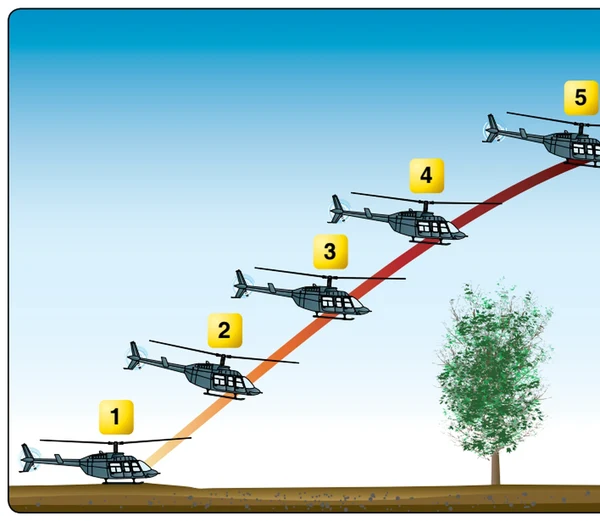
- maximum performance takeoff is used to climb at a steep angle to clear barriers in the flightpath.
- It can be used when taking off from small areas surrounded by high obstacles.
- Allow for a vertical takeoff, although not preferred, if obstruction clearance could be in doubt.
- Before attempting maximum performance takeoff, know thoroughly the capabilities and limitations of the equipment.
- Also consider the wind velocity, temperature, density altit ude, gross weight, center of gravity (CG) location, and other factors affecting pilot technique and the performa nce of the helicopter.
- To accomplish this type of takeoff safely, there must enough power to hover out of ground effect (OGE) in to prevent the helicopter from sinking back to the after becoming airborne.
- A hover power check can be determ ine if there is sufficient power available to accomplish this maneuver.
- The angle of climb for a maximum performance depends on existing conditions.
- The more critical conditions are, such as high-density altitudes, calm and high gross weights, the shallower the angle of climb light or no wind conditions, it might be necessary to in the crosshatched or shaded areas of the height/velocity diagram during the beginn ing of this maneuver.
- Therefore, be aware of the calculated risk when operating in these An engine failure at a low altitude and airspeed could the helicopter in a dangerous position, requiring a high of skill in making a safe autorotative landing.
Technique
- Before attempting a maximum performance reposition the helicopter to the most downwind area to longer takeoff climb, then bring the helicopter to a hover, determine the excess power available by noting the difference between the power available and that required to Also, perform a balance and flight control check and the position of the cyclic.
- If the takeoff path allows, the helicopter into the wind and return the helicopter surface.
- Normally, this maneuver is initiated from the After checking the area for obstacles and other aircraft, reference points along the takeoff path to maintain track.
- Also consider alternate routes in case the maneuver not possible.
- []
- Begin the takeoff by getting the helicopter light on the (position 1).
- Pause and neutralize all aircraft movement.
- Slowly increase the collective and position the be to lift off in a 40-knot attitude.
- This is approximately order the same attitude as when the helicopter is light on the surface skids.
- Continue to increase the collect ive slowly until the used to maximum power available is reached (takeoff power is normally 10 percent above power required for hover).
- This large collective movement requires a substantial increase in pedal pressure to maintain heading (position 2).
- Use the takeoff cyclic, as necessary, to control movement toward the desired the flightpath and, therefore, climb angle during the maneuver winds, (position 3).
- Maintain rotor rpm at its maxim um, and do is.
- In not allow it to decrease since you would probably need to operate lower the collective to regain it.
- Maintain these inputs until the helicopter clears the obstacle, or until reaching 50 feet for demonstration purposes (position 4).
- Then, establish a areas. normal climb attitude and power setting (position 5).
- As place in any maximum performance maneuver, the techniques degree used affect the actual results.
- Smooth, coordinated inputs coupled with precise control allow the helicopter to attain its maximum performance.
- An acceptable method when departing from an area that does takeoff, not allow for a takeoff with forward airspeed is to perform a allow a vertical takeoff.
- This technique allows the pilot to descend and vertically back into the confined area if the helicopter does not have the performance to clear the surrounding hover. obstacles.
- During this maneuver, the helicopter must climb note vertically and not be allowed to accelerate forward until the position surrounding obstacles have been cleared.
- If not, a situation to the may develop where the helicopter does not have sufficient surface. climb performance to avoid obstructions and may not have select power to descend back to the takeoff point.
- The vertical ground takeoff might not be as efficient as the climbing profile but is is much easier to abort from a vertical position directly over the landing point.
- The vertical takeoff, however, places the skids helicopter in the avoid area of the height/velocity diagram for a longer time.
- This maneuver requires hover OGE power cyclic to accomplish.
Common Errors
- 1.
- Failure to consider performance data, including heightvelocity diagram.
- 2.
- Nose too low initially causing horizontal flight rather than more vertical flight.
- 3.
- Failure to maintain maximum permissible rpm.
- 4.
- Abrupt control movements.
- 5.
- Failure to resume normal climb power and airs peed after clearing the obstacle.
Running/Rolling Takeoff
- A running takeoff in helicopter with fixed landing gear, such as skids, skis or floats, or a rolling takeoff in a wheeled helicopter is sometimes used when conditions of load and/or density altitude prevent a sust ained hover at normal hovering height.
- For wheeled helicopters, a rolling takeoff is sometimes used to minimize the downwash created during a takeoff from a hover.
- Avoid a running/ rolling maneuver if there is not sufficient power to hover, at least momentarily.
- If the helicopter cannot be hovered, its performance is unpredictable.
- If the helicopter cannot be raised off the surface at all, sufficient power might not be available to accomplish the maneuver safely.
- If a pilot cannot momentarily hover the helicopter, wait for conditions to improve or off-load some of the weight. to To accomplish a safe running or rolling takeoff, the sur face area must be of sufficient length and smoothness, and there cannot be any barriers in the flightpath to interfere with a shallow climb.
Technique
- Refer to [] .
- To begin the maneuver, first align the helicopter to the takeoff path.
- Next, increase the throttle to obtain takeoff rpm, and increase the collec tive smoothly until the helicopter becomes light on the skids or landing gear (position 1).
- If taking off from the water, ensure that the floats are mostly out of the water.
- Then, move the cyclic slightly forward of the neutral hovering position, and apply additional collective to start the forward movement (position 2).
- To simulate a reduced power condition during practice, use one to two inches less manifold pressure, or three to five percent less torque than that required to hover.
- The landing gear must stay aligned with the takeoff direction until the helicopter leaves the surface to avoid dynamic rollover.
- Maintain a straight ground track with lateral cyclic and heading with antitorque pedals until a climb is established. or As effective translational lift is gained, the helicopter becomes airborne in a fairly level attitude with little or no pitching (position 3).
- Maintain an altitude to take advant age of ground effect, and allow the airspeed to increase toward normal climb speed.
- Then, follow a climb profile that takes the helicopter through the clear area of the height-velocity is diagram (position 4).
- During practice maneuvers, after having climbed to an altitude of 50 feet, establish the normal climb power setting and attitude.
- NOTE: It should be remembered that if a running takeoff is necessary for most modern helicopters, the helicopter is very close to, or has exceeded the maximum operating weight for the conditions (i.e., temperature and altitude).
- The height/velocity parameters should be respected at all times.
- The helicopter should be flown to a suitable altitude allow a safe acceleration in accordance with the heightvelocity diagram.
Common Errors
- 1.
- Failing to align heading and ground track to keep surface friction to a minimum.
- 2.
- Attempting to become airborne before obtaining effective translational lift.
- 3.
- Using too much forward cyclic during the surface run.
- 4.
- Lowering the nose too much after becoming airb orne, resulting in the helicopter settling back to the surface.
- 5.
- Failing to remain below the recommended altitude until airspeed approaches normal climb speed.
![Running/rolling takeoff. [Figure 10-3, position 1]. After leveling off at an altitude](/graphics/helicopters/advanced-flight-maneuvers/running-rolling-takeoff-figure-10-3-position-600.webp)
![Running/rolling takeoff. [Figure 10-3, position 1]. After leveling off at an altitude](/graphics/helicopters/advanced-flight-maneuvers/running-rolling-takeoff-figure-10-3-position-400.webp)
Rapid Deceleration or Quick Stop
- This maneuver is used to decelerate from forward flight to a hover.
- It is often used to abort takeoffs, to stop if something blocks the helicopter flightpath, or simply to terminate an air taxi maneuver, as mentioned in the Aeronautical Information Manual (AIM).
- A quick stop is usually practiced on a runway, taxiway, or over a large grassy area away from other traffic obstacles.
Technique
- The maneuver requires a high degree of coordination of all controls.
- It is practiced at a height that permits a safe clearance between the tail rotor and the surface throughout the maneuver, especially at the point where the pitch attitude highest.
- The height at completion should be no higher than the maximum safe hovering height prescribed by that particular helicopter's manufacturer.
- In selecting a height at which to begin the maneuver, take into account the overall length of the helicopter and its height/velocity diagram.
- Even though the maneuver is called a rapid deceleration or quick stop, it is performed slowly and smoothly with the primary emphasis on coordination.
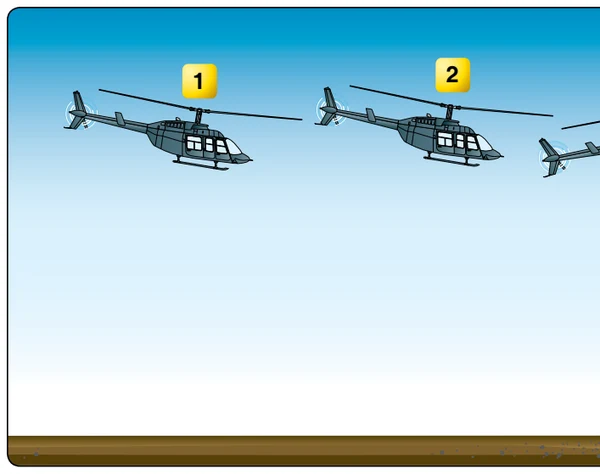
- During training, always perform this maneuver into the wind [], position 1] .
- After leveling off at an altitude between 25 and 40 feet, depending upon the manufacturer's recommendations, accelerate to the desired entry which is approximately 45 knots for most training helicopters (position 2).
- The altitude chosen should be high enough avoid danger to the tail rotor during the flare, but low to stay out of the hazardous areas of that helicopter's velocity diagram throughout the maneuver.
- In addition, altitude should be low enough that the helicopter can brought to a hover during the recovery.
- At position 3, initiate the deceleration by applying aft to reduce forward groundspeed.
- Simultaneously, lower collective, as necessary, to counteract any climbing The timing must be exact.
- If too little collective is taken for the amount of aft cyclic applied, the helicopter climbs. too much downward collective is applied, the helicopter descend.
- A rapid application of aft cyclic requires an rapid application of down collective.
- As collective is apply proper antitorque pedal pressure to maintain and adjust the throttle to maintain rpm. The G loading on rotor system depends on the pitch-up attitude.
- If the attitude too high, the rotor system may stall and cause the helicopter to impact the surface.
- After attaining the desired speed (position 4), initiate recovery by lowering the nose and allowing the helicopter to descend to a normal hovering height in level flight zero groundspeed (position 5).
- During the recovery, collective pitch, as necessary, to stop the helicopter at hovering height, adjust the throttle to maintain rpm, and proper antitorque pedal pressure, as necessary, to heading.
- During the maneuver, visualize rotating about tail rotor's horizontal axis until a normal hovering height reached.
Common Errors
- speed, 1.
- Initiating the maneuver by lowering the collective without aft cyclic pressure to maintain altitude. to 2.
- Initially applying aft cyclic stick too rapidly, causing enough the helicopter to balloon (climb). heightthis 3.
- Failing to effectively control the rate of deceleration be to accomplish the desired results.
- 4.
- Allowing the helicopter to stop forward motion in a tail-low attitude. cyclic the 5.
- Failing to maintain proper rotor rpm. tendency.
- 6.
- Waiting too long to apply collective pitch (power) out during the recovery, resulting in an overtorque If situation when collective pitch is applied rapidly. will 7.
- Failing to maintain a safe clearance over the terrain. equally lowered, 8.
- Using antitorque pedals improperly, resulting in erratic heading, heading changes. the 9.
- Using an excessively nose-high attitude. is
Steep Approach
- A steep approach is used primarily when there are obstacles in the approach path that are too high to allow a normal the approach.
- A steep approach permits entry into most confined areas and is sometimes used to avoid areas of turbulence and around a pinnacle.
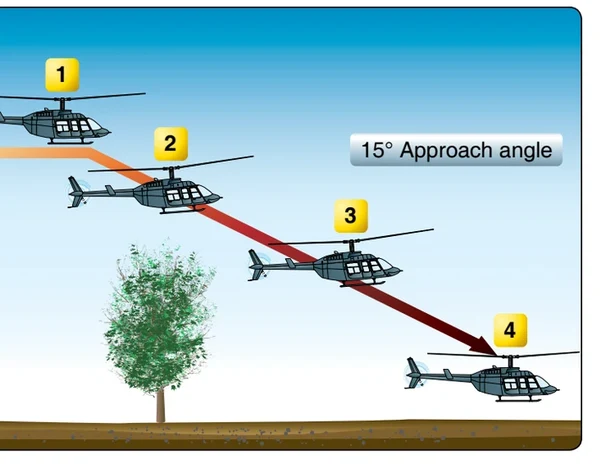
- An approach angle of approximately 13° increase to 15° is considered a steep approach.
- [] Caution normal must be exercised to avoid the parameters for vortex ring apply state (20-100 percent of available power applied, airspeed maintain of less than 10 knots, and a rate of descent greater than 300 the feet per minute (fpm)).
- For additional information on vortex is ring state (formerly referenced as settling-with-power), refer to Chapter 11, Helicopter Emergencies and Hazards. to is of as
Technique
- On final approach, maintain track with the intended touchdown point and into the wind as much as possible at the recommended approach airspeed [], position 1] .
- When intercepting an approach angle of 13° to 15°, begin the approach by lowering the collective sufficiently to start the helicopter descending down the approach path and decelerating (position 2).
- Use the proper antitorque pedal for trim.
- Since this angle is steeper than a normal approach angle, reduce the collective more than that required for a normal approach.
- Continue to decelerate with slight aft cyclic and smoothly lower the collective to maintain the approach angle.
- The intended touchdown point may not always be visible throughout the approach, especially when landing to a hover.
- Pilots must learn to cue in to other references that are parallel to the intended landing area that will help them maintain ground track and position.
- Constant management of approach angle and airspeed is essential to any approach.
- Aft cyclic is required to decelerate sooner than with a normal approach, and the rate of closure becomes apparent at a higher altitude.
- Maintain the approach angle and rate of descent with the collective, rate of closure with the cyclic, and trim with antitorque pedals.
- The helicopter should be kept in trim just prior to loss of effective translational lift (approximately 25 knots).
- Below 100 feet above ground level (AGL), the antitorque pedals should be adjusted to align the helicopter with the intended touchdown point.
- Visualize the location of the tail rotor to behind the helicopter and fly the landing gear to 3 feet above the intended landing point.
- In small confined areas, the pilot must precisely position the helicopter over the intended landing area.
- Therefore, the approach must stop at that point.
- Loss of effective translational lift occurs higher in a steep approach (position 3), requiring an increase in the collective prevent settling, and more forward cyclic to achieve the proper rate of closure.
- Once the intended landing area reached, terminate the approach to a hover with zero groundspeed (position 4).
- If the approach has been executed properly, the helicopter will come to a halt at a hover altitude 3 feet over the intended landing point with very little additional power required to hold the hover.
- The pilot must remain aware that any wind effect is lost once the aircraft has descended below the barriers surrounding a confined area, causing the aircraft to settle more quickly.
- Additional power may be needed on a strong wind condition the helicopter descends below the barriers.
Common Errors
- 1.
- Failing to maintain proper rpm during the entire approach.
- 2.
- Using collective improperly in maintaining the selected angle of descent.
- 3.
- Failing to make antitorque pedal corrections to compensate for collective pitch changes during the approach.
- 4.
- Slowing airspeed excessively in order to remain on the proper angle of descent.
- 5.
- Failing to determine when effective translat ional lift is being lost.
- 6.
- Failing to arrive at hovering height and attitude, and zero groundspeed almost simultaneously.
- 7.
- Utilizing low rpm in transition to the hover at the end of the approach.
- 8.
- Using too much aft cyclic close to the surface, which may result in the tail rotor striking the surf ace.
- 9.
- Failure to align landing gear with direction of travel no later than beginning of loss of translational lift.
Shallow Approach and Running/Roll-On Landing
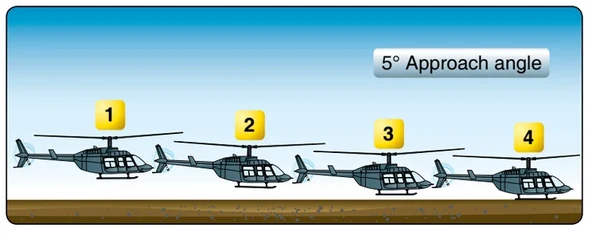
- Use a shallow approach and running landing when a high-density altitude, a high gross weight condition, or some combination thereof, is such that a normal or steep approach cannot be made because of insufficient power hover.
- [] To compensate for this lack of power, a shallow approach and running landing makes use of translational lift until surface contact is made.
- If flying a wheeled helicopter, a roll-on landing can be used to minimize the effect of downwash.
- The glide angle shallow approach is approximately 3° to 5°.
- This angle similar to the angle used on an instrument landing (ILS) approach.
- Since the helicopter is sliding or to a stop during this maneuver, the landing area be smooth, and the landing gear must be aligned with direction of travel to prevent dynamic rollover and must long enough to accomplish this task.
- After landing, that the pitch of the rotor blades is not too far aft as the rotor blades could contact the tailboom.
Technique
- A shallow approach is initiated in the same manner as normal approach except that a shallower angle of descent maintained.
- The power reduction to initiate the desired of descent is less than that for a normal approach since angle of descent is less (position 1).
- As the collective is lowered, maintain heading with antitorque pedal pressure and rpm with the throttle. approach airspeed until the apparent rate of closure to be increasing.
- Then, begin to slow the helicopter with cyclic (position 2).
- As in normal and steep approaches, the primary for the angle and rate of descent is the collective, while cyclic primarily controls the groundspeed.
- However, must be a coordination of all the cont rols for the maneuver to be accomplished successfully.
- The helicopter arrive at the point of touchdown at or slightly above translational lift.
- Since translational lift diminishes at slow airspeeds, the deceleration must be coordinated smoothly, at the same time keeping enough lift to the helicopter from settling abruptly.
- Just prior to touchdown, place the helicopter in a attitude with the cyclic, and maintain heading with antitorque pedals.
- Use the cyclic to keep the direction travel and ground track identical (position 3).
- Allow helicopter to descend gently to the surface in a straightlevel attitude, cushioning the landing with the collective.
- After surface contact, move the cyclic slightly forward ensure clearance between the tail boom and the rotor Use the cyclic to maintain the surface track (position 4).
- A pilot normally holds the collective stationary until the helicopter stops; however, to get more braking action, lower the collective slightly.
- Keep in mind that, due to the increased ground friction when the collective is lowered or if the landing is being executed to a rough or irregular surface, the helicopter may come to an abrupt stop and the nose might pitch forward.
- Exercise caution not to correct this pitching movement with aft cyclic, for a which could result in the rotor making contact with the tail is boom.
- An abrupt stop may also cause excessive transmission system movement resulting in the transmission contacting its mount. rolling During the landing, maintain normal rpm with the throttle should and directional control with the antitorque pedals. the be For wheeled helicopters, use the same technique except ensure after landing, lower the collective, neutralize the controls, main and apply the brakes, as necessary, to slow the helicopter.
- Do not use aft cyclic when bringing the helicopter to a stop.
Common Errors
- the 1.
- Assuming excessive nose-high attitude to slow the is helicopter near the surface. angle 2.
- Utilizing insufficient collective and throttle to cushion the a landing.
- 3.
- Failure to maintain heading resulting in a turning or proper pivoting motion.
- Maintain 4.
- Failure to add proper antitorque pedal as collect ive is appears added to cushion landing, resulting in a touchdown aft while the helicopter is moving sideward.
- 5.
- Failure to maintain a speed that takes advantage of effective translational lift. control the 6.
- Touching down at an excessive groundspeed for the there existing conditions. (Some helicopters have maximum touchdown groundspeeds.) should 7.
- Failure to touch down in the appropriate attitude effective necessary for a safe landing.
- Appropriate attitude is rapidly based on the type of helicopter and the landing gear installed. prevent 8.
- Failure to maintain proper rpm during and after touchdown. level 9.
- Maintaining poor alignment with direction of travel the during touchdown. of the
Slope Operations
- and- Prior to conducting any slope operations, be thoroughly familiar with the characteristics of dynamic rollover and to mast bumping, which are discussed in Chapter 11, Helicopter disk.
- Emergencies and Hazards.
- The approach to a slope is similar to the approach to any other landing area.
- During slope operations, make allowances for wind, barriers, and forced landing sites in case of engine failure.
- Since the slope may constitute an obstruction to wind passage, anticipate turbulence If and downdrafts.
Slope Landing
- A pilot usually lands a helicopter across the slope rather than with the slope.
- Landing with the helicopter facing down the slope or downhill is not recommended because of the possibility of striking the tail rotor on the surface.
Technique
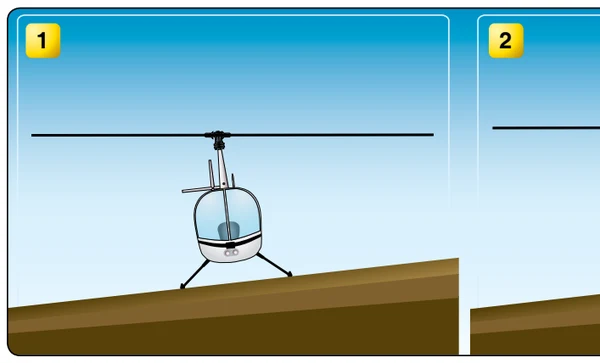
- as Refer to [] .
- At the termination of the approach, if necessary, move the helicopter slowly toward the slope, being to careful not to turn the tail upslope.
- Position the helicopter across the slope at a stabilized hover headed into the wind over the intended landing spot (frame 1).
- Downward pressure on the collective starts the helicopter descending.
- As the upslope skid touches the ground, hesitate momentarily in a level attitude, then apply slight lateral cyclic in the direction of the slope (frame 2).
- This holds the skid against the slope while the pilot continues lowering the downslope skid with the col lective.
- As the collective is lowered, continue to move the cyclic toward the slope to maintain a fixed position (frame 3) The slope must be shallow enough to hold the helicopter against it with the cyclic during the entire landing.
- A slope of 5° is recommended maximum for training in most helicopters.
- However, additional training to the manufacturer's limitations may be required.
- Consult the Rotorcraft Flight Manual (RFM) or Pilot's Operating Handbook (POH) for the specific limitations of the helicopter being flown.
- Be aware of any abnormal vibration or mast bumping that A signals maximum cyclic deflection.
- If helicopter mast moment or slope limits are reached before the helicopter is firmly on the ground, return the helicopter to a hover.
- Select a new area with a lesser degree of slope.
- In most helicopters with a counterclockwise rotor system, landings can be made on steeper slopes when holding the cyclic to the right.
- When landing on slopes using left cyclic, some cyclic input must be used to overcome the translating tendency. wind is not a factor, consider the drifting tendency when determining landing direction.
- After the downslope skid is on the surface, reduce the collective to full down, and neutralize the cyclic and pedals (frame 4).
- Normal operating rpm should be maintained until the full weight of the helicopter is on the landing gear.
- This ensures adequate rpm for immediate takeoff in case the helicopter starts sliding down the slope.
- Use antitorque pedals necessary throughout the landing for heading control.
- Before reducing the rpm, move the cyclic control as necess ary check that the helicopter is firmly on the ground.
Common Errors
- 1.
- Failing to consider wind effects during the approach and landing.
- 2.
- Failing to maintain proper rpm throughout the entire maneuver.
- 3.
- Failure to maintain heading resulting in a turning or pivoting motion.
- 4.
- Turning the tail of the helicopter into the slope.
- 5.
- Lowering the downslope skid or wheel too rapidly.
- 6.
- Applying excessive cyclic control into the slope, causing mast bumping.
Slope Takeoff
- slope takeoff is basically the reverse of a slope landi ng.
- [] Conditions that may be associated with the slope, such as turbulence and obstacles, must be considered during the takeoff.
- Planning should include suitable forced landing areas.
Technique
- Begin the takeoff by increasing rpm to the normal range the collective full down.
- Then, move the cyclic toward slope (frame 1).
- Holding the cyclic toward the direction the slope causes the downslope skid to rise as the pilot raises the collective (frame 2).
- As the skid comes up, the cyclic as necessary to maintain a level attitude in to the horizon.
- If properly coordinated, the helicopter attain a level attitude as the cyclic reaches the neutral At the same time, use antitorque pedal pressure to heading and throttle to maintain rpm. With the helicopter level and the cyclic centered, pause momentarily to everything is correct, and then gradually raise the collective to complete the liftoff (frame 3).
- After reaching a avoid hitting the ground with the tail rotor by not turning helicopter tail upslope and gaining enough altitude to the tail rotor is clear.
- If an upslope wind exists, execute crosswind takeoff and then make a turn into the wind clearing the ground with the tail rotor.
Common Errors
- 1.
- Failing to adjust cyclic control to keep the helic from sliding down slope.
- 2.
- Failing to maintain proper rpm.
- 3.
- Holding excessive cyclic into the slope as the slope skid is raised.
- 4.
- Failure to maintain heading, resulting in a turning pivoting motion.
- 5.
- Turning the tail of the helicopter into the slope takeoff.
Confined Area Operations
- A confined area is an area where the flight of the heli is limited in some direction by terrain or the presence obstructions, natural or manmade.
- For example, a in the woods, a city street, a road, a building roof, etc., each be regarded as a confined area.
- The helicopter has added responsibilities when conducting operations from a confined area that airplanes pilots do not.
- He or she assumes the additional roles of the surveyor, engineer, and with manager when selecting an area to conduct operations.
- While the airplane pilots generally operate from known pre-surveyed of and improved landing areas, helicopter pilots fly into areas slowly never used before for helicopter operations.
- Generally, move takeoffs and landings should be made into the wind to obtain relation maximum airspeed with minimum groundspeed.
- The pilot should should begin with as nearly accurate an altimeter setting as position. possible to determine the altitude. maintain There are several things to consider when operating in verify confined areas.
- One of the most important is maintaining a clearance between the rotors and obstacles forming the hover, confined area.
- The tail rotor deserves special considerat ion the because, in some helicopters, it is not always visible from ensure the cabin.
- This not only applies while making the approach, a but also while hovering.
- Another considera tion is that wires after are especially difficult to see; however, their supporting devices, such as poles or towers, serve as an indication of their presence and approximate height.
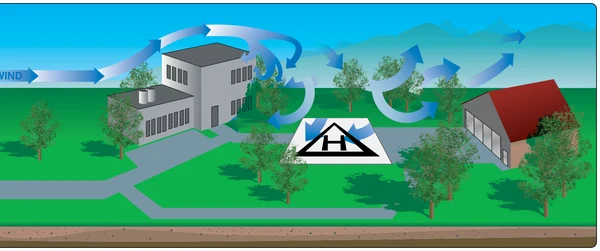
- If any wind is present, expect some turbulence.
- [] opter Something else to consider is the availability of forced landing areas during the planned approach.
- Think about the possibility of flying from one alternate landing area to down another throughout the approach, while avoiding unfavorable areas.
- Always leave a way out in case the landing cannot be or completed, or a go-around is necessary.
- During the high reconnaissance, the pilot needs to formulate during a takeoff plan as well.
- The heights of obstacles need to be determined.
- It is not good practice to land in an area and then determine that insufficient power exists to depart.
- Generally, more power is required to take off than to land copter so the takeoff criteria is most crucial.
- Fixing the departure of azimuth or heading on the compass is a good technique to clearing use.
- This ensures that the pilot is able to take off over the can preselected departure path when it is not visible while sitting pilot in the confined area.
Approach
- A high reconnaissance should be completed before ini tiating A the confined area approach.
- Start the approach phase using the wind and speed to the best possible advantage.
- Keep in mind areas suitable for forced landi ng.
- It may be necessary to choose a crosswind approach that is over an open area, then be one directly into the wind that is over trees.
- If these conditions exist, consider the possibility of making the initial phase of the approach crosswind over the open area and then turni ng into the wind for the final portion of the approach.
- If Always operate the helicopter as close to its normal capabilities as possible, taking into consideration the situation at hand.
- In all confined area operations, with the exception of a pinnacle operation (see next section, Takeoff), the angle of descent should be no steeper than necessary to clear any barrier with be the tail rotor in the approach path and still land on the selected spot.
- The angle of climb on takeoff should be normal, or not steeper than necessary to clear any barr ier.
- Clearing a barrier by a few feet and maintaining normal operating rpm, with perhaps a reserve of power, is better than clearing a barrier by a wide marg in but with a dangerously low rpm and no power reserve.
- Always make the landing to a specific point and not to some general area.
- This point should be located well forward, away from the approach end of the area.
- The more confined the area is, the more essential it is that the helicopter land precisely at a definite point.
- Keep this point in sight during the entire final approach.
- When flying a helicopter near obstacles, always consider the tail rotor.
- A safe angle of descent over barr iers must be established to ensure tail rotor clearance of all obstructions.
- After coming to a hover, avoid turning the tail into obstructions.
Takeoff
- confined area takeoff is considered an altitude over airspeed maneuver where altitude gain is more important to airspeed gain.
- Before takeoff, make a reconnaissance from the ground or cockpit to determine the type of takeoff to performed, to determine the point from which the takeoff should be initiated to ensure the maximum amount of available area, and finally, how to maneuver the helicopter best from the landing point to the proposed takeo ff position. wind conditions and available area permit, the helicopter should be brought to a hover, turned around, and hovered forward from the landing position to the takeo ff position.
- Under certain conditions, sideward flight to the takeoff position may be preferred, but rearward flight may necessary, stopping often while moving to check on the location of obstacles relative to the tail rotor.
- When planning the takeoff, consider the direction of the wind, obstructions, and forced landing areas.
- To help fly up and over an obstacle, form an imaginary line from a point on the leading edge of the helicopter to the highest obstacle to be cleared.
- Fly this line of ascent with enough power to clear the obstacle by a safe distance.
- After clearing the obstacle, maintain the power setting and accelerate to the normal climb speed.
- Then, reduce power to the normal climb power setting.
Common Errors
- 1.
- Failure to perform, or improper performance of, a high or low reconnaissance.
- 2.
- Approach angle that is too steep or too shal low for the existing conditions.
- 3.
- Failing to maintain proper rpm.
- 4.
- Failure to consider emergency landing areas.
- 5.
- Failure to select a specific landing spot.
- 6.
- Failure to consider how wind and turbulence affect the approach.
- 7.
- Improper takeoff and climb technique for exist conditions.
- 8.
- Failure to maintain safe clearance distance obstructions.
Pinnacle and Ridgeline Operations
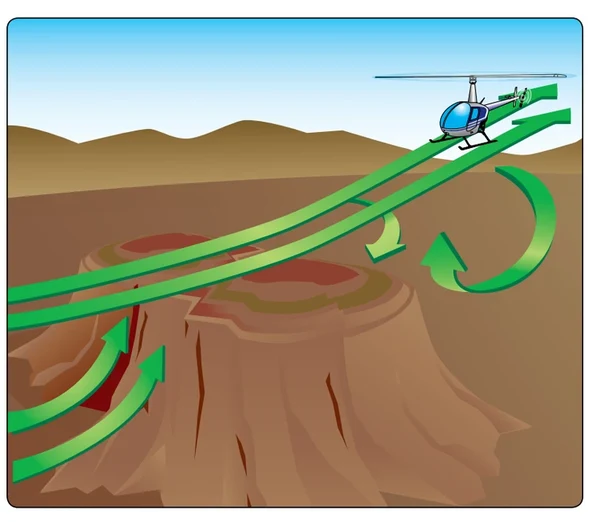
- A pinnacle is an area from which the surface drops steeply on all sides.
- A ridgeline is a long area where the surface drops away steeply on one or two sides, such as a bluff or precipice.
- The absence of obstacles does not necessarily decrease the difficulty of pinnacle or ridgeline operations.
- Updrafts, downdrafts, and turbulence, with unsuitable terrain in which to make a forced may still present extreme hazards.
Approach and Landing
- If there is a need to climb to a pinnacle or ridgeline, do the upwind side, when practicable, to take advantage of updrafts.
- The approach flightpath should be parall el to ridgeline and into the wind as much as possi ble.
- [Figure Load, altitude, wind conditions, and terrain determine the angle to use in the final part of an approach.
- As a general rule, the greater the winds are, the steeper approach needs to be to avoid turbulent air and downdrafts.
- Groundspeed during a pinnacle approach is more difficult to judge because visual references are farther away than during approaches over trees or flat terrain.
- Pilots must continually perceive the apparent rate of closure by observing changes in the apparent size of landing-zone features.
- Avoid the misperception of an increasing rate of closure to the landing ing site.
- The apparent rate of closure should be that of a brisk walk.
- If a crosswind exists, remain clear of down-drafts on from the leeward or downwind side of the ridgeline.
- If the wind velocity makes the crosswind landing hazardous, it may be possible to make a low, coordinated turn into the wind just prior to terminating the approach.
- When making an approach away to a pinnacle, avoid leeward turbulence and keep the helicopter which within reach of a forced landing area as long as possible. such not On landing, take advantage of the long axis of the area when ridgeline wind conditions permit.
- Touchdown should be made in the together forward portion of the area.
- When approaching to land on landing, pinnacles, especially manmade areas such as rooftop pads, the pilot should determine the personnel access pathway to the helipad and ensure that the tail rotor is not allowed to intrude into that walkway or zone.
- Parking or landing with the it on tail rotor off the platform ensures personnel safety.
- Always any per form a stability check prior to reducing rpm to ensure the the landing gear is on firm terrain that can safely support 10-9] the weight of the helicopter.
- Accomplish this by slowly moving the cyclic and pedals while lowering the collective. features If movement is detected, reposition the aircraft. the
Takeoff
- A pinnacle takeoff is considered an airspeed over altitude maneuver which can be made from the ground or from a hover.
- Since pinnacles and ridgelines are generally higher than the immediate surrounding terrain, gaining airspeed on the takeoff is more important than gaining altitude.
- As airspeed increases, the departure from the pinnacle becomes more rapid, and helicopter time in the avoid area of the height/velocity area decreases.
- [Figure 11-3] In addition to covering unfavor able terrain rapidly, a higher airspeed affords a more favorable glide angle and thus contributes to the chances of reaching a safe area in the event of a forced landing.
- If a suitable forced landing area is not availa ble, a higher airspeed also permits a more effective flare prior to making an autorotative landing.
- On takeoff, as the helicopter moves out of ground effect, maintain altitude and accelerate to normal climb airspeed.
- When normal climb speed is attained, estab lish a normal climb attitude.
- Never dive the helicopter down the slope after clearing the pinnacle.
Common Errors
- 1.
- Failing to perform, or improper performance of, a high or low reconnaissance.
- 2.
- Flying the approach angle too steep or too shal low for the existing conditions.
- 3.
- Failing to maintain proper rpm.
- 4.
- Failing to consider emergency landing areas.
- 5.
- Failing to consider how wind and turbulence could affect the approach and takeoff.
- 6.
- Failure to maintain pinnacle elevation after takeoff.
- 7.
- Failure to maintain proper approach rate of closure.
- 8.
- Failure to achieve climb airspeed in timely manner.
Chapter Summary
- This chapter described advanced flight maneuvers such as slope landings, confined area landings, and running takeoffs.
- The correlation between helicopter performance requirements, the environmental factors associated with different flight techniques, and safety considerations were also explained to familiarize the pilot with the measures that can be taken when performing these maneuvers to mitigate risks.
- Hazards associated with helicopter flight and certain aerodynamic considerations were also discussed.
- []