Effective Aeronautical Decision Making
Learn effective aeronautical decision-making for helicopter operations, including the procedures, techniques, hazards, and decision-making guidance presented in the FAA Helicopter Flying Handbook.
Introduction
- The accident rate for helicopters has traditionally been than the accident rate of fixed-wing aircraft, probably the helicopter's unique capabilities to fly and land in diverse situations than fixed-wing aircraft and pilot to fly the helicopter beyond the limits of his or her abilities beyond the capabilities of the helicopter.
- With no significant improvement in helicopter accident rates for the last 20 the Federal Aviation Administration (FAA) has joined various members of the helicopter community to the safety of helicopter operations.
- According to National Transportation Safety Board (NTSB) statistics, approximately 80 percent of all aviation accidents are caused by pilot error, the human factor.
- Many these accidents are the result of the failure of instructors to incorporate single-pilot resource management (SRM) and risk management into flight training instruction aeronautical decision-making (ADM).
- SRM is defined as the art of managing all the resources on board the aircraft and from outside sources) available pilot prior to and during flight to ensure a successful When properly applied, SRM is a key component of Additional discussion includes integral topics such as, concepts of risk management, workload or task management, situational awareness, controlled flight into terrain awareness, and automation management. higher due to more attempts or years, with improve (NTSB) of (SRM) of (both to a flight.
- ADM. the (CFIT)
- ADM is all about learning how to gather information, analyze it, and make decisions.
- It helps the pilot accurately assess of and manage risk and make accurate and timely decisions.
- Although the flight is coordinated by a single person, the use of available resources, such as air traffic control (ATC) and flight service stations (FSS)/automated flight service stations (AFSS), replicates the principles of crew resource management (CRM) (see page 14-7).
- References on SRM and ADM include: to • FAA-H-8083-2, Risk Management Handbook. of • Aeronautical Information Manual (AIM).
- • Advisory Circular (AC) 60-22, Aeronautical Decision Making, which provides background information about ADM training in the general aviation (GA) environment.
- • FAA-H-8083-25, Pilot's Handbook of Aeronautical Knowledge.
- Reinforce your understanding of Effective Aeronautical Decision Making by reviewing the key concepts on this page before moving on.
Aeronautical Decision-Making (ADM)
- Making good choices sounds easy enough.
- However, A there are a multitude of factors that come into play when of these choices, and subsequent decisions, are made in the at aeronautical world.
- Many tools are available for pilots to become more self-aware and assess the options available, along with the impact of their decision.
- Yet, with all the available resources, accident rates are not being reduced.
- Poor to decisions continue to be made, frequently resulting in lives being lost and/or aircraft damaged or destroyed.
- The Risk Management Handbook discusses ADM and SRM in detail and should be thoroughly read and understood.
e a k e s e
- While progress is continually being made in the advancement pilot training methods, aircraft equipment and systems, and services for pilots, accidents still occur.
- Historically, the term "pilot error" has been used to describe the causes of these accidents.
- Pilot error means an action or decision made by the pilot was the cause of, or a contributing factor that led to, the accident.
- This definition also includes the pilot's failure to make a decision or take action.
- From a broader perspective, the phrase "human factors related" more aptly describes these accidents since it is usually not a single decision that leads an accident, but a chain of events triggered by a number factors.
- []
- The poor judgment chain, sometimes referred to as the "error chain," is a term used to describe this concept of contributing factors in a human factors related accident.
- Breaking one link in the chain is often the only event necessary to change the outcome of the sequence of events.
- The following is an example of the type of scenario illustrating the poor judgment chain.
Scenario
- Helicopter Air Ambulance (HAA) pilot is nearing the end his shift when he receives a request for a patient pickup a roadside vehicle accident.
- The pilot has started to feel the onset of a cold; his thoughts are on getting home and getting a good night's sleep.
- After receiving the request, the pilot checks the accident location and required flightpath determine if he has time to complete the flight to the scene, then on to the hospital before his shift expires.
- The pilot checks the weather and determines that, although thunderstorms are approaching, the flight can be completed prior to their arrival.
ac a
- The pilot and on-board medical crews depart the location and arrive overhead, at the scene of the accident.
- The pilot is not comfortable with the landing area due to tall trees in all quadrants of the area.
- The pilot searches for a secondary landing area. to find one nearby, the pilot then returns to the initial area and decides he can make it work.
- After successfully landing the aircraft, he is told that will be a delay before the patient is loaded because more is needed to extricate the patient from the wreckage. his shift is nearly over, the pilot begins to feel pressured "hurry up" or he will require an extension for his duty After 30 minutes, the patient is loaded, and the pilot everyone is secure.
- He notes that the storm is now nearby that winds have picked up considerably.
- The pilot thinks, turning back now, the patient is on board and I'm running of time." The pilot knows he must take off almost to clear the obstacles and chooses his departure path on the observed wind during landing.
- Moments later, prior clearing the obstacles, the aircraft begins an uncontrollable spin and augers back to the ground, seriously injuring board and destroying the aircraft.
- What could the pilot have done differently to break error chain?
- More important - what would you have differently?
- By discussing the events that led to this you should develop an understanding of how a series judgmental errors contributed to the final outcome of this For example, the pilot's decision to fly the aircraft that the effects of an illness were present was the contributing factor.
- The pilot was aware of his illness, was he aware of the impact of the symptoms - fatigue, general uneasy feeling due to a slight fever, perhaps?
- Next, knowing the shift was about to end, the pilot based time required to complete the flight on ideal conditions, did not take into consideration the possibility of delays. led to a feeling of being time limited.
- Even after determining the landing area was unsuitable, pilot forced the landing due to time constraints.
- At any during this sequence, the pilot could have aborted the rather than risk crew lives.
- Instead, the pilot became by a determination to continue.
- After landing, and waiting 30 minutes longer than the pilot observed the outer effects of the thunderstorm, still attempted to depart.
- The pilot dispelled any options by thinking the only option was to go however, it would have been safer to discontinue the home Using the same departure path selected under different wind vehicular conditions, the pilot took off and encountered winds that selected led to loss of aircraft control.
- Once again faced with a selfconfined imposed time constraint, the pilot improperly chose to depart Unable the confined area.
- The end result: instead of one patient to landing transport by ground (had the pilot aborted the flight at any point), there were four patients to be transported. there On numerous occasions leading to and during the flight, the time pilot could have made effective decisions that could have Knowing prevented this accident.
- However, as the chain of events to unfolded, each poor decision left him with fewer options. day.
- Making sound decisions is the key to preventing accidents.
- Traditional pilot training emphasizes flying skills, knowledge ensures of the aircraft, and familiarity with regulations.
- SRM and and ADM training focus on the decision-making process and on "No the factors that affect a pilot's ability to make effective choices. out vertically
Trescott Tips
- based Max Trescott, Master Certificated Flight Instructor (CFI) to and Master Ground Instructor and winner of the 2008 CFI of the year, has published numerous safety tips that every pilot all on should heed.
- He believes that the word "probably" should be purged from our flying vocabulary.
- Mr.
- Trescott contends that "probably" means we've done an informal assessment this of the likelihood of an event occurring and have assigned a done probability to it.
- He believes the term implies that we believe accident, things are likely to work out, but there's some reasonable of doubt in our mind.
- He further explains that if you ever think flight. that your course of action will "probably work out," you need to choose a new option that you know will work out. knowing initial Another safety tip details the importance of accumulating but, flight hours in one specific airframe type.
- He explains that "statistics have shown that accidents are correlated more with the number of hours of experience a pilot has in a particular aircraft model and not with his or her total number of flight his hours.
- Accidents tend to decrease after a pilot accumulates and at least 100 hours of experience in the aircraft he or she is This flying.
- Thus, when learning to fly, or when transitioning into a new model, your goal should be to concentrate your flying hours in that model." He suggests waiting until you reach 100 the hours of experience in one particular model before attempting time a dual rating with another model.
- In addition, if you only fly flight a few hours per year, maximize your safety by concentrating blinded those hours in just one aircraft model.
- The third safety tip that is well worth mentioning is what planned, Mr.
- Trescott calls "building experience from the armchair." yet Armchair flying is simply closing your eyes and mentally available practicing exactly what you do in the aircraft.
- This is an forward; excellent way to practice making radio calls, departures, flight. approaches and even visualizing the parts and pieces of the aircraft.
- This type of flying does not cost a dime and will make you a better prepared and more proficient pilot.
- All three of Max Trescott's safety tips incorporate the ADM process and emphasize the importance of how safety and good decision-making is essential to aviation.
- At
The Decision-Making Process
- An understanding of the decision-making process provides a pilot with a foundation for developing ADM skills.
- Some situations, such as engine failures, require a pilot to respond immediately using established procedures with little time for detailed analysis.
- Called automatic decision-making, it is based upon training, experience, and recognition.
- Traditionally, pilots have been well trained to react to emergencies, but are not as well prepared to make decisions that require a more reflective response when greater analysis up is necessary.
- They often overlook the phase of decisionmaking that is accomplished on the ground: the preflight, flight planning, performance planning, weather briefing, and weight/center of gravity configurations.
- Thorough and proper completion of these tasks provides increased awareness and a base of knowledge available to the pilot prior to departure and once airborne.
- Typically during a flight, a pilot has time to examine any changes that occur, gather information, and assess risk before reaching a decision.
- The steps leading to this conclusion constitute the decision-making process.
- Defining the problem is the first step in the decision-making process and begins with recognizing that a change has occurred or that an expected change did not occur.
- A problem is perceived first by the senses, then is distinguished through insight (self-awareness) and experience.
- Insight, experience, and objective analysis of all available information are used to determine the exact nature and severity of the problem.
- One critical error that can be made during the decision-making process is incorrectly defining the problem.
- While going through the following example, keep in mind what errors lead up to the event.
- What planning could have been completed prior to departing that may have led to avoiding It this situation?
- What instruction could the pilot have had during training that may have better prepared the pilot for this scenario?
- Could the pilot have assessed potential problems based on what the aircraft "felt like" at a hover?
- All these factors go into recognizing a change and the timely response.
- While doing a hover check after picking up firefighters at the bottom of a canyon, a pilot realized that she was only 20 pounds under maximum gross weight.
- What she failed to realize was that the firefighters had stowed some of their heaviest gear in the baggage compartment, which shifted the center of gravity (CG) slightly behind the aft limits.
- Since weight and balance had never created any problems for her in the past, she did not bother to calculate CG and power required.
- She did try to estimate it by remembering the figures from earlier in the morning at the base camp. a 5,000-foot density altitude (DA) and maximum gross weight, the performance charts indicated the helicopter had plenty of excess power.
- Unfortunately, the temperature was 93 °F and the pressure altitude at the pickup point was 6,200 feet (DA = 9,600 feet).
- Since there was enough power for the hover check, the pilot decided there was sufficient power to takeoff.
- Even though the helicopter accelerated slowly during the takeoff, the distance between the helicopter and the ground continued to increase.
- However, when the pilot attempted to establish the best rate of climb speed, the nose tended to pitch to a higher-than-normal attitude, and the pilot noticed that the helicopter was not gaining enough altitude in relation to the canyon wall approximately 200 yards ahead.
- After the problem has been identified, a pilot must evaluate the need to react to it and determine the actions to take to resolve the situation in the time available.
- The expected outcome of each possible action should be considered and the risks assessed before a pilot decides on a response to the situation.
- The pilot's first thought was to pull up on the collective and pull back on the cyclic.
- After weighing the consequences of possibly losing rotor revolutions per minute (rpm) and not being able to maintain the climb rate sufficiently to clear the canyon wall, which was then only a hundred yards away, she realized the only course was to try to turn back to the landing zone on the canyon floor.
- Although a decision may be reached and a course of action implemented, the decision-making process is not complete. is important to think ahead and determine how the decision could affect other phases of the flight.
- As the flight progresses, a pilot must continue to evaluate the outcome of the decision to ensure that it is producing the desired result.
- As the pilot made the turn to the downwind, the airspeed dropped nearly to zero, and the helicopter became very difficult to control. (At this point, the pilot must increase airspeed in order to maintain translational lift.) Since the CG was aft of limits, she needed to apply more forward cyclic than usual.
- As she approached the landing zone with a high rate of descent, she realized that she would be in a potential vortex ring state situation if she tried trade airspeed for altitude and lost effective translational lift (ETL).
- Therefore, it did not appear that she would able to terminate the approach in a hover.
- The pilot to make the shallowest approach possible and perform run-on landing.
- Pilots sometimes have trouble not because of deficient skills or system knowledge, but because of faulty making skills.
- Although aeronautical decisions may to be simple or routine, each individual decision in often defines the options available for the next decision pilot must make, and the options (good or bad) it provides.
- Therefore, a poor decision early in a flight can compromise the safety of the flight at a later time.
- It is important to appropriate and decisive choices because good making early in an emergency provide greater latitude later options. to
Decision-Making Models
- The decision-making process normally consists of several be steps before a pilot chooses a course of action.
- A variety decided of structured frameworks for decision-making provide a assistance in organizing the decision process.
- These models include but are not limited to the 5P (Plan, Plane, Pilot, Passengers, Programming), the OODA Loop (Observation, basic Orientation, Decision, Action), and the DECIDE (Detect, decision- Estimate, Choose, Identify, Do, and Evaluate) models. appear [] All these models and their variations are aviation discussed in detail in the Pilot's Handbook of Aeronautical the Knowledge section covering aeronautical decision-making.
- Whichever model is used, the pilot learns how to define the problem, choose a course of action, implement the make decision, and evaluate the outcome.
- Remember, there is decisionno one right answer in this process: a pilot analyzes the for situation in light of experience level, personal minimums, and current physical and mental readiness levels, and then makes a decision.
Pilot Self-Assessment
- The pilot in command (PIC) of an aircraft is directly of responsible for and is the final authority for the operation of that aircraft.
- The list of PIC responsibilities is long, and nothing should be overlooked.
- To exercise those responsibilities effectively and make effective decisions regarding the outcome of a flight, a pilot must have an understanding of personal limitations.
- Pilot performance from planning the flight to execution of the flight is affected by many factors, such as health, experience, knowledge, skill level, and attitude.
- Exercising good judgment begins prior to taking the controls of an aircraft.
- Often, pilots thoroughly check their aircraft to determine airworthiness, yet do not evaluate their own fitness for flight.
- Just as a checklist is used when preflighting an aircraft, a personal checklist based on such factors as as experience, currency, and comfort level can help determine if a pilot is prepared for a particular flight.
- Specifying when to refresher training should be accomplished and designating weather minimums, which may be higher than those listed in Title 14 of the Code of Federal Regulations (14 CFR) part 91, are elements that may be included on a personal checklist.
- Over confidence can kill just as fast as inexperience.
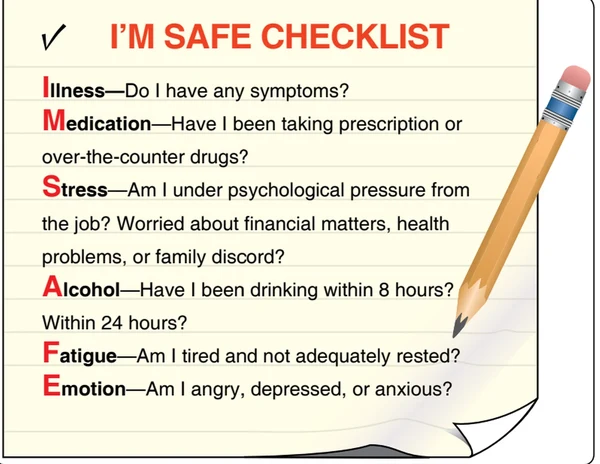
- In addition to a I review of personal limitations, a pilot should use the I'M SAFE checklist to further evaluate fitness for flight.
- []
Curiosity: Healthy or Harmful?
- The roots of aviation are firmly based on curiosity.
- Where would we be today had it not been for the dreams of Leonardo da Vinci, the Wright Brothers, and Igor Sikorsky?
- They all were infatuated with flight, a curiosity that led to the origins of aviation.
- The tale of aviation is full of firsts: first flight, first helicopter, first trans-Atlantic flight, and so on.
- But, along the way there were many setbacks, fatalities, and lessons learned.
- Today, we continue to learn and investigate the limits aviation.
- We've been to the moon, and soon beyond.
- Our curiosity will continue to drive us to search for the next challenge.
- However, curiosity can also have catastrophic consequences.
- Despite over 100 years of aviation practice, we still see accidents that are caused by impaired judgment formed from curious behavior.
- Pilots commonly seek to determine the limits of their ability as well as the limits of the aircraft.
- Unfortunately, too often this leads to mishaps with deadly results.
- Inquisitive behavior must be harnessed and displayed within personal and material limits.
- Deadly curiosity may not seem as obvious to some as it is to others.
- Simple thoughts such as, "Is visibility really as bad what the ATIS is reporting?" or "Will the 20-minute fuel light really indicate only 20 minutes worth of fuel?" can lead poor decisions and disastrous outcomes.
- Some aviators blatantly violate rules and aircraft limitations without thinking through the consequences.
- "What indications and change in flight characteristics will I see if fly this helicopter above its maximum gross weight?" or "I've heard this helicopter can do aerobatic flight.
- Why is it prohibited?" are examples of extremely harmful curiosity.
- Even more astounding is their ignoring to the fact that the damage potentially done to the aircraft will probably manifest later in the aircraft's life, affecting other crews.
- Spontaneous excursions in aviation can be deadly.
- Curiosity is natural and promotes learning.
- Airmen should abide by established procedures until proper and complete hazard assessment and risk management can be completed.
The PAVE Checklist
- As found in the Pilot's Handbook of Aeronautical Knowledge, the FAA has designed a personal minimums checklist.
- To help pilots with self-assessment, which in turn helps mitigate risk, the acronym PAVE divides the risks of flight into four categories.
- For each category, think of the applicability specific to helicopter operations:
- • Pilot (pilot in command)
- - Physical, emotional readiness.
- - Flight experience, recency, currency, total time in type.
- • Aircraft - Is the helicopter capable of performing the task?
- - Can it carry the necessary fuel?
- - Does it provide adequate power margins for task to be accomplished?
- - Can it carry the weight and remain within - Will there be external loads?
- • Environment - Helicopters are susceptible to the impact changing weather conditions.
- - How will the change in moderating temperatures and DA affect performance?
- - Will controllability be jeopardized by terrain, and turbulence?
- • External pressures - Do not let the notion to accomplish "the override good judgment and safety.
- - Many jobs include time lines.
- How often do hear "time is money" or "time is wasting"? sacrifice safety for an implied or actual need meet the deadline!
- - Do not allow yourself to feel pressured coworkers, family events, or friends.
- Incorporated into preflight planning, the PAVE provides the pilot with a simple way to remember category to examine for risk prior to each flight.
- Once pilot identifies the risks of a flight, he or she needs to whether the risk or combination of risks can be safely and successfully.
- Remember, the PIC is responsible for deciding about canceling the flight.
- If the pilot decides continue with the flight, he or she should develop to mitigate the risks.
- One way to control risk is by setting personal minimums for items in each risk category.
- Remember, these are unique to an individual pilot's current level of experience proficiency.
- They should be reevaluated periodically upon experience and proficiency.
Single-Pilot Resource Management
- Many of the concepts utilized in CRM have been successfully applied to single-pilot operations which led to the development of SRM.
- Defined as the art and science of managing all resources (both on board the aircraft and from resources) available to a single pilot (prior to and flight), SRM helps to ensure the successful outcome of flight.
- As mentioned earlier, this includes risk management, situational awareness (SA), and CFIT awareness.
- SRM training helps the pilot maintain SA by managing automation, associated control, and navigation tasks. the enables the pilot to accurately assess hazards, manage resulting risk potential, and make good decisions.
- CG?
- To make informed decisions during flight operations, a pilot must be aware of the resources found both inside and outside the cockpit.
- Since useful tools and sources of information may not always be readily apparent, learning to recognize of these resources is an essential part of SRM training.
- The pilot must not only identify the available resources, but he or she must also assess whether sufficient time is available to use a particular one, and the impact its use will have upon the safety of the flight. winds, If a pilot is flying alone into a confined area with no wind sock or access to a current wind report, should that pilot pick mission" an approach path based on the direction of wind information received from an earlier weather brief?
- Making an approach into a confined area with a tailwind is a bad decision and can we be avoided.
- Prior to landing, the pilot should use outside Don't resources such a smoke, trees, and water on a pond to help to him or her accurately determine which direction the winds are coming from.
- Pilots should never leave flying up to chance by and hope for the best.
- Many accidents could and should be avoided by simply using the resources, internal and external that are available. checklist each Internal resources are found in the cockpit during flight.
- Since the some of the most valuable internal resources are ingenuity, decide knowledge, and skill, a pilot can expand cockpit resources managed immensely by improving these capabilities.
- This can be accomplished by frequently reviewing flight information to publications, such as 14 CFR and the AIM, as well as by strategies pursuing additional training.
- No other internal resource is more important than the pilot's own ability to control the situation, thereby controlling the limits aircraft.
- Helicopter pilots quickly learn that it is not possible and to hover, single pilot, and pick up the checklist, a chart, or based publication without endangering themselves, the aircraft, or those nearby.
- Checklists are essential cockpit resources used to verify the aircraft instruments and systems are checked, set, and operating properly.
- They also ensure proper procedures the are performed if there is a system malfunction or inflight outside emergency.
- Pilots at all levels of experience refer to during checklists.
- The more advanced the aircraft is, the more crucial the checklists are.
- Therefore, have a plan on how to use the checklist (and other necessary publications) before you begin the flight.
- Always control the helicopter first.
- When hovering in an airport This environment, the pilot can always land the aircraft to access the checklist or a publication, or have a passenger assist with holding items.
- There is nothing more unsettling than being in flight and not having a well thought-out plan for managing the necessary documents and data.
- This lack of planning often leads to confusion, distractions and aircraft mishaps.
- Another way to avoid a potentially complex and confusing is situation is to remove yourself from the situation.
- The following is an example of how proper resource management and removal from a situation are vital to safe flight.
- A single pilot is conducting a helicopter cross-country flight.
- He frequently goes to and is familiar with the final destination airport.
- Weather is briefed to be well above the minimum weather needed, but with isolated thunderstorms possible.
- For the pilot, this is a routine run-of-the-mill flight.
- He has done this many times before and has memorized the route, checkpoints, frequencies, fuel required and knows exactly what to expect.
- However, once within 30 miles of the destination airport the pilot observes that weather is deteriorating, and a thunderstorm is nearby.
- The pilot assesses the situation and determines the best course of action is to reroute to another airport.
- The closest airport is an airport within Class C airspace.
- At this point, the pilot realizes the publications with the required alternate airport information are in the back of the helicopter out of reach.
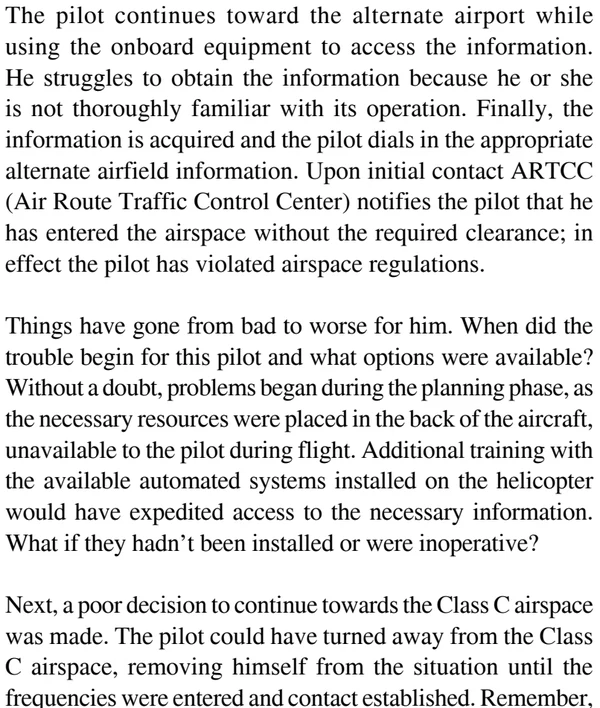
- Now what? if The pilot continues toward the alternate airport while using the onboard equipment to access the information.
- He struggles to obtain the information because he or she to is not thoroughly familiar with its operation.
- Finally, the information is acquired and the pilot dials in the appropriate alternate airfield information.
- Upon initial contact ARTCC (Air Route Traffic Control Center) or (Air Route Traffic Control Center) notifies the pilot that he a has entered the airspace without the required clearance; in effect the pilot has violated airspace regulations.
- Things have gone from bad to worse for him.
- When did the trouble begin for this pilot and what options were available?
- Without a doubt, problems began during the planning phase, as the necessary resources were placed in the back of the aircraft, unavailable to the pilot during flight.
- Additional training with the available automated systems installed on the helicopter would have expedited access to the necessary information.
- What if they hadn't been installed or were inoperative?
- Next, a poor decision to continue towards the Class C airspace was made.
- The pilot could have turned away from the Class C airspace, removing himself from the situation until the frequencies were entered and contact established.
- Remember, when possible, choose an option that gives more time to determine a course of action.
- Proper resource management could have negated this airspace violation.
- The example also demonstrates the need to have a thorough understanding of all the equipment and systems in the aircraft.
- As is often the case, the technology available today seldom used to its maximum capability.
- It is necessary to become as familiar as possible with this equipment to utilize all resources fully.
- For example, advanced navigation and autopilot systems are valuable resources.
- However, if pilots do not fully understand how to use this equipment, or they rely on it so much they become complacent, the equipment can become a detriment to safe flight.
- Another internal resource is the Rotorcraft Flight Manual (RFM).
- [] The RFM:
- • Must be on board the aircraft.
- • Is indispensable for accurate flight planning.
- • Plays a vital role in the resolution of inflight equipment malfunctions.
- Other valuable flight deck resources include current aeronautical charts and publications, such as the Airport/ Facility Directory (A/FD).
- As stated previously, passengers can also be a valuable resource.
- Passengers can help watch for traffic and may be able to provide information in an irregular situation, especially they are familiar with flying.
- Crew briefs to passengers should always include some basic helicopter terminology.
- For example, explain that in the event you ask them if you are clear hover to the right, their response should be either "yes, you are clear to hover to the right" or "no you are not clear." A simple yes or no answer can be ambiguous.
- A strange smell sound may alert a passenger to a potential problem.
- As PIC, pilot should brief passengers before the flight to make sure that they are comfortable voicing any concerns.
- Instruction that integrates Single-Pilot Resource Management into flight training teaches aspiring pilots how to be aware of potential risks in flying, how to identify risks clearly, and how to manage them successfully. importance of integrating available resources and effective SRM skills cannot be overemphasized. safety issues can have fatal results.
Risk Management
- Risk management is a formalized way of dealing hazards.
- It is the logical process of weighing the cost of risks from hazards against the possible benefits allowing those risks from hazards to stand unmitigated. is a decision-making process designed to identify systematically, assess the degree of risk, and determine best course of action.
- Once risks are identified, they must assessed.
- The risk assessment determines the degree of (negligible, low, medium, or high) and whether the of risk is worth the outcome of the planned activity. degree of risk is "acceptable," the planned activity then be undertaken.
- Once the planned activity is consideration must then be given whether to continue. must have preplanned, viable alternatives available in event the original flight cannot be accomplished as Two defining elements of risk management are hazard and • A hazard is a present condition, event, object, circumstance that could lead to or contribute unplanned or undesired event, such as an It is a source of danger.
- For example, binding antitorque pedals represents a hazard.
- • Risk is the future impact of a hazard that is controlled or eliminated.
- It is the possibility of loss or injury.
- The level of risk is measured by the number more of people or resources affected (exposure), the extent those of possible loss (severity), and the likelihood of The loss (probability). learning Ignoring A hazard can be a real or perceived condition, event, or circumstance that a pilot encounters.
- Learning how to identify hazards, assess the degree of risk they pose, and determine the best course of action is an important element of a safe flight. with
Four Risk Elements
- potential During each flight, decisions must be made regarding events of that involve interactions between the four risk elements - the It PIC, the aircraft, the environment, and the operation.
- The hazards decision-making process involves an evaluation of each of the these risk elements to achieve an accurate perception of the be flight situation.
- [] risk degree One of the most important decisions that a PIC must make is If the the go/no-go decision.
- Evaluating each of these risk elements may can help a pilot decide whether a flight should be conducted started, or continued.
- In the following situations, the four risk Pilots elements and how they affect decision-making are evaluated. the planned.
- Pilot - A pilot must continually make decisions about personal competency, condition of health, mental and risk. emotional state, level of fatigue, and many other variables. or A situation to consider: a pilot is called early in the morning to an to make a long flight.
- With only a few hours of sleep and accident. congestion that indicates the possible onset of a cold, is in the that pilot safe to fly? not Aircraft - A pilot frequently bases decisions to fly on personal evaluations of the aircraft, such as its powerplant, performance, equipment, fuel state, or airworthiness.
- A situation to consider: en route to an oil rig an hour's flight from shore, having just passed the shoreline, the pilot notices the oil temperature at the high end of the caution range.
- Should the pilot continue out to sea or return to the nearest suitable heliport/airport?
- Environment - This encompasses many elements unrelated to the pilot or aircraft.
- It can include such factors as weather, ATC, navigational aids (NAVAID), terrain, takeoff and landing areas, and surrounding obstacles.
- Weather is one element that can change drastically over time and distance.
- A situation to consider: a pilot is ferrying a helicopter crosscountry and encounters unexpected low clouds and rain in an in area of rising terrain.
- Does the pilot try to stay under them and scud run, or turn around, stay in the clear, and obtain current weather information?
- External Pressures - The interaction between the pilot, the aircraft, and the environment is greatly influenced by of the purpose of each flight operation.
- A pilot must evaluate the three previous areas to decide on the desirability of undertaking or continuing the flight as planned.
- It is worth asking why the flight is being made, how critical it is to maintain the schedule, and if the trip is worth the risks.
- A situation to consider: a pilot is tasked to take some technicians a into rugged mountains for a routine survey in marginal weather.
- Would it be preferable to wait for better conditions to ensure a safe flight?
- How would the priorities change if a pilot were tasked to search for cross-country skiers who had become lost in deep snow and radioed for help?
Assessing Risk
- a It is important for a pilot to learn how to assess risk.
- Before a pilot can begin to assess risk, he or she must first perceive the hazard and attendant risk(s).
- In aviation, experience, training, and education help a pilot learn how to spot hazards quickly and accurately.
- During flight training, the instructor should point out the hazards and attendant risks to help the student pilot learn to recognize them. it Once a hazard is identified, determining the probability and severity of an accident (level of risk associated with it) becomes the next step.
- For example, the hazard of binding in the antitorque pedals poses a risk only if the helicopter is flown.
- If the binding leads to a loss of directional control, the risk is high that it could cause catastrophic damage at to the helicopter and the passengers.
- The pilot learns to identify hazards and how to deal with them when they are incorporated into the training program.
- Every flight has hazards and some level of risk associated with it.
- It is critical that pilots be able to:
- • Differentiate, in advance, between a low-risk flight and a high-risk flight.
- • Establish a review process and develop risk mitigation strategies to address flights throughout that range.
- Examining NTSB reports and other accident research can help a pilot to assess risk more effectively.
- For example, the accident rate decreases by nearly 50 percent once a pilot obtains 100 hours and continues to decrease until the 1,000-hour level.
- The data suggest that for the first 500 hours, pilots flying visual flight rules (VFR) at night should establish higher personal limitations than are required by the regulations and, if applicable, apply instrument flying skills this environment.
- Individuals training to be helicopter pilots should remember that the helicopter accident rate is 30 percent higher than the accident rate for fixed-wing aircraft.
- While many factors contribute to this, students must recognize the small margin error that exists for helicopter pilots in making critical decisions.
- In helicopters, certain emergency actions require immediate action by the pilot.
- In the event of an engine malfunction, failure to immediately lower the collective results in rotor decay and failed autorotation.
- Fixed wing pilots may have slightly more time to react and establish controllable descent.
- According to the General Aviation (GA) Joint Steering Committee, the leading causes of accidents in GA are CFIT (see p.14-15), weather, runway incursions, pilot decision-making, and loss of control.
- These causes are referred to as pilot-error, or human factors related, accidents.
- CFIT, runway incursions, and loss of control type accidents typically occur when the pilot makes series of bad judgments, which leads to these events.
- For example, when the pilot has not adequately planned the flight and the pilot subsequently fails to maintain adequate situational awareness to avoid the terrain, a CFIT accident occurs.
- While the reasons for individual helicopter incidents vary, can be argued that it is the helicopter's flight mode and operational complexity that directly contributes to each incident.
- By nature of its purpose, a helicopter usually flies closer to terrain than does a fixed-wing aircraft.
- Subsequently, minimal time exists to avoid CFIT, weather related, or loss of control type incidents that require quick and accurate assessments.
- Fixed-wing aircraft normally fly higher altitudes and are flown from prepared surface to prepared surface.
- Helicopters are often operated in smaller, confined area-type environments and require continuous pilot control.
- Helicopter pilots must be aware of what rotor wash can do when landing to a dusty area or prior to starting where loose debris may come in contact with the rotor blades.
- Often, the loss of control occurs when the pilot design or established operating standards, and the situation exceeds pilot capability to handle it successfully.
- The FAA generally characterizes these occurrences resulting from poor judgment.
- Likewise, most related accidents are not a result of the weather per se, of a failure of the pilot to avoid a weather phenomenon which the aircraft is not equipped, or the pilot is not to handle.
- That is, the pilot decides to fly or to continues into conditions beyond pilot capability, an action commonly considered to be demonstrating bad judgment.
- It cannot be emphasized enough that the helicopter's capabilities come with increased risk.
- Since most helicopter operations are conducted by a single pilot, the workload increased greatly.
- Low-level maneuvering flight (a all category for different types of flying close to terrain obstacles, such as power line patrol, wildlife control, dusting, air taxiing, and maneuvering for landing after instrument approach), is one of the largest single categories of fatal accidents.
- Fatal accidents that occur during approach often happen night or in instrument flight rules (IFR) conditions. initial climb accidents are frequently due to the pilot's of awareness of the effects of density altitude on performance or other improper takeoff planning that in loss of control during or shortly after takeoff.
- One most lethal types of GA flying is attempting VFR flight instrument meteorological conditions (IMC).
- Accidents involving poor weather decision-making account for 4 percent of the total accidents but 14 percent of the mishaps.
- While weather forecast information has gradually improving, weather should remain a high for every pilot assessing risk.
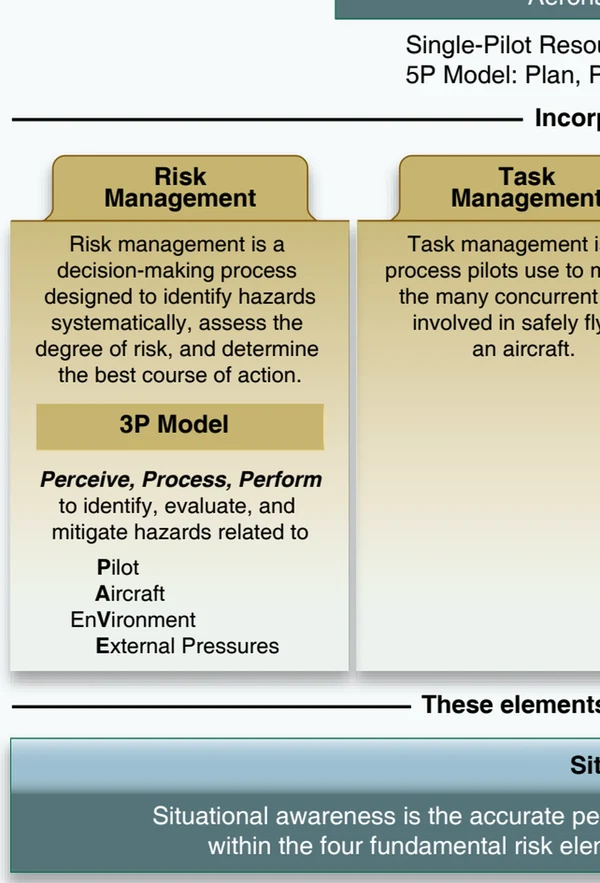
Using the 3P Model to Form Good Safety Habits
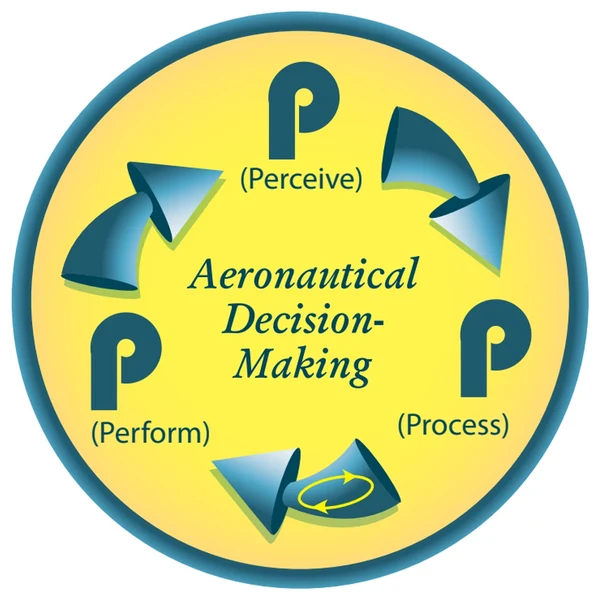
- As discussed in the Pilot's Handbook of Aeronautical Knowledge, the Perceive, Process, Perform (3P) model a pilot assess and manage risk effectively in the real []
- To use this model, the pilot will:
- • Perceive hazards • Process level of risk • Perform risk management Let's put this to use through a common scenario, involving common task, such as a confined area approach.
- As is the case, the continuous loop consists of several elements; each element must be addressed through the 3P process. exceeds resulting as weatherbut for trained unique is catchor crop an A utility helicopter pilot receives the task of flying four at passengers into a remote area for a hunting expedition.
- The Takeoff/ passengers have picked the location where they would like lack to be dropped off based on the likelihood of wildlife being aircraft in the area.
- The area has steep, rugged terrain in a series of results valleys and canyons leading up to large mountains. of the into Upon arrival at the location, the pilot locates a somewhat large confined area near the base of one of the mountains. about The pilot begins the 3P process by quickly noting (or fatal perceiving) the hazards that affect the approach, landing, been and takeoff.
- Through thorough assessment the pilot takes priority into consideration:
- • Current aircraft weight/power available, • Required approach angle to clear the trees for landing in the confined area, helps • Wind direction and velocity, world. • Limited approach and departure paths (due to constricting terrain), • Escape routes should the approach need to be terminated prior to landing, • Possible hazards, such as wires or structures either around the landing site or inside of the confined area, and • The condition of the terrain at the landing site.
- Mud, a dust, and snow can be extreme hazards if the pilot is not often properly trained to land in those particular conditions.
- The pilot reviews the 3P process for each hazard.
- The pilot has perceived the risk associated for each of the bullets listed is above.
- Now, the pilot assesses the risk level of each and what to do to manage or mitigate the risk.
- The aircraft weight/power risk is assessed as low.
- While performing power checks, the pilot verified adequate out of ground effect (OGE) power exists.
- The pilot is also aware that, in this scenario, the departure DA (6,500 feet) is greater than the arrival location DA (6,000 feet) and that several hundred pounds of fuel have been burned off en route. a Furthermore, once the passengers have disembarked, more power will be available for departure. a The pilot estimates that the highest obstacles along the approach path are 70-80 feet in height.
- With the size of the confined area, a normal approach angle can be maintained to clear these obstacles, giving this a low risk level.
- To further mitigate this risk the pilot has selected mental checkpoints along the approach path that will serve as go/no-go points should the pilot feel any assessed parameter is being exceeded.
- Wind direction and velocity are assessed as a medium risk because (for this scenario) the direction of the wind is slightly offset from the chosen approach path, creating a 15-20° an crosswind with a steady 10-knot wind.
- The pilot also takes be into consideration that, due to the terrain, the wind direction and velocity may change during the approach.
- The pilot's experience and awareness of the complexity of mountain flow wind provide a management tool for risk reduction. a From an approach and departure standpoint, the risk is assessed to be medium.
- There is only one viable approach and departure path.
- Given the size of the confined area and the wind direction, the approach and departure path is deemed acceptable.
- The pilot assigns a medium risk level to the selection of an escape route.
- The pilot is aware of the constricting terrain on either side.
- Although adequate area exists for maneuvering, the pilot realizes there are physical boundaries and that they can affect the options available should the pilot need to conduct a go-around or abort the approach.
- Again, the pilot uses mental checkpoints to ensure an early decision is made to conduct a go-around, if needed.
- The selected go-around or escape route will be in line with the selected approach/ departure path and generally into the wind.
- As you may have noticed, one identified hazard and its correlating risk management action may have subsequent impact on other factors.
- This demonstrates the need for continuous assessment and evaluation of the impact of chosen courses of action.
- The 3P model offers three good reasons for its use.
- First, it fairly simple to remember.
- Second, it offers a structured, efficient, and systematic way to identify hazards, assess risk, and implement effective risk controls.
- Third, practicing risk management needs to be as automatic as basic aircraft control.
- As is true for other flying skills, risk management thinking habits are best developed through repetition and consistent adherence to specific procedures.
- Once the pilot completes the 3P decision process and selects course of action, the process begins anew as the set of circumstances brought about by the selected course of action requires new analysis.
- Thus, the decision-making process is continuous loop of perceiving, processing, and performing.
Workload or Task Management
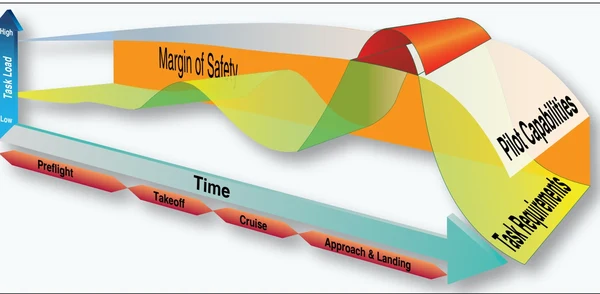
- One component of SRM is workload or task management.
- Research shows that humans have a limited capacity for information.
- Once information flow exceeds the person's ability to mentally process the information, any additional information becomes unattended or displaces other tasks and information already being processed.
- Once this situation occurs, only two alternatives exist: shed the unimportant tasks or perform all tasks at a less than optimal level.
- Like overloaded electrical circuit, either the consumption must reduced or a circuit failure is experienced.
- Effective workload management ensures essential operations are accomplished by planning and then placing them in sequence that avoids work overload.
- As a pilot gains experience, he or she learns to recognize future workload requirements and can prepare for high workload periods during times of low workload.
- Reviewing the appropriate chart and setting radio frequencies well in advance of need help reduce workload as a flight nears the airport.
- In addition, a pilot should listen to Automatic Terminal Information Service (ATIS), Automated Surface Observing System (ASOS), or Automated Weather Observing System (AWOS), if available, and then monitor the tower frequency or Common Traffic Advisory Frequency (CTAF) to get a good idea of what traffic conditions to expect.
- Checklists should be performed well in advance so there is time to focus on traffic and ATC instructions.
- These procedures are especially important prior to entering a highdensity traffic area, such as Class B airspace.
- To manage workload, items should be prioritized.
- For example, during any situation, and especially in an emergency, a pilot should remember the phrase "aviate, navigate, and communicate." This means that the first thing a pilot should do is make sure the helicopter is control, then begin flying to an acceptable landing Only after the first two items are assured should a pilot to communicate with anyone.
- Another important part of managing workload is recognizing a work overload situation.
- The first effect of high is that a pilot begins to work faster.
- As workload increases, attention cannot be devoted to several tasks at one time, a pilot may begin to focus on one item.
- When a pilot task saturated, there is no awareness of additional inputs various sources, so decisions may be made on incomplete information, and the possibility of error increases.
- A very good example of this is inadvertent IMC.
- Once into bad weather, work overload can occur immediately.
- Mentally, the pilot must transition from flying outside aircraft to flying inside the aircraft.
- Losing all visual references can cause sensory overload and the ability to think can be lost.
- Instead of trusting the aircraft's instruments, may try to hang onto the few visual references that they and forget all about all other factors surrounding them. of slowing the helicopter down they increase airspeed. can be caused by an oculogravic illusion.
- This type of occurs when an aircraft accelerates and decelerates. from linear accelerations and decelerations cause the organ to sense a nose-high or nose-low attitude.
- Pilots perceive that the aircraft is in a nose-high attitude.
- Therefore, pilots increase airspeed.
- Pilots can also be looking down visual references and forget about the hazards in front them.
- Finally, since the pilots are not looking at the instruments, the aircraft is not level.
- All of this can be by proper training and proper planning.
- If going inadvertent IMC is your only course of action, pilots must commit and fly the helicopter using only the flight instruments and trying to follow the few visual references they have.
- When a work overload situation exists, a pilot needs to:
- • Stop, • Think, • Slow down, and then • Prioritize.
- It is important for a pilot to understand how to workload by:
- • Placing a situation in the proper perspective, • Remaining calm, and • Thinking rationally.
- These key elements reduce stress and increase the ability to fly safely.
- They depend upon the experience, under discipline, and training that each safe flight earns.
- It is area. important to understand options available to decrease try workload.
- For example, setting a radio frequency may be delegated to another pilot or to a passenger, freeing the pilot to perform higher-priority tasks.
Situational Awareness
- workload In addition to learning to make good aeronautical decisions, and and learning to manage risk and flight workload, SA is an becomes important element of ADM.
- SA is the accurate perception from and understanding of all the factors and conditions within the four fundamental risk elements (PAVE) that affect safety before, during, and after the flight.
- SA involves being aware of what is happening around you, in order to understand how entering information, events, and your own actions will impact your goals and objectives, both now and in the near future.
- Lacking of the SA or having inadequate SA has been identified as one of the primary factors in accidents attributed to human error. rationally pilots SA in a helicopter can be quickly lost.
- Understanding the have, significance and impact of each risk factor independently Instead and cumulatively aid in safe flight operations.
- It is possible, This and all too likely, that we forget flying while at work.
- Our illusion occupation, or work, may be conducting long line operations, Inertia maneuvering around city obstacles to allow a film crew otolith access to news events, spraying crops, ferrying passengers falsely or picking up a patient to be flown to a hospital.
- In each case we are flying a helicopter.
- The moment we fail to account for for the aircraft systems, the environment, other aircraft, hazards, of and ourselves, we lose SA. flight avoided To maintain SA, all of the skills involved in SRM are used.
- For example, an accurate perception of pilot fitness to it can be achieved through self-assessment and recognition not of hazardous attitudes.
- A clear assessment of the status of navigation equipment can be obtained through workload management, while establishing a productive relationship with ATC can be accomplished by effective resource use.
Obstacles to Maintaining Situational Awareness
- What distractions interfere with our focus or train of thought?
- There are many.
- A few examples pertinent to aviation, and helicopters specifically, follow.
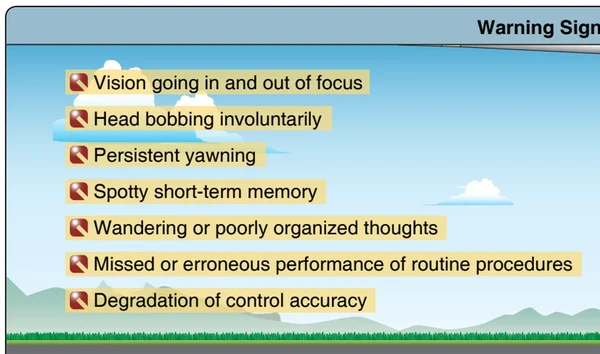
- Fatigue, frequently associated with pilot error, is a threat to decrease aviation safety because it impairs alertness and performance.
- [] The term is used to describe a range of experiences from sleepy or tired to exhausted.
- Two major physiological phenomena create fatigue: circadian rhythm disruption and sleep loss.
- Many helicopter jobs require scheduling flexibility, pilot's frequently affecting the body's circadian rhythm.
- You may be flying a day flight Monday and then at night on Tuesday.
- Your awareness of how your body and mind react to this variation in schedule is vital to safety.
- This disruptive pattern may result in degradation of attention and concentration, impaired coordination, and decreased ability to communicate.
- Physical fatigue results from sleep loss, exercise, or physical work.
- Factors such as stress and prolonged performance of cognitive work result in mental fatigue.
- Consecutive days of flying the maximum allowable flight time can fatigue a pilot, it mentally and physically.
- It is important to take breaks within the workday, as well as days off when possible.
- When you find yourself in this situation, take an objective, honest assessment of your state of mind.
- If necessary, use rest periods to allow rejuvenation of the mind and body.
- []
- Fatigue also occurs under circumstances in which there is anticipation of flight followed by inactivity.
- For instance, a pilot is given a task requiring a specific takeoff time.
- In anticipation of the flight, the pilot's adrenaline kicks in and SA is elevated.
- After a delay (weather, maintenance, or any other unforeseen delay), the pilot feels a letdown, in effect, becoming fatigued.
- Then, upon resuming the flight, the pilot does not have that same level of attention.
- Complacency presents another obstacle to maintaining SA.
- Defined as overconfidence from repeated experience with a specific activity, complacency has been implicated as a contributing factor in numerous aviation accidents and incidents.
- When activities become routine, a pilot may have a tendency to relax and not put as much effort into performance.
- Like fatigue, complacency reduces a pilot's effectiveness on the flight deck.
- However, complacency is more difficult to recognize than fatigue, since everything seems to be progressing smoothly.
- Since complacency seems to creep into our routine without notice, ask what has changed.
- The minor changes that go unnoticed can be associated with the four fundamental risks we previously discussed: pilot, aircraft, environment, and external pressures.
- As a pilot, am I still using checklists or have I become reliant on memory to complete my checks?
- Do I check (Notices to Airmen) NOTAMs before every flight or only when I think is necessary?
- And the aircraft: did I feel that vibration before or is it new?
- Was there a log book entry for it?
- If so, has it been checked?
- Complacent acceptance of common weather patterns have huge impacts on safety.
- The forecast was for after the rain shower, but what was the dew-point The winds are greater than forecast.
- Will this create visibility in dusty, snowy areas or exceed wind limitations?
- While conducting crop spraying, a new agent is Does that change the weight?
- Does that change the profile and, if so, what new hazards might be encountered?
- When things are going smoothly, it is time to heighten awareness and become more attentive to your flight Advanced avionics have created a high degree of redundancy and dependability in modern aircraft systems, which promote complacency and inattention.
- Routine operations may lead to a sense of complacency, which threaten flight safety by reducing SA.
- Loss of SA can be caused by a minor distraction that the pilot's attention from monitoring the instruments scanning outside the aircraft.
- For example, a gauge not reading correctly is a minor problem, but it can cause accident if the pilot diverts attention to the perceived and neglects to control the aircraft properly.
Operational Pitfalls
- There are numerous common behavioral traps that ensnare the unwary pilot.
- Pilots, particularly those considerable experience, try to complete a flight as please passengers, and meet schedules.
- This basic drive achieve can have an adverse effect on safety and can an unrealistic assessment of piloting skills under conditions.
- These tendencies ultimately may bring practices that are dangerous and sometimes illegal and lead to a mishap.
- Pilots develop awareness and learn to many of these operational pitfalls through effective training.
- []
Controlled Flight Into Terrain (CFIT) Awareness
- An emergency medical services (EMS) helicopter for a night flight to transport an 11-day-old infant from one hospital to another.
- No record was found indicating the pilot obtained a weather briefing before departure. pilot had a choice of taking either a direct route that a remote area of rugged mountainous terrain with maximum ground elevations of about 9,000 feet or a route that about 10 minutes longer and followed an interstate with maximum ground elevations of about 6,000 feet. data, which show about 4 minutes of the helicopter's before coverage was lost due to mountainous terrain, consistent with the flight following the direct route. can A search was initiated about 4 hours after the helicopter did clearing not arrive at the destination hospital, and the wreckage was spread? located the following morning.
- Physical evidence observed reduced at the accident site indicated that the helicopter was in level flight at impact and was consistent with CFIT.
- Figure 13-10 is used.
- CFIT is a type of accident that continues to be a major safety flight concern, while at the same time difficult to explain because it involves a pilot controlling an airworthy aircraft that is your flown into terrain (water or obstacles) with inadequate pilot activities. awareness of the impending disaster.
- One constant in CFIT accidents is that outside visibility is can limited, or the accident occurs at night and the terrain is not flight seen easily until just prior to impact.
- Another commonality can among CFIT accidents is lack of SA.
- This includes not only horizontal awareness, and knowing where the helicopter is over the ground, but also vertical awareness. diverts or Training, planning, and preparation are a pilot's best defenses that is for avoiding CFIT accidents.
- For example, take some time an before takeoff to become familiar with the proposed flight and problem the terrain.
- Avoidance of CFIT begins before the helicopter departs the home location.
- Proper planning, including applied risk mitigation must occur before the aircraft is even started.
- Thorough assessment of terrain, visibility, pilot experience and available contingencies must be conducted.
- If necessary, can delay or postpone the flight while on the ground.
- The decision with to abort the flight is much easier to make in the planning room planned, than in the air.
- In case conditions deteriorate once in flight. to Have contingency options available. impose stressful While many CFIT accidents and incidents occur during about nonprecision approaches and landings, great measures have may been taken to improve instrument training, equipment and avoid procedures.
- For the qualified pilot, instrument flight should SRM not be avoided, but rather, trained as a viable option for safely recovering the aircraft.
- Like any other training, frequent instrument training builds confidence and reassurance.
- Good instrument procedures include studying approach departed charts before leaving cruise altitude.
- Key fixes and airport patient elevation must be noted and associated with terrain and obstacles along the approach path.
- Pilots should have a good The understanding of both approach and departure design criteria crossed to understand fully the obstacle clearance margins built into them.
- Some pilots have the false belief that ATC provides was obstacle clearance while en route off airways.
- The pilot is highway ultimately responsible for obstacle clearance.
- Radar flight are Altitude error is another common cause of CFIT.
- Cases of altitude error involve disorientation with respect to the NAVAID, improper transition on approach, selecting the wrong NAVAID, or just plain lack of horizontal SA.
- Today's modern aircraft have sophisticated flight directors, autopilots, autothrottles, and flight management systems.
- These devices make significant contributions to the overall safety of flight, but they are only machines that follow instructions.
- They do whatever is asked of them, even if it is wrong.
- When commanded, they unerringly follow instructions - sometimes straight into the ground.
- The pilot must ensure that both vertical and horizontal modes are correct and engaged.
- Crosscheck autopilots constantly.