Procedure Turn & Hold In Lieu of
A procedure turn is the maneuver prescribed when it is necessary to reverse direction to establish the aircraft inbound on an approach course.
Introduction to Procedure Turn & Hold In Lieu of
- A procedure turn is the maneuver prescribed when it is necessary to reverse direction to establish the aircraft inbound on an intermediate or final approach course
- Test your understanding of Procedure Turn & Hold In Lieu of by applying your knowledge in the interactive scenario, comparing your performance against the applicable Airman Certification Standards, and concluding with the topic summary to reinforce the key concepts before moving on to the next lesson.
WARNING:
All procedures are GENERALIZED.
Use the Pilot Operating Handbook (POH) procedures for specific aircraft performance and limitations.
and/or current Standard Operating Procedures (SOPs).
Procedure Turn & Hold In Lieu of Key Highlights
- Procedure turns and holds in lieu of procedure turns provide course reversal guidance to align aircraft with the final approach course during instrument approaches.
- These procedures help pilots establish proper approach alignment, descent planning, and situational awareness before final approach.
- A hold in lieu of procedure turn (HILPT) uses a published holding pattern instead of a traditional procedure turn for course reversal.
- Pilots must comply with published altitudes, entry procedures, turn directions, and protected airspace limitations during course reversal operations.
- ATC vectors or specific approach clearances may eliminate the need to perform a published procedure turn or HILPT.
- Wind correction techniques are essential to maintain proper timing, spacing, and course alignment throughout the maneuver.
- Modern GPS and RNAV avionics systems can assist pilots with navigation and situational awareness during HILPT procedures.
- Improper maneuver execution or loss of situational awareness can result in course deviations or protected airspace violations.
- Approach briefings should include entry procedures, timing, altitudes, inbound courses, and missed approach instructions.
- Understanding procedure turns and holds in lieu of procedure turns improves instrument proficiency, navigation accuracy, and overall flight safety.
Procedure Turn and Hold-in-lieu of Procedure Turn
- The procedure turn or hold-in-lieu-of-PT is a required maneuver when it is depicted on the approach chart, unless:
- ATC clears the aircraft for a straight-in approach.
- The symbol "NoPT" is depicted on the initial segment being flown; in that case, the course reversal is not permitted without an amended ATC clearance.
- ATC provides radar vectors to the final approach course.
- The pilot is conducting a timed approach from a holding fix.
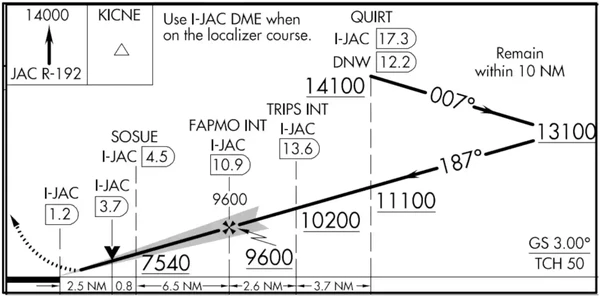
- The altitude prescribed for the procedure turn is a minimum altitude until the aircraft is established on the inbound course. The maneuver must be completed within the distance specified in the profile view. For a hold-in-lieu-of-PT, the holding pattern direction must be flown as depicted and the specified leg length/timing must not be exceeded.
- The pilot may elect to use the procedure turn or hold-in-lieu-of-PT when it is not required by the procedure, but must first receive an amended clearance from ATC. If the pilot is uncertain whether the ATC clearance intends for a procedure turn to be conducted or to allow for a straight-in approach, the pilot must immediately request clarification from ATC (14 CFR Section 91.123).
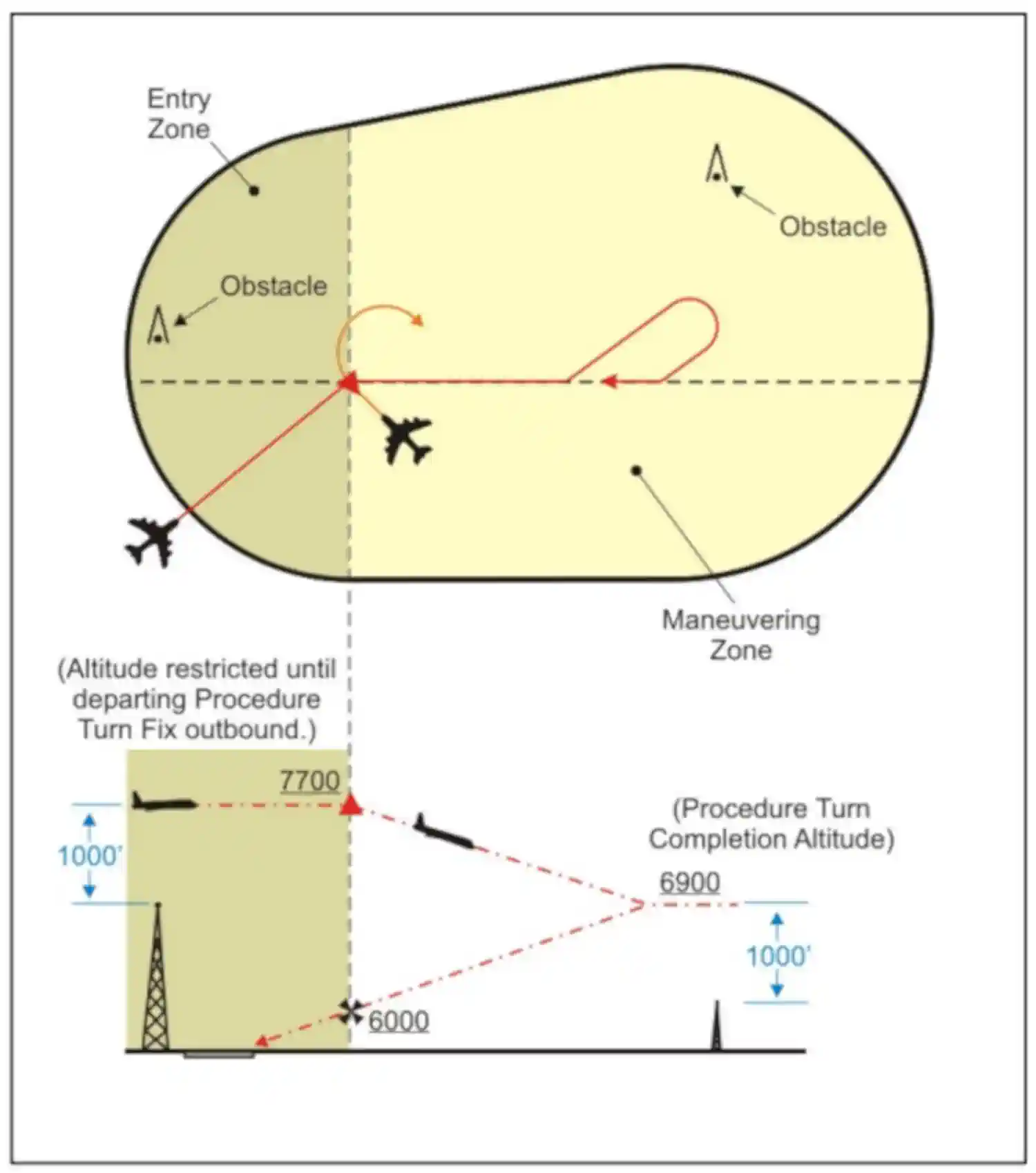
- On U.S. Government charts, a barbed arrow indicates the maneuvering side of the outbound course on which the procedure turn is made. Headings are provided for course reversal using the 45 degree type procedure turn. However, the point at which the turn may be commenced and the type and rate of turn is left to the discretion of the pilot (limited by the charted remain within xx NM distance). Some of the options are the 45 degree procedure turn, the racetrack pattern, the teardrop procedure turn, or the 80 degree ? 260 degree course reversal. Racetrack entries should be conducted on the maneuvering side where the majority of protected airspace resides. If an entry places the pilot on the non-maneuvering side of the PT, correction to intercept the outbound course ensures remaining within protected airspace. Some procedure turns are specified by procedural track. These turns must be flown exactly as depicted.
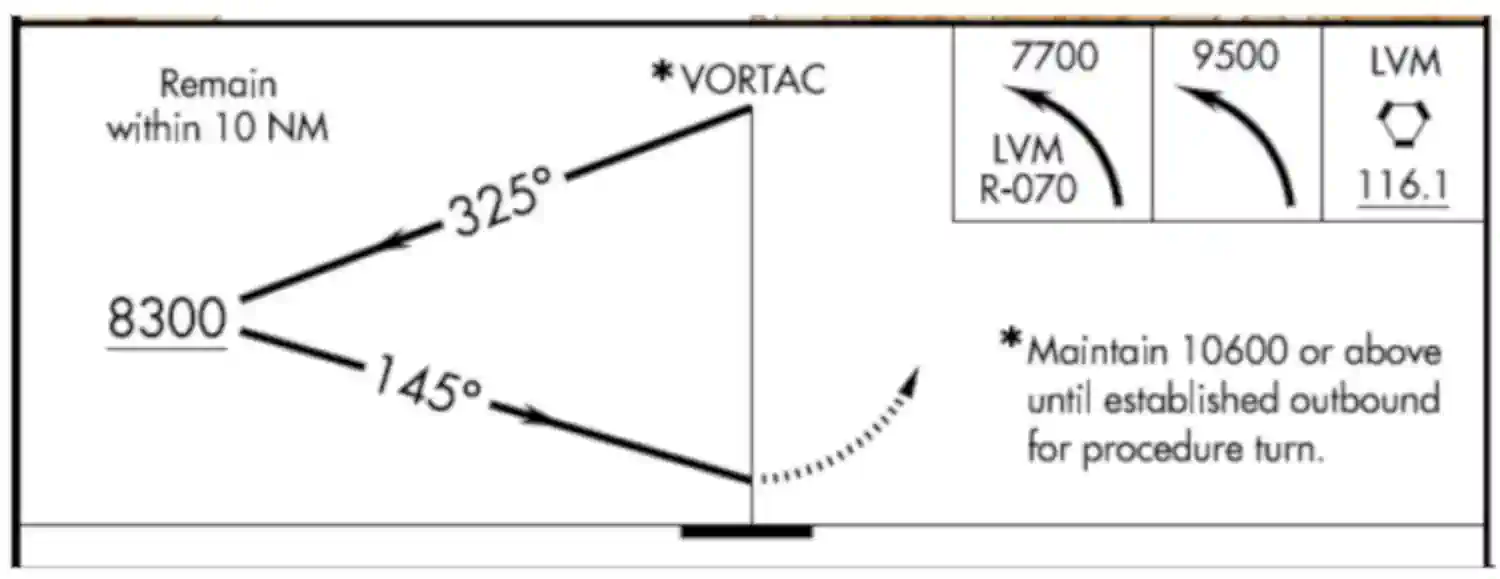
- Descent to the procedure turn (PT) completion altitude from the PT fix altitude (when one has been published or assigned by ATC) must not begin until crossing over the PT fix or abeam and proceeding outbound. Some procedures contain a note in the chart profile view that says "Maintain (altitude) or above until established outbound for procedure turn". []. Newer procedures will simply depict an "at or above" altitude at the PT fix without a chart note. []. Both are there to ensure required obstacle clearance is provided in the procedure turn entry zone. []. Absence of a chart note or specified minimum altitude adjacent to the PT fix is an indication that descent to the procedure turn altitude can commence immediately upon crossing over the PT fix, regardless of the direction of flight. This is because the minimum altitudes in the PT entry zone and the PT maneuvering zone are the same
- When the approach procedure involves a procedure turn, a maximum speed of not greater than 200 knots (IAS) should be observed from first overheading the course reversal IAF through the procedure turn maneuver to ensure containment within the obstruction clearance area. Pilots should begin the outbound turn immediately after passing the procedure turn fix. The procedure turn maneuver must be executed within the distance specified in the profile view. The normal procedure turn distance is 10 miles. This may be reduced to a minimum of 5 miles where only Category A or helicopter aircraft are to be operated or increased to as much as 15 miles to accommodate high performance aircraft.
- A teardrop procedure or penetration turn may be specified in some procedures for a required course reversal. The teardrop procedure consists of departure from an initial approach fix on an outbound course followed by a turn toward and intercepting the inbound course at or prior to the intermediate fix or point. Its purpose is to permit an aircraft to reverse direction and lose considerable altitude within reasonably limited airspace. Where no fix is available to mark the beginning of the intermediate segment, it must be assumed to commence at a point 10 miles prior to the final approach fix. When the facility is located on the airport, an aircraft is considered to be on final approach upon completion of the penetration turn. However, the final approach segment begins on the final approach course 10 miles from the facility.
- A holding pattern in lieu of procedure turn may be specified for course reversal in some procedures. In such cases, the holding pattern is established over an intermediate fix or a final approach fix. The holding pattern distance or time specified in the profile view must be observed. For a hold-in-lieu-of-PT, the holding pattern direction must be flown as depicted and the specified leg length/timing must not be exceeded. Maximum holding airspeed limitations as set forth for all holding patterns apply. The holding pattern maneuver is completed when the aircraft is established on the inbound course after executing the appropriate entry. If cleared for the approach prior to returning to the holding fix, and the aircraft is at the prescribed altitude, additional circuits of the holding pattern are not necessary nor expected by ATC. If pilots elect to make additional circuits to lose excessive altitude or to become better established on course, it is their responsibility to so advise ATC upon receipt of their approach clearance.
- A procedure turn is not required when an approach can be made directly from a specified intermediate fix to the final approach fix. In such cases, the term "NoPT" is used with the appropriate course and altitude to denote that the procedure turn is not required. If a procedure turn is desired, and when cleared to do so by ATC, descent below the procedure turn altitude should not be made until the aircraft is established on the inbound course, since some NoPT altitudes may be lower than the procedure turn altitudes.
- Limitations on Procedure Turns:
- In the case of a radar initial approach to a final approach fix or position, or a timed approach from a holding fix, or where the procedure specifies NoPT, no pilot may make a procedure turn unless, when final approach clearance is received, the pilot so advises ATC and a clearance is received to execute a procedure turn.
- When a teardrop procedure turn is depicted and a course reversal is required, this type turn must be executed.
- When a holding pattern replaces a procedure turn, the holding pattern must be followed, except when RADAR VECTORING is provided or when NoPT is shown on the approach course. The recommended entry procedures will ensure the aircraft remains within the holding pattern's protected airspace. As in the procedure turn, the descent from the minimum holding pattern altitude to the final approach fix altitude (when lower) may not commence until the aircraft is established on the inbound course. Where a holding pattern is established in-lieu-of a procedure turn, the maximum holding pattern airspeeds apply.
- REFERENCE-AIM, Paragraph 5-3-8j2, Holding.
- The absence of the procedure turn barb in the plan view indicates that a procedure turn is not authorized for that procedure.
Procedure Turn & Hold In Lieu of Interactive Scenario
Interactive Scenario
Loading scenario details...
Decision 1
0%
Scenario Complete
Airman Certification Standards
Procedure Turn & Hold In Lieu of Conclusion
- Some may choose to use the mnemonic SHARPTT—S: cleared straight in; H: hold in lieu of a procedure turn; A: DME arc; R: radar vectors to final; P: NoPT; T: timed approach from a holding fix; and T: teardrop—to determine when a procedure turn is not required.
- In practice, procedure turns should be flown when approaching the final approach course when more than 90 degrees off or at an altitude that requires additional time to descend.
- Consider actual versus realized performance when doing any performance calculations
- Consider practicing maneuvers on a flight simulator to introduce yourself to maneuvers or knock off rust
- Still looking for something? Continue searching:
Procedure Turn & Hold In Lieu of References
- Federal Aviation Administration - Pilot/Controller Glossary.
- Federal Aviation Regulations (91.175) Takeoff and landing under IFR.
- Instrument Flying Handbook (9-5) Homing