Overhead Approach Maneuver
Overhead approach maneuvers permit the expeditious recovery of aircraft, especially in the case of multiple aircraft arriving simultaneously.
Introduction to Overhead Approach Maneuver
- The overhead approach maneuver is a 180° energy depleting turn used to slow the aircraft in the landing pattern developed at airports where aircraft have an operational need to conduct the maneuver (military, formation flight recovery, etc.)
- Available to pilots operating with an Instrument Flight Rule (IFR) flight plan in Visual Meteorological Conditions (VMC)
- Test your understanding of Overhead Approach Maneuver by completing the knowledge quiz, applying your knowledge in the interactive scenario, comparing your performance against the applicable Airman Certification Standards, and concluding with the topic summary to reinforce the key concepts before moving on to the next lesson.
Overhead Approach Maneuver Key Highlights
- The overhead approach maneuver is a descending visual arrival procedure commonly used in military and high-performance aircraft operations.
- The maneuver transitions aircraft from initial approach to landing through a continuous descending traffic pattern.
- Pilots typically enter the overhead at higher airspeeds before executing a coordinated break maneuver to downwind.
- Energy management, aircraft spacing, and precise timing are critical during overhead pattern operations.
- The overhead approach can improve traffic flow efficiency and reduce time spent in conventional traffic patterns.
- Pilots must manage airspeed reduction, configuration changes, and descent planning throughout the maneuver.
- Proper visual scanning and communication are essential due to high aircraft speeds and close traffic sequencing.
- Weather conditions, runway environment, and aircraft performance influence overhead approach execution and safety.
- Improper spacing, excessive bank angles, or unstable energy management can increase operational risk during the maneuver.
- Understanding overhead approach maneuvers improves traffic pattern proficiency, aircraft energy management, and overall flight safety.
Overhead Approach Maneuver
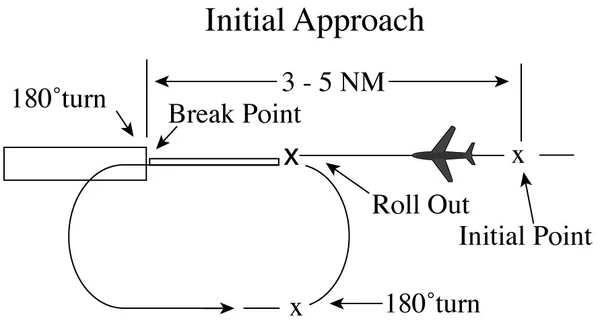
- An overhead maneuver is not an instrument approach procedure (IAP). []
- The aircraft is considered operating under visual flight rules (VFR), and its instrument flight rules (IFR) flight plan is canceled when it reaches the initial point of the maneuver.
- At an airport without a functioning control tower, the pilot must initiate IFR flight-plan cancellation before executing the overhead maneuver.
- The cancellation must be completed after crossing the landing threshold on initial or after landing.
Overhead Approach Maneuver Clearance
- Controllers may authorize an overhead maneuver and issue the following clearance:
- Pattern altitude and direction of traffic, if either are non-standard.
- "Pattern altitude [Altitude]. Right turns"
- Request for a report on an initial.
- "Report initial"
- "Break" information and request for a pilot to report the break.
- The "Break Point" will be specified if nonstandard.
- Pilots may be requested to report "break" if required for traffic or other reasons.
- "Break at [Specified Point]"
- "Report break"
Overhead Approach Maneuver Procedure
- Performed by adhering to the 1% rule:
- 150 KCAS = 1.5G
- 200 KCAS = 2.0G
- Etc.
- Vary AoB and G to arrive at the appropriate abeam distance
- Never descend in a break until wings level on downwind
Overhead Approach Maneuver Interactive Scenario
Interactive Scenario
Loading scenario details...
Scenario Complete
Overhead Approach Maneuver Knowledge Check
Choose the knowledge check that matches your current training for Overhead Approach Maneuver.
 Private Pilot
PPL knowledge check
Core Knowledge Review
Review foundational knowledge, key concepts, and practical considerations. Topic: Overhead Approach Maneuver.
- Immediate feedback
- Answer explanations
- Account progress tracking
 Commercial Pilot
CPL knowledge check
Advanced Application
Apply knowledge to advanced operations, risk management, and aeronautical decision-making. Topic: Overhead Approach Maneuver.
- Immediate feedback
- Answer explanations
- Account progress tracking
Why Take a Quiz?
Quizzes reinforce key concepts, identify knowledge gaps, and build confidence for real-world decisions. Quiz material is representative of the information provided here and is not based on or sourced from the Federal Aviation Administration test bank.
Overhead Approach Maneuver Conclusion
- If the maneuver cannot be accommodated, the pilot must be available to fly the conventional rectangular pattern
- To learn more about instrument procedures, be sure to check out the Instrument Procedures Handbook online or in paperback.
- Pilots can visit the FAA's Instrument Flight Procedures Information Gateway to review and submit questions related to the how and why certain procedures are as they are
- Still looking for something? Continue searching: