Takeoff Minimums
Takeoff minimums established safety margins for departures from the terminal environment when instrument meteorological conditions exist.
Introduction to Takeoff Minimums
- Takeoff minimums provide a margin of safety
- Civil aviation minimums are dependent upon which part you operate
- Test your understanding of Takeoff Minimums by completing the knowledge quiz, applying your knowledge in the interactive scenario, comparing your performance against the applicable Airman Certification Standards, and concluding with the topic summary to reinforce the key concepts before moving on to the next lesson.
Takeoff Minimums Key Highlights
- Takeoff minimums establish the minimum weather conditions and visibility requirements necessary for safe aircraft departure operations.
- FAA regulations and operating specifications determine takeoff minimum requirements based on aircraft type, pilot certification, and operation category.
- Part 91 operators are generally not assigned standard takeoff minimums unless operating under specific instrument procedures or aircraft limitations.
- Commercial operators under Parts 121 and 135 commonly follow published takeoff minimums and obstacle departure procedures.
- Runway lighting, centerline markings, approach lighting systems, and navigation equipment may affect authorized takeoff minimums.
- Obstacle departure procedures and diverse departure criteria help ensure terrain and obstacle clearance following takeoff.
- Pilots should evaluate weather conditions, runway conditions, aircraft performance, and emergency options before departure.
- Low-visibility takeoffs increase workload and may reduce visual references available during initial climb operations.
- Improper departure planning or inadequate obstacle clearance consideration can create significant operational hazards.
- Understanding takeoff minimums improves preflight planning, risk management, and overall flight safety.
Civil VFR Takeoff Minimums
- Takeoff minimums under basic VFR (Visual Flight Rules) are governed by FAR (Federal Aviation Regulations) 91.155.
- For takeoff under basic VFR within Class B, C, D, or E surface areas designated for an airport, reported ground visibility must be at least 3 statute miles.
- If ground visibility is not reported, flight visibility during takeoff must be at least 3 statute miles.
- Operating beneath the ceiling requires a ceiling of at least 1,000 feet.
- Once airborne, FAR 91.155 further provides cloud clearance requirements.
- Class A: not applicable.
- Class B: clear of clouds.
- Class C: 500 feet below, 1000 feet above, 2000 feet horizontal.
- Class D: 500 feet below, 1000 feet above, 2000 feet horizontal.
- Class E:
- Below 10,000 feet MSL (Mean Sea Level): 500 feet below, 1,000 feet above, and 2,000 feet horizontal from clouds.
- At or above 10,000 feet MSL: 1,000 feet below, 1,000 feet above, and 1 statute mile horizontal from clouds.
- Recognize that in many locations, operating below 500 feet AGL (Above Ground Level) is not permitted.
- Takeoff minimums under special VFR are governed by FAR 91.157.
- Special VFR does not establish a minimum ceiling, but requires 1 SM (Statute Mile) visibility.
Civil Takeoff Minimums
- For general aviation (part 91), there are no takeoff minimums and instead, good judgment should be applied
- A prudent pilot will look to maintain any published takeoff minimum and not takeoff unless they have the expected minimums to shoot an instrument approach back to the same airport (think of an emergency). []
- If you are assigned an instrument departure with published minimums, you must meet them.
- You must decline the departure if the aircraft cannot meet its performance requirements.
- Part 121, 125, 129, and 135 operators must follow their requirements:
- Must meet the requirements of part 97, or if none are prescribed:
- For aircraft, other than helicopters, having 2 engines or less - 1 SM visibility
- For aircraft having more than two engines, 1/2 SM visibility
- For helicopters, 1/2 SM visibility
- No pilot may take off under IFR from a civil airport with a Part 97 obstacle departure procedure published for the runway unless the pilot uses that ODP or an assigned alternative.
- Must meet the requirements of part 97, or if none are prescribed:
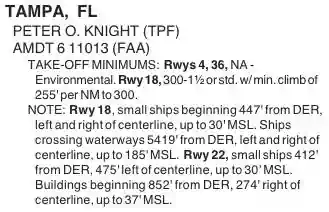
- An inverted black triangle containing a capital letter "T" indicates that nonstandard takeoff minimums and/or departure procedures are published for the airport. Consult the airport's entry in the Takeoff Minimums, Obstacle Departure Procedures, and Diverse Vector Areas section of the applicable Terminal Procedures Publication. []
- Review these before departure!
- If the pilot does not possess a DP or does not wish to use one, he/she is expected to advise ATC (Air Traffic Control)
- This may be accomplished by stating "NO DP" in the remarks section of the flight plan or by verbally advising ATC


Takeoff Minimums Interactive Scenario
Interactive Scenario
Loading scenario details...
Scenario Complete
Takeoff Minimums Knowledge Check
Choose the knowledge check that matches your current training for Takeoff Minimums.
 Private Pilot
PPL knowledge check
Core Knowledge Review
Review foundational knowledge, key concepts, and practical considerations. Topic: Takeoff Minimums.
- Immediate feedback
- Answer explanations
- Account progress tracking
 Commercial Pilot
CPL knowledge check
Advanced Application
Apply knowledge to advanced operations, risk management, and aeronautical decision-making. Topic: Takeoff Minimums.
- Immediate feedback
- Answer explanations
- Account progress tracking
 Instrument Rating (Airplane)
Instrument knowledge check
Instrument Knowledge
Practice the procedures, systems, weather, and decisions used in instrument flight. Topic: Takeoff Minimums.
- Immediate feedback
- Answer explanations
- Account progress tracking
 Instrument Instructor
CFII knowledge check
Instrument Instructor Knowledge
Review instrument knowledge at the depth expected of an instrument flight instructor. Topic: Takeoff Minimums.
- Immediate feedback
- Answer explanations
- Account progress tracking
Why Take a Quiz?
Quizzes reinforce key concepts, identify knowledge gaps, and build confidence for real-world decisions. Quiz material is representative of the information provided here and is not based on or sourced from the Federal Aviation Administration test bank.
Takeoff Minimums Conclusion
- Pay attention to landing minimums before you worry about takeoff minimums
- Always make sure you can return to the airfield if you have an emergency
- Still looking for something? Continue searching: