Climb
Climbing into the enroute environment requires careful planning and consideration of aircraft performance.
Introduction to Climb
- Takeoff and climb procedures.
- Test your understanding of Climb by completing the knowledge quiz, applying your knowledge in the interactive scenario, comparing your performance against the applicable Airman Certification Standards, and concluding with the topic summary to reinforce the key concepts before moving on to the next lesson.
Climb Key Highlights
- Climb performance is influenced by aircraft weight, atmospheric conditions, power setting, and aircraft configuration.
- Best rate of climb speed (Vy) provides the greatest altitude gain over a given period of time.
- Best angle of climb speed (Vx) provides the greatest altitude gain over a given horizontal distance.
- High density altitude conditions reduce engine power, propeller efficiency, and aerodynamic climb capability.
- Aircraft weight directly affects climb rate, obstacle clearance performance, and acceleration capability.
- Proper pitch control and power management are essential for maintaining desired climb performance and engine cooling.
- Wind conditions, turbulence, and terrain can affect climb planning and obstacle clearance margins.
- Pilots should monitor engine instruments, airspeed, and aircraft configuration continuously during climb operations.
- Published climb performance data in the Pilot’s Operating Handbook (POH) should be used during preflight planning.
- Understanding climb operations improves aircraft performance management, obstacle avoidance, and overall flight safety.
Night
- Night flying is very different from day flying and demands more attention of the pilot.
- The most noticeable difference is the limited availability of outside visual references.
- Therefore, flight instruments should be used to a greater degree in controlling the airplane.
- This is particularly true on night takeoffs and climbs.
- The cockpit lights should be adjusted to a minimum brightness that will allow the pilot to read the instruments and switches and yet not hinder the pilot's outside vision.
- This will also eliminate light reflections on the windshield and windows.
- After ensuring that the final approach and runway are clear of other air traffic, or when cleared for takeoff by the tower, the landing lights and taxi lights should be turned ON and the airplane lined up with the centerline of the runway.
- If the runway does not have centerline lighting, use the painted centerline and the runway edge lights.
- After the airplane is aligned, the heading indicator should be noted or set to correspond to the known runway direction.
- To begin the takeoff, the brakes should be released and the throttle smoothly advanced to maximum allowable power.
- As the airplane accelerates, it should be kept moving straight ahead between and parallel to the runway-edge lights.
- The procedure for night takeoffs is the same as for normal daytime takeoffs except that many of the runway visual cues are not available.
- Therefore, the flight instruments should be checked frequently during the takeoff to ensure the proper pitch attitude, heading, and airspeed are being attained.
- As the airspeed reaches the normal lift-off speed, the pitch attitude should be adjusted to that which will establish a normal climb.
- This should be accomplished by referring to both outside visual references, such as lights, and to the flight instruments.
- After becoming airborne, the darkness of night often makes it difficult to note whether the airplane is getting closer to or farther from the surface.
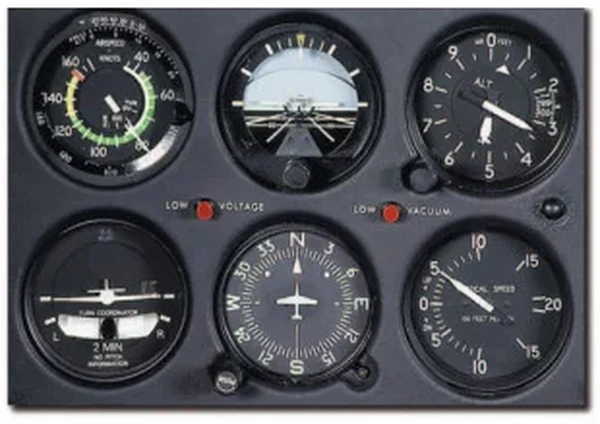
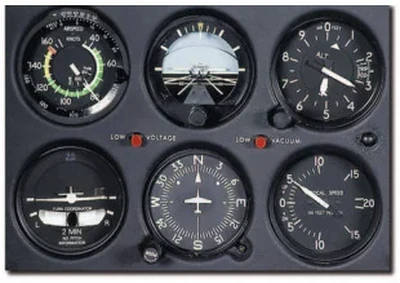
- To ensure the airplane continues in a positive climb, be sure a climb is indicated on the attitude indicator, vertical speed indicator (VSI), and altimeter. []
- It is also important to ensure the airspeed is at best climb speed. Necessary pitch and bank adjustments should be made by referencing the attitude and heading indicators.
- It is recommended that turns not be made until reaching a safe maneuvering altitude.
- Although the use of the landing lights provides help during the takeoff, they become ineffective after the airplane has climbed to an altitude where the light beam no longer extends to the surface.
- The light can cause distortion when it is reflected by haze, smoke, or fog that might exist in the climb.
- Therefore, when the landing light is used for the takeoff, it may be turned off after the climb is well established provided other traffic in the area does not require its use for collision avoidance.
Climb Interactive Scenario
Interactive Scenario
Loading scenario details...
Decision 1
0%
Scenario Complete
Climb Knowledge Check
Choose the knowledge check that matches your current training for Climb.
 Private Pilot
PPL knowledge check
Core Knowledge Review
Review foundational knowledge, key concepts, and practical considerations. Topic: Climb.
- Immediate feedback
- Answer explanations
- Account progress tracking
 Commercial Pilot
CPL knowledge check
Advanced Application
Apply knowledge to advanced operations, risk management, and aeronautical decision-making. Topic: Climb.
- Immediate feedback
- Answer explanations
- Account progress tracking
Why Take a Quiz?
Quizzes reinforce key concepts, identify knowledge gaps, and build confidence for real-world decisions. Quiz material is representative of the information provided here and is not based on or sourced from the Federal Aviation Administration test bank.
Climb Conclusion
- Still looking for something? Continue searching: