Enhanced Flight Vision System
Enhanced Flight Vision Systems enable pilots to see objects or features that might not be visible using natural vision alone.
Introduction to Enhanced Flight Vision System
- During an instrument approach, an EFVS can enable a pilot to see the approach lights, visual references associated with the runway environment, and other objects or features that might not be visible using natural vision alone. An EFVS uses a head-up display (HUD), or an equivalent display that is a head-up presentation, to combine flight information, flight symbology, navigation guidance, and a real-time image of the external scene to the pilot. Combining the flight information, navigation guidance, and sensor imagery on a HUD (or equivalent display) allows the pilot to continue looking forward along the flightpath throughout the entire approach, landing, and rollout
- Test your understanding of Enhanced Flight Vision System by applying your knowledge in the interactive scenario, comparing your performance against the applicable Airman Certification Standards, and concluding with the topic summary to reinforce the key concepts before moving on to the next lesson.
Enhanced Flight Vision System Key Highlights
- Enhanced Flight Vision Systems (EFVS) improve pilot visibility and situational awareness during low-visibility flight operations.
- EFVS technology uses infrared sensors, cameras, and display systems to present enhanced external imagery to the pilot.
- Enhanced vision imagery may help pilots identify runways, terrain, obstacles, and aircraft during reduced visibility conditions.
- EFVS information is commonly displayed on head-up displays (HUDs) or integrated electronic flight displays.
- Infrared imaging systems can detect heat signatures that may not be visible to the human eye in darkness or haze.
- EFVS operations must comply with Federal Aviation Regulations, aircraft certification requirements, and operational approval standards.
- Pilots must maintain proficiency with EFVS procedures, display interpretation, and associated approach requirements.
- Weather conditions such as heavy precipitation, dense fog, or sensor limitations can reduce EFVS effectiveness.
- EFVS supplements but does not eliminate the need for proper instrument procedures and visual landing references.
- Understanding EFVS operation improves low-visibility situational awareness, approach capability, and overall flight safety.
Types of EFVS Operations
- An EFVS operation is an operation in which visibility conditions require an EFVS to be used in lieu of natural vision to perform an approach or landing, determine enhanced flight visibility, identify required visual references, or conduct a rollout. There are two types of EFVS operations:
- EFVS operations to touchdown and rollout.
- EFVS operations to 100 feet above the touchdown zone elevation (TDZE).
-
EFVS Operations to Touchdown and Rollout:
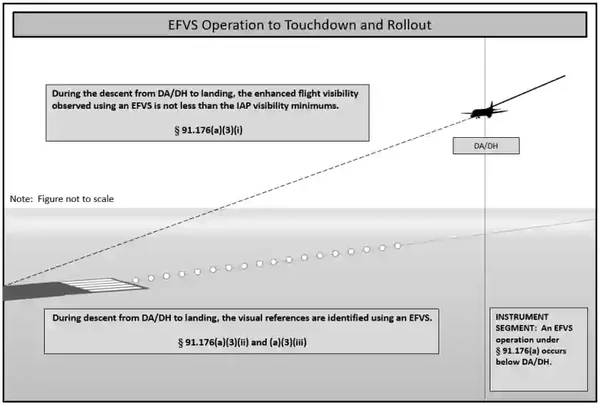
- An EFVS operation to touchdown and rollout is an operation in which the pilot uses the enhanced vision imagery provided by an EFVS in lieu of natural vision to descend below DA or DH to touchdown and rollout. (See FIG 5-4-34.) These operations may be conducted only on Standard Instrument Approach Procedures (SIAP) or special IAPs that have a DA or DH (for example, precision or APV approach). An EFVS operation to touchdown and rollout may not be conducted on an approach that has circling minimums. The regulations for EFVS operations to touchdown and rollout can be found in 14 CFR 91.176(a).
-
EFVS Operations to 100 Feet Above the TDZE:
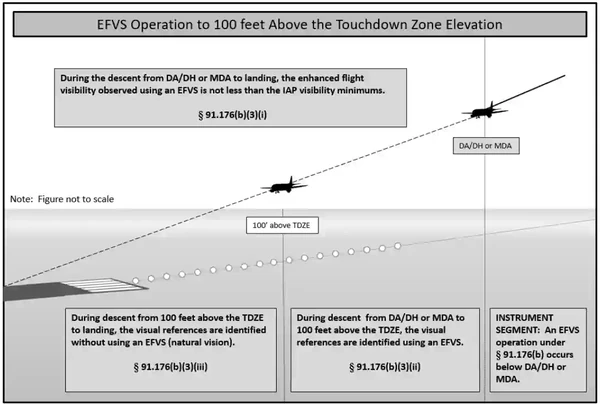
- An EFVS operation to 100 feet above the TDZE is an operation in which the pilot uses the enhanced vision imagery provided by an EFVS in lieu of natural vision to descend below DA/DH or MDA down to 100 feet above the TDZE. To continue the approach below 100 feet above the TDZE, a pilot must have sufficient flight visibility to identify the required visual references using natural vision and must continue to use the EFVS to ensure the enhanced flight visibility meets the visibility requirements of the IAP being flown. These operations may be conducted on SIAPs or special IAPs that have a DA/DH or MDA. An EFVS operation to 100 feet above the TDZE may not be conducted on an approach that has circling minimums. The regulations for EFVS operations to 100 feet above the TDZE can be found in 14 CFR 91.176(b).
EFVS Equipment Requirements
- An EFVS that is installed on a U.S.-registered aircraft and is used to conduct EFVS operations must conform to an FAA-type design approval (i.e., a type certificate (TC), amended TC, or supplemental type certificate (STC)). A foreign-registered aircraft used to conduct EFVS operations that does not have an FAA-type design approval must be equipped with an EFVS that has been approved by either the State of the Operator or the State of Registry to meet the requirements of ICAO Annex 6. Equipment requirements for an EFVS operation to touchdown and rollout can be found in 14 CFR 91.176(a)(1), and the equipment requirements for an EFVS operation to 100 feet above the TDZE can be found in 14 CFR 91.176(b)(1). An operator can determine the eligibility of their aircraft to conduct EFVS operations by referring to the Airplane Flight Manual, Airplane Flight Manual Supplement, Rotorcraft Flight Manual, or Rotorcraft Flight Manual Supplement as applicable. [/]
Operating Requirements
- Any operator who conducts EFVS operations to touchdown and rollout (14 CFR 91.176(a)) must have an OpSpec, MSpec, or LOA that specifically authorizes those operations. Parts 91K, 121, 125, 129, and 135 operators who conduct EFVS operations to 100 feet above the TDZE (14 CFR 91.176(b))must have an OpSpec, MSpec, or LOA that specifically authorizes the operation. Part 91 operators (other than 91K operators) are not required to have an LOA to conduct EFVS operations to 100 feet above the TDZE in the United States. However, an optional LOA is available to facilitate operational approval from foreign Civil Aviation Authorities (CAA). To conduct an EFVS operation to touchdown and rollout during an authorized Category II or III operation, the operator must have:EFVS Operations in RotorcraftEFVS Operations in RotorcraftEFVS Operations in Rotorcraft.
- An OpSpec, MSpec, or LOA authorizing EFVS operations to touchdown and rollout (14 CFR 91.176(a)); and EFVS Operations in Rotorcraft.
- An OpSpec, MSpec, or LOA authorizing Category II or Category III operations.
-
EFVS Operations in Rotorcraft:
- Currently, EFVS operations in rotorcraft can only be conducted on IAPs that are flown to a runway. Instrument approach criteria, procedures, and appropriate visual references have not yet been developed for straight-in landing operations below DA/DH or MDA under IFR to heliports or platforms. An EFVS cannot be used in lieu of natural vision to descend below published minimums on copter approaches to a point in space (PinS) followed by a "proceed visual flight rules (VFR)" visual segment, or on approaches designed to a specific landing site using a "proceed visually" visual segment.
-
EFVS Pilot Requirements:
- A pilot who conducts EFVS operations must receive ground and flight training specific to the EFVS operation to be conducted. The training must be obtained from an authorized training provider under a training program approved by the FAA. Additionally, recent flight experience and proficiency or competency check requirements apply to EFVS operations. These requirements are addressed in 14 CFR 61.66, 91.1065, 121.441, Appendix F to Part 121, 125.287, and 135.293.
Enhanced Flight Visibility and Visual Reference Requirements
- To descend below DA/DH or MDA during EFVS operations under 14 CFR 91.176(a) or (b), a pilot must make a determination that the enhanced flight visibility observed by using an EFVS is not less than what is prescribed by the IAP being flown. In addition, the visual references required in 14 CFR 91.176(a) or (b) must be distinctly visible and identifiable to the pilot using the EFVS. The determination of enhanced flight visibility is a separate action from that of identifying required visual references, and is different from ground-reported visibility. Even though the reported visibility or the visibility observed using natural vision may be less, as long as the EFVS provides the required enhanced flight visibility and a pilot meets all of the other requirements, the pilot can continue descending below DA/DH or MDA using the EFVS. Suitable enhanced flight visibility is necessary to ensure the aircraft is in a position to continue the approach and land. It is important to understand that using an EFVS does not result in obtaining lower minima with respect to the visibility or the DA/DH or MDA specified in the IAP. An EFVS simply provides another means of operating in the visual segment of an IAP. The DA/DH or MDA and the visibility value specified in the IAP to be flown do not change
Flight Planning and Beginning or Continuing an Approach Under IFR
- A Part 121, 125, or 135 operator's OpSpec or LOA for EFVS operations may authorize an EFVS operational credit dispatching or releasing a flight and for beginning or continuing an instrument approach procedure. When a pilot reaches DA/DH or MDA, the pilot conducts the EFVS operation in accordance with 14 CFR 91.176(a) or (b) and their authorization to conduct EFVS operations
Missed Approach Considerations
- In order to conduct an EFVS operation, the EFVS must be operable. In the event of a failure of any required component of an EFVS at any point in the approach to touchdown, a missed approach is required. However, this provision does not preclude a pilot's authority to continue an approach if continuation of an approach is considered by the pilot to be a safer course of action
Light Emitting Diode (LED) Airport Lighting Impact on EFVS Operations
- Incandescent lamps are being replaced with LEDs at some airports in threshold lights, taxiway edge lights, taxiway centerline lights, low intensity runway edge lights, windcone lights, beacons, and some obstruction lighting. Additionally, there are plans to replace incandescent lamps with LEDs in approach lighting systems. Pilots should be aware that LED lights cannot be sensed by infrared-based EFVSs. Further, the FAA does not currently collect or disseminate information about where LED lighting is installed
Other Vision Systems
- Unlike an EFVS that meets the equipment requirements of 14 CFR 91.176, a Synthetic Vision System (SVS) or Synthetic Vision Guidance System (SVGS) does not provide a real-time sensor image of the outside scene and also does not meet the equipment requirements for EFVS operations. A pilot cannot use a synthetic vision image on a head-up or a head-down display in lieu of natural vision to descend below DA/DH or MDA. An EFVS can, however, be integrated with an SVS, also known as a Combined Vision System (CVS). A CVS can be used to conduct EFVS operations if all of the requirements for an EFVS are satisfied and the SVS image does not interfere with the pilot's ability to see the external scene, to identify the required visual references, or to see the sensor image
Additional Information
- Operational criteria for EFVS can be found in Advisory Circular (AC) 90-106, Enhanced Flight Vision System Operations, and airworthiness criteria for EFVS can be found in AC 20-167, Airworthiness Approval of Enhanced Vision System, Synthetic Vision System, Combined Vision System, and Enhanced Flight Vision System Equipment
Enhanced Flight Vision System Interactive Scenario
Interactive Scenario
Loading scenario details...
Decision 1
0%
Scenario Complete
Enhanced Flight Vision System Conclusion
- An enhanced flight vision system can be invaluable if the windscreen becomes obscured, such as when oil escapes the engine cowling and coats the windscreen.
- More info can be found in FAR 91.175 for part 119, 121, 125 and 135 operators
- Still looking for something? Continue searching: