Callsigns
Call signs are standardized identifiers used by ATC to identify and communicate with a specific aircraft or group of aircraft.
Introduction to Callsigns
- An ATC (Air Traffic Control) call sign will be used for ATC purposes
- Call signs should never be abbreviated on an initial contact or at any time when other aircraft call signs have similar numbers/sounds or identical letters/number
- After ATC initiates an abbreviated call sign, you may use the prefix and last three digits or letters of the identification in subsequent contacts.
- Civil aircraft pilots should state the aircraft type, model, or manufacturers name, followed by the digits/letters of the registration number
- When the aircraft manufacturer's name or model is stated, the prefix "N" is dropped.
- Air carriers and commuter air carriers having FAA authorized call signs should identify themselves by stating the complete call sign, using group form for the numbers, and the word "Super" or "Heavy" as appropriate.
- Use your aircraft call sign, abbreviated only when appropriate, rather than replying merely "two."
- Never abbreviate a call sign on initial contact or when other aircraft have similar Callsigns; only abbreviate when ATC does first
- Air taxi or commercial operators without FAA authorized Callsigns prefix with "tango"
- Air ambulance flights will use the word "MEDEVAC" if flying medical emergencies and need the priority handling
- ATC also provides priority handling to HOSP and AIR EVAC flights when verbally requested.
- Civilian pilots filing HOSP use normal call signs; military pilots use the EVAC call sign.
- ATC also provides priority handling to HOSP and AIR EVAC flights when verbally requested.
- Use "student pilot" on your initial contact (if applicable) to notify ATC that you could use any additional help/special consideration
- The pilot is also expected to use the appropriate aircraft call sign to acknowledge all ATC clearances, frequency changes, or advisory information
- Reinforce your understanding of Callsigns by completing the knowledge quiz and interactive scenario, comparing your performance with the applicable Airman Certification Standards, and reviewing the topic summary before moving on.
Callsigns Key Highlights
- Callsigns identify aircraft during radio communications and air traffic control operations within the National Airspace System.
- Civil aircraft commonly use registration numbers, company identifiers, or assigned tactical identifiers as radio callsigns.
- FAA and ICAO communication standards help ensure callsigns are transmitted clearly and interpreted accurately.
- Pilots should use full aircraft registration numbers during initial communications unless abbreviated by air traffic control.
- Air carrier and commercial operators typically use company callsigns followed by flight numbers during ATC communications.
- Similar-sounding callsigns can increase the risk of communication errors and runway or altitude deviations.
- Pilots should verify ATC instructions carefully when multiple aircraft with similar callsigns operate on the same frequency.
- Standard phonetic alphabet procedures improve communication clarity and reduce misunderstanding during radio transmissions.
- Military, law enforcement, medical, and special mission aircraft may use unique operational callsigns during flight operations.
- Understanding callsign procedures improves communication accuracy, situational awareness, and overall flight safety.
Student Pilot Radio Identification
- The FAA desires to help student pilots in acquiring sufficient practical experience in the environment in which they will be required to operate
- To receive additional assistance while operating in areas of concentrated air traffic, student pilots need only identify themselves as a student pilot during their initial call to an FAA radio facility:
- "[Facility], [Callsign] student pilot"
- "Dayton tower, Fleetwing One Two Three Four, student pilot"
- This special identification will alert FAA ATC personnel and enable them to provide student pilots with such extra assistance and consideration as they may need
- State “student pilot” confidently rather than apologetically; identifying your experience gives controllers context to speak more slowly, allow additional response time, and keep instructions as simple as practicable.
- At a nontowered airport, including “student pilot” in a position report can help other pilots anticipate that the student may need additional time or spacing.
- It is recommended that student pilots identify themselves as such, on initial contact with each clearance delivery prior to taxiing, ground control, tower, approach and departure control frequency, or FSS (Flight Service Station) contact
- Ultimately, the use of the student pilot identification is optional and should be viewed as a tool, not an additional task
Air Ambulance Flights
- Because of the priority afforded air ambulance flights in the ATC system, extreme discretion is necessary when using the term "MEDEVAC"
- It is only intended for those missions of an urgent medical nature and to be utilized only for that portion of the flight requiring priority handling
- It is important for ATC to be aware of a flight's MEDEVAC status, and it is the pilot's responsibility to ensure that this information is provided to ATC
- To receive priority handling from ATC, the pilot must verbally identify the flight in radio transmissions by stating "MEDEVAC" followed by the FAA authorized call sign (ICAO three-letter designator, US Special, or local) or the aircraft civil "N" registration numbers/letters.
- Example: For DAL51, state “MEDEVAC Delta Fifty One.” For MDSTR1, state “MEDEVAC Medstar One.” For N123G or LN123G, state “MEDEVAC One Two Three Golf.”
- If requested by the pilot, ATC will provide additional assistance (e.g., landline notifications) to expedite ground handling of patients, vital organs, or urgently needed medical materials. When possible make these requests to ATC via methods other than through ATC radio frequencies
- MEDEVAC flights may include:
- Civilian air ambulance flights responding to medical emergencies (e.g., first call to an accident scene, carrying patients, organ donors, organs, or other urgently needed lifesaving medical material).
- Air carrier and air taxi flights responding to medical emergencies. The nature of these medical emergency flights usually concerns the transportation of urgently needed lifesaving medical materials or vital organs, but can include inflight medical emergencies. It is imperative that the company/pilot determine, by the nature/urgency of the specific medical cargo, if priority ATC assistance is required.
- When filing a flight plan, pilots may include "L" for MEDEVAC with the aircraft registration letters/digits and/or include "MEDEVAC" in Item 11 (Remarks) of the flight plan or Item 18 (Other Information) of an international flight plan. However, ATC will only use these flight plan entries for informational purposes or as a visual indicator. ATC will only provide priority handling when the pilot verbally identifies the "MEDEVAC" status of the flight as above.
- NOTE: Civilian air ambulance aircraft operating VFR (Visual Flight Rules) and without a filed flight plan are eligible for priority handling in accordance with the above.
- ATC will also provide priority handling to HOSP and AIR EVAC flights when verbally requested. These aircraft may file "HOSP" or "AIR EVAC" in either Item 11 (Remarks) of the flight plan or Item 18 of an international flight plan. For aircraft identification in radio transmissions, civilian pilots will use normal call signs when filing "HOSP" and military pilots will use the "EVAC" call sign
Flight Checks
- Flight Check is a call sign used to alert pilots and ATC when an FAA aircraft is engaged in flight inspection/certification of NAVAIDs (Navigational Aids) and flight procedures
- Flight check aircraft fly pre-planned high/low altitude flight patterns such as grids, orbits, DME (distance measuring equipment) arcs, and tracks including low passes along the full length of the runway to verify NAVAID performance.
- Pilots should be especially watchful and avoid the flight paths of any aircraft using the call sign "Flight Check".
- These flights will normally receive special handling from ATC.
- Pilot patience and cooperation in allowing uninterrupted recordings can significantly help expedite flight inspections, minimize costly, repetitive runs, and reduce the burden on the U.S. Taxpayer.
Aircraft Tail Letters and Side Numbers
- Assignment of aircraft tail letters and identification markings is the responsibility of Air Warfare Assistant for Aviation History and Publications (OPNAVINST (N88H))
- Aircraft side numbers are assigned by force, wing, group, and squadron commanders, as appropriate
- Appendix C delineates the visual identification system for naval aircraft and provides procedures and guidelines for assignment of the markings and side numbers that uniquely identify each aircraft
- Pilots may request specific N-numbers in accordance with FAA guidance.
Precautions in the Use of Callsigns
- Improper use of call signs can result in pilots executing a clearance intended for another aircraft.
- Call signs should never be abbreviated on an initial contact or at any time when other aircraft call signs have similar numbers/sounds or identical letters/number; e.g., Cessna 6132F, Cessna 1622F, Baron 123F, Cherokee 7732F, etc.
- Example: Assume that a controller issues an approach clearance to an aircraft at the bottom of a holding stack and an aircraft with a similar call sign (at the top of the stack) acknowledges the clearance with the last two or three numbers of the aircraft's call sign. If the aircraft at the bottom of the stack did not hear the clearance and intervene, flight safety would be affected, and there would be no reason for either the controller or pilot to suspect that anything is wrong. This kind of "human factors" error can strike swiftly and is extremely difficult to rectify.
- Call signs should never be abbreviated on an initial contact or at any time when other aircraft call signs have similar numbers/sounds or identical letters/number; e.g., Cessna 6132F, Cessna 1622F, Baron 123F, Cherokee 7732F, etc.
- Be aware that sometimes controllers will be listening to multiple frequencies which you are not, but talking on all leaving you with partial instructions to other aircraft which can also lead to confusion
- Example: A controller may be speaking to an aircraft on another frequency. You may hear the controller but not that pilot's response; do not assume the instruction is for you.
- Pilots, therefore, must be certain that aircraft identification is complete and clearly identified before taking action on an ATC clearance.
- ATC specialists will not abbreviate call signs of air carrier or other civil aircraft having authorized call signs.
- ATC specialists may initiate abbreviated call signs of other aircraft by using the prefix and the last three digits/letters of the aircraft identification after communications are established.
- The pilot may use the abbreviated call sign in subsequent contacts with the ATC specialist.
- When aware of similar/identical call signs, ATC specialists will take action to minimize errors by emphasizing certain numbers/letters, by repeating the entire call sign, by repeating the prefix, or by asking pilots to use a different call sign temporarily.
- Pilots should use the phrase "VERIFY CLEARANCE FOR (your complete call sign)" if doubt exists concerning proper identity.
- Civil aircraft pilots should state the aircraft type, model or manufacturer's name, followed by the digits/letters of the registration number.
- When the aircraft manufacturer's name or model is stated, the prefix "N" is dropped; e.g., Aztec Two Four Six Four Alpha.
- Bonanza Six Five Five Golf.
- Breezy Six One Three Romeo Experimental (omit "Experimental" after initial contact).
- When the aircraft manufacturer's name or model is stated, the prefix "N" is dropped; e.g., Aztec Two Four Six Four Alpha.
- Air Taxi or other commercial operators not having FAA authorized call signs should prefix their normal identification with the phonetic word "Tango".
- Tango Aztec Two Four Six Four Alpha.
- Air carriers and commuter air carriers having FAA authorized call signs should identify themselves by stating the complete call sign (using group form for the numbers) and the word "super" or "heavy" if appropriate.
- United Twenty-Five Heavy.
- Midwest Commuter Seven Eleven.
- Military aircraft use a variety of systems including serial numbers, word call signs, and combinations of letters/numbers.
- Examples include Army Copter 48931; Air Force 61782; REACH 31792; Pat 157; Air Evac 17652; Navy Golf Alfa Kilo 21; Marine 4 Charlie 36, etc.
Description of Interchange or Leased Aircraft
- Controllers issue traffic information based on familiarity with airline equipment and color/markings
- When an air carrier dispatches a flight using another company's equipment and the pilot does not advise the terminal ATC facility, the possible confusion in aircraft identification can compromise safety
- Pilots flying an "interchange" or "leased" aircraft not bearing the colors/markings of the company operating the aircraft should inform the terminal ATC facility on first contact the name of the operating company and trip number, followed by the company name as displayed on the aircraft, and aircraft type.
- "Air Cal Three Eleven, United [Interchange/Lease], Boeing Seven Two Seven"
ADS-B Considerations
- All FAA-authorized callsigns must match the aircraft's ADS-B (Automatic Dependent Surveillance-Broadcast) Flight Identification (flight ID) filed in the flight plan
- This is particularly important if the ADS-B equipment cannot edit the callsign
- See AOPA (Aircraft Owners and Pilots Association)'s callsign policy update article
Ground Callsigns
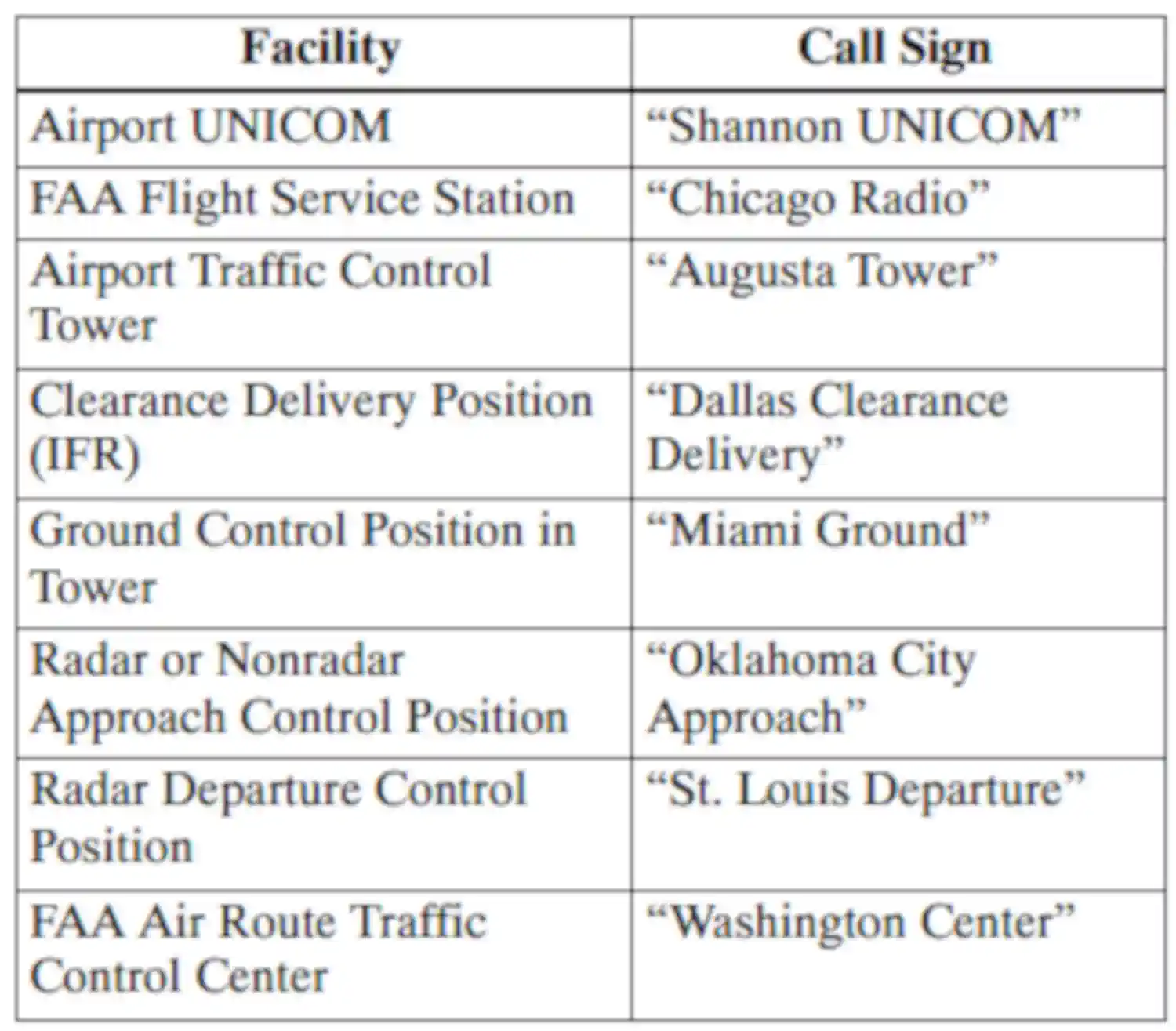
- Pilots, when calling a ground station, should begin with the name of the facility being called followed by the type of the facility being called. []
Callsigns Versus Telephonies
- Callsigns are alpha-numeric phrases such as "November One Seven Two Seven Victor"
- Registration-based call signs are commonly used in general aviation.
- A telephony designator, such as "Delta," combines with the flight number to form the aircraft call sign, such as "Delta 1199".
- Telephonies are most common in commercial aviation
Callsigns Interactive Scenario
The Similar Call Signs on Tower Frequency
Manage one busy tower arrival as abbreviation, similar call signs, commercial identifiers, student status, and readback discipline create repeated opportunities for a clearance error. Abbreviations used in this scenario: Aeronautical Information Manual (AIM).
Scenario Complete
Callsigns Knowledge Check
Choose the knowledge check that matches your current training for Callsigns.
 Private Pilot
PPL knowledge check
Core Knowledge Review
Review foundational knowledge, key concepts, and practical considerations. Topic: Callsigns.
- Immediate feedback
- Answer explanations
- Account progress tracking
 Commercial Pilot
CPL knowledge check
Advanced Application
Apply knowledge to advanced operations, risk management, and aeronautical decision-making. Topic: Callsigns.
- Immediate feedback
- Answer explanations
- Account progress tracking
Why Take a Quiz?
Quizzes reinforce key concepts, identify knowledge gaps, and build confidence for real-world decisions. Quiz material is representative of the information provided here and is not based on or sourced from the Federal Aviation Administration test bank.
Callsigns Conclusion
- Although callsigns are procedural to air operations, they have an aspect of safety
- Listen to these unique identifiers to pick up on what they're doing, or being instructed to do, especially in the terminal area
- Don't be afraid to use your tools as well, such as student pilot declaration
- The Air Traffic Organization (ATO) headquarters' (HQ) Aeronautical Information Management (AIM) Office (AJV-2) (Callsigns@faa.gov) assigns the designators when the Federal Aviation Administration (FAA) determines that designators are advantageous and operationally appropriate to the U.S. ATC system
- Still looking for something? Continue searching:
Callsigns References
- Federal Aviation Administration - Pilot/Controller Glossary.
- Advisory Circular (120-26) Assignment of Aircraft Call Signs and Associated Telephonies.
- Aeronautical Information Manual (4-2-4) Aircraft Call Signs.
- Aeronautical Information Manual (4-2-5) Description of Interchange or Leased Aircraft.
- Aeronautical Information Manual (4-2-6) Ground Station Callsigns.
- Aeronautical Information Manual (4-3-25) Flight Inspection / "Flight Check" Aircraft in Terminal Areas.
- Aeronautical Information Manual (4-4-1) Clearance.
- FAA - Order JO 7340.2 (1-4-1) General.
- FAA - Order JO 7110.10
- FAA - Order JO 7610.12
- FAA Safety Briefing - Sorry, Wrong Number: A Fresh Look At Avoiding Callsign Mismatch Issues.