Notice To Airmen
Notice to Airman contain changes and notifications to pilots that are temporary or not yet reflected in appropriate documents.
Introduction to Notice To Airmen
- Aeronautical information is disseminated to pilots through the Aeronautical Information System when information is predictable.
- The NOTAM system provides pilots with time critical aeronautical information that is temporary, or information to be published on aeronautical charts at a later date, or information from another operational publication.
- The NOTAM system does not advertise data already published or charted.
Abbreviations used below: Navigational Aid (NAVAID).
- A NOTAM normally remains active until the condition returns to normal or the information is correctly incorporated into every applicable publication or chart.
- However, a NAVAID-outage NOTAM remains active until the NAVAID returns to service, is published as shut down, or is decommissioned.
- NOTAMs may be disseminated up to 7 days before the start of activity.
- The NOTAM system does not advertise data already published or charted.
- Pilots can access NOTAM information via FSS or online via NOTAM Search at: https://notams.aim.faa.gov/notamSearch/.
- NOTAMs are then published online.
- Test your understanding of Notice To Airmen by completing the knowledge quiz, applying your knowledge in the interactive scenario, comparing your performance against the applicable Airman Certification Standards, and concluding with the topic summary to reinforce the key concepts before moving on to the next lesson.
Notice To Airmen Key Highlights
- Notices to Airmen (NOTAMs) provide time-critical aeronautical information that may affect flight safety and operational decision-making.
- NOTAMs communicate changes or hazards related to airports, airspace, navigation aids, runways, lighting systems, and flight procedures.
- Pilots are responsible for reviewing applicable NOTAMs during preflight planning and before flight operations.
- Common NOTAM categories include runway closures, Temporary Flight Restrictions (TFRs), navigation aid outages, and airspace changes.
- Flight Data Center (FDC) NOTAMs contain regulatory information such as instrument procedure amendments and airspace restrictions.
- NOTAM information may change rapidly and should be verified using current FAA-approved sources before departure.
- Electronic Flight Bags (EFBs), flight planning systems, and FAA briefing services commonly distribute NOTAM information.
- Failure to review NOTAMs can result in operational disruptions, airspace violations, or increased safety risk during flight operations.
- Pilots should interpret NOTAM abbreviations and formatting carefully to understand operational impacts accurately.
- Understanding Notices to Airmen improves situational awareness, preflight preparation, and overall flight safety.
NOTAM Content
- In accordance with 14 CFR (Code of Federal Regulations) 91.103, Preflight Action, directs pilots to become familiar with all available information concerning a planned flight prior to departure, including NOTAMs.
- Pilots may change their flight plan based on available information.
- Current NOTAM information may affect:
- Aerodromes.
- Runway, taxiway, and ramp restrictions.
- Obstructions.
- Communications.
- Airspace.
- Changes in the status of navigational aids, landing systems, or radar service availability.
- Hazards, such as air shows, parachute jumps, kite flying, and rocket launches.
- Flights by important people such as heads of state.
- Military exercises with resulting airspace restrictions.
- Inoperable lights on tall obstructions.
- Temporary erection of obstacles near airfields.
- Other information essential to planned en route, terminal, or landing operations.
- Searched by either searching for an airport or center.
- Example: Boston International Airport: KBOS.
- Example: Miami Center: ZMA.
- NOTAMs are available through Flight Service Station (FSS), private vendors, and many online websites.
-
NOTAM Composition:
Abbreviations used below: Coordinated Universal Time (UTC).
- A domestic NOTAM begins with an exclamation point, the accountability location, the NOTAM number and affected location, and the applicable keyword.
- When applicable, the keyword is followed by an attribute, activity, or surface designator; affected surface segment; facility, feature, service, or system; location description; altitude limits; changed condition; reason; remarks; and schedule.
- A surface designator is required when the keyword is RWY, TWY, or APRON.
- Altitudes from the surface through 17,999 feet are expressed in feet; feet are MSL (Mean Sea Level) unless AGL (Above Ground Level) is stated. Altitudes at or above 18,000 feet are expressed as flight levels.
- A schedule identifies the recurring periods during which the condition is active and appears before the NOTAM's overall validity period. "DLY" means that the activity occurs at the same time each day during the stated validity period.
- The start of activity and end of validity are normally expressed as 10-digit UTC date-time groups in YYMMDDHHMM format. "EST" means the ending time is estimated, while "PERM" means the condition is intended for publication and will not automatically expire.
- Interpret NOTAM status terms according to their specific meanings:
- "U/S" or "unserviceable" means that the equipment, NAVAID, facility, or service is not operational, is not certified when certification is required, and is not immediately available for use.
- "NOT AVBL" means that a facility, equipment item, or service is not accessible or is not being provided as published during normal operations.
- "UNUSABLE" means that a NAVAID is unavailable for operational use because it may provide unsafe or erroneous signals, or signals of unknown quality.
- A "(U)" prefix identifies unverified aeronautical information that meets NOTAM criteria but has not been confirmed by the airport manager or designee.
NOTAM Dissemination and Availability
- The system for disseminating aeronautical information consists of the Aeronautical Information System, which provides charts and publications containing baseline data, and the NOTAM System, which distributes qualifying temporary or time-critical changes.
-
Aeronautical Information System:
- The AIS consists of your usual charts and publications and is disseminated by the following methods:
- Aeronautical charts depicting permanent baseline data:
- IFR (Instrument Flight Rules) Charts-Enroute High Altitude Conterminous U.S., Enroute Low Altitude Conterminous U.S., Alaska Charts, and Pacific Charts.
- U.S. Terminal Procedures-Departure Procedures (DPs), Standard Terminal Arrivals (STARs) and Standard Instrument Approach Procedures (SIAPs).
- VFR (Visual Flight Rules) Charts-Sectional Aeronautical Charts, Terminal Area Charts (TAC), and World Aeronautical Charts (WAC).
- Flight information publications outlining baseline data:
- Chart Supplement U.S. (formerly Chart Supplement U.S.).
- Pacific Chart Supplement.
- Alaska Supplement.
- Alaska Terminal.
- Aeronautical Information Manual (AIM).
- Aeronautical charts depicting permanent baseline data:
- The AIS consists of your usual charts and publications and is disseminated by the following methods:
-
NOTAM System:
- Pilots can obtain current NOTAM information through Flight Service, the FAA's NOTAM Search website, and flight-planning or briefing services that receive current FAA NOTAM data.
- Defense NOTAMs can be found at Defense Internet NOTAM Service.
-
Destination Update:
- Pilots should also contact ATC or FSS while en route to obtain updated airfield information for their destination. This is particularly important when flying to the airports without an operating control tower. Snow removal, fire and rescue activities, construction, and wildlife encroachment, may pose hazards to pilots. This information may not be available to pilots prior to arrival/departure.
-
GPS NOTAMs:
- The FAA issues information on the status of GPS through the NOTAM system. Operators may find information on GPS satellite outages, GPS testing, and GPS anomalies by specifically searching for GPS NOTAMS prior to flight.
Abbreviations used below: Area Navigation (RNAV).
- The NOTAM system uses "UNRELIABLE" or "UNREL," "MAY NOT BE AVAILABLE" or "MAY NOT BE AVBL," and "NOT AVAILABLE" or "NOT AVBL" to describe GPS or WAAS service limitations. "UNREL" warns that the expected level of service may not be available, while "NOT AVBL" states that the service is not accessible or is not being provided as published.
- GPS operations may also be NOTAMed for testing. This is indicated in the NOTAM language with the name of the test in parenthesis. When GPS testing NOTAMS are published and testing is actually occurring, ATC will advise pilots requesting or cleared for a GPS or RNAV (GPS) approach, that GPS may not be available and request the pilot's intentions. TBL 5-1-1 lists an example of a GPS testing NOTAM.
- The FAA issues information on the status of GPS through the NOTAM system. Operators may find information on GPS satellite outages, GPS testing, and GPS anomalies by specifically searching for GPS NOTAMS prior to flight.
-


NOTAM Classification
- NOTAM information is classified into four categories:
-
Domestic, or NOTAM (D):
- Contains information for all navigational facilities that are part of the National Airspace System (NAS), all public use aerodromes, seaplane bases, and heliports listed in the Chart Supplement U.S. []
- U.S. NOTAM (D) information includes taxiway closures, personnel and equipment near or crossing runways, and airport lighting aids that do not affect instrument approach criteria (i.e., VGSI (Visual Glide Slope Indicator)).
- NOTAM (D) are categorized by subject; for example, APRON (ramp), RWY (runway), SVC (Services), etc.
- There are several types of NOTAM (Ds):
- Aerodrome activity and conditions, to include field conditions.
- Airspace to include CARF, SAA, and general airspace activity like UAS or pyrotechnics.
- Special Activity Airspace (SAA) includes special use airspace, instrument and visual military training routes, and aerial-refueling tracks and anchors.
- A NOTAM is used to activate permanent or temporary SAA when the airspace is activated by NOTAM only or at other than published times for SAA containing a NOTAM provision in its legal description.
- Pilots and other users remain responsible for checking published schedule times for special use airspace as well as applicable NOTAMs.
- Visual and radio navigational aids.
- Communication and services.
- Pointer NOTAMs are NOTAM Ds used only to direct users to traffic-management-program alerts, temporary flight restrictions, or temporary special use airspace information. A pointer is originated only for an aerodrome directly affected by the referenced activity, uses the same keyword as the original NOTAM, and identifies the original affected location, NOTAM number, and subject after the word "SEE."
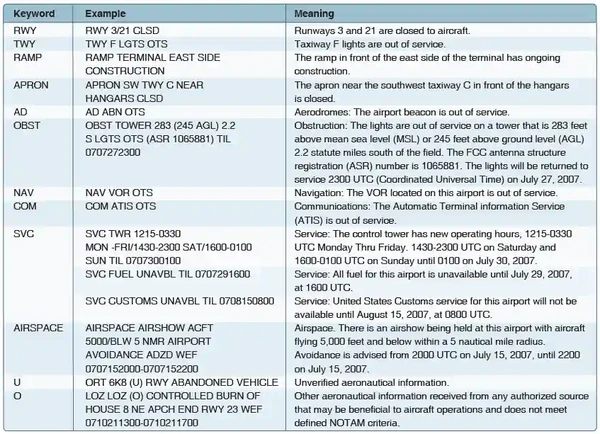
- All NOTAM (Ds) are required to have one of the following keywords as the first part of the text:
- RWY: Runway.
- TWY: Taxiway.
- APRON: Apron.
- AD: Aerodrome.
- OBST: Obstruction.
- NAV:Navigation.
- COM: Communications.
- SVC: Service.
- AIRSPACE: Airspace.
-
Flight Data Center (FDC) NOTAMs:
- FDC NOTAMs are issued when it is necessary to disseminate regulatory information. FDC NOTAMs include NOTAMs such as:
- FDC NOTAMs normally contain regulatory information, including interim changes to air traffic service routes, instrument approaches, obstacle departure procedures, SIDs (Standard Instrument Departures), STARs, airspace, temporary flight restrictions, special-security instructions, charting corrections, and laser activity.
- Amendments to published instrument approach procedures and other current aeronautical charts.
- Temporary Flight Restrictions (TFRs) restrict entrance to a certain airspace at a certain time, however, some TFRs provide relief if ATC permission is given to enter the area when requested.
- Online preflight resources for TFRs provide graphics and plain language interpretations.
- High barometric pressure warning.
- Laser light activity.
- ADS-B (Automatic Dependent Surveillance-Broadcast), TIS-B (Traffic Information Service-Broadcast), and FIS-B (Flight Information Service-Broadcast) service availability.
- Satellite-based systems such as WAAS (Wide Area Augmentation System) or GPS.
- Special Notices.
- Security NOTAMS:
- U.S. Domestic Security NOTAMS are FDC NOTAMS that inform pilots of certain U.S. security activities or requirements, such as Special Security Instructions for aircraft operations to, from, within, or transitioning U.S. territorial airspace. These NOTAMS are found on the Federal NOTAM System (FNS) NOTAM Search website under the location designator KZZZ.
- United States International Flight Prohibitions, Potential Hostile Situations, and Foreign Notices are issued by the FAA and are found on the Federal NOTAM System (FNS) NOTAM Search website under the location designator KICZ.
- FDC NOTAMs are issued when it is necessary to disseminate regulatory information. FDC NOTAMs include NOTAMs such as:
-
International NOTAMs:
- International notices to airmen (NOTAMs) follow the International Civil Aviation Organization (ICAO) format established in Annex 15 and are distributed internationally.
- International NOTAMs issued by the U.S. NOTAM Office use Series A followed by a four-digit sequence number, a slash, and the two-digit year of issuance.
- These international NOTAMs generally duplicate information published in a U.S. domestic NOTAM.
- The United States does not issue every domestic NOTAM subject internationally, but it links an international NOTAM to the corresponding U.S. domestic NOTAM when possible.
- The FAA stores international NOTAMs received from other countries in the U.S. NOTAM System.
- Some countries may issue a BIRDTAM to warn of significant bird activity or migrating flocks.
- A SNOWTAM may report runway, taxiway, or apron conditions involving snow, ice, slush, or standing water.
- An ASHTAM may report an operationally significant change in volcanic activity, including volcanic ash clouds.
- The ICAO international NOTAM format uses an encoded Q line and Items A through G:
- Q line: Encoded information used to identify and distribute the NOTAM.
- Item A: ICAO location indicator or flight information region (FIR) affected.
- Item B: Start of validity.
- Item C: End of validity, with Items B and C expressed as year, month, day, hour, and minute.
- Item D, when present: Schedule.
- Item E: Plain-language NOTAM description using approved abbreviations where appropriate.
- Item F, when present: Lower altitude limit or "SFC" for the surface.
- Item G, when present: Upper altitude limit or "UNL" for unlimited.
- See ICAO Annex 15 for additional information about the international NOTAM format.
-
Military NOTAMs:
- NOTAMs originated by the U.S. Air Force, Army, Marine, or Navy, and pertaining to military or joint-use navigational aids/airports that are part of the NAS. Military NOTAMs are published in the International NOTAM format and should be reviewed by users of a military or joint-use facility.
- This includes GPS testing which can be found here.
Notice To Airmen Interactive Scenario
Interactive Scenario
Loading scenario details...
Scenario Complete
Notice To Airmen Knowledge Check
Choose the knowledge check that matches your current training for Notice To Airmen.
 Private Pilot
PPL knowledge check
Core Knowledge Review
Review foundational knowledge, key concepts, and practical considerations. Topic: Notice To Airmen.
- Immediate feedback
- Answer explanations
- Account progress tracking
 Commercial Pilot
CPL knowledge check
Advanced Application
Apply knowledge to advanced operations, risk management, and aeronautical decision-making. Topic: Notice To Airmen.
- Immediate feedback
- Answer explanations
- Account progress tracking
Why Take a Quiz?
Quizzes reinforce key concepts, identify knowledge gaps, and build confidence for real-world decisions. Quiz material is representative of the information provided here and is not based on or sourced from the Federal Aviation Administration test bank.
Notice To Airmen Conclusion
- Pilots are encouraged to provide PIREPs (Pilot Weather Reports), even when the weather is not significant.
- This is especially significant when the weather is different from reported.
- Air traffic control (ATC) may also request PIREPs to help build situational awareness for themselves and other pilots in the area.
- ARTCC NOTAMs. Pilots should also review NOTAMs for the ARTCC area (for example, Washington Center (ZDC), Cleveland Center (ZOB), etc.) in which the flight will be operating. You can find the 3 letter code for each ARTCC on the FAA's NOTAM webpage. These NOTAMs may affect the planned flight. Some of the operations include Central Altitude Reservation Function (CARF), Special Use Airspace (SUA), Temporary Flight Restrictions (TFR), Global Positioning System (GPS), Flight Data Center (FDC) changes to routes, wind turbine, and Unmanned Aircraft System (UAS).
- Although sometimes non-intuitive, NOTAM information is transmitted using standard contractions to reduce transmission time.
- A comprehensive list of keywords & abbreviations can be found under Aeronautical Information Manual (5-1-3) Notice to Airmen (NOTAM) System.
- For a complete listing, see FAA Order JO 7340.2, Contractions.
- Note that the Notice to Airman Publication (NTAP) has been discontinued in favor of web services.
- See also Pilot Workshops - Do You Have the NOTAMs?.
- Still looking for something? Continue searching:
Notice To Airmen References
- Advisory Circular (150/5200-28) Notice to Airmen (NOTAMs) for Airport Operators.
- Federal Aviation Administration (FAA) - Pilot/Controller Glossary.
- Aeronautical Information Manual (5-1-3) Notice to Airmen (NOTAM) System.
- Federal Aviation Administration Order 7930.2U, Change 1—Notice to Airmen (NOTAM).
- Notices to Airmen (NOTAMS).
- FAA Order (JO 7340.2) Contractions.
- CFI Notebook.net - Instrument Approach Procedures.
- CFI Notebook.net - Navigation Charts.
- CFI Notebook.net - Chart Supplement U.S..
- CFI Notebook.net - Air Route Traffic Control Center (ARTCC).
- CFI Notebook.net - Preflight Briefing.
- Aircraft Owners and Pilots Association (AOPA) Air Safety Institute - SkySpotter, PIREPS made easy.
- NOTAMs - Back to Basics: Pilots.
- NOTAMS - Back to Basics: Airports.
- Federal Aviation Administration - Aeronautical Information Portal.