Braking Action & Runway Friction Reports & Advisories
Landing performance depends on the aircraft's ability to decelerate and maintain directional control; runway condition and expected braking action are critical inputs.
Introduction to Braking Action & Runway Friction Reports & Advisories
- Landing performance depends on the aircraft's ability to decelerate and maintain directional control after touchdown; runway condition and expected braking action are critical inputs.
- Friction is the tangential force needed to maintain uniform relative motion between two contacting surfaces to the perpendicular force holding them in contact
- The coefficient of friction describes the available tire-to-surface traction; less usable friction means less braking and lateral control.
- Runway condition reports and advisories are critical planning inputs.
- When available, Air Traffic Control (ATC) furnishes Braking Action Reports and Advisories.
- Test your understanding of Braking Action & Runway Friction Reports & Advisories by completing the knowledge quiz, applying your knowledge in the interactive scenario, comparing your performance against the applicable Airman Certification Standards, and concluding with the topic summary to reinforce the key concepts before moving on to the next lesson.
Braking Action & Runway Friction Reports & Advisories Key Highlights
- Braking action and runway friction reports provide pilots with information about runway surface conditions and stopping capability.
- Runway contamination from water, snow, slush, ice, or rubber buildup can reduce braking effectiveness and directional control.
- Pilots may receive braking action advisories categorized as good, good to medium, medium, medium to poor, poor, or nil.
- Airport operators use the Runway Condition Assessment Matrix to report contaminant and runway-condition information; pilots combine that information with aircraft-specific performance data.
- Reduced braking action increases landing distance requirements and may affect rejected takeoff performance.
- Pilots should evaluate runway condition reports, aircraft performance data, and environmental conditions before takeoff or landing.
- Hydroplaning can occur when water accumulation prevents tires from maintaining effective contact with the runway surface.
- Crosswinds combined with poor braking conditions can significantly reduce aircraft controllability during landing roll operations.
- Air traffic control and airport operations personnel distribute runway condition information through advisories, NOTAMs, and pilot reports.
- Understanding braking action and runway friction information improves aeronautical decision-making and overall runway safety.
Runway Friction Reports and Advisories
- Aircraft braking coefficient is dependent upon the surface friction between the tires on the aircraft wheels and the pavement surface.
- Less friction means less aircraft braking coefficient and less aircraft braking response.
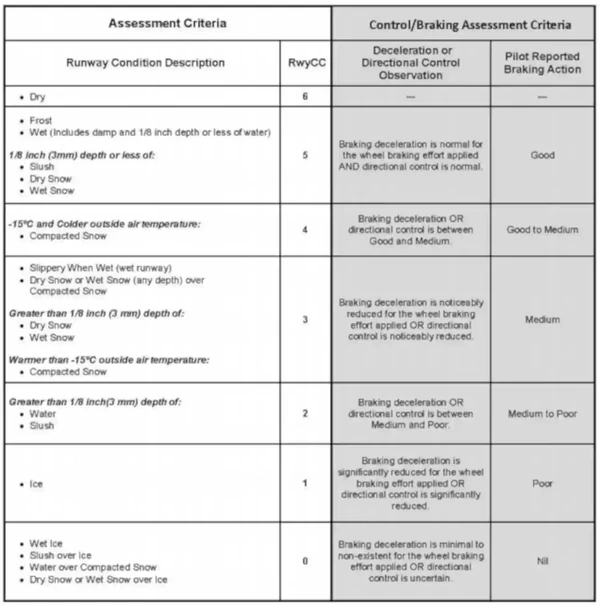
- Runway condition code (RwyCC) values range from 1 (poor) to 6 (dry)
- A Runway Condition Code is generated only for paved runways when contamination covers more than 25 percent of the full runway; nonpaved-surface NOTAMs do not include a RwyCC.
- For frozen contaminants on runway surfaces, a runway condition code reading of 4 indicates the level when braking deceleration or directional control is between good and medium.
- A RwyCC of "0" is used to delineate a braking action report of NIL and is prohibited from being reported in a FICON NOTAM.
- Airport management should conduct runway condition assessments on wet runways or runways covered with compacted snow and/or ice.
- Numerical readings may be obtained by using the Runway Condition Assessment Matrix (RCAM).
- The RCAM provides the airport operator with data to complete the report that includes the following:
- Runway(s) in use
- Time of the assessment.
- Runway condition codes for each zone (touchdown, mid-point, roll-out)
- Pilot-reported braking action report (if available).
- The contaminant (for example, wet snow, dry snow, slush, ice, etc.)
- Assessments for each zone (touchdown, mid-point, roll-out) will be issued in the direction of takeoff and landing on the runway, ranging from "1" to "6" to describe contaminated surfaces.
- A RwyCC of "0" is used to delineate a braking action report of NIL and is prohibited from being reported in a FICON NOTAM.
- When any 1 or more runway condition codes are reported as less than 6, airport management must notify ATC for dissemination to pilots.
- Controllers will not issue runway condition codes when all 3 segments of a runway are reporting values of 6.
- When runway condition code reports are provided by airport management, the ATC facility providing approach control or local airport advisory must provide the report to all pilots
- Pilots should use runway condition code information with other knowledge including aircraft performance characteristics, type, and weight, previous experience, wind conditions, and aircraft tire type (such as bias ply vs. radial constructed) to determine runway suitability
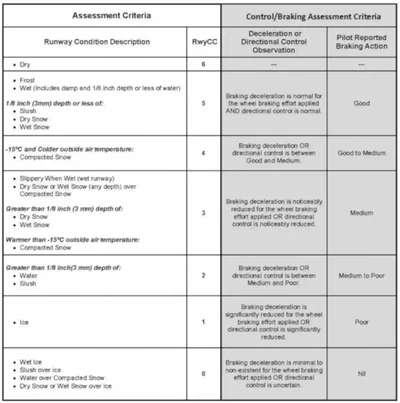
- The Runway Condition Assessment Matrix identifies the descriptive terms "good," "good to medium," "medium," "medium to poor," "poor," and "nil" used in braking action reports. []
Braking Action Reports and Advisories
- When available, air traffic control (ATC) relays pilot braking-action reports using the terms good, good to medium, medium, medium to poor, poor, or nil.
- Pilots should identify the affected portion of the runway and aircraft type, such as, "Braking action poor on the first half of the runway, Cessna 172."
- Field condition (FICON) NOTAMs provide contaminant measurements for paved runways, but braking-action terms are used only for unpaved runways, taxiways, and aprons.
- The FICON NOTAM uses the most critical reported braking-action term: good to medium, medium, medium to poor, or poor.
- Federally obligated airports and airports certificated under Title 14 of the Code of Federal Regulations (14 CFR) Part 139 may not report paved-runway braking conditions in a FICON NOTAM.
- At these airports, a nil braking condition requires closure of the affected surface, and the FICON NOTAM must not identify the reporting vehicle type.
- The FICON NOTAM uses the most critical reported braking-action term: good to medium, medium, medium to poor, or poor.
- When braking is reported as medium, poor, or nil—or conditions may deteriorate rapidly—the tower adds "Braking action advisories are in effect" to the automatic terminal information service (ATIS) broadcast.
- While braking action advisories are in effect, ATC provides the most recent report for the runway in use to each arriving and departing aircraft.
- Pilots should anticipate deteriorating conditions, request current runway information if ATC does not provide it, and report the observed braking action after landing.
Braking Action & Runway Friction Reports & Advisories Interactive Scenario
Interactive Scenario
Loading scenario details...
Scenario Complete
Braking Action & Runway Friction Reports & Advisories Knowledge Check
Choose the knowledge check that matches your current training for Braking Action & Runway Friction Reports & Advisories.
 Private Pilot
PPL knowledge check
Core Knowledge Review
Review foundational knowledge, key concepts, and practical considerations. Topic: Braking Action & Runway Friction Reports & Advisories.
- Immediate feedback
- Answer explanations
- Account progress tracking
 Commercial Pilot
CPL knowledge check
Advanced Application
Apply knowledge to advanced operations, risk management, and aeronautical decision-making. Topic: Braking Action & Runway Friction Reports & Advisories.
- Immediate feedback
- Answer explanations
- Account progress tracking
Why Take a Quiz?
Quizzes reinforce key concepts, identify knowledge gaps, and build confidence for real-world decisions. Quiz material is representative of the information provided here and is not based on or sourced from the Federal Aviation Administration test bank.
Braking Action & Runway Friction Reports & Advisories Conclusion
- Key runway-condition terms include Takeoff and Landing Performance Assessment (TALPA), Runway Condition Assessment Matrix (RCAM), runway condition code (RwyCC), and field condition (FICON) NOTAM.
- Pilots should report experienced braking action to ATC using the applicable descriptive term, affected runway portion, and aircraft type.
- Likewise, airports are looking at methods to maintain surface condition, like electrically conductive concrete (ECON) materials
- Still looking for something? Continue searching:
Braking Action & Runway Friction Reports & Advisories References
- Federal Aviation Administration - Pilot/Controller Glossary.
- Advisory Circular 91-79B, Aircraft Landing Performance and Runway Excursion Mitigation.
- Advisory Circular (150/5200-30D) Airport Field Condition Assessments and Winter Operations Safety.
- Aeronautical Information Manual (4-3-8) Braking Action Reports and Advisories.
- Aeronautical Information Manual (4-3-9) Runway Condition Reports.
- Reddit - Runway Condition Codes Questions!.