Formation Flying
Formation flying is the intentional operation of two aircraft in a pattern for either utility or show.
Introduction to Formation Flying
- Formation flight is a very challenging and rewarding aspect of flight, typically associated with the military, used to expedite aircraft departures and recoveries when operating in large numbers or adverse weather
- Formation flying shall only be conducted after a thorough pre-flight brief that is conducted by the formation leader
- Formation flying requires structured, incremental training; a brief alone does not prepare a pilot for close formation operations.
- Before conducting close-formation operations, complete appropriate formation training, demonstrate suitability to an experienced formation lead, and maintain proficiency through recurring practice, detailed briefs, and candid debriefs.
- Test your understanding of Formation Flying by completing the knowledge quiz, applying your knowledge in the interactive scenario, comparing your performance against the applicable Airman Certification Standards, and concluding with the topic summary to reinforce the key concepts before moving on to the next lesson.
WARNING:
All procedures are GENERALIZED.
Use the Pilot Operating Handbook (POH) procedures for specific aircraft performance and limitations.
and/or current Standard Operating Procedures (SOPs).
Formation Flying Key Highlights
- Formation flying involves operating multiple aircraft in close proximity using coordinated procedures and precise aircraft control.
- Formation operations require specialized training, standardized communication, and disciplined coordination between participating pilots.
- Lead aircraft are responsible for navigation, maneuver coordination, and maintaining overall formation organization.
- Wing pilots maintain assigned position references while adjusting power, pitch, and bank smoothly to preserve spacing.
- Formation flying demands continuous situational awareness and precise control inputs to prevent collision hazards.
- Wake turbulence, propeller wash, and jet blast can affect aircraft handling and spacing during close formation operations.
- Standardized visual signals and radio communication procedures improve coordination and operational safety within the formation.
- Weather conditions, visibility, and aircraft performance limitations significantly affect formation flying operations.
- Improper spacing or abrupt maneuvering can rapidly create hazardous conditions during formation flight.
- Understanding formation flying improves aircraft control precision, coordination skills, and overall flight safety.
Formation Flight Defined
- Formation flight is when more than one aircraft, by prior arrangement between the pilots, operates as a single aircraft with regard to navigation and position reporting
- Separation between aircraft within the formation is the responsibility of the flight leader and the pilots of the other aircraft in the flight.
- This includes transition periods when aircraft within the formation are maneuvering to attain separation from each other to effect individual control and during join-up and breakaway.
-
Standard Formations:
- A standard formation is one in which each wingman maintains a proximity of no more than 1 mile laterally or longitudinally and within 100 feet vertically from the flight leader.
-
Non-Standard Formations:
- Non-standard formations are those operating under any of the following conditions:
- When the flight leader has requested and ATC has approved other than standard formation dimensions.
- When operating within an authorized altitude reservation (ALTRV) or under the provisions of a letter of agreement.
- When the operations occur in airspace specifically designed for a special activity.
- Non-standard formations are those operating under any of the following conditions:
Rules to live by
- Rules to live by:
- The higher numbers in the formation must avoid all lower numbers:
- -4 must avoid -3, -2, and Lead;
- -3 must avoid -2 and Lead;
- -2 must avoid Lead
- Commonly referred to as "4 avoids 3 avoids 2 avoids 1".
- Collision avoidance is in reference to the position you're flying, not necessarily your formation number
- The higher numbers in the formation must avoid all lower numbers:
- Radios:
- Comm 1 (primary) is for ATC and other external frequencies
- Comm 2 (aux/tac) is for intra-formation calls
- Always de-conflict prior to transiting anyone's altitude
Formation Preflight
- The formation leader shall execute one flight plan for the entire formation and shall:
- Sign the flight plan form as PIC
- Ensure that all pilots are briefed on en-route weather and navigational aids
- Ensure that each pilot holds a valid instrument rating if any portion of flight is to be under IMC
- Ensure that a flight leader formation brief is conducted to include, but not limited to:
- Loss of sight
- Lost communication
- Inadvertent IMC
- Emergency procedures
- Ensure that necessary maps, charts, and publications are in the possession of each pilot
- Ensure that formation integrity is maintained in flight
Formation Communications
- UNICOM/MULTICOM frequencies are available for use
Joining Formations
- Unless specifically ordered, a single aircraft shall not join a formation in the air
- One formation shall not join another formation
- The order for joining the formation in the air shall be given before takeoff of the aircraft concerned or by radio, and the leader of the formation to be joined shall be informed that the order has been given
- Exceptions to this paragraph may be made when the leader of a formation signals another aircraft to join the formation
- When about to join a formation, the pilot of a single aircraft or leader of other formations shall approach their formation position from a safe altitude and from the side
- They shall not take their final position until their presence has been acknowledged by the leader of the formation to be joined
- Whenever a lead change is required in a formation of two or more aircraft, it will be accomplished in an unambiguous manner
- Pilots shall ensure that both aircraft exchanging the lead are aware of the change through positive acknowledgment by visual signals or voice transmissions
- Standard section formation is parade on initial join-up and in IMC
- ATC Spread (within 1 NM and ± 100') should be used if VMC en route
- Standard division formation is fingertip on initial join-up and in IMC
- Fluid four (all aircraft within 1 NM and ± 100') should be used if VMC en route
- Using an A/A TACAN each 0.1 is 600'
Dissimilar Formation Flight
- Pilots involved should perform a preflight brief delineating all aspects of the pending formation flight
- Items to be briefed, in addition to those identified above, shall include items peculiar to either aircraft community (e.g., limitations/capabilities/hazards affecting the flight/rendezvous/join-up/separation)
Unplanned Formation Flight
- In the event unscheduled formation flight becomes necessary, every attempt shall be made by the aircrew involved to conduct a sufficient in-flight brief prior to join up
De-confliction
- Altitude blocks, if allowed, are the safest option
- Typically wing will have the higher block (1-4 and 5-9)
Parade to Position
- Used in congested areas, takeoff rendezvous, IMC, battle damage checks, traffic patterns, instrument conditions, airfield entries, demonstrations, etc. []
- The perfect parade position is transitory
- Defined as the intersection of the reference line with the bearing line
- Always maintain a good inside/outside scan (mission crosscheck)
- Smooth is best; jerky motions will displace the aircraft, but do nothing to move its position
- Wingtip overlap must be avoided for safety
WARNING:
All procedures are GENERALIZED.
Use the Pilot Operating Handbook (POH) procedures for specific aircraft performance and limitations.
and/or current Standard Operating Procedures (SOPs).-
Parade position Advantages:
- Provides good visual communication between aircraft, making it easier for the lead to maintain positive control
- Minimum use of airspace
- Presents a professional military appearance.
-
Parade Position Disadvantages:
- Less maneuverable than a single aircraft or a tactical formation
- The wingman constantly adjusts power, which results in fatigue and higher fuel consumption
- It restricts the wingman's lookout doctrine
-
Relative Motion:
- As wing, attempt to "zero out" motion
- Scan the entire aircraft, not just the key locations
- Elevator controls vertical movement
- Power controls fore and aft movement
- Aileron controls lateral movement
- When flying multi-plane forms, flying with increased lateral separation will reduce the relative motions making it easier to fly a smooth platform
-
Corrections:
- Corrections should be slight (as you gain experience you can do all 3 simultaneously)
- Corrections require 3 separate actions: ("3 part power corrections")
- Initiate movement toward the desired position
- Arrest the aircraft's momentum once the position has been achieved
- Maintain the desired position
- A: Step down
- B: Bearing
- C: Relative closeness
- Acute: forward of the bearing line
- Sucked: aft of the bearing line
- Can be with both power and aileron to maintain that bearing line
-
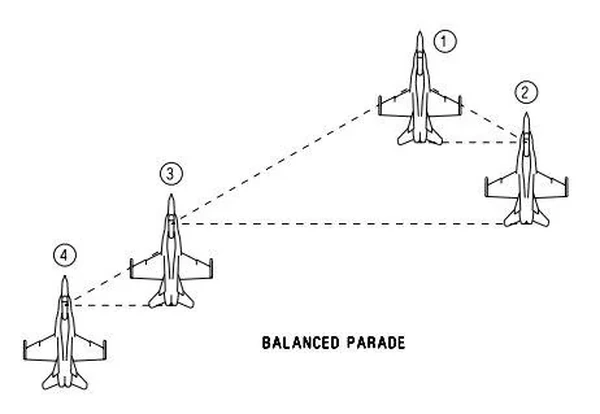
Balanced Parade:
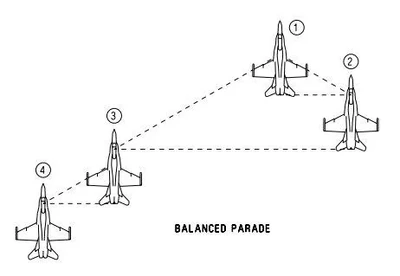
- After joining up in echelon, three and four plane formations will normally be placed in balance parade formation. []
- Dash-2 will "auto balance"
- Dash-3 will step out until the exhaust nozzles on Dash-2 are flush
- This will leave enough space between Dash-3 and Lead for
Dash-2 to cross under into echelon
- Turns:
- Dash-3 steps out opposite the formation of Dash-2, far enough back so that Dash-2's exhaust nozzles are flush, on lead's bearing line (bearing and step-down on lead, nose-to-tail off Dash-2)
- Dash-4 in parade on Dash-3
- After joining up in echelon, three and four plane formations will normally be placed in balance parade formation. []
-
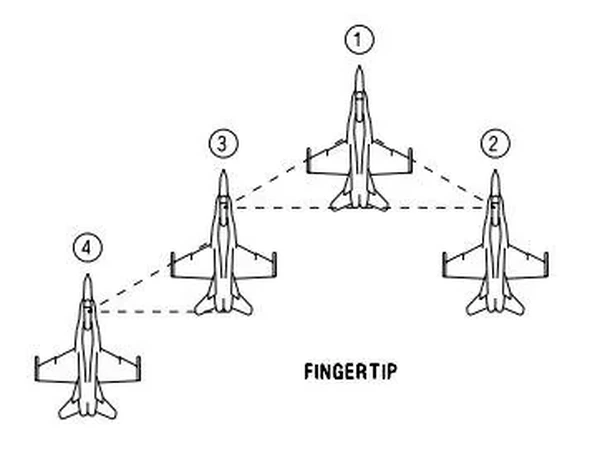
Fingertip Parade:
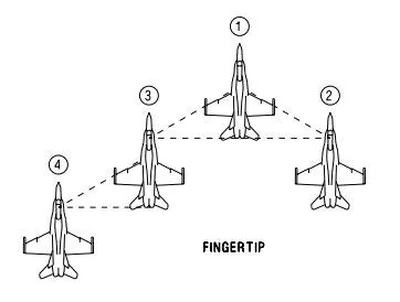
- When it is necessary to enter IFR conditions with a three or four plane formation, the lead will direct the flight to assume fingertip formation. []
- Dash-3 moves up directly opposite Dash-2 on lead into close parade on the lead
- All turns are instrument "welded wing" turns
-
Tips:
- Try not to over control the aircraft
- Trim the aircraft
- Brace your forearm on your knee board (rudders set back to provide higher knees)
- Relax! Try wiggling your fingers and toes - it's magic, it works!
- Control your breathing
- Walk the throttles and use small movements of the stick
- If you start to PIO, don't fix it all at once; stop the PIO then move back into position
- Scan lead, front to back, continuously
- Bring up the HUD on the DDI closest to lead to judge relative attitude
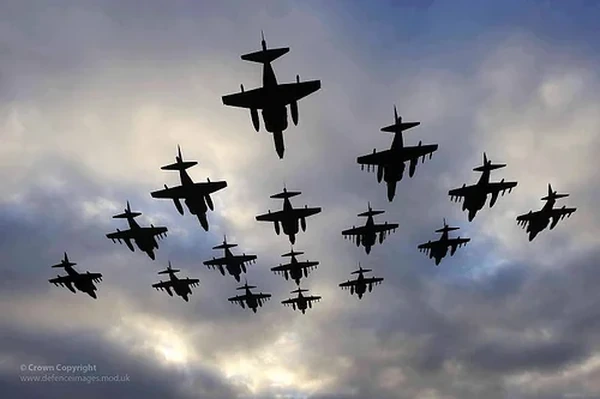
Positioning
- During both cruise and parade, you must be in a position to see hand and arm signals - if unable due to maneuvering, assume that position as soon as practical
Crossunders
- The purpose of a cross-under is to move the Wing from the parade position on one side of lead to the other
- Cross unders may be used to:
- Minimize Wing's exposure to sun
- Area management
- Breakup and rendezvous
- Returning to the airfield (overhead maneuver)
- The maneuver is performed slowly to control movement, and should be not be performed faster than a walking pace
- There are two methods to perform this maneuver, the box, and the V
WARNING:
All procedures are GENERALIZED.
Use the Pilot Operating Handbook (POH) procedures for specific aircraft performance and limitations.
and/or current Standard Operating Procedures (SOPs).-
Cross-under Mechanics:
- Throttles control nose-to-tail
- Nose controls step-down
- Angle of bank controls crossing rate
- All corrections should be "3 part power corrections".
-
Cross-under Procedure:
WARNING:
All procedures are GENERALIZED.
Use the Pilot Operating Handbook (POH) procedures for specific aircraft performance and limitations.
and/or current Standard Operating Procedures (SOPs).- LEAD: Check the wingman is in position and the area is clear
- LEAD: Give the cross-under signal
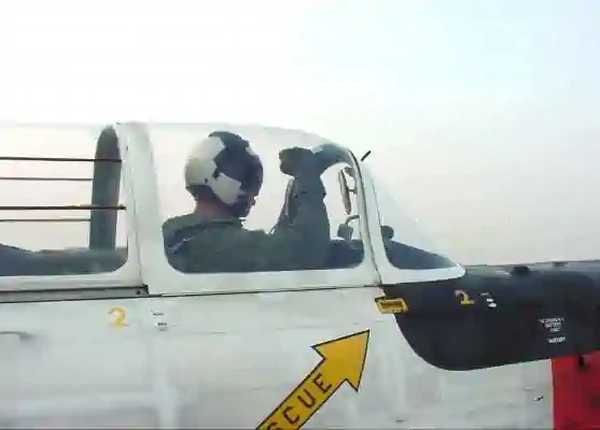
- The cross-under signal is a fist held vertically. []
- WING: Acknowledge receipt of the signal with a head-nod
- WING: Simultaneously reduce the power slightly and pitch down to increase step-down.
-
Perform the Step-down:
-
Box Method:
- Move straight back and down to achieve 10' of nose-to-tail and 15' of vertical separation
- If the horizontal stabilizer is swept, you will be looking roughly down the leading edge
- If the horizontal stabilizer is straight, you will be looking at the forward tip of the stabilizer moving toward the trailing edge of the wing
- Add power to stabilize in position.
-
V-Method:
- Move back at an angle while descending to establish 10' of nose-to-tail and 15' of vertical separation, established in column behind lead.
- Add power to stabilize in position.
-
-
Perform the Cross-under:
-
Box Method:
- Simultaneously add power while increasing bank angle to move laterally to the same position, but on the other side of lead
- Wing must achieve a controlled move to the other side of lead without disturbing the nose-to-tail clearance
- Wings nose should never be under leads tail, EVER
- Project yourself outside of leads wingtip to avoid driving too close
- Add power to stabilize in the stepped-down position
- Visual cues will remain the same as on the other side of lead
-
V Method:
- N/A
-
-
Return to Parade Position:
-
Box Method:
- Simultaneously add power and increase pitch to maneuver back into parade position
-
V Method:
- Complete the other side of the V, simultaneously adding power and increasing pitch to move back into parade position
-
-
Cross-under Common Errors:
- Failure to observer/recognize the cross-under signal given by lead
- Excessive control inputs
- Not applying power early enough to prevent excessive drift aft of lead
Introduction to Formation Flying
WARNING:
All procedures are GENERALIZED.
Use the Pilot Operating Handbook (POH) procedures for specific aircraft performance and limitations.
and/or current Standard Operating Procedures (SOPs).-
Aircraft Checks:
- While in the marshall/run-up area, the formation will perform aircraft checks whereby each pilot reviews the aircraft to their left/right
- Checks include:
- Taxi light on (day); off (night).
- Nose wheel straight
- Safety pins removed
- No fluids leaking
- Panels all closed.
- Flaps set for takeoff
- Stabs trimmed for takeoff.
- Speed brake/spoilers retracted.
- With checks complete, all aircraft will give the thumbs up to lead, and if outside of visual range (-4), report up on the internal frequency.
-
Formation Takeoff Positioning:
- Lead will normally take the downwind side of the runway
- Downwind is preferred to mitigate wake turbulence for those that follow
- If winds are calm, positioning does not matter
- If crosswind is not a factor (less than 10 knots) lead can take either side (usually the far side for jet blast on line up)
- Rule of Thumb: the windsock always points to the wingman (i.e. upwind)
- If IMC conditions are expected and winds are not a factor it may be desirable to place your wingman on the outside of the turn.
-
Section Positioning:
- Each aircraft will take the center of their half of the runway.
-
Three-Plane/Division Light Positioning:
- Lead downwind, -2 centerline and -3 on the upwind side
- -2 will be on bearing but -3 will be acute (tactical banana).
-
Division Positioning:
- Same as three plane but -4 will wait until clear to take the runway if less than 200' wide.
- Lead will normally take the downwind side of the runway
-
Takeoff Options:
-
Section Takeoff:
- Section takeoffs are used to launch multiple aircraft quickly without the necessity for rendezvous post-takeoff, especially if a flight must be established on course quickly or if poor weather conditions prevail
- Section takeoffs further mitigate FOD considerations, expedite departure, and establish mutual support
- Lead will operate at slightly less power to give wing a power advantage
- Throughout the maneuver, wing will maintain parade
- When two sections are to begin takeoff roll from the same point on the runway, the second section must delay takeoff roll until 10 seconds after the first section starts the takeoff roll
- When 2,000' of runway separation exists at the beginning of takeoff roll, use a 5-second delay instead of 10 seconds
- Differences in flying characteristics, especially stall speeds because of gross weight and/or configuration, and atmospherics like crosswind velocity shall be considered
- Similar configurations are required
- Each pilot remains responsible for observing aircraft limitations, including gear- and flap-operating limits, and must assume control or discontinue the maneuver if necessary.
- Section takeoffs are not performed if: the maximum crosswind component, temperature, takeoff roll, or significant difference in gross weight exceeds acceptable limits
- "Give me some" called by wing instructs lead to reduce power slightly
- "Power" called by wing instructs lead to increase power slightly
- Early lift-off by the wingman creates a less than ideal situation due to:
- Low altitude
- Step up on the lead
- Difficulty in keeping sight
- Leads impending rotation can be predicted by:
- Lead's stab deflection increasing
- Lead's nose strut beginning to extend
- Lead's nose gear (and perhaps main gear) leaving the runway.
- Section takeoffs are used to launch multiple aircraft quickly without the necessity for rendezvous post-takeoff, especially if a flight must be established on course quickly or if poor weather conditions prevail
-
Interval Takeoff:
- If situations permit a section or simo takeoff for FOD considerations
- Done to provide sufficient separation between aircraft on the takeoff roll so the trail aircraft can safely stop if the aircraft ahead aborts
- Used any time the winds are out of limits or when more than two aircraft are on the runway together
- Recommended minimum widths:
- 3-plane: 150'
- 4-plane: 200'
- Simultaneous (Simo) takeoff (dual runways): For FOD and abort considerations.
-
-
Interval Takeoff Procedure:
- Essentially, execute a normal takeoff with delay (5-10 seconds depending on standard operating procedure).
- After all aircraft are lined up on the runway a thumbs up will be passed through to lead
- Lead will give the run-up signal
- Run up to 80% as normal
- Check engine instruments and perform a wipeout as normal
- Check adjacent aircraft are ready for takeoff
- You will give each other a thumbs up
- When everyone is set for takeoff, -2 will give a thumbs up to lead
- Lead will give the kiss off signal and execute own takeoff
- The entire flight will remain at 80%
- 5-10 seconds after the aircraft in front of you has rolled - begin your takeoff
- Safely airborne, raise the gear and flaps and stabilize.
- Lead will be ~90%. to facilitate join-up.
- Last aircraft may taxi onto the runway when lead or -3 has begun their roll and there is no potential for jet blast or FOD
- Dash last shall report "Dash [#], airborne" on frequency.
-
Simultaneous Takeoff:
- Simultaneous takeoff procedures (dual runways) is nearly identical to interval takeoffs
- Use of radio will be necessary to substitute coordination otherwise conducted with hand/arm signals.
-
Formation Takeoff Tips:
- Resists the temptation to point at lead during the initial climbout
- Rendezvous are most efficient if you accelerate to the briefed rendezvous speed. and then raise the nose to maintain this speed at full. power
-
Night Considerations:
- Wing taxi lights should be off
Night Formation Flight
- You own the formation lights in front of you
- The cue for maintaining bearing line at night is to have lead slightly aft of the day cue, because of the reduced overtake
- DDI HUD display should be closest to lead for a shorter scan
- 25 knots maximum excessive speed
- All turns are IMC
- "lights" or "go midnight" can be used to determine if you found leads jet
Hand Signals
-
Formation:
Affirmative:
- Day: Thumbs up or head nod
- Night: Flashlight moved vertically up-and-down repeatedly
Negative:
- Day: Thumbs down or head shake
- Night: Flashlight moved horizontally back-and-forth repeatedly
Clarify:
- Day: Hand cupped behind ear as if listening
- Night: None
Wait:
- Day: Hand held up, palm toward pilot
- Night: None
Ignore Last Signal:
- Day: Hand waved back and forth in an erasing motion in front of face, with palm turned forward
- Night: Trace of letter N, given by external light
Numbers:
- Day:
- Fingers held vertically indicate 1 through 5
- Fingers held horizontally indicate 6 through 9
- A clenched fist indicates zero
- Night: None
- Day:
Equipment Malfunctions:
- To quickly pass equipment malfunctions across aircraft, numbers have been labeled to large systems (Abbreviated HEFOE-F):
- 1: Hydraulic
- 2: Electric
- 3: Fuel
- 4: Oxygen System
- 5: Engine
- 6: Flight Control System
- Day: Arms bend across forehead weeping indicated by the number 1 through 6
- Night: Flashlight held above head toward wingman, followed by 1 to 6 dashes
- To quickly pass equipment malfunctions across aircraft, numbers have been labeled to large systems (Abbreviated HEFOE-F):
-
Takeoff:
Lead Ready to Take Position on Runway:
- Day: Affirmative Signal
- Night: Lead turns formation lights off
Wingman Ready to Take Position on Runway:
- Day: Affirmative Signal
- Night: Wingman turns formation lights off
Wingman Ready for Takeoff:
- Day: Affirmative Signal
- Night: Wingman turns formation lights on
Takeoff in Sequence:
- Day: Lead kisses off wingman
- Night: Lead turns on formation lights
-
Lead Changes:
You have the lead:
- Day: Leader pats self on the head and points to wingman
- Night: Lead turns strobes on or points flashlight at head then to wingman
Designate new lead:
- Day: Leader pats self on the head and hold up two or more fingers
- Night: None
-
Leaving/Breakup Formation:
Leaving Formation:
- Day: Blows kiss to leader
- Night: None
Designate Aircraft to Leave Formation:
- Day: Leader blows kiss and points to aircraft
- Night: None
Investigate Area:
- Day: Leader points to wingman then points to eye then to area
- Night: None
Breakup Formation:
- Day: Leader holds up and rotates two fingers in horizontal circle
- Night: None
Breakup & Rendezvous:
- Day: Leader holds up and rotates horizontal circle
- Night: Series of Is in code given by external lights
-
Landing:
I am landing:
- Day: Landing motion with open hand followed by patting head
- Night: None
You Land:
- Day: Landing motion with open hand followed by pointing to another aircraft
- Night: None
-
Inflight:
Adjust Wing Position Fore or Aft:
- Day: Open hand held vertically and moved forward or backward, palm facing the intended direction
- Night: None
Adjust Wing Position Up or Down:
- Day: Open hand held vertically and moved up or down, palm facing the intended direction
- Night: None
Adjust Wing Position In or Out:
- Day: Open hand held vertically and moved in or out, palm facing the intended direction
- Night: None
I am going to Climb or Descend:
- Day: Open hand flat and palm down, simulating a dive or climb
- Night: None
I am going to Level-off:
- Day: Open hand flat and palm down, moved horizontally above the glare shield
- Night: None
Turn Transponder to Standby:
- Day: Two fingers pointed toward eyes followed by cut
- Night: None
Set Transponder Mode/Code:
- Day: Two fingers pointed toward eyes followed by the code
- Night: None
Slow down:
- Day: Move head backward
- Night: None
Speed up:
- Day: Move head forward
- Night: None
Turn:
- Day: Move head left or right
- Night: None
Take Cruise Position:
- Day: Thumb waved backward over shoulder
- Night: Series of 00s given by external lights
Single Crossunder:
- Day: Left/Right arm held up with a clenched fist
- Night: Single R given by external lights
Section Crossunder:
- Day: Left/Right clenched in a fist, pumping motion
- Night: Series of Rs given by external lights
Division Crossunder:
- Day: Triple wing-dip
- Night: Series of Vs given by external lights
Lead Swishes Tail:
- Day: Form column formation
- Night: None
Extend or retract speed brakes:
- Day: Open and close four fingers and thumb
- Night: Three dashes with external lights
Runway in Sight:
- Day: Point index finger toward runway
- Night: One dash with external lights
Fuel check:
- Day: Raise fist with thumb extended in drinking position
- Night: None
You have the radios:
- Day: Tap earphones followed by patting the head and pointing to other aircraft
- Night: None
I have the radios:
- Day: Tap earphones followed by patting the head
- Night: None
Switch Channel:
- Day: Tap earphones followed by number of channel
- Night: None
-
Emergency:
I must land immediately:
- Day: Landing motion with open hand
- Night: Circular motion of flash light toward other aircraft
Are you having difficulty:
- Day: Point to pilot and give thumbs down
- Night: Flash dots with exterior lights
Formation Flying Interactive Scenario
Interactive Scenario
Loading scenario details...
Decision 1
0%
Scenario Complete
Formation Flying Knowledge Check
Choose the knowledge check that matches your current training for Formation Flying.
 Private Pilot
PPL knowledge check
Core Knowledge Review
Review foundational knowledge, key concepts, and practical considerations. Topic: Formation Flying.
- Immediate feedback
- Answer explanations
- Account progress tracking
 Commercial Pilot
CPL knowledge check
Advanced Application
Apply knowledge to advanced operations, risk management, and aeronautical decision-making. Topic: Formation Flying.
- Immediate feedback
- Answer explanations
- Account progress tracking
Why Take a Quiz?
Quizzes reinforce key concepts, identify knowledge gaps, and build confidence for real-world decisions. Quiz material is representative of the information provided here and is not based on or sourced from the Federal Aviation Administration test bank.
Formation Flying Conclusion
- Remain mindful that performance calculations are usually more optimistic than actual performance.
- Formation maneuvers are unfamiliar to most in general aviation, requiring in-depth preflight briefing, communication, and practice
- Do NOT treat these maneuvers haphazardly as the risk of mid-aid collision is clearly greater
- Maneuvers should always be practiced with an instructor experienced in formation flight before attempting
- Most of this page is written for military, however, all can be applied to civil formation flying
- Note when flying in formation, only lead's transponder is set to transmit, while dash-2, -3, etc. are set to standby, so as not to transmit multiple aircraft close together
- Be mindful and apply the spirit of FAR 91.111, Operating near other aircraft
- Consider actual versus realized performance when doing any performance calculations
- Consider practicing maneuvers on a flight simulator to introduce yourself to maneuvers or knock off rust
- Still looking for something? Continue searching: