Intercepting & Tracking
Radial intercepting and tracking establish the airplane on a predetermine radial and to track it to a location, thereby aiding in navigation.
Introduction to Intercepting & Tracking
- Radial intercepts and tracking for both VORs and TACANs are flown identically
- Their purpose is to establish the airplane on a predetermine radial and to track it to a location, thereby aiding in navigation
- once established, pilots must then be able to make necessary corrections for the effects of wind
- Test your understanding of Intercepting & Tracking by applying your knowledge in the interactive scenario, comparing your performance against the applicable Airman Certification Standards, and concluding with the topic summary to reinforce the key concepts before moving on to the next lesson.
WARNING:
All procedures are GENERALIZED.
Use the Pilot Operating Handbook (POH) procedures for specific aircraft performance and limitations.
and/or current Standard Operating Procedures (SOPs).
Intercepting & Tracking Key Highlights
- VOR and TACAN radial intercept and tracking procedures allow pilots to navigate accurately using ground-based navigation systems.
- VOR systems provide azimuth guidance through radials extending outward from the navigation station.
- TACAN systems provide military navigation capability with azimuth and distance information similar to VOR/DME functionality.
- Intercepting a radial requires selecting the desired course, determining aircraft position, and choosing an appropriate intercept angle.
- Wind correction techniques are necessary to maintain accurate course tracking and prevent drift from the selected radial.
- Course deviation indicators and heading adjustments help pilots maintain precise navigation alignment during tracking operations.
- Reverse sensing can occur if the selected course or aircraft orientation is interpreted incorrectly.
- Pilots should identify navigation stations positively using Morse code or approved identification methods before use.
- Modern RNAV and GPS systems supplement traditional VOR and TACAN navigation but understanding ground-based systems remains important.
- Understanding VOR and TACAN radial intercept and tracking improves navigation proficiency, situational awareness, and overall flight safety.
Introduction to Intercepting & Tracking
- Homing is flying the aircraft on any heading required to keep the needle pointing directly to the 0° Relative Bearing (RB) position.
- The Automatic Direction Finder (ADF) may be used to "home" in on a station.
-
Homing Procedure:
- Tune the station, identify the Morse code signal and identify the station, as appropriate.
- Turn the aircraft to bring the ADF azimuth needle to the 0° relative-bearing (RB) position, with the needle pointing straight up.
- Turns should be made using the heading indicator.
- When the turn is complete, check the ADF needle and make small corrections as necessary to keep the needle straight up and down (RB of 0°).
- Small heading corrections are then made to zero the ADF needle.
- If there is no wind, the aircraft homes to the station on a direct track over the ground.
- With a crosswind, the aircraft follows a circuitous path to the station on the downwind side of the direct track to the station.
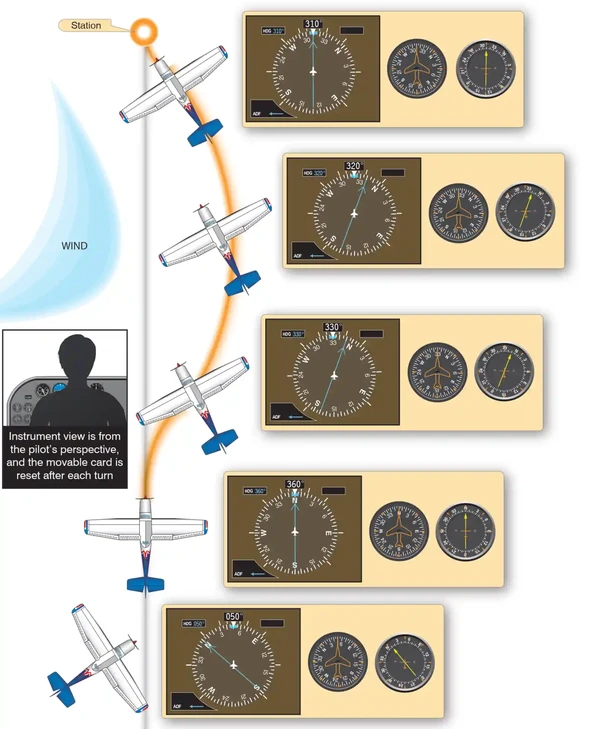
VOR & TACAN Radial Intercept Procedure
- Tune the station frequency and verify the station's Morse Code identifier
- Check the heading indicator with the magnetic compass
- Reset as necessary
- Turn the airplane to a heading to parallel the desired course, in the sae direction as the course to be flown
- With the Omni Bearing Selector (OBS), center the Course Deviation Indicator (CDI) with a TO flag indication (inbound), or a FROM flag indication (outbound) as appropriate
- Determine the difference between the radial to be intercepted and the radial presently on
- Double the difference to determine the interception angle
- May not be less than 20°, nor more than 90°
- Since the distance between radials varies with distance from the station (at 60 NM 1° between radials = 1 nm, 30 NM, 1° = 0.5 NM, etc.), the amount of intercept heading used must vary accordingly to prevent overshooting the desired course
- Rotate the OBS to select the desired radial ("FROM" Flag), or the course ("TO" Flag)
- Turn to the intercept heading determined and hold the heading constant until the CDI begins to center
- As the CDI begins to center, begin turning to the heading corresponding to the radial or course selected
- Track the radial (outbound) or course (inbound), as appropriate
- As proficiency increases, steps 3 and 4 may be eliminated
- Once the radial has been intercepted, proceed with VOR/TACAN Radial Tracking procedures
VOR & TACAN Radial Tracking Procedure
- After the course has been intercepted, maintain the heading that corresponds to the course selected
- If the CDI should move off center, re-intercept by beginning with a 20° change (intercept angle) in heading (intercept heading) toward the deflection of the CDI
- Maintain the intercept heading until the CDI re-centers, and then turn back to a new course heading by taking out 1/2 of the intercept angle
- For example, the airplane has drifted to the right of the 090° radial (outbound). To re-intercept the radial, a left turn is made to a heading of 070°. When the CDI re-centers, a right turn is made to maintain a new Course Heading of 080° (10° Wind Correction Angle)
- If the CDI should move off center, re-intercept by beginning with a 10° change in heading (intercept heading) toward the deflection of the CDI
- Maintain the intercept heading until the CDI re-centers, and then turn back to a new course heading by taking out 1/2 of the intercept angle
- For example, The airplane has drifted again to the right of the 090° radial (outbound). To re-intercept the radial, a left turn is made to a heading of 070° (10° change). When the CDI re-centers, a right turn is made to maintain a new Course Heading of 075° (5° change, 15° Wind Correction Angle now total)
- Wind conditions may require the use of intercept angles greater than 20° to change the direction of the CDI deflection however, the "bracketing" procedures above are still applicable
- Consider setting the heading bug to the heading to be flown so as to maintain the wind correction angle and therefore track
- Deviations:
- Consider what full-scale deflection means in terms of distance for the mode of flight the aircraft is in (enroute, terminal, etc.) or sensitivity relative to distance from a navigation station to understand how far off you are before inputting too much or too little of a correct.
- Reference the cross-track error (XTK) shown by the avionics or EFB, if available, to better gauge your deviation.
Intercepting & Tracking Interactive Scenario
Interactive Scenario
Loading scenario details...
Decision 1
0%
Scenario Complete
Intercepting & Tracking Conclusion
- Distinguishing the meaning of FROM and TO is important to avoid reverse sensing
- We fly a course TO, and intercept radials FROM
- Although these procedures are largely written for radio frequency NAVAIDs, GPS procedures are very similar
- Consider actual versus realized performance when doing any performance calculations
- Consider practicing maneuvers on a flight simulator to introduce yourself to maneuvers or knock off rust
- Still looking for something? Continue searching:
Intercepting & Tracking References
- Federal Aviation Administration - Pilot/Controller Glossary.
- Instrument Flying Handbook