Search & Rescue
Search and Rescue (SAR) is a lifesaving service provided through the combined efforts of federal agencies signatory to the National SAR Plan.
Introduction to Search & Rescue
- Search and Rescue (SAR) is a lifesaving service provided through combined efforts of federal agencies signatory to the National SAR Plan, and the agencies responsible for SAR within each state
- Resources are provided by the Coast Guard, Department of Defense components, Civil Air Patrol, Coast Guard Auxiliary, state, county and local law enforcement and other public safety agencies and private volunteer organizations.
- Services include search for missing aircraft, survival aid, rescue, and emergency medical help for occupants after an accident site is located.
- An activated VFR flight plan supplies overdue-aircraft information and a structured starting point for alerting and search-and-rescue procedures. It does not provide continuous tracking or guarantee that a physical search begins at one exact time.
- If not found within 1 hour, ATC (Air Traffic Control) facilities are alerted and two hours after ETA (Estimated Time of Arrival) a full SAR effort is initiated
- Reinforce your understanding of Search & Rescue by completing the knowledge quiz and interactive scenario, comparing your performance with the applicable Airman Certification Standards, and reviewing the topic summary before moving on.
Search & Rescue Key Highlights
- Search and rescue (SAR) operations locate and assist overdue, missing, or distressed aircraft and occupants.
- Flight plans, flight following, ELTs, and ADS-B (Automatic Dependent Surveillance-Broadcast) tracking improve the effectiveness and speed of search and rescue efforts.
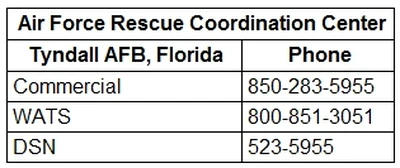
- The Air Force Rescue Coordination Center (AFRCC) coordinates inland federal search and rescue operations within the United States.
- Pilots should provide accurate flight plans, route information, and estimated arrival times to support potential SAR operations.
- ELTs automatically transmit distress signals after significant impact forces to assist rescue personnel in locating aircraft.
- Survival equipment, signaling devices, and emergency preparedness improve occupant survivability following forced landings or accidents.
- Weather conditions, terrain, communication limitations, and remote operating environments can complicate search and rescue efforts.
- Pilots should report overdue aircraft or emergency signals promptly to appropriate authorities or Flight Service.
- Proper emergency communication and position reporting improve rescue coordination and reduce response time during emergencies.
- Understanding search and rescue procedures improves emergency preparedness, survivability, and overall flight safety.
National Search and Rescue Plan
- The National Search and Rescue Plan provides effective use of all available facilities in all types of SAR missions.
- Facilities include aircraft, vessels, pararescue and ground rescue teams, and emergency radio fixing.
- The U.S. Coast Guard is responsible for coordination in Maritime Region
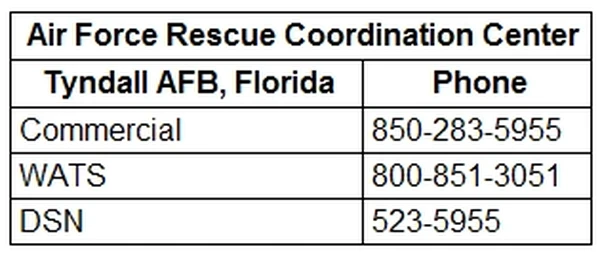
- The USAF (United States Air Force) is responsible in the Inland Region
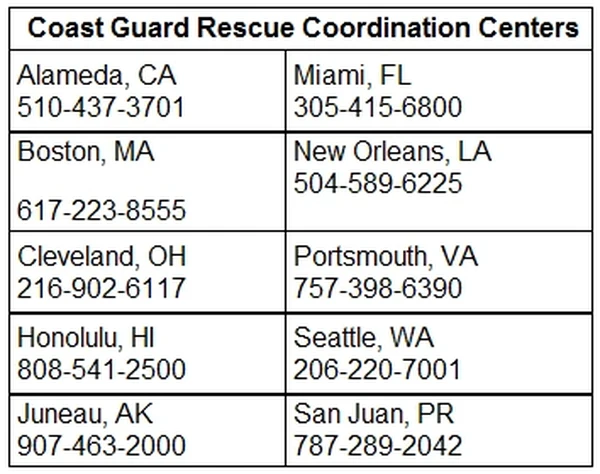
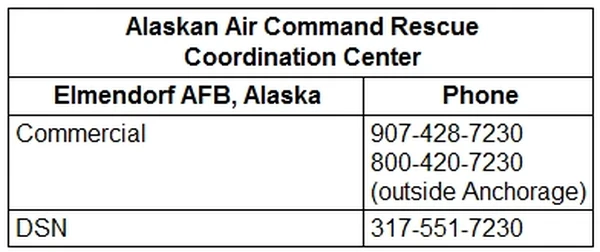
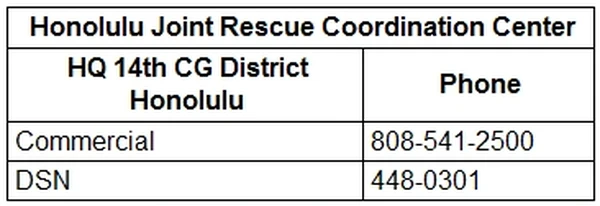
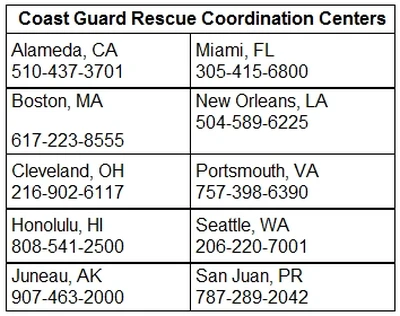
- Rescue Coordination Centers (RCC) coordinate SAR efforts within their regions [///]
- Aircraft emergencies, distress, and urgency information is passed to the appropriate RCC through Air Route Traffic Control Centers (ARTCCs) or Flight Service Stations (FSS).
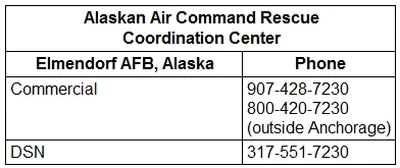
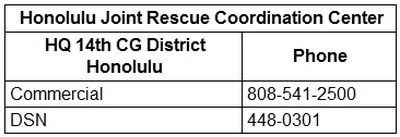
- Rescue Coordination Center Contacts:
- Air Force: 1–800–851–3051.
- Alaska: 1–800–420–7230.
- Coast Guard: 1–855–406–8724.
Rescue Coordination Centers
Emergency and Overdue Aircraft
- ARTCCs and FSS' will alert the SAR system if an aircraft is in difficulty, overdue, or missing.
- Radar facilities providing radar flight following or advisories consider the loss of radar and radios, without service termination notice, to be a possible emergency.
- Pilots receiving VFR (Visual Flight Rules) services from radar facilities should be aware that SAR may be initiated under these circumstances.
- A filed flight plan is the most timely and effective indicator that an aircraft is overdue.
- Flight plan information is invaluable to SAR forces for search planning and executing search efforts.
- Radar facilities providing radar flight following or advisories consider the loss of radar and radios, without service termination notice, to be a possible emergency.
- Prior to departure on every flight, local or otherwise, someone at the departure point should be advised of your destination and route of flight if other than direct.
- Search efforts are often wasted and rescue is often delayed because of pilots who thoughtlessly takeoff without telling anyone where they are going. File a flight plan for your safety.
- According to the National Search and Rescue Plan, "The life expectancy of an injured survivor decreases as much as 80 percent during the first 24 hours, while the chances of survival of uninjured survivors rapidly diminishes after the first 3 days"
- An Air Force Review of 325 SAR missions conducted during a 23-month period revealed that "Time works against people who experience a distress but are not on a flight plan, since 36 hours normally pass before family concern initiates an (alert)"
VFR Search and Rescue Protection
- To receive this valuable protection, file and activate a VFR or DVFR Flight Plan with an FAA FSS.
- For maximum protection, file only to the point of first intended landing, and refile for each leg to final destination.
- When a lengthy flight plan is filed, with several stops en route and an ETE (Estimated Time En Route) to final destination, a mishap could occur on any leg, and unless other information is received, it is probable that no one would start looking for you until 30 minutes after your ETA at your final destination.
- If you land at a location other than the intended destination, report the landing to the nearest FAA FSS and advise them of your original destination
- If you land en route and are delayed more than 30 minutes, report this information to the nearest FSS and give them your original destination
- If your ETE changes by 30 minutes or more, report a new ETA to the nearest FSS and give them your original destination.
- Remember that if you fail to respond within one-half hour after your ETA at final destination, a search will be started to locate you.
- It is important that you close your flight plan IMMEDIATELY AFTER ARRIVAL AT YOUR FINAL DESTINATION WITH THE FSS DESIGNATED WHEN YOUR FLIGHT PLAN WAS FILED.
- The pilot is responsible for closure of a VFR or DVFR (Defense Visual Flight Rules) flight plan; they are not closed automatically.
- This will prevent needless search efforts.
- The rapidity of rescue on land or water will depend on how accurately your position may be determined.
- If a flight plan has been followed and your position is on course, rescue will be expedited.
- There are tools available to remind you to close your flight plan such as EasyActivate™ and EasyClose™.
- After an accident or forced landing, verify and manually activate the ELT when appropriate and safe. A properly registered 406 megahertz (MHz) ELT, personal locator beacon, or compatible satellite communicator can improve alerting and location information, but no device guarantees detection or immediate rescue.
Intercept and Escort
- The concept of airborne intercept and escort is based on the Search and Rescue (SAR) aircraft establishing visual and/or electronic contact with an aircraft in difficulty, providing in-flight assistance, and escorting it to a safe landing. If bailout, crash landing or ditching becomes necessary, SAR operations can be conducted without delay. For most incidents, particularly those occurring at night and/or during instrument flight conditions, the availability of intercept and escort services will depend on the proximity of SAR units with suitable aircraft on alert for immediate dispatch. In limited circumstances, other aircraft flying in the vicinity of an aircraft in difficulty can provide these services
- If specifically requested by a pilot in difficulty or if a distress condition is declared, SAR coordinators will take steps to intercept and escort an aircraft. Steps may be initiated for intercept and escort if an urgency condition is declared and unusual circumstances make such action advisable
- It is the pilot's prerogative to refuse intercept and escort services. Escort services will normally be provided to the nearest adequate airport. Should the pilot receiving escort services continue onto another location after reaching a safe airport, or decide not to divert to the nearest safe airport, the escort aircraft is not obligated to continue and further escort is discretionary. The decision will depend on the circumstances of the individual incident
Survival Equipment
- When flying over uninhabited areas, carry—and know how to use—survival equipment suited to the climate and terrain.
- If ditching becomes necessary, survival depends on crew proficiency and effective water-survival equipment.
Body Signals
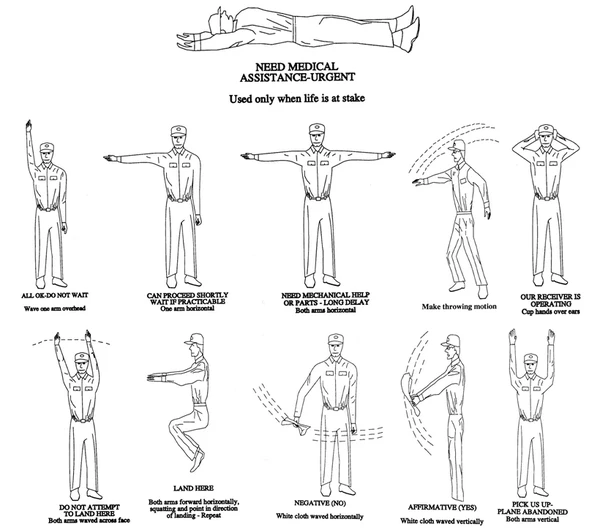
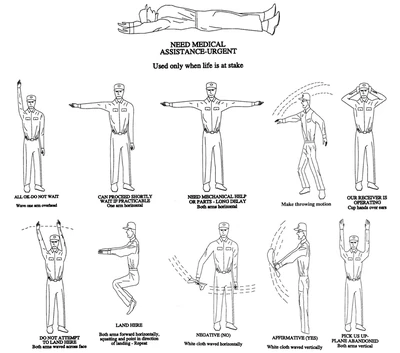
- If you are forced down and are able to attract the attention of the pilot of a rescue airplane, body signals can be used to transmit messages to a pilot circling over your location. []
- Stand in the open when you make the signals
- Be sure the background, as seen from the air, is not confusing
- Go through the motions slowly and repeat each signal until you are positive that the pilot understands you
Observence of Downed Aircraft
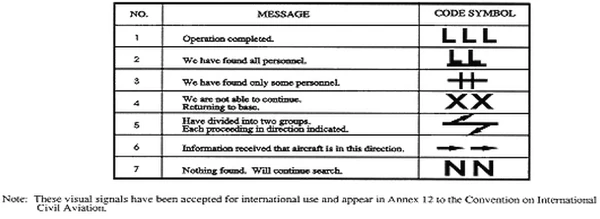
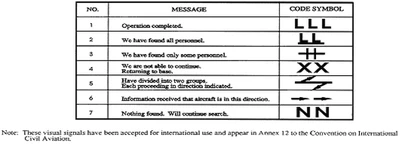
- Ground signals communicate distress to aircraft flying over. [/]
- Determine if crash is marked with a yellow cross; if so, the crash has already been reported and identified
- If possible, determine type and number of aircraft and whether there is evidence of survivors
- Fix the position of the crash as accurately as possible with reference to a navigational aid.
- If possible, provide geographic or physical description of the area to aid ground search parties.
- Transmit the information to the nearest FAA or other appropriate radio facility
- If circumstances permit, orbit the scene to guide in other assisting units until their arrival or until you are relieved by another aircraft
- Immediately after landing, make a complete report to the nearest FAA facility, or Air Force or Coast Guard Rescue Coordination Center.
- The report can be made by a long distance collect telephone call.


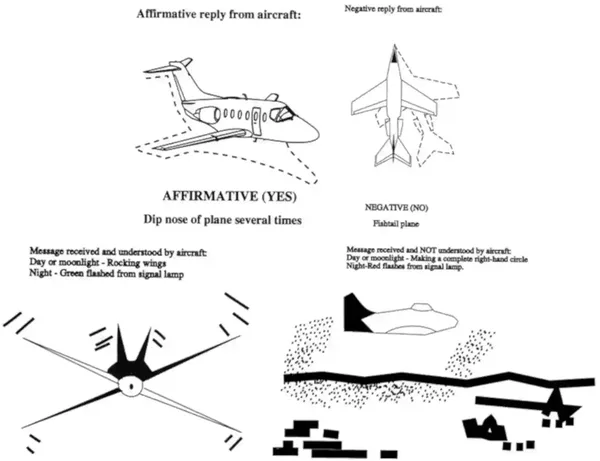
Aircraft Signals
- Provide non-verbal communication in intercept or lost communication scenarios. []
- Can also be used to acknowledge ground signals
- NOTE: The flight expectancy of an injured survivor decreases as much as 80% during the first 24 hours, while the chances of survival of uninjured survivors rapidly diminishes after the first 3 days
- NOTE: Time works against people who experience a distress but are not on a flight plan, since 36 hours normally pass before family concern initiates an (alert).
Search & Rescue Lessons & Case Studies
- National Transportation Safety Board (NTSB) Identification: DFW08FA053:
- The NTSB determines the probable cause(s) of this accident to be: The pilot's decision to continue to the destination landing platform in weather conditions below the company's weather minimums and his failure to maintain aircraft control during the approach. Contributing to the passenger fatality and the severity of the occupant injuries were the lack of a passenger briefing on how to deploy the liferaft, which was required by the company but not by the Federal Aviation Administration because this flight was not an extended overwater operation; the pilot's failure to deploy the liferafts; and the company radio operator's misreporting of the helicopter's "landed" status, which delayed the rescue response
- National Transportation Safety Board Identification: ANC13GA036:
- The NTSB determines the probable cause(s) of this accident to be: The pilot's decision to continue flight under visual flight rules into deteriorating weather conditions, which resulted in the pilot's spatial disorientation and loss of control. Also causal was the Alaska Department of Public Safety's punitive culture and inadequate safety management, which prevented the organization from identifying and correcting latent deficiencies in risk management and pilot training. Contributing to the accident was the pilot's exceptionally high motivation to complete search and rescue missions, which increased his risk tolerance and adversely affected his decision-making.
- National Transportation Safety Board Identification: CEN09PA348:
- The NTSB determines the probable cause(s) of this accident to be: The pilot's decision to take off from a remote, mountainous landing site in dark (moonless) night, windy, instrument meteorological conditions. Contributing to the accident were an organizational culture that prioritized mission execution over aviation safety and the pilot's fatigue, self-imposed pressure to conduct the flight, and situational stress. Also contributing to the accident were deficiencies in the NMSP aviation section's safety-related policies, including lack of a requirement for a risk assessment at any point during the mission; inadequate pilot staffing; lack of an effective fatigue management program for pilots; and inadequate procedures and equipment to ensure effective communication between airborne and ground personnel during search and rescue missions.
- National Transportation Safety Board Identification: WPR21FA143:
- The NTSB determines the probable cause(s) of this accident to be: The pilot’s failure to adequately respond to an encounter with whiteout conditions, which resulted in the helicopter’s collision with terrain. Contributing to the accident was the (1) operator’s inadequate pilot training program and pilot competency checks, which failed to evaluate pilot skill during an encounter with inadvertent instrument meteorological conditions, and (2) the Federal Aviation Administration principal operations inspector’s insufficient oversight of the operator, including their approval of the operator’s pilot training program without ensuring that it met requirements. Contributing to the severity of the surviving passenger’s injuries was the delayed notification of search and rescue organizations.
- National Transportation Safety Board Identification: WPR13FA061:
- The NTSB determines the probable cause(s) of this accident to be: The pilot's failure to maintain clearance with terrain while maneuvering in a remote mountainous region. Contributing to the accident was the pilot's improper decision to traverse the remote mountainous area in high-density altitude conditions with the airplane near its maximum gross weight. Contributing to the delay in the search and rescue (SAR) was the lack of a 406-MHz ELT signal, which would have allowed SAR responders to initiate a more timely search and find the accident site more quickly.
Search & Rescue Interactive Scenario
Interactive Scenario
Loading scenario details...
Scenario Complete
Search & Rescue Knowledge Check
Choose the knowledge check that matches your current training for Search & Rescue.
 Private Pilot
PPL knowledge check
Core Knowledge Review
Review foundational knowledge, key concepts, and practical considerations. Topic: Search & Rescue.
- Immediate feedback
- Answer explanations
- Account progress tracking
 Commercial Pilot
CPL knowledge check
Advanced Application
Apply knowledge to advanced operations, risk management, and aeronautical decision-making. Topic: Search & Rescue.
- Immediate feedback
- Answer explanations
- Account progress tracking
Why Take a Quiz?
Quizzes reinforce key concepts, identify knowledge gaps, and build confidence for real-world decisions. Quiz material is representative of the information provided here and is not based on or sourced from the Federal Aviation Administration test bank.
Search & Rescue Conclusion
- According to the National Search and Rescue Plan, "The life expectancy of an injured survivor decreases as much as 80% during the first 24 hours, while the chances of survival of uninjured survivors rapidly diminishes after the first 3 days"
- An Air Force Review of 325 SAR missions conducted during a 23-month period revealed that "Time works against people who experience a distress but are not on a flight plan, since 36 hours normally pass before family concern initiates an (alert)"
- Prior to departure on every flight, local or otherwise, someone at the departure point should be advised of your destination and route of flight if other than direct
- Search efforts are often wasted and rescue is often delayed because of pilots who thoughtlessly takeoff without telling anyone where they are going-File a flight plan for your safety!
- Services include search for missing aircraft, survival aid, rescue, and emergency medical help for the occupants after an accident site is located
- Search efforts are often wasted and rescue is often delayed because of pilots who thoughtlessly takeoff without telling anyone where they are going
- File a flight plan for your safety, and remember to close it!
- A conspicuous paint scheme can make a downed aircraft easier to locate; for example, a green aircraft may be camouflaged after coming down in a forest.
- To avoid false alarms, pay close attention to ELT (Emergency Locator Transmitter) procedures when performing maintenance or tests
- The FAA investigates thousands of false ELT alerts every year, wasting resources
- If an ELT is accidentally activated, cancel the false alert by calling the U.S. Air Force Rescue Coordination Center
- Companies like McMurdo provide a state-of-the-art emergency response ecosystem, working in parallel with other agencies to aid effective search and rescue
- Still looking for something? Continue searching:
Search & Rescue References
- Federal Aviation Administration (FAA) - Pilot/Controller Glossary.
- Aeronautical Information Manual (6-2-3) Intercept and Escort.
- Aeronautical Information Manual (6-2-6) Search and Rescue.
- CFI Notebook.net Air Route Traffic Control Center (ARTCC).
- CFI Notebook.net - Emergency Transmitter Locator (ELT).
- CFI Notebook.net - VFR Flight Plan.
- NYC Aviation - Inside the US Coast Guard's SAR Response to a Plane Crash.
- Wikipedia - The National SAR Plan.