Commercial Pilot (Airplane) Emergency Equipment & Survival Gear Lesson Plan
Commercial Pilot (Airplane) • ACS Area IX, Task D
The Commercial Pilot (Airplane) Emergency Equipment and Survival Gear Lesson Plan covers the knowledge, risk management, and skills associated with emergency equipment, and survival gear appropriate to the airplane and environment encountered during flight.
Introduction
-
Schedule
Topic:Time:Part 1, Introduce the lesson:0:05Part 2, Emergency Equipment and Survival Gear:0:10Part 3, Emergency Equipment and Survival Gear Risk Management:0:10Part 4, Emergency Equipment and Survival Gear Guided Scenario:0:15Part 5, Conclude Lesson:0:10Remotivation/Closure:0:05Total Ground Time:0:00
-
Attention Getter:
- Research and present a mishap case study:
- Discuss how the initial conditions developed into an incident/accident/mishap.
- Relate similar personal experiences of the same type of incident/accident/mishap.
- Consider incorporating a case study as a guided scenario.
-
Motivator:
- Emergency equipment is a lifeline when occupants must survive after an off-airport landing until search and rescue (SAR) arrives.
Materials
-
Required Materials:
- Writing instrument (pen, marker, etc.).
- Writing surface (paper, whiteboard, etc.).
- Weight and Balance worksheet.
- Pilot Information/Operating Handbook.
- Airman Certification Standards.
- Student jacket.
-
Optional Materials:
- Personal Weather Minimums Worksheet.
- Instructor endorsement log.
-
Reference Materials:
- Emergency Equipment Supplement.
- Instructor Endorsement Log.
- Takeoff and Climb Supplement.
- Fitness for Flight Supplement.
- Risk Management Handbook.
- Airplane Flying Handbook.
- Pilot Handbook of Aeronautical Knowledge.
- Emergency Locator Transmitter Supplement.
- Test-taking Guidance.
- Test Guides.
- The Checkride Supplement.
Instructor Actions
- Before the lesson, review reference materials.
- Part 1, Introduce the lesson:
- Review the lesson plan, including the attention and motivator.
- Review the Commercial Pilot Emergency Equipment and Survival Gear Airman Certification Standards.
- Elicit prior knowledge, then establish the operational relevance of the purpose, selection, inspection, accessibility, and limitations of emergency equipment and survival gear appropriate to the airplane, route, occupants, and operating environment.
- Part 2, Emergency Equipment and Survival Gear:
- Use an aircraft- or scenario-specific example, then have the learner explain Emergency Locator Transmitter operation, limitations, and testing requirements. (CA.IX.D.K1)
- Use an aircraft- or scenario-specific example, then have the learner explain fire-extinguisher operation and limitations. (CA.IX.D.K2)
- Select emergency equipment and survival gear appropriate to the planned environment. (CA.IX.D.K3)
- Climate extremes. (CA.IX.D.K3a)
- Mountainous terrain. (CA.IX.D.K3b)
- Overwater operations. (CA.IX.D.K3c)
- Use an aircraft- or scenario-specific example, then have the learner explain when to deploy an installed ballistic parachute and how to brief passengers. (CA.IX.D.K4)
- Use an aircraft- or scenario-specific example, then have the learner explain when to activate an installed emergency autoland system and how to brief passengers. (CA.IX.D.K5)
- Part 3, Emergency Equipment and Survival Gear Risk Management:
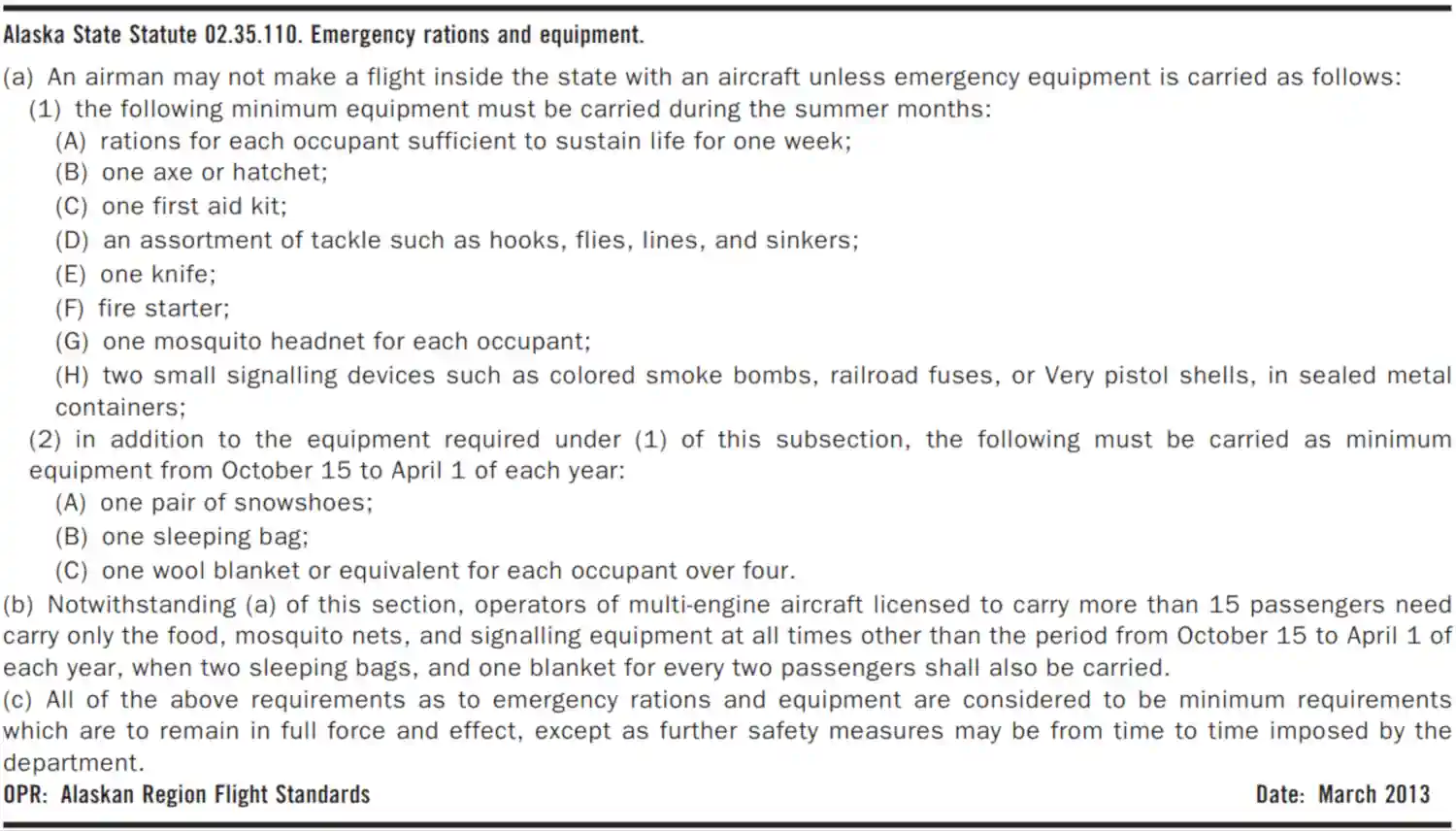
- Evaluate whether water, clothing, and shelter can sustain the occupants for 48–72 hours in the expected environment. (CA.IX.D.R1)
- Assess the risks and limitations associated with using an installed ballistic-parachute system. (CA.IX.D.R2)
- Assess the risks and limitations associated with using an installed emergency-autoland system. (CA.IX.D.R3)
- Part 4, Emergency Equipment and Survival Gear Guided Scenario:
- Given a route, season, occupants, and expected environment, identify the appropriate emergency equipment and personal gear. (CA.IX.D.S1)
- Brief passengers on the location and proper use of onboard emergency equipment and survival gear. (CA.IX.D.S2)
- If equipped, simulate the manufacturer's ballistic-parachute deployment procedure. (CA.IX.D.S3)
- Part 5, Conclude Lesson:
- Tie lesson back to previous lessons to reinforce past experiences (law of readiness).
- Present the remotivation, conclude, and provide guidance for follow-on lessons.
- Review student actions required ahead of the next lesson.
- Update the instructor log and student progress. Select the student and sign off completed objectives. If the student does not have a connected account, record the update manually in the instructor log and student training record.
Commercial Pilot (Airplane) Emergency Equipment & Survival Gear Lesson Plan Interactive Guided Scenario
Commercial Pilot Airplane Emergency Equipment And Survival Gear Guided Flight
Work through one integrated 79-decision guided scenario combining 5 linked lesson topics into a comprehensive training exercise.
Decision 1
0%
Scenario Complete
Student Actions
- Complete the assigned readings (see content above).
- Ask pertinent questions.
- Perform self-assessment, including fitness for flight and personal minimums, as appropriate.
- Make a go/no-go decision, as appropriate.
Airman Certification Standards
Commercial Pilot (Airplane) Emergency Equipment and Survival Gear Airman Certification Standards
- Objective: To determine whether the applicant exhibits satisfactory knowledge, risk management, and skills associated with emergency equipment, and survival gear appropriate to the airplane and environment encountered during flight
- Note: See Appendix 3: Aircraft, Equipment, and Operational Requirements & Limitations for information related to this Task
- References: FAA-H-8083-2 (Risk Management Handbook), FAA-H-8083-3 (Airplane Flying Handbook), FAA-H-8083-25 (Pilot Handbook of Aeronautical Knowledge); POH/AFM.
Knowledge 5 ACS Elements
-
CA.IX.D.K1: -
CA.IX.D.K2: -
CA.IX.D.K3: Emergency equipment and survival gear needed for:-
CA.IX.D.K3a: Climate extremes (hot/cold). -
CA.IX.D.K3b: Mountainous terrain. -
CA.IX.D.K3c: Overwater operations.
-
-
CA.IX.D.K4: When to deploy a ballistic parachute and associated passenger briefings, if equipped. -
CA.IX.D.K5: When to activate an emergency auto-land system and brief passengers, if equipped.
Risk Management 3 ACS Elements
-
CA.IX.D.R1: Survival gear (water, clothing, shelter) for 48 to 72 hours. -
CA.IX.D.R2: -
CA.IX.D.R3: Use of an emergency auto-land system, if installed.
Skills 3 ACS Elements
-
CA.IX.D.S1: Identify appropriate equipment and personal gear. -
CA.IX.D.S2: Brief passengers on proper use of on-board emergency equipment and survival gear. -
CA.IX.D.S3: Simulate ballistic parachute deployment procedures, if equipped.
Conclusion
-
Re-Motivation:
- Emergency Equipment and Survival Gear develops the calm, disciplined response needed when time, altitude, aircraft capability, or available options are limited.
- Early recognition, aircraft control, checklist use, clear priorities, and continuous evaluation of recovery or landing options help prevent an abnormal event from becoming unmanageable.
- Scenario practice strengthens situational awareness and aeronautical decision-making so pilots can adapt procedures to the aircraft, environment, and urgency of the event.
- Continued practice with Emergency Equipment and Survival Gear prepares commercial pilots to manage more complex failures while preserving the margins needed for a safe outcome.
-
Closure:
- The Federal Aviation Administration (FAA) provides test-taking guidance and test guides on its website.
- To learn more about preparing for the practical test, visit the checkride page.
- Advise students that this lesson will be used as a starting point for the next lesson.
- Assign study materials for the next lesson.