Sport Pilot (Airplane) Performance & Limitations Lesson Plan
Sport Pilot (Airplane) • PTS Area I, Task J
The Sport Pilot (Airplane) Performance And Limitations Lesson Plan covers the knowledge and skills required by FAA-S-8081-29A.
Introduction
-
Schedule
Topic:Time:Attention/Motivator:0:05Part 1, Lesson Introduction:0:05Part 2, Aerodynamics:0:20Part 3, Performance Calculations:0:20Part 4, Performance Factors:0:15Part 5, Performance and Limitations Risk Management:0:15Part 6, Performance and Limitations Guided Scenario(s):0:20Part 7, Lesson Conclusion:0:05Remotivation/Closure:0:05Total Ground Time:0:00
-
Attention Getter:
- Research and present a mishap case study:
- Discuss how the initial conditions developed into an incident/accident/mishap.
- Relate similar personal experiences of the same type of incident/accident/mishap.
- Consider incorporating a case study as a guided scenario.
-
Motivator:
- Aerodynamics is the branch of dynamics dealing with the motion of air and other gases, which gives us the performance we need to fly.
- Every flight is influenced by the relationship between the aircraft, the atmosphere, and the pilot's decisions.
- It begins with understanding why an airplane flies, continues with recognizing how aerodynamic forces influence aircraft behavior, and eventually leads to applying that knowledge during flight planning.
- Along the way, pilots must also consider how the atmosphere changes aircraft performance and learn to interpret performance information before and during every flight.
- Understanding why an airplane flies, how it responds to changing conditions, and what limits its performance helps pilots make informed decisions long before advancing the throttle or leaving the runway.
Materials
-
Required Materials:
- Writing instrument (pen, marker, etc.).
- Writing surface (paper, whiteboard, etc.).
- A sheet of paper or curved object and a ball to demonstrate static/dynamic stability.
- Pilot Operating Handbook.
- Weight & Balance Form Template.
- Airman Certification Standards.
- Student jacket.
-
Optional Materials:
-
Reference Materials:
- Weight and Balance Supplement.
- Instructor Endorsement Log.
- Principles of Flight Supplement.
- Performance Calculations Supplement.
- Takeoff and Climb Performance Supplement.
- Takeoff and Climb Supplement.
- Descent and Landing Performance Supplement.
- Aircraft Stability Supplement.
- Cruise Performance Supplement.
- Turn Performance Supplement.
- Stall Performance Supplement.
- Glide Performance Supplement.
- Aerodynamics and Performance Supplement.
- Aircraft Owners and Pilots Association (AOPA)'s Online Learning Course - Essential Aerodynamics.
- Fitness for Flight Supplement.
Instructor Actions
- Before the lesson, review reference materials.
- Part 1, Lesson Introduction:
- Review the lesson plan, including the attention and motivator.
- Review the airman certification standards.
- Part 2, Aerodynamics:
- Principles of Flight
- Introduce Lift, including AOA (angle of attack).
- Use guided questioning to have the learner explain and apply Newton's Laws, Bernoulli's Principle.
- Use guided questioning to have the learner explain and apply lift in relation to the lift formula.
- Emphasize AoA is the angle between RW and Chord, center of lift/pressure, and how it is agnostic to aircraft orientation.
- Elicit prior knowledge about lift, then have the learner explain how pilots control it.
- Elicit prior knowledge, then establish the operational relevance of weight.
- Elicit prior knowledge, then establish the operational relevance of thrust.
- Elicit prior knowledge, then establish the operational relevance of drag.
- Elicit prior knowledge, then establish the operational relevance of ground effect.
- Introduce Lift, including AOA (angle of attack).
- Use a concrete example, then have the learner describe the interaction of forces.
- Principles of Flight
- Part 3, Performance Calculations:
- Elicit prior knowledge, then establish the operational relevance of Temperature Conversion.
- Introduce turn performance:
- Load Factor.
- Rate and radius of turns.
- Introduce stall performance:
- Introduce takeoff performance.
- Elicit prior knowledge, then establish the operational relevance of normal takeoff and climb performance.
- Crosswind Component.
- Elicit prior knowledge, then establish the operational relevance of soft-field takeoff and climb performance.
- Short-Field Takeoff and Climb.
- Elicit prior knowledge, then establish the operational relevance of confined area takeoff and maximum performance climb.
- Rate of Climb Performance.
- Elicit prior knowledge, then establish the operational relevance of takeoff performance rules of thumb.
- Elicit prior knowledge, then establish the operational relevance of climb performance.
- Elicit prior knowledge, then establish the operational relevance of rate of climb.
- Elicit prior knowledge, then establish the operational relevance of descent performance.
- Introduce landing performance.
- Normal landing.
- Crosswind landing.
- Short-field landing.
- Soft-field landing.
- Confined area approach and landing.
- Pivotal altitude.
- Temperature conversion.
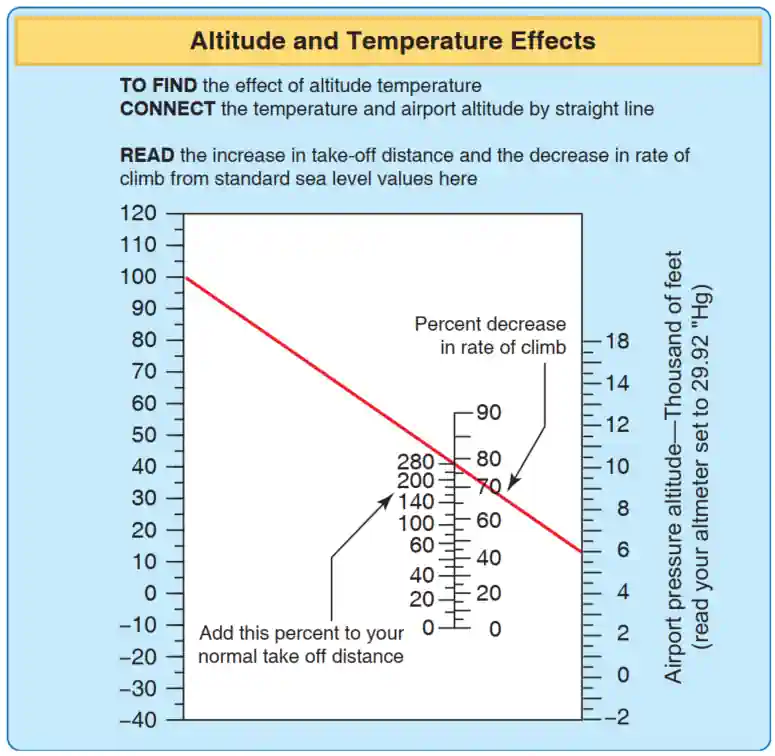
- Pressure Altitude.
- Density Altitude.
- Determining Climb Gradient.
- Determining Rate-of-Climb Requirements.
- Maneuvering Speed.
- Rate of Turn.
- Overbank Acceleration.
- Minimum Safe Altitude (MSA).
- Part 4, Performance Factors:
- Weight and Balance
- Elicit prior knowledge, then establish the operational relevance of Center of Gravity.
- Elicit prior knowledge, then establish the operational relevance of effects of a foreward and aft center of gravity.
- Elicit prior knowledge, then establish the operational relevance of multiengine considerations, as applicable.
- Introduce aircraft stability.
- Elicit prior knowledge, then establish the operational relevance of balanced flight including maneuverability vs. controllability.
- Elicit prior knowledge, then establish the operational relevance of static and dynamic stability.
- Elicit prior knowledge, then establish the operational relevance of lateral, vertical, and longitudinal stability.
- Elicit prior knowledge, then establish the operational relevance of left turning tendancies, including adverse yaw.
- Elicit prior knowledge, then establish the operational relevance of pilot induced oscillations and the pilot's impact on aircraft stability.
- Elicit prior knowledge about configuration changes, then have the learner explain their performance effects, including retractable landing gear, high-lift devices, spoilers/speed brakes, and propeller feathering.
- Elicit prior knowledge, then establish the operational relevance of wing planform, including aspect ratio and wing design.
- Elicit prior knowledge, then establish the operational relevance of factors impacting descent performance and landing performance.
- Elicit prior knowledge, then establish the operational relevance of pilot technique considerations.
- Elicit prior knowledge, then establish the operational relevance of performance limitations in PoH.
- Weight and Balance
- Part 5, Performance and Limitations Risk Management:
- Assess optimistic data selection, interpolation or calculation error, density altitude, wind, runway or water condition, obstacles, weight and balance, inadequate margin, and external-pressure risks; compare calculated performance with conservative operational limits.
- Required teaching coverage:
- Assess whether the learner exhibits knowledge of the elements related to performance and limitations by explaining the use of charts, tables, and data if appropriate, to determine performance and the adverse effects of exceeding limitations. (SP.1)
- Have the learner verify weight and center of gravity throughout the planned flight and determine whether computed takeoff, climb, cruise, and landing performance provide an adequate margin within aircraft limitations. (SP.2) (SP.3) (SP.4) (SP.5)
- Part 6, Performance and Limitations Guided Scenario(s):
- Elicit prior knowledge, then establish the operational relevance of a weight & balance calculation.
- Takeoff & Climb Performance
- Demonstrate a takeoff distance calculation for each type of takeoff chart provided.
- Demonstrate an aborted takeoff calculation (if provided).
- Demonstrate a time/distance/fuel for a top of climb, climb gradient required, and rate of climb requirements.
- Use guided questioning to have the learner explain and apply the factors which impact climb performance, including best angle/rate-of-climb.
- Cruise Performance.
- Demonstrate a time/distance/fuel calculation.
- Use guided questioning to have the learner explain and apply factors accounted for on the chart and those not explicitly mentioned which impact cruise performance.
- Demonstrate a descent calculation.
- Demonstrate a landing distance calculation for each type of landing chart provided.
- Introduce Turn Performance.
- Rate and Radius of Turns.
- Coordination Throughout Turns.
- Aircraft Performance While Turning (Adverse Yaw [drag], Yaw against the direction of turn [lift], diving tendency, over-banking tendency, oncreased stall speed).
- Stall Performance.
- Glide Performance.
- Descent and landing Performance
- Demonstrate a landing distance calculation.
- Use guided questioning to have the learner explain and apply various factors accounted for on the chart and those not explicitly mentioned which impact descent and landing performance.
- Conduct a weight and balance configuration.
- Part 7, Lesson Conclusion:
- Use guided questioning to have the learner explain and apply the possible differences between calculated performance and actual performance.
- Tie lesson back to previous lessons to reinforce past experiences (law of readiness).
- Present the remotivation, conclude, and provide guidance for follow-on lessons.
- Review student actions required ahead of the next lesson.
- Update the instructor log and student progress. Select the student and sign off completed objectives. If the student does not have a connected account, record the update manually in the instructor log and student training record.
Guided Scenario(s)
The Chart Between the Lines
Build and test a complete performance plan for a high-country trip as interpolation, weight, atmosphere, runway, Climb, cruise, and landing assumptions change. Abbreviations used in this scenario: Center of Gravity (CG); Estimated Time of Arrival (ETA); Global Positioning System (GPS); gallons per hour (GPH).
Decision 1
0%
Scenario Complete
- What happens to the AOA if while in straight-and-level flight, a pilot pushes forward on the control stick, pulls backward?
- What happens to the AOA if while in straight-and-level flight, a pilot pushes forward on the throttle? pulls backward?
- What factors can the pilot control to change the amount of lift an aircraft has? Weight? Thrust? Drag?
- The pilot is ready to taxi, applying power to start moving.
- What must the pilot do with the power after the aircraft starts moving?
- What principle requires the pilot to change the power setting?
- After completing a weight and balance, the pilot realizes the aircraft is within tolerance, but the center of gravity tends aft.
- How should the pilot expect stall speed to change? What if the center of gravity tends forward?
- Why does a heavy aircraft requires more takeoff distance? Can a pilot do anything to shorten this disance? If so, what? and at what cost?
- Before the next flight, the pilot realizes they need more cargo space and wish to remove the back seats.
- Is this permitted and if so, by whom?
- What are the follow-on weight and balance requirements if so?
- The pilot mounts a weather radar pod on the wing, what type of drag can be expected?
- The interaction between the pod and the natural form of the wing is considered what kind of drag?
- The wing it is mounted has several imperfections, rivets, etc. what kind of drag is characterized by these features?
- What sort of performance changes would be expected by such a modification?
- As an aircraft is accelerating down the runway, it is actually increasing it's drag, how is this possible?
- While in the traffic pattern, the pilot finds themselves "behind the power curve." what does this mean?
- While landing, the pilot experiences what feels like a cushion of air beneath the wings. What is this phenomena?
- When could the pilot expect to feel this cushion?
- What is causing this anomaly?
- What forces are changing when a pilot initiates a climb (or descent)?
- What is the relationship between forces as the pilot establishes steady-state climb (or descent)?
- How can a pilot increase/decrease rate and radius of turn to hit a specific reference? (relate to a car, as required).
Student Actions
- Complete the assigned readings (see content above).
- Complete or review AOPA's Online Learning Course - Essential Aerodynamics.
- Ask pertinent questions.
- Perform self-assessment, including fitness for flight and personal minimums, as appropriate.
- Make a go/no-go decision, as appropriate.
Airman Certification Standards
Sport Pilot (Airplane) Performance & Limitations Practical Test Standards
- Source: FAA-S-8081-29A, Section 1 - Sport Pilot Airplane.
- Task: PERFORMANCE AND LIMITATIONS (ASEL and ASES).
- References: FAA-H-8083-1, FAA-H-8083-23, FAA-H-8083-25; AFM/POH.
- Objective: To determine the applicant:
Objective Elements 5 PTS Elements
-
SP.1: Exhibits knowledge of the elements related to performance and limitations by explaining the use of charts, tables, and data if appropriate, to determine performance and the adverse effects of exceeding limitations. -
SP.2: Exhibits knowledge of the principles of weight and balance by explaining weight and balance terms and the effect of weight and balance on airplane performance. -
SP.3: Determines if weight and center of gravity will remain within limits during all phases of flight. -
SP.4: Describes the effects of atmospheric conditions on the airplane’s performance. -
SP.5: Determines whether the computed performance is within the airplane’s capabilities and operating limitations.
Conclusion
-
Re-Motivation:
- Performance and Limitations helps pilots translate aircraft data, limitations, and system knowledge into decisions that preserve safe operating margins.
- Understanding how configuration, loading, environment, and equipment condition affect performance enables pilots to identify unacceptable combinations before flight.
- Verifying calculations, monitoring actual performance, and responding early to unexpected indications connect technical knowledge with sound aeronautical decision-making.
- Further exploration of Performance and Limitations prepares sport pilots to evaluate more complex aircraft and operating conditions with confidence.
-
Closure:
- Advise students that this lesson will be used as a starting point for the next lesson.
- Assign study materials for the next lesson.