Night Operations
Learn night operations for helicopter operations, including the procedures, techniques, hazards, and decision-making guidance presented in the FAA Helicopter Flying Handbook.
Introduction
- Pilots rely more on vision than on any other sense to themselves in flight.
- The following visual factors contribute to flying performance: good depth perception for landings, good visual acuity to identify terrain features obstacles in the flightpath, and good color vision.
- Although vision is the most accurate and reliable sense, visual cues be misleading, contributing to incidents occurring within flight environment.
- Pilots should be aware of and know to compensate effectively for the following:
- • Physical deficiency or self-imposed stress, such smoking, which limits night-vision capability • Visual cue deficiencies • Limitations in visual acuity, dark adaptation, and and depth perception For example, at night, the unaided eye has degraded acuity.
- For more information on night operations, reference Chapter 17, Aeromedical Factors, of the Pilot's Handbook of Aeronautical Knowledge (FAA-H-8083-25, as revised). orient safe and can the how as color visual be
- Reinforce your understanding of Night Operations by reviewing the key concepts on this page before moving on.
Visual Deficiencies
Night Myopia
- At night, blue wavelengths of light prevail in the visible portion of the spectrum.
- Therefore, slightly nearsighted (myopic) individuals viewing blue-green light at night may experience blurred vision.
- Even pilots with perfect vision find that image sharpness decreases as pupil diameter increases.
- For individuals with mild refractive errors, these factors combine to make vision unacceptably blurred unless they wear corrective glasses.
- Another factor to consider is "dark is focus." When light levels decrease, the focusing mechanism of the eye may move toward a resting position and make the eye more myopic.
- These factors become important when pilots rely on terrain features during unaided night flights.
- Practicing good light discipline is very important and helps in pilots to retain their night adaptation.
- Keeping the cockpit lighting on dim allows the pilot to better identify outside details, unmarked hazards such as towers less than 200' AGL (Above Ground Level), and unimproved landing sites with no hazard lighting.
- A simple exercise that shows the effect of high versus low light contrast would be to go out to a very dark road and turn the dash board lights down very low or off and let your eyes adjust to the ambient light level.
- Then, turn the dash board lights up and note how the outside features disappear.
- The same concept applies to cockpit lighting and being able to see the surrounding terrain and obstacles.
- [] Special corrective lenses can be prescribed to pilots who experience night myopia.
- The eye automatically adjusts for the light level experienced.
- During night flight, cockpit and instrument lights should be as dim as practical.
- The eye can then adjust for the outside lighting conditions (ambient lighting) to see outside.
- The dimmer the inside lighting is, the better you can see outside.
Hyperopia
- Hyperopia is also caused by an error in refraction.
- In a hyperopic state, when a pilot views a near image, the actual focal point of the eye is behind the retinal plane (wall), causing blurred vision.
- Objects that are nearby are not seen clearly; only more distant objects are in focus.
- This problem, referred to as farsightedness .
Astigmatism
- An unequal curvature of the cornea or lens of the eye causes this condition.
- A ray of light is spread over a diffused area one meridian.
- In normal vision, a ray of light is sharply focused on the retina.
- Astigmatism is the inability to focus different meridians simultaneously.
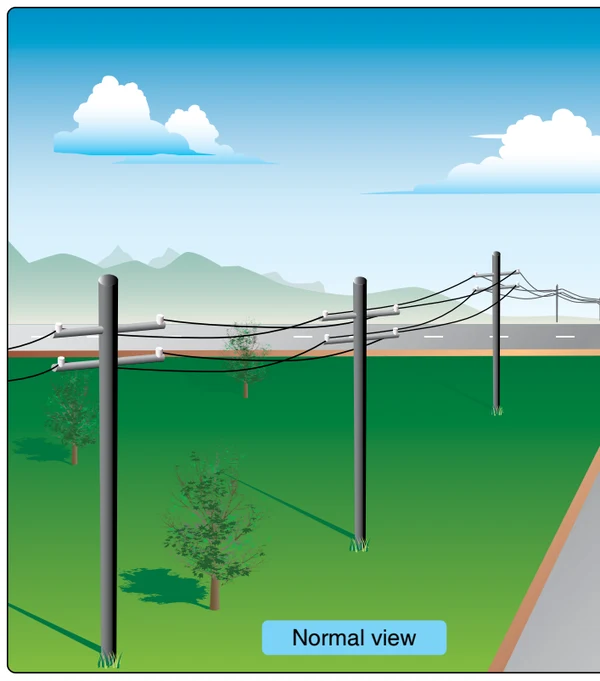
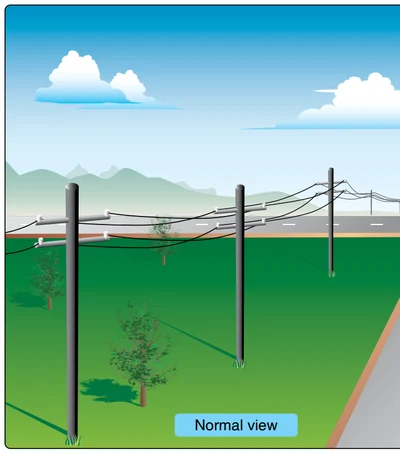
- If, for example, astigmatic individuals focus on power poles (vertical), the wires (horizontal) are out of focus for most of them.
- []
Presbyopia
- This condition is part of the normal aging process, which causes the lens to harden.
- Beginning in the early teens, the human eye gradually loses the ability to accommodate for and focus on nearby objects.
- When people are about 40 years old, their eyes are unable to focus at normal reading distances without reading glasses.
- Reduced illumination interferes with focus depth and accommodation ability.
- Hardening of the lens may also result in clouding of the lens (cataract formation).
- Aviators with early cataracts may see a standard eye chart clearly under normal daylight but have difficulty seeing under bright light conditions.
- This problem is due to light scattering it enters the eye.
- This glare sensitivity is disabling under certain circumstances.
- Glare disability, related to contrast sensitivity, is the ability to detect objects against varying shades of backgrounds.
- Other visual functions decline with age and affect the aircrew member's performance:
- • Dynamic acuity • Recovery from glare • Function under low illumination • Information processing
Vision in Flight
- The visual sense is especially important in collision avoidance and depth perception.
- Due to the structure of the human eye, illusions and blindspots occur.
- The more pilots understand the eye and how it functions, the easier it is to compensate for these illusions and blindspots.
- [] shows the basic anatomy of the human eye and how it is like a camera.
- A camera is able to focus on near and far by changing the distance between the lens and the With the eye on the other hand, objects can be seen at various distances because the shape of its lens is automatically by small muscles. objects
Visual Acuity
- film.
- Normal visual acuity, or sharpness, is 20/20.
- A value of clearly 20/80 indicates that an individual reads at 20 feet the letters changed that an individual with normal acuity (20/20) reads at 80 feet away.
- The human eye functions like a camera.
- It has an instantaneous field of view, which is oval and typically In measures 120° vertically by 150° horizontally.
- When both eyes are used for viewing, the overall field of vision measures about 120° vertically by 200° horizontally. of
The Eye
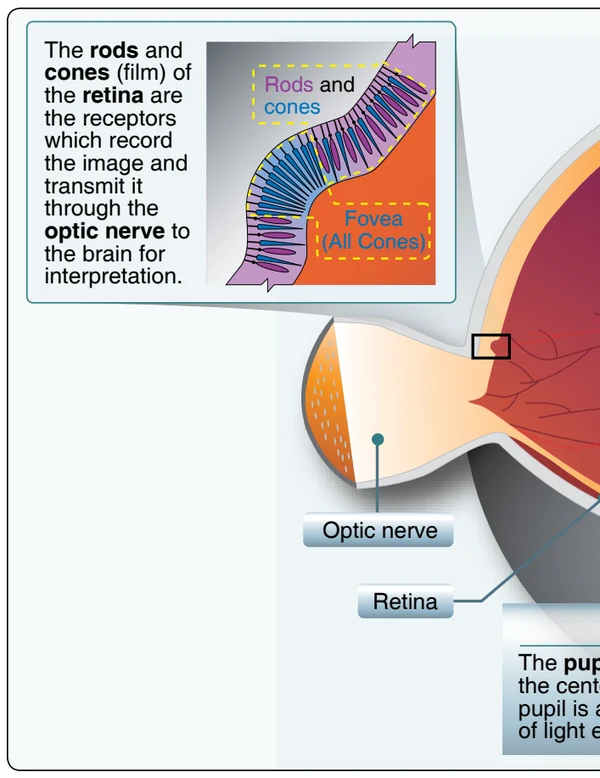
- at Vision is primarily the result of light striking a photosensitive layer, called the retina, at the back of the eye.
- The retina is composed of light-sensitive cones and rods.
- The cones in the eye perceive an image best when the light is bright, while the rods work best in low light.
- The pattern of light that strikes the cones and rods is transmitted as electrical impulses by the optic nerve to the brain where these signals are interpreted a as an image. as
Cones
- Cones are concentrated around the center of the retina.
- They gradually diminish in number as the distance from the center increases.
- Cones allow color perception by sensing red, blue, and green light.
- Directly behind the lens, on the retina, is a small, notched area called the fovea.
- This area contains only a high concentration of cone receptors.
- The best vision in daylight is obtained by looking directly at the object.
- This focuses the image on the fovea, where detail is best seen.
- The cones, however, do not function well in darkness, on which explains why color is not seen as vividly at night as it is during the day. at
Rods
- Concentrated outside the fovea area, the rods are the dim be light and night receptors.
- The number of rods increases as the distance from the fovea increases.
- Rods sense images only in black and white.
- Because the rods are not located directly behind the pupil, they are responsible for most peripheral vision.
- Images that move are perceived more easily by the rod areas than by the cones in the fovea.
- If you have ever seen something move out of the corner of your eye, it was most likely detected by rod receptors. low light, the cones lose much of their function, while rods become more receptive.
- The eye sacrifices sharpness for sensitivity.
- The ability to see an object directly in front of you is reduced, and much depth perception is lost, as well as judgment size.
- The concentration of cones in the fovea can make a night blindspot at the center of vision.
- How well a person sees night is determined by the rods in the eyes, as well as by the amount of light allowed into the eyes.
- At night, the wider the pupil is open at night, the better night vision becomes.
Night Vision
- Diet and general physical health have an impact on how well person can see in the dark.
- Deficiencies in vitamins A and C have been shown to reduce night acuity.
- Other factors, such carbon monoxide poisoning, smoking, alcohol, and certain drugs can greatly decrease night vision.
- Lack of oxygen can also decrease night vision as the eye requires more oxygen per unit weight than any other part of the body.
Night Scanning
- Good night visual acuity is needed for collision avoidance.
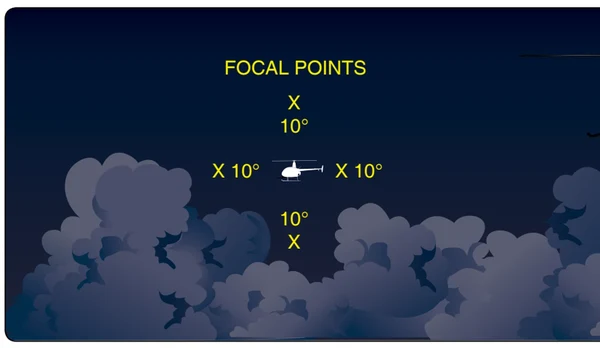
- Night scanning, like day scanning, uses a series of short, regularly spaced eye movements in 10° sectors.
- Unlike day scanning, however, off-center viewing is used to focus objects the rods rather than the fovea blindspot.
- [] When looking at an object, avoid staring at it too long.
- If staring an object without moving the eyes, the retina becomes accustomed to the light intensity and the image begins to fade.
- To keep it clearly visible, new areas in the retina must exposed to the image.
- Small, circular eye movements help eliminate the fading.
- Also, move the eyes more slowly from sector to sector than during the day to prevent blurring.
- During daylight, objects can be perceived at a great distance with good detail.
- At night, range is limited, and detail is poor.
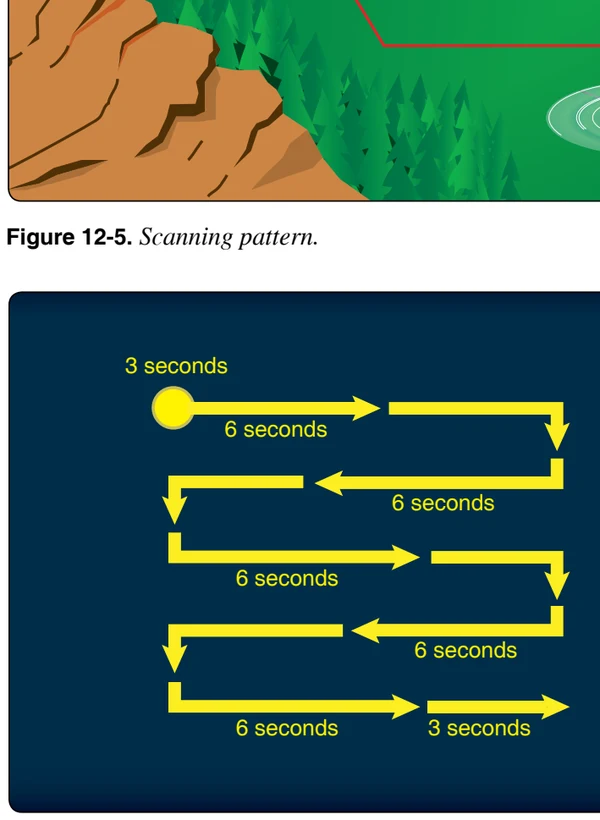
- Objects along the flight path can be more readily identified at night, by using the proper techniques to scan the terrain.
- To scan effectively, pilots look from side to side.
- They begin scanning at the greatest distance at which an can be perceived high on the horizon, thence moving toward the position of the aircraft.
- [] shows scanning pattern.
- Because the light-sensitive elements the retina are unable to perceive images that are in motion, stop-turn-stop-turn motion should be used.
- For each stop, area about 30 degrees wide should be scanned.
- This angle includes an area about 250 meters wide at a distance 500 meters.
- The duration of each stop is based on the should of detail that is required, but no stop should last more than object two or three seconds.
- When moving from one viewing point inward to the next, pilots should overlap the previous field of view this by 10 degrees.
- This scanning technique allows greater clarity of in observing the periphery.
- Other scanning techniques, as a illustrated in [], may be developed to fit the situation. an viewing
Obstruction Detection
- of Obstructions having poor reflective surfaces, such as wires degree and small tree limbs, are difficult to detect.
- The best way to on locate wires is by looking for the support structures.
- However, pilots should review the most current hazard maps with known wire locations before night flights.
Aircraft Lighting
- In order to see other aircraft more clearly, regulations require that all aircraft operating during the night hours have special lights and equipment.
- The requirements for operating at night are found in Title 14 of the Code of Federal Regulations (14 is CFR) part 91.
- In addition to aircraft lighting, the regulations also provide a definition of night flight in accordance with Title 14 of the Code of Federal Regulations (CFR) part 91, currency requirements, fuel reserves, and necessary electrical systems.
- Position lights enable a pilot to locate another aircraft, as well as help determine its direction of flight.
- The approved aircraft lights for night operations are a green light on the right cabin side or wingtip, a red light on the left cabin side or wingtip, and a white position light on the tail.
- In addition, operable flashing aviation-red or aviation-white anticollision lights must be used when the aircraft is so equipped, in accordance with 14 CFR 91.209(b); these lights aid identification at night. in These flashing lights can be in a number of locations but are most commonly found on the top and bottom of the cabin.
- [] shows examples of aircraft lighting.
- By interpreting the position lights on other aircraft, the pilot in aircraft 3 can determine whether the aircraft is flying in the in opposite direction or is on a collision course.
- If a red position it light is seen to the right of a green light, such as shown by aircraft 1, it is flying toward aircraft 3.
- A pilot should watch this aircraft closely and be ready to change course.
- Aircraft 2, in to is is the other hand, is flying away from aircraft 3, as indicated by the white position light.
Visual Illusions
- Illusions give false impressions or misconceptions of actual conditions; therefore, pilots must understand the type of illusions that can occur and the resulting disorientation.
- Although the eye is the most reliable of the senses, some illusions can result from misinterpreting what is seen; what perceived is not always accurate.
- Even with the references outside the cockpit and the display of instruments inside, pilots must be on guard to interpret information correctly.
Relative-Motion Illusion
- Relative motion is the falsely perceived self-motion in relation to the motion of another object.
- The most common example is as follows.
- An individual in a car is stopped at a traffic light and another car pulls alongside.
- The individual who was stopped at the light perceives the forward motion the second car as his or her own motion rearward.
- This results in the individual applying more pressure to the brakes unnecessarily.
- This illusion can be encountered during flight situations such as formation flight, hover taxi, or hovering over water or tall grass.
Confusion with Ground Lights
- Confusion with ground lights occurs when a pilot mistakes ground lights for stars.
- The pilot can place the helicopter an extremely dangerous flight attitude if he or she aligns with the wrong lights.
- In []A , the helicopter is aligned with a road and not with the horizon.
- Isolated ground lights can appear as stars and could lead to the illusion that the helicopter is in a nose-high attitude.
- When no stars are visible because of overcast conditions, unlighted areas of terrain can blend with the dark overcast to create the illusion that the unlighted terrain is part of the sky []B.
- In this illusion, the shoreline is mistaken for the horizon.
- In an attempt to correct for the apparent nosehigh attitude, a pilot may lower the collective and attempt fly "beneath the shore." This illusion can be avoided by referencing the flight instruments and establishing a true horizon and attitude.
Reversible Perspective Illusion
- At night, an aircraft or helicopter may appear to be moving away when it is actually approaching.
- If the pilot of each aircraft has the same assumption, and the rate of closure significant, by the time each pilot realizes his or her own error in assumption, it may be too late to avoid a mishap.
- This illusion is called reversible perspective and often experienced when a pilot observes another aircraft or helicopter flying an approaching, parallel course. determine the direction of flight, the pilot should observe other aircraft's position lights.
- Remember the following: on right returning; that is, if an aircraft is seen with the position light on the right and the green position light on left, the observed aircraft is traveling in the opposite
Flicker Vertigo
- Flicker vertigo is technically not an illusion; however, most people are aware from personal experience, a flickering light can be both distracting and annoying.
- Flicker vertigo may be created by helicopter rotor blades airplane propellers interrupting direct sunlight at a rate to 20 cycles per second.
- Flashing anticollision strobe especially while the aircraft is in the clouds, can also this effect.
- One should also be aware that photic stimuli certain frequencies could produce seizures in those individuals who are susceptible to flicker-induced




Night Flight
- The night flying environment and the techniques used flying at night depend on outside conditions.
- Flying bright, clear, moonlit evening when the visibility is good, the wind is calm is not much different from flying during day.
- However, if flying on an overcast night over a populated area, with few or no outside lights on the the situation is quite different.
- Visibility is restricted, more alert in steering clear of obstructions and low Options are also limited in the event of an emergency, is more difficult to find a place to land and determine direction and speed.
- At night, rely more heavily on the systems, such as lights, flight instruments, and navigation equipment.
- As a precaution, if visibility is limited or references are inadequate, strongly consider delaying To flight until conditions improve, unless proper instrument the flight training has been received and the helicopter has the red appropriate instrumentation and equipment. red the
Preflight
- direction.
- Aircraft preflight inspection is a critical aspect of flight safety.
- It must comply with the appropriate rotorcraft flight manual (RFM).
- Schedule the preflight as early as possible in the planning sequence, preferably during daylight hours, to allow time for maintenance assistance and corrections.
- If a night preflight is necessary, a flashlight with or an unfiltered lens (white light) should be used to supplement of 4 lighting.
- Oil and hydraulic fluid levels and leaks are difficult lights, to detect with a blue-green or red lens.
- Windscreens should produce be checked to ensure they are clean and relatively free of at scratches.
- Slight scratches are acceptable for day flight but rare may not be for night flight.
- The search light or landing light epilepsy. should be positioned for the best possible illumination during an emergency descent.
- Careful attention must be paid to the aircraft electrical system. when In helicopters equipped with fuses, a spare set is required on a by regulation, and by common sense, so make sure they are and on board.
- If the helicopter is equipped with circuit breakers, the check to see that they are not tripped.
- A tripped circuit breaker sparsely may be an indication of an equipment malfunction and should ground, be left for maintenance to troubleshoot before flying. so be clouds.
- All aircraft operating between sunset and sunrise are required as it to have operable navigation (position) lights.
- Turn these lights wind on during the preflight to inspect them visually for proper aircraft operation.
- Between sunset and sunrise, these lights must be on any time the helicopter is operating. outside the All recently manufactured aircraft certificated for night in flight must have an anticollision light that makes the aircraft a more visible to other pilots.
- This light is either a red or white a flashing light and may be in the form of a rotating beacon or a strobe.
- Installed anticollision lights must be operated during day and night operations, but may be turned off when the pilot in command determines that operating conditions make doing so safer.
- One of the first steps in preparation for night flight is to become thoroughly familiar with the helicopter's cockpit, instrumentation, and control layout.
- It is recommended that a pilot practice locating each instrument, control, and switch, both with and without cabin lights.
- Since the markings on some switches and circuit breaker panels may be difficult to read at night, be able to locate and use these devices, and read the markings in poor light conditions.
- Before starting the engine, make sure all necessary equipment and supplies needed for the flight, such as charts, notepads, and flashlights, are accessible and ready for use.
Cockpit Lights
- Check all interior lights with special attention to the instrument and panel lights.
- The panel lighting can usually be controlled with a rheostat or dimmer switch, allowing the pilot to adjust the intensity.
- If a particular light is too bright or causes reflection or glare off the windshield, it should be adjusted or turned off.
- As ambient light level decreases from twilight to darkness, intensity of the cockpit lights is reduced to a low, usable intensity level that reduces any glare or reflection off the windshield.
- The light level should be adjusted to as close to the ambient light level as possible.
- A flashlight, with red or blue-green lens filter, or map light can supplement the available light in the cockpit.
- Always carry a flashlight with fresh batteries to provide an alternate source of light if the interior lights malfunction.
- If an existing map/utility light is used, it should be hand-held or remounted to a convenient location.
- In order to retain night adaptation, use low level light when using your checklist.
- Brief your passengers on the importance of light discipline during night flight so the pilot is not blinded, causing loss of dark adaptation.
Engine Starting and Rotor Engagement
- Use extra caution when starting the engine and engaging the rotors, especially in dark areas with little or no outside lights.
- In addition to the usual call of "clear," turn on the position and anticollision lights.
- If conditions permit, also turn the landing light on momentarily to help warn others that the engine is about to start and engage the rotors.
Taxi Technique
- Landing lights usually cast a beam that is narrow and concentrated ahead of the helicopter, so illumination to the side is minimal.
- Therefore, slow the taxi at night, especially congested ramp and parking areas.
- Some helicopters have hover light in addition to a landing light, which illuminates larger area under the helicopter.
- When operating at an unfamiliar airport at night, ask for instructions or advice concerning local conditions, so as to avoid taxiing into areas of construction, or unlighted, unmarked obstructions.
- Ground controllers or UNICOM operators are usually cooperative in furnishing this type of information.
Night Traffic Patterns
- Traffic patterns are covered in Chapter 9, Basic Flight Maneuvers, but the following additional considerations should be taken into account when flying a helicopter in a night traffic pattern:
- 1.
- The minimum recommended pattern height at night is 1,000 feet when able.
- 2.
- If possible, consider taking the right hand night pattern with fixed wing in the left hand pattern for extra separation, but if needed, conform and integrate with the fixed wing using the same pattern height.
- 3.
- Be extra vigilant on abiding with noise abatement procedures at night.
- 4.
- Always plan to use the lit runway at night for unaided (no night vision equipment) approaches and departures.
- 5.
- Avoid downwind and crosswind approaches at night when able.
Takeoff
- Before takeoff, make sure that there is a clear, unobstructed takeoff path.
- At airports, this is accomplished by taking off over a runway or taxi way, however, if operating offairport, pay more attention to the surroundings.
- Obstructions may also be difficult to see if taking off from an unlighted area.
- Once a suitable takeoff path is chosen, select a point down the takeoff path to use for directional reference.
- The landing light should be positioned in order to illuminate the tallest obstacles in the takeoff path.
- During a night takeoff, notice a lack of reliable outside visual references after becoming airborne.
- This is particularly true at small airports and off-airport landing sites located in sparsely populated areas.
- To compensate for the lack of outside references, use the available flight instruments as an aid.
- Check the altimeter and the airspeed indicator to verify the proper climb attitude.
- An attitude indicator, if installed, can enhance attitude reference.
- The first 500 feet of altitude after takeoff is considered to be the most critical period in transitioning from the comparatively well-lit airport or heliport into what sometimes appears to be total darkness.
- A takeoff at night is usually an "altitude airspeed" maneuver, meaning a pilot most likely a nearly maximum performance takeoff.
- This improves chances for obstacle clearance and enhances safety.
En Route Procedures
- In order to provide a higher margin of safety, recommended that a cruising altitude somewhat higher normal be selected.
- There are three reasons for this. a higher altitude gives more clearance between obstacles, especially those that are difficult to see at night, such as tension wires and unlighted towers.
- Second, in the event an engine failure, there is more time to set up for a and the greater gliding distance gives more options for a landing.
- Third, radio reception is improved, particularly using radio aids for navigation.
- During preflight planning, when possible, it is recommended that a route of flight be selected that is within reach airport, or any safe landing site.
- It is also recommended that pilots fly as close as possible to a populated or area, such as a highway or town.
- Not only does this more options in the event of an emergency, but also navigation a lot easier.
- A course comprised of a series slight zigzags to stay close to suitable landing sites well-lit areas, only adds a little more time and distance otherwise straight course.
- In the event of a forced landing at night, use the procedure recommended for day time emergency If available, turn on the landing light during the final to help in avoiding obstacles along the approach path.
Collision Avoidance at Night
- Because the quantity and quality of outside visual references are greatly reduced, a pilot tends to focus on a single or instrument, making him or her less aware of the traffic around.
- Make a special effort to devote enough to scan for traffic.
- As discussed previously in this effective scanning is accomplished with a series of regularly spaced eye movements that bring successive areas of the sky into the central visual field.
- Contrary the 30-degree scan used to view the ground in the case scanning for other aircraft, each movement in this should not exceed 10 degrees, and each area should observed for at least 1 second to enable detection.
- If pilot detects a dimly lit object in a certain direction, pilot should not look directly at the object, but scan the adjacent to it, called off-center viewing.
- This will the chances of fixating on the light and allow focusing on the objects (e.g., tower, aircraft, ground lights). stops of a few seconds in duration in each scan will detect the light and its movement.
- A pilot can determine over another aircraft's direction of flight by interpreting the performs position and anticollision lights, as previously described. the When scanning, pilots should also remember to move their heads, not just their eyes.
- Ground obstructions can cover a considerable amount of sky, and the area can easily be uncovered by a small head movement. it is than
Approach and Landing
- First, Night approaches and landings do have some advantages over daytime approaches, as the air is generally smoother, and the high- disruptive effects of turbulence and excessive crosswinds are of often absent.
- However, there are a few special considerations landing and techniques that apply to approaches at night.
- For safe example, when landing at night, especially at an unfamiliar if airport, make the approach to a lighted runway and then use the taxiways to avoid unlighted obstructions or equipment.
- Carefully controlled studies have revealed that pilots have a of an tendency to make lower approaches at night than during the day.
- This is potentially dangerous as there is a greater chance lighted of hitting an obstacle, such as an overhead wire or fence, that is offer difficult to see.
- It is good practice to make steeper approaches at makes night, increasing the probability of clearing obstacles.
- Monitor of altitude and rate of descent using the altimeter. and to an Another pilot tendency during night flight is to focus too much on the landing area and not pay enough attention to airspeed.
- If too much airspeed is lost, a vortex ring state same condition may result.
- Maintain the proper attitude during landings. the approach, and ensure that you keep some forward descent airspeed and movement until close to the ground.
- Outside visual references for airspeed and rate of closure may not be available, especially when landing in an unlit area, so pay special attention to the airspeed indicator.
- Although the landing light is a helpful aid when making point night approaches, there is an inherent disadvantage.
- The other portion of the landing area illuminated by the landing light time seems higher than the dark area surrounding it.
- This effect chapter, can cause a pilot to terminate the approach at an altitude that short, is too high, which may result in a vortex ring state condition and a hard landing. to of case
Illusions Leading to Landing Errors
- be Various surface features and atmospheric conditions the encountered in night landing can create illusions of incorrect the height above and distance from the runway threshold. area Landing errors from these illusions can be prevented by decrease anticipating them during approaches, conducting an aerial more visual inspection of unfamiliar airports before landing, using Short electronic glideslope or VASI (Visual Approach Slope Indicator) systems when available, and help to maintaining optimum proficiency in landing procedures.
- An absence of ground features, as when landing over water, darkened areas, and terrain made featureless by snow, can create the illusion that the aircraft is at a higher altitude than it actually is.
- The pilot who does not recognize this illusion will fly a lower approach.
- Rain on the windscreen can create the illusion of greater height, and atmospheric haze can create the illusion of being at a greater distance from the runway.
- The pilot who does not recognize these illusions flies a higher approach.
- Penetration of fog can create the illusion of pitching up.
- The pilot who does not recognize this illusion steepens the approach, often quite abruptly.
- Lights along a straight path can be mistaken for runway and approach lights.
- This might include street lights along a roadside or even the internal lights of a moving train.
- Another illusion may occur with very intense runway and approach lighting.
- Due to the relative brightness of these lights, the pilot may perceive them to be closer than they really are.
- Assuming that the lights are as close as they appear, the pilot may attempt an approach that is actually lower than glideslope.
- Conversely, the pilot flying over terrain with few lights may make a lower than normal approach.
Helicopter Night VFR Operations
- a While ceiling and visibility significantly affect safety in night VFR operations, lighting conditions also have a profound of effect on safety.
- Even in conditions in which visibility and ceiling are determined to be visual meteorological conditions, as the ability to discern unlit or low contrast objects and terrain at night may be compromised.
- The ability to discern these objects and terrain is referred to as the "seeing condition," and is related to the amount of natural and man-made lighting available, and the contrast, reflectivity, and texture of surface terrain and obstruction features.
- In order to conduct operations safely, seeing conditions must be accounted for in the planning and execution of night VFR operations.
- Night VFR seeing conditions can be described by identifying high lighting conditions and low lighting conditions.
- High-lighting conditions exist when either of two sets of conditions is present:
- 1.
- The sky cover is less than broken (less than ⁄ cloud cover), the time is between the local moon rise and moon set, and the lunar disk is at least 50 percent is illuminated; or 2.
- The aircraft is operated over surface lighting that, at least, provides lighting of prominent obstacles, the identification of terrain features (shorelines, valleys, hills, mountains, slopes) and a horizontal reference by which the pilot may control the helicopter.
- For example, this surface lighting may be the result of: a.
- Extensive cultural lighting (manmade, such as a built-up area of a city), b.
- Significant reflected cultural lighting (such as the illumination caused by the reflection of a major metropolitan area's lighting reflecting off a cloud ceiling), or c.
- Limited cultural lighting combined with a high level of natural reflectivity of celestial illumination, such as that provided by a surface covered by snow or a desert surface.
- Low lighting conditions are those that do not meet the high lighting conditions requirements.
- Some areas may be considered a high lighting environment only in specific circumstances.
- For example, some surfaces, such as a forest with limited cultural lighting, normally have little reflectivity, requiring dependence on significant moonlight to achieve a high lighting condition.
- However, when that same forest is covered with snow, its reflectivity may support a high lighting condition based only on starlight.
- Similarly, a desolate area, with little cultural lighting, such as desert, may have such inherent natural reflectivity that it may be considered a high lighting conditions area regardless season, provided the cloud cover does not prevent starlight from being reflected from the surface.
- Other surfaces, such areas of open water, may never have enough reflectivity or cultural lighting to ever be characterized as a high lighting area.
- Through the accumulation of night flying experience in a particular area, the pilot develops the ability to determine, prior to departure, which areas can be considered supporting high or low lighting conditions.
- Without that pilot experience, low lighting considerations should be applied by pilots for both preflight planning and operations until high lighting conditions are observed or determined to be regularly available.
- Even if the aircraft is certified for day and night VFR conditions, night flight should only be conducted if adequate celestial illumination is assured during the entirety the flight.
Chapter Summary
- Knowledge of the basic anatomy and physiology of the eye helpful in the study of helicopter night operations.
- Adding