Visual Flight Rules
Learn VFR weather minimums, cloud clearances, cruising altitudes, required equipment, terminal-area operations, and the differences between VFR-on-top and VFR over-the-top.
Introduction to Visual Flight Rules
- Although sometimes used interchangeably, Visual Meteorological Conditions (VMC) and Visual Flight Rules (VFR) have different meanings.
- Review Visual Flight Rules Versus Visual Meteorological Conditions to see how the rules and weather conditions relate.
- Review basic VFR weather minimums and cloud clearances before deciding whether a flight can be conducted under VFR.
- Use VFR cruising altitudes and flight levels to plan the en route portion of the flight.
- Account for traffic and visibility risks in congested areas and terminal areas, including situations where pilots follow instrument flight rules procedures while operating VFR.
- Check the aircraft equipment requirements, required equipment for VFR operations, and other requirements to operate VFR before departure.
- Distinguish an IFR clearance to operate VFR-on-Top from VFR Over-the-Top and an IFR-to-VFR Over-the-Top transition.
- Apply these rules to real flights in the lessons and case studies.
- Reinforce your understanding of Visual Flight Rules by completing the knowledge quiz and interactive scenario, comparing your performance with the applicable Airman Certification Standards, and reviewing the topic summary before moving on.
Visual Flight Rules Key Highlights
- Visual Flight Rules (VFR) govern aircraft operations conducted primarily by visual reference to the outside environment.
- VFR operations require pilots to meet specified weather minimums and cloud clearance requirements based on airspace classification.
- Pilots operating under VFR are responsible for traffic avoidance, terrain clearance, and maintaining visual separation from other aircraft.
- VFR weather minimums vary depending on altitude, airspace class, time of day, and operating environment.
- Flight visibility, cloud clearance, and situational awareness are essential to safe VFR operations.
- Pilots should evaluate weather trends, terrain, airspace restrictions, and daylight conditions before conducting VFR flights.
- Special VFR operations may allow aircraft to operate within controlled surface areas below standard VFR weather minimums under ATC authorization.
- Loss of visual references or continued VFR flight into instrument meteorological conditions can create significant safety hazards.
- Navigation under VFR commonly relies on pilotage, dead reckoning, visual checkpoints, and supplemental navigation systems.
- Understanding Visual Flight Rules improves regulatory compliance, aeronautical decision-making, and overall flight safety.
Visual Flight Rules Versus Visual Meteorological Conditions
- Visual Flight Rules (VFR) are the rules governing flight in Visual Meteorological Conditions (VMC).
-
Visual Flight Rules Regulations:
- As a flight-rules term, VFR identifies the operating rules and procedures a pilot follows rather than a particular weather observation.
- The FAA also uses “VFR” to describe weather meeting VFR minimums or the type of flight plan, so context determines which meaning is intended.
- Under basic VFR, flight visibility and distance from clouds must meet the minimums prescribed for applicable altitudes and airspace classes.
- Student pilots must comply with 14 CFR (Code of Federal Regulations) § 61.89(a)(6) and (7).
-
Visual Meteorological Conditions:
- VMC describes weather conditions that meet or exceed regulatory minimums for visibility, distance from clouds, and ceiling.
- VMC describes the weather conditions at a place and time, not the flight rules or clearance under which an aircraft is operating.
- For example, a pilot may fly a visual approach in VMC while remaining on an IFR flight plan; the visual approach is still an IFR procedure.
- Except as provided in 14 CFR § 91.157 for Special VFR, flight beneath the ceiling under VFR is prohibited within the lateral boundaries of controlled airspace designated to the surface for an airport when the ceiling is less than 1,000 feet (14 CFR § 91.155(c)).
Basic VFR Weather Minimums
- VFR operations must meet the weather minimums for the applicable airspace class, unless authorized to operate under special VFR. []
- 14 CFR § 91.157 (Special VFR) allows aircraft to operate beneath the ceiling under VFR within the lateral boundaries of controlled airspace designated to the surface for an airport when the ceiling is less than 1,000 feet (see 14 CFR § 91.155(c)).
- Student pilots must comply with 14 CFR § 61.89(a)(6) and (7).

VFR Cloud Clearances
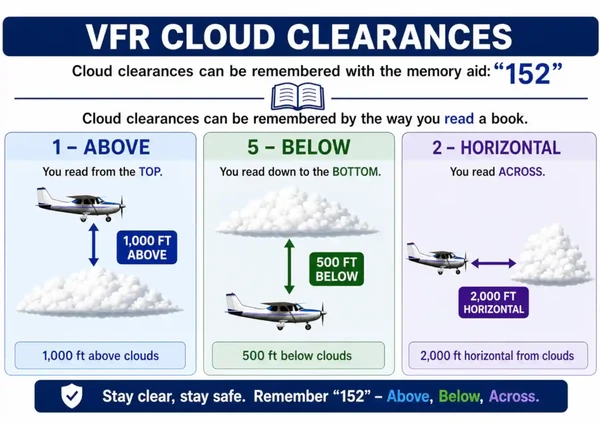
- The memory aid “152” helps you remember commonly applicable VFR cloud clearances. []
- To remember the order of “152,” think of up, down, and across:
- Up and down: 1,000 feet above and 500 feet below clouds.
- Across: 2,000 feet horizontally from clouds.
VFR Cruising Altitudes and Flight Levels
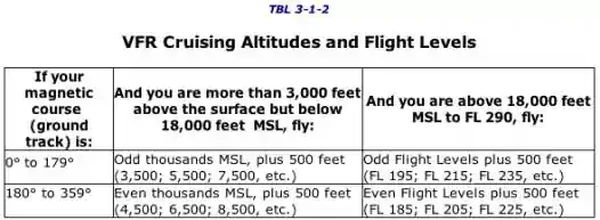
- VFR cruising altitudes help reduce the risk of midair collisions by assigning cruising altitudes under 14 CFR § 91.159, which states: []
- Except while holding in a holding pattern of 2 minutes or less (see VFR Holding), or while turning, each person operating an aircraft under VFR in level cruising flight more than 3,000 feet above the surface shall maintain the appropriate altitude or flight level prescribed below, unless otherwise authorized by ATC:
- When operating below 18,000 feet mean sea level (MSL):
- On a magnetic course of 0° through 179°, maintain an odd-thousand-foot MSL altitude plus 500 feet (such as 3,500, 5,500, or 7,500 feet).
- On a magnetic course of 180° through 359°, maintain an even-thousand-foot MSL altitude plus 500 feet (such as 4,500, 6,500, or 8,500 feet).
- When operating at or above 18,000 feet MSL, maintain the altitude or flight level assigned by Air Traffic Control (ATC).
- When operating below 18,000 feet mean sea level (MSL):
- Except while holding in a holding pattern of 2 minutes or less (see VFR Holding), or while turning, each person operating an aircraft under VFR in level cruising flight more than 3,000 feet above the surface shall maintain the appropriate altitude or flight level prescribed below, unless otherwise authorized by ATC:
- ATC may issue additional restrictions when you are under its control, such as while receiving flight following or operating in controlled airspace.
- See 14 CFR § 91.179 for Instrument Flight Rules (IFR) cruising altitudes.
Memory Aids:
- The 13 colonies—an odd number—were on the East Coast of the U.S.
- Eastern states have odd shapes.
- NEODD SWEVEN: North East Odd, South West Even.
VFR in Congested Areas
- A high percentage of near midair collisions occur below 8,000 feet above ground level (AGL) and within 30 miles of an airport.
- Risk areas include terrain that funnels aircraft into common routes, sightseeing areas, or designated alert areas.
- When operating VFR in these highly congested areas, maintain extra vigilance and monitor an appropriate control frequency, whether landing in the area or flying through.
- The appropriate frequency is normally an approach control frequency.
- Monitoring the frequency helps you build awareness of nearby traffic.
- When radar is available, VFR pilots may request radar traffic advisories from approach control (flight following).
- Because VFR traffic advisories are provided only as controller workload permits, identify congested corridors during preflight planning, consider routing around them, and be prepared to continue safely without flight following.
VFR Flights in Terminal Areas
- Exercise caution when choosing to fly VFR, especially in terminal areas.
- Published weather and cloud clearance requirements are minimums.
- Use good judgment to provide a greater safety margin when conditions warrant.
-
Approach Area:
- Although VFR operations in Class B, C, D, or E surface areas may be permitted when the official visibility is 3 or 4 miles, good judgment calls for staying clear of the approach area.
-
Reduced Visibility:
- Precipitation reduces forward visibility.
- Even when you can legally cancel your IFR flight plan and proceed under VFR, good practice during precipitation is to continue operating under IFR into the terminal area until reasonably close to your destination.
-
Simulated Instrument Flights:
- During simulated instrument flight, ensure the weather provides an adequate safety margin for the safety pilot’s restricted view and your increased focus on the flight instruments.
- Allow a greater safety margin when your route follows or passes near a busy airway or airport.
-
Following IFR Procedures Even When Operating VFR
- Pilots are encouraged to practice IFR procedures whenever possible, even when operating VFR, to maintain IFR proficiency.
Suggested IFR proficiency practices include:
- Obtain a complete preflight briefing and check Notices to Airmen (NOTAMs).
- Before every flight, pilots should gather all information essential to the planned flight.
- Pilots can obtain a briefing that meets regulatory requirements without contacting Flight Service.
- Pilots are encouraged to use automated resources and review Advisory Circular (AC) 91-92, Pilot’s Guide to a Preflight Briefing, for more information.
- NOTAMs are available from the Federal NOTAM System (FNS) NOTAM Search website, private vendors, or upon request from Flight Service.
- File a flight plan.
- Filing a flight plan is a simple precaution that takes only a little time.
- An activated VFR flight plan helps initiate search and rescue procedures if you become overdue at your destination.
- Pilots can file flight plans online or by calling Flight Service.
- Flight planning applications can also be used to file, activate, and close VFR flight plans.
- Use current charts.
- To enhance situational awareness and minimize distractions during critical phases of flight, pre-load all intended waypoints into a suitable RNAV system while the aircraft is on the ground.
- Use navigation aids to practice maintaining your course and keeping the needle centered.
- Maintain a constant altitude appropriate for the direction of flight.
- Estimate arrival times at checkpoints along your route.
- Make accurate and frequent position reports to Flight Service Stations (FSSs) along your route.
- Obtain a complete preflight briefing and check Notices to Airmen (NOTAMs).
- Simulated IFR flight (under the hood) is recommended, but pilots must review and comply with 14 CFR § 91.109 before and during the flight.
- When flying VFR at night, pilots should maintain an altitude appropriate for the direction of flight and at or above the charted minimum en route altitude.
- This is especially important over mountainous terrain, where visual references to the ground are often limited at night.
- Do not rely on vision alone to avoid rising, unlighted terrain or even lighted obstructions such as TV towers.
Aircraft Equipment Requirements
-
Visual Flight Rules:
-
Day VFR (TOMATO FLAAMES):
- T - Tachometer (one for each engine)
- O - Oil Pressure Gauge (one for each liquid-cooled engine)
- M - Magnetic Direction Indicator.
- A - Airspeed indicator.
- T - Temperature gauge (each liquid-cooled engine)
- O - Oil temperature gauge (each liquid-cooled engine)
- F - Fuel Gauges.
- L - Landing gear position indicator lights (retractable landing gear)
- A - Altimeter.
- A - Anti-Collision light system (strobes), if manufactured after 3/11/1996
- M - Manifold pressure gauge (each altitude engine)
- E - Emergency Locator Transmitter.
- S - Seat belts & shoulder harness (front seats).
-
Night VFR (FLAPS):
- Day VFR requirements, plus:
- F - Fuses (spares), one spare set of fuses or three spare fuses of each kind required, that are accessible to the pilot in flight.
- L - Landing lights (if for hire).
- A - Anti-collision light system (strobes), if manufactured after 8/11/1971
- P - Position Lights.
- S - Source of energy (adequate to power all electrical and radio equipment)
- Day VFR requirements, plus:
-
-
Instrument Flight Rules:
-
Day/Night IFR (GRABCARDD):
- G - Generator or alternator.
- R - Rate of turn indicator (turn coordinator or turn & bank indicator).
- A - Altimeter, sensitive, adjustable for barometric pressure (Kollsman window).
- B - Ball (slip-skid indicator [inclinometer]).
- C - Clock (digital or analog displaying hours, minutes, and seconds).
- A - Attitude indicator.
- R - Radios (radio communication and navigation equipment suitable for the route to be flown).
- D - Direction (gyroscopic) indicator (directional gyro or heading indicator).
- D - DME (Distance Measuring Equipment) or suitable RNAV/GPS.
- At or above Flight Level 240 (24,000 feet pressure altitude), approved DME or a suitable area navigation (RNAV) system is required when VOR navigation equipment is required for the route under 14 CFR 91.205(d)(2), for U.S.-registered civil aircraft within the 50 states and the District of Columbia.
- A Global Positioning System (GPS) installation must qualify as the suitable RNAV system; a portable GPS alone does not establish compliance.
- This additional, conditional requirement comes from 14 CFR 91.205(e).
-
-
Inoperative Equipment:
- The FAA has developed a process for determining airworthiness when equipment is inoperative.
- First, determine if there is a minimum equipment list.
- If not, determine if the item is part of the Type Certificate Data Sheet.
- If not, determine if the item is on the Kinds of Equipment list.
- If not, determine if the item is required per FAR 91.205.
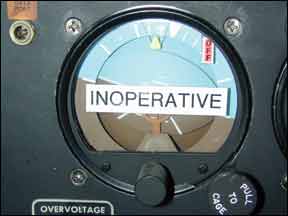
- If the item is not required on any of the above, the instrument must be removed or deactivated, placarded inoperative, and logged in the maintenance manuals per FAR 91.213 and in accordance with FAR 43.9. []
- If any other item is inoperative, 14 CFR section 91.405 states that it shall be placarded as required by Sec. 43.11.
- Following scheduled inspections:
- Aircraft shall have discrepancies repaired unless it is permitted to be inoperative by 91.213.
- Maintenance personnel shall make appropriate entries in the aircraft maintenance records indicating the aircraft has been approved for return to service.
- Equipment impacting the safety of flight must be repaired, but items that are not required may remain inoperative indefinitely provided they are appropriately placarded.
- Applying for a special flight permit may be appropriate, depending on the situation.
Required Equipment for VFR Operations
- VFR equipment requirements differ for day and night operations.
- Remember day VFR equipment with TOMATO FLAMES and the additional equipment required for night VFR with FLAPS, while retaining all day VFR equipment.
Day Operations:
- Airspeed indicator.
- Altimeter.
- Magnetic direction indicator.
- Tachometer for each engine.
- Oil pressure gauge for each engine using a pressure system.
- Temperature gauge for each liquid-cooled engine.
- Oil temperature gauge for each air-cooled engine.
- Manifold pressure gauge for each altitude engine.
- Fuel gauge indicating the quantity of fuel in each tank.
- Landing gear position indicator, if the aircraft has retractable landing gear.
- For small civil airplanes certificated after March 11, 1996, in accordance with part 23 of this chapter, an approved aviation red or aviation white anticollision light system.
- In the event of failure of any light of the anticollision light system, operation of the aircraft may continue to a location where repairs or replacement can be made.
- If the aircraft is operated for hire over water and beyond power-off gliding distance from shore, approved flotation gear readily available to each occupant and, unless the aircraft is operating under part 121, at least one pyrotechnic signaling device.
- As used in this section, "shore" means that area of the land adjacent to the water which is above the high water mark and excludes land areas which are intermittently under water.
- An approved safety belt with an approved metal-to-metal latching device for each occupant 2 years of age or older.
- For small civil airplanes manufactured after July 18, 1978, an approved shoulder harness for each front seat.
- The shoulder harness must be designed to protect the occupant from serious head injury when the occupant experiences the ultimate inertia forces specified in FAR 23.561(b)(2).
- Each shoulder harness installed at a flight crewmember station must permit the crewmember, when seated and with the safety belt and shoulder harness fastened, to perform all functions necessary for flight operations:
- The date of manufacture of an airplane is the date the inspection acceptance records reflect that the airplane is complete and meets the FAA-approved type design data.
- A front seat is a seat located at a flight crewmember station or any seat located alongside such a seat.
- An emergency locator transmitter, if required by 14 CFR § 91.207.
- For normal, utility, and acrobatic category airplanes with a seating configuration, excluding pilot seats, of 9 or less, manufactured after December 12, 1986, a shoulder harness for:
- Each front seat that meets the requirements of 14 CFR § 23.785(g) and (h) in effect on December 12, 1985;
- Each additional seat that meets the requirements of 14 CFR § 23.785(g) in effect on December 12, 1985.
- For rotorcraft manufactured after September 16, 1992, a shoulder harness for each seat that meets the requirements of 14 CFR § 27.2 or § 29.2 in effect on September 16, 1991.
-
Night Operations:
- Instruments and equipment specified above for day operations.
- Approved position lights.
- An approved aviation red or aviation white anticollision light system on all U.S.-registered civil aircraft.
- Anticollision light systems initially installed after August 11, 1971, on aircraft for which a type certificate was issued or applied for before August 11, 1971, must at least meet the anti-collision light standards of FAR parts 23, 25, 27, or 29, as applicable, that were in effect on August 10, 1971, except that the color may be either aviation red or aviation white.
- In the event of failure of any light of the anti-collision light system, operations with the aircraft may be continued to a stop where repairs or replacement can be made.
- If the aircraft is operated for hire, one electric landing light.
- An adequate source of electrical energy for all installed electrical and radio equipment.
- One spare set of fuses, or three spare fuses of each kind required, that are accessible to the pilot in flight.
Requirements to operate VFR
- Pilots must meet the applicable ATC clearance or radio communication requirements before entering Class B, C, or D airspace.
- The pilot retains this responsibility when receiving ATC radar advisories (see 14 CFR Part 91).
VFR-on-Top
- VFR-on-top allows pilots on an IFR flight plan to select an appropriate VFR cruising altitude, which may help them avoid weather or operate at an altitude unavailable under a conventional IFR clearance.
- VFR-on-top must be requested by the pilot on an IFR flight plan and, if approved, allows the pilot to select an altitude or flight level in VFR conditions instead of an assigned altitude.
- The pilot may select an altitude or flight level of their choice, subject to any ATC restrictions.
- A pilot operating in VFR conditions may request a climb or descent while remaining in VFR conditions.
- A clearance to operate VFR-on-top or in VFR conditions does not cancel the IFR flight plan.
- ATC will not authorize VFR-on-top operations in Class A airspace. Other airspace restrictions and the terms of the IFR clearance remain applicable.
- The pilot is responsible for remaining vigilant to see and avoid other aircraft.
- Comply with the VFR visibility and cloud clearance requirements in 14 CFR § 91.155.
- Fly at the appropriate VFR altitude prescribed by 14 CFR § 91.159.
- Comply with applicable IFR requirements, including minimum altitudes, position reporting, communications, and adherence to ATC clearances.
- Pilots should advise ATC before any altitude change to ensure the exchange of accurate traffic information.
-
VFR-on-Top Equipment Requirements:
- Because VFR-on-top is an IFR operation, the aircraft must have the instruments and equipment required for IFR operations under 14 CFR § 91.205(d).
- Each required instrument and item of equipment must be operable.
-
VFR-on-Top Restrictions:
- ATC will not authorize VFR-on-top operations in Class A airspace.
- Pilots must also comply with any other applicable airspace restrictions and their IFR clearance.
- If VFR conditions cannot be maintained, the pilot must advise ATC and obtain an amended IFR clearance before entering instrument meteorological conditions (IMC).
- ATC will not authorize VFR-on-top operations in Class A airspace.
-
VFR-on-Top Reporting Requirements:
-
VFR-on-Top Responsibilities:
-
Pilot Responsibilities:
- The pilot must request VFR-on-top while on an IFR flight plan and, if approved, may select an altitude or flight level instead of an assigned altitude, subject to any ATC restrictions.
- NOTE: ATC will not authorize VFR-on-top operations in Class A airspace. Other airspace restrictions and the terms of the IFR clearance remain applicable.
- References: Aeronautical Information Manual (AIM), paragraphs 4-4-8, IFR Clearance VFR-on-Top; 4-4-11, IFR Separation Standards; 5-3-2, Position Reporting; and 5-3-3, Additional Reports.
- By requesting a VFR-on-top clearance, the pilot assumes sole responsibility for remaining vigilant to see and avoid other aircraft and for the following:
- Fly at the appropriate VFR altitude prescribed by 14 CFR § 91.159.
- Comply with the VFR visibility and cloud clearance requirements in 14 CFR § 91.155, Basic VFR Weather Minimums.
- Comply with applicable IFR requirements, including minimum IFR altitudes, position reporting, radio communications, the course to be flown, and adherence to the ATC clearance.
- Pilots should advise ATC before any altitude change to ensure the exchange of accurate traffic information.
- The pilot must request VFR-on-top while on an IFR flight plan and, if approved, may select an altitude or flight level instead of an assigned altitude, subject to any ATC restrictions.
-
Controller Responsibilities:
- May clear an aircraft on an IFR flight plan to maintain VFR-on-top if the pilot requests the clearance.
- Informs the pilot of the reported cloud-top height or that no report is available, issues an alternate clearance if necessary, and, once the aircraft reports reaching VFR-on-top, re-clears it to maintain VFR-on-top.
- Before issuing the clearance, verify that the aircraft is not in and will not enter Class A airspace.
-
VFR Over-the-Top
- VFR over-the-top allows pilots to fly above clouds while operating under VFR.
- VFR over-the-top can be useful for flying above clouds or fog while maintaining VFR conditions.
- A VFR flight plan is not normally required within the continental United States; when filed and activated, it provides VFR search-and-rescue services.
- VFR over-the-top remains a VFR operation, unlike VFR-on-top, which is an ATC authorization for a pilot on an IFR flight plan.
- Meet VFR visibility and cloud-clearance minimums throughout the flight, including the climb, cruise, and descent; see basic VFR weather minimums and cloud clearances.
- Plan a descent in VFR conditions before climbing above clouds, considering ceilings and visibility at your destination and alternate areas, cloud coverage, terrain, fuel, and changing forecasts.
- An IFR clearance is a contingency only when the pilot and aircraft meet IFR requirements and ATC issues the clearance before the flight enters instrument meteorological conditions.
- Use the appropriate VFR cruising altitude when the rule applies, and do not assume the cloud layer provides terrain clearance; mountains and other obstacles may be hidden below it.
- Because you can become trapped above a cloud layer, reserve VFR over-the-top for situations where that risk is low or can be mitigated by obtaining an IFR clearance, subject to the pilot, aircraft, and clearance requirements described above.
IFR-to-VFR Over-the-Top
- Flying above a cloud layer may offer excellent visibility, but requires a safe plan for both the climb and descent.
- Along the Pacific Coast, particularly in winter, dense early morning fog can reduce runway visibility to less than 1/2 mile, while clear skies may exist just 1,000 feet above.
- Low coastal hills may rise above the fog layer, while inland airports may remain clear.
- Airports on valley floors can experience similar fog conditions, particularly with a nighttime temperature inversion.
- Pilots are permitted to request an IFR climb to VFR-on-top, then cancel IFR once conditions permit and continue under VFR.
- To operate IFR to VFR-on-top, file an IFR flight plan and request VFR-on-top as part of the clearance.
- Follow normal IFR departure procedures: obtain and read back your clearance before takeoff, fly the assigned route or departure procedure, set the assigned transponder code, and contact ATC as instructed.
- The departure is conducted under IFR, with a clearance that may resemble the following example:
- "Departure frequency [Frequency], climb to and report reaching VFR-on-top, if not VFR by [Altitude], maintain [Altitude] and advise."
- Once operating in VFR conditions outside Class A airspace, you may cancel IFR with ATC and continue VFR.
- After canceling IFR, comply with VFR rules and any applicable ATC clearances or instructions.
- After canceling IFR, file a new IFR flight plan and obtain an ATC clearance before resuming flight in IFR conditions.
- After you cancel IFR, the controller may remind you to “Maintain VFR.”
- If you want flight-plan search and rescue coverage after canceling IFR, file a separate VFR flight plan.
- Activate and close that VFR flight plan with Flight Service or another capable service provider.
- The Instrument flight plan opens automatically when you are cleared for takeoff
- It closes when you tell a controller "cancel IFR"
- The visual portion of the flight plan does not automatically activate
- After you cancel IFR, you need to call a Flight Service radio - whose frequency is typically found on your sectional chart - and activate your VFR flight plan
- Then you need to either close it by phone or radio when you land
- If VFR-on-top is not reached by the specified altitude, follow the alternative clearance issued by ATC, or request further clearance if none was provided.
- Also, if you don't arrive at your destination, someone will come looking for you and they will know where to look
Visual Flight Rules Lessons & Case Studies
- National Transportation Safety Board (NTSB) Identification: SEA04LA095:
- The NTSB determines the probable cause(s) of this accident to be: The pilot's inadequate planning/decision, VFR into IMC, and his failure to maintain terrain clearance. Factors include mountainous terrain and instrument meteorological condition
- National Transportation Safety Board (NTSB) Identification: LAX04FA113:
- The NTSB determines the probable cause(s) of this accident to be: the pilot's disregard for an in-flight weather advisory, his likely encounter with marginal VFR or IMC weather conditions, his decision to continue flight into those conditions, and failure to maintain an adequate terrain clearance altitude resulting in an in-flight collision with trees and mountainous terrain
- National Transportation Safety Board Identification: ANC20MA010:
- The NTSB determines the probable cause(s) of this accident to be: The pilot’s decision to continue flight under visual flight rules (VFR) into instrument meteorological conditions (IMC), which resulted in the collision into terrain. Contributing to the accident was Safari Aviation Inc.’s lack of safety management processes to identify hazards and mitigate the risks associated with factors that influence pilots to continue VFR flight into IMC. Also contributing to the accident was the Federal Aviation Administration’s delayed implementation of a Hawaii aviation weather camera program, its lack of leadership in the development of a cue-based weather training program for Hawaii air tour pilots, and its ineffective monitoring and oversight of Hawaii air tour operators’ weather-related operating practices.
- National Transportation Safety Board Identification: ERA09LA128:
- The NTSB determines the probable cause(s) of this accident to be: The pilot's improper preflight weather planning and his continued VFR flight into IMC conditions resulting in an in-flight collision with trees.
- National Transportation Safety Board Identification: ERA25LA130:
- The NTSB determines the probable cause(s) of this accident to be: The pilot’s improper decision to continue the visual flight rules flight into instrument meteorological conditions, which resulted in the accumulation of airframe icing and a subsequent aerodynamic stall/spin.
- National Transportation Safety Board Identification: ERA25FA037:
- The NTSB determines the probable cause(s) of this accident to be: The student pilot’s decision to continue the visual flight rules flight into instrument meteorological conditions at night, which resulted in controlled flight into terrain.
- National Transportation Safety Board Identification: ANC24LA069:
- The NTSB determines the probable cause(s) of this accident to be: The pilot’s decision to continue the visual flight rules flight into instrument meteorological conditions, which resulted in controlled flight into terrain.
- National Transportation Safety Board Identification: WPR24FA202:
- The NTSB determines the probable cause(s) of this accident to be: The pilot’s decision to continue the visual flight rules flight through an apparent visual corridor that rapidly narrowed due to rising terrain and mountain obscuration, resulting in momentary instrument meteorological conditions and the pilot’s subsequent controlled flight into the obscured terrain.
- National Transportation Safety Board Identification: ANC24FA032:
- The NTSB determines the probable cause(s) of this accident to be: The non-certificated pilot’s continued visual flight rules flight into instrument meteorological conditions, which resulted in controlled flight into the water.
- National Transportation Safety Board Identification: WPR24FA105:
- The NTSB determines the probable cause(s) of this accident to be: The pilot’s continued visual flight rules flight into instrument meteorological conditions, which resulted in an encounter with turbulence and structural icing conditions, loss of control, and subsequent impact with terrain.
Visual Flight Rules Knowledge Check
Choose the knowledge check that matches your current training for Visual Flight Rules.

PPL knowledge check
Core Knowledge Review
Review foundational knowledge, key concepts, and practical considerations. Topic: Visual Flight Rules.
- Immediate feedback
- Answer explanations
- Account progress tracking
Sport knowledge check
Sport Pilot Knowledge
Review the foundational knowledge and decisions used in sport-pilot operations. Topic: Visual Flight Rules.
- Immediate feedback
- Answer explanations
- Account progress tracking

CPL knowledge check
Advanced Application
Apply knowledge to advanced operations, risk management, and aeronautical decision-making. Topic: Visual Flight Rules.
- Immediate feedback
- Answer explanations
- Account progress tracking

Instrument knowledge check
Instrument Knowledge
Practice the procedures, systems, weather, and decisions used in instrument flight. Topic: Visual Flight Rules.
- Immediate feedback
- Answer explanations
- Account progress tracking

CFI knowledge check
Instructor Knowledge
Review the technical knowledge expected of an airplane flight instructor. Topic: Visual Flight Rules.
- Immediate feedback
- Answer explanations
- Account progress tracking

CFII knowledge check
Instrument Instructor Knowledge
Review instrument knowledge at the depth expected of an instrument flight instructor. Topic: Visual Flight Rules.
- Immediate feedback
- Answer explanations
- Account progress tracking
Why Take a Quiz?
Quizzes reinforce key concepts, identify knowledge gaps, and build confidence for real-world decisions. Quiz material is representative of the information provided here and is not based on or sourced from the Federal Aviation Administration test bank.
Visual Flight Rules Interactive Scenario
The VFR Corridor That Narrowed
Manage a day-VFR cross-country through Class G, E, C, and B airspace as cloud bases lower, cruising-altitude rules change, over-the-top options disappear, and legal minima prove insufficient for the route.
Scenario Complete
Visual Flight Rules Conclusion
- Pilot training requires instruction on how to handle VFR into IMC with the AOPA offering a syllabus to assist
- It is always possible to get stuck above a cloud layer and, therefore, VFR-Over-The-Top should be reserved for when risk of becoming trapped is low or can be mitigated by picking up an IFR clearance.
Visual Flight Rules References
- Federal Aviation Administration (FAA) - Pilot/Controller Glossary.
- Aeronautical Information Manual (3-1-4) Basic VFR Weather Minimums.
- Aeronautical Information Manual (4-3-16) VFR Flights in Terminal Areas.
- Aeronautical Information Manual (4-4-8) IFR Clearance VFR-On-Top.
- Aeronautical Information Manual (4-4-11) IFR Separation Standards.
- Aeronautical Information Manual (5-1-2) Follow IFR Procedures Even When Operating VFR.
- Aeronautical Information Manual (5-3-2) Position Reporting.
- Aeronautical Information Manual (5-3-3) Additional Reports.
- Aeronautical Information Manual (5-5-13) VFR-on-Top.
- Aeronautical Information Manual (7-6-3) VFR in Congested Areas.
- Aircraft Owners and Pilots Association (AOPA) - VFR into IMC Syllabus.
- CFI Notebook.net - Near Midair Collision (NMAC) Reporting.
- Federal Aviation Regulations (91.205) Powered civil aircraft with standard category U.S. airworthiness certificates: Instrument and equipment requirements
- Federal Aviation Regulations (91.507) Equipment requirements: Over-the-top or night VFR operations.
- Reddit - Helpful way to memorize Class G/E VFR Weather mins.